
粗波分复用器市场:规模、市场份额与预测 2034年
粗波分复用器市场规模及预测(2021-2034 年),全球及区域份额、趋势和增长机会分析(按类型(单模和多模)、终端用户行业(银行、金融服务和保险、IT 和电信、能源、医疗保健及其他)和地域划分)
- 状态 : 数据发布
- 报告代码 : TIPRE00027026
- 类别 : 电子和半导体
- 页数 : 150
- 可用报告格式 :


- 最后更新日期 : August 05, 2026


2025 Market Size
US$ 773.97 Mn
Base year value
2034 Forecast
US$ 1,180.46 Mn
Projected by 2034
CAGR 2026-2034
5.42 %
Growth rate
Addressable Market
US$ 9,153.92 Mn
(2026-2034)
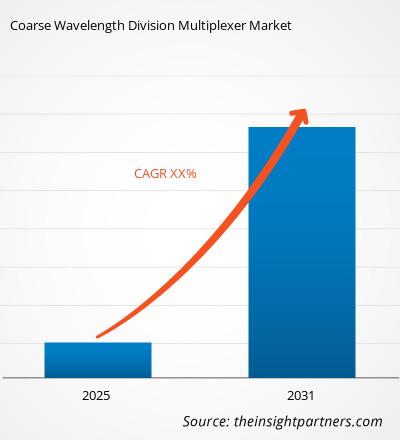
The Coarse Wavelength Division Multiplexer Market had a value of US$ 773.97 Million in 2025 and is estimated to touch US$ 1,180.46 Million by 2034, recording a CAGR of 5.42% between 2026–2034. The market is growing due to the usage of CWDM by service providers, enterprises, and critical infrastructures to enhance fiber capacity without laying down any new routes.
In North America, Coarse Wavelength Division Multiplexer Market size is expected to be moderate, backed by a regional CAGR rate between 5.0-5.8%. Fiber densification, metro access enhancements, cloud traffic, and broadband expansion drives the demand for low-cost optical bandwidth capacity. Fiber passings in the United States and broadband expansion in Canada drive CWDM usage in short hauls, access and enterprise networks.
Coarse Wavelength Division Multiplexer Market Assessment and Insights
- North America accounted for 31–34% share in 2025 and is growing at a CAGR range of 5.0–5.8% during 2026–2034, supported by FTTH expansion, metro aggregation upgrades, and cloud-edge interconnect demand.
- US represented 78–82% of North America in 2025 and is growing at a CAGR range of 5.1–5.9%, led by data center corridors and broadband funding.
- Europe held 24–27% share in 2025 and is growing at a CAGR range of 4.7–5.4%, with Germany, the UK, France, Italy, and Spain leading fiber modernization and enterprise network upgrades.
- Asia Pacific captured 28–31% share in 2025 and is growing at a CAGR range of 5.8–6.6%, driven by China, Japan, South Korea, India, and Australia investing in 5G, data centers, and broadband access.
- Largest Segment IT & Telecommunication held 52–56% market share in 2025, with a CAGR range of 5.4–6.1%, reflecting carrier transport, broadband, and data center demand.
- High Growth Segment Healthcare held 8–11% market share in 2025, with a CAGR range of 6.0–6.8%, as connected imaging, telehealth, and hospital campus networks increase bandwidth needs.
- Key companies analyzed in detail: EXFO Inc., Huawei Technologies Co., Ltd., Cisco Systems, Inc., Charles Industries, LLC, ViaLite Communications, FIBRAIN Sp. z o.o., ADVA Optical Networking SE, Pan Dacom Direkt GmbH, FS.COM LIMITED, ETL Systems Ltd.
Source: The Insight Partners' analysis based on proprietary research, government publications, company annual reports, investor presentations, industry databases, and expert interviews.
The network designers are moving from single CWDM modules to an optical transport system where the function of mux-demux, add-drop filters, monitoring, and pluggable optics is consolidated into one system. There is a growing trend in manufacturing to focus on reduced power consumption, standardized channel spacing, and modular inventory systems as telecommunication companies strive to increase their capacity without having to do any civil works. Therefore, the market growth would see a shift in its purchase behavior from components to a lifecycle approach involving test equipment, spares, and network assurance.
During the forecast period, there will be an increasing demand for Coarse Wavelength Division Multiplexers as new fiber routes open up in APAC and selective regions of the Middle East through densification and renewal cycles. Laws requiring broadband services, data management, smart grids, and healthcare connectivity will drive investments. Providers who can make deployment easy, assure optical performance, and multivendor compatibility will be favored.
Coarse Wavelength Division Multiplexer Market Report Scope
| Report Attribute | Details |
|---|---|
| Market size in 2025 | US$ 773.97 Million |
| Market Size by 2034 | US$ 1,180.46 Million |
| Global CAGR (2026 - 2034) | 5.42% |
| Historical Data | 2021-2024 |
| Forecast period | 2026-2034 |
Coarse Wavelength Division Multiplexer Market Analysis
Coarse Wavelength Division Multiplexer Market Share is driven by growing requirements to increase the bandwidth of available fiber cables, particularly in cases of route congestion, permit delays, and/or limited budgets. CWDM is still attractive for metro and access links due to wider channel spacing, which allows using uncooled lasers, easy installation, and reduced power consumption compared to dense optical systems.
The supply chain includes designing of optical filters, modules assembly, integration of transceivers, testing, distribution, and implementation services. The demand is still dominated by the IT and telecommunication sectors, however, the demand from the BFSI, energy, and healthcare segments has been growing, using CWDM for safe campus connections, remote operations, telemetry, and high-resolution information exchange.
Positioning of competition in the Coarse Wavelength Division Multiplexer Market Report is determined by optical portfolio width, testability, coverage of channels, and compatibility with carrier grade solutions. Huawei Technologies Co., Ltd. and Cisco Systems, Inc. are engaged in broad networking solutions, whereas EXFO Inc., ADVA Optical Networking SE, and FS.COM LIMITED have more specialized applications for deployments, testing, and components.
There is a trend in the investment flow toward more compact passive solutions, outdoor modules, and service packages lowering the need for manual field installation. Charles Industries, LLC, ViaLite Communications, FIBRAIN Sp. z o.o., Pan Dacom Direkt GmbH, and ETL Systems Ltd. provide specialized solutions for access, RF over Fiber, satellite and enterprise applications, thus forming an even competitive environment in standard and customized optical solutions.
● REPORT CUSTOMIZATION
Tailor This Report To Align With Your Specific Business Requirements
This report can be customized to align precisely with your business objectives, scope, and target markets. Customization options include tailored segmentation, geography, competitive analysis, and strategic insights to support informed decision-making.
Customize This Report →WHAT YOU CAN ADJUST
- ● Segmentations
- ● Geography
- ● Competitive Analysis
- ● Language Preferences
Coarse Wavelength Division Multiplexer Market:
自定义此报告以满足您的要求
您将免费获得任何报告的定制,包括本报告的部分内容,或国家级分析、Excel 数据包,以及为初创企业和大学提供超值优惠和折扣
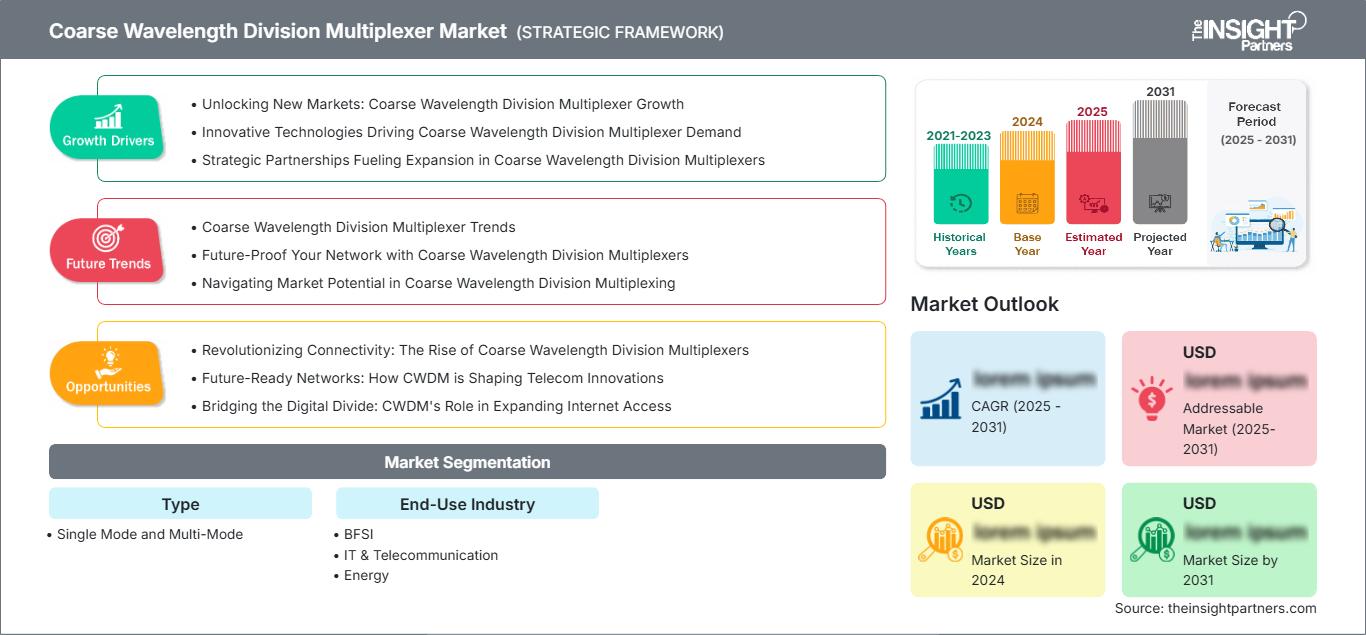
粗波分复用器市场: 战略洞察
-
获取本报告的主要市场趋势。这个免费样本将包括数据分析,从市场趋势到估计和预测。
Regional Insights
North America Coarse Wavelength Division Multiplexer Market
North America's market share in 2025 was 31-34%, and is expected to rise at a CAGR of 5.0-5.8% from 2026-2034. Regional growth drivers include FTTH roll-outs, cloud region additions, carrier metropolitan networks, and private fiber for enterprises. Coarse Wavelength Division Multiplexer Market share is characterized by high installation density in both the U.S. and Canada.
Fiber installation records predicted for 2025 by the Fiber Broadband Association make up the basis of optical access trends in this region, and household fiber deployment in Canada contributes to passive transport network improvements. CWDM is widely used in metro rings, data center interconnections, education networks, and utility communication networks when it is economically feasible to increase wavelengths without deploying fibers.
U.S. Coarse Wavelength Division Multiplexer Market
The United States accounted for 78-82% of North America in 2025 and is projected to register a CAGR of 5.1-5.9% for the period 2026-2034. Demand centers on data center clusters, broadband overbuilds, municipal networks, and enterprise campuses requiring scalable short haul optical transport networks. CWDM is favored by network operators in cases where civil works are expensive.
The vendor landscape is quite wide with Cisco Systems, Inc., EXFO Inc., Charles Industries, LLC, and FS.COM LIMITED catering to equipment, testing, enclosures, and distribution respectively. The applications sector comprises mobile fronthaul, rural broadband aggregation, healthcare campus, and financial data links. Vendor interoperability and replacement availability become critical factors in procurement.
Europe Coarse Wavelength Division Multiplexer Market
The European region had a share of 24-27% in 2025 and is estimated to register a growth at CAGR of 4.7-5.4% up till 2034. The German market will dominate regional demand due to industrial connectivity, improved carrier connectivity, and digitization of enterprises. UK will have altnet fibre and financial network resiliency regulations within metropolitan areas.
Demand from France, Italy, and Spain will be driven by the need for broadband upgrade, digitization of government, and increased availability of cloud zones. Companies such as ADVA Optical Networking SE, Pan Dacom Direkt GmbH, FIBRAIN Sp. z o.o., and ETL Systems Ltd. provide regional specialization. Buyers in Europe stress on energy efficiency, standardization, and longevity of equipment.
APAC Coarse Wavelength Division Multiplexer Market
The APAC region accounted for a market share of 28–31% in 2025 and is anticipated to register the fastest growth at a CAGR of 5.8–6.6% over 2026–2034. China dominates in terms of volume demand, whereas Japan and South Korea focus on dense 5G and data center interconnects.
The volume demand will be fueled by India and Australia by means of broadband connectivity, cloud regions, smart cities, and industrial connectivity. Government policy in favor of digital infrastructure and manufacturing drives deployment visibility. Key players include Huawei Technologies Co., Ltd. and FS.COM LIMITED.
Middle East & Africa Coarse Wavelength Division Multiplexer Market
Middle East & Africa is expected to grow at a CAGR range of 5.2–6.0% during 2026–2034, led by the UAE and Saudi Arabia. Fiber transport demand is linked to data centers, oil and gas sites, smart cities, satellite gateways, and national digital infrastructure programs.
In South Africa and the Rest of MEA region, there is selective adoption for mobile backhaul, enterprise parks, and energy infrastructure applications that require a reliable optical connection. ViaLite Communications and ETL Systems Ltd. are providing solutions for RF-over-fiber and satellite applications, while CWDM helps in capacity expansion.
Segmentation Analysis
Type
The type segment is projected to grow at a CAGR range of 5.1–5.8% during 2026–2034. Coarse Wavelength Division Multiplexer Market scope across single mode and multi-mode systems reflects different distance, budget, and capacity requirements. Single mode supports carrier and metro links, while multi-mode remains relevant for shorter enterprise, campus, and facility networks where deployment simplicity matters.
- Single Mode leads demand in telecom, data center interconnect, and long campus routes because it supports longer reach, lower attenuation, and greater wavelength scalability across metro and access networks.
- Multi-Mode serves shorter enterprise and facility applications where installation cost, available cabling, and compact network footprints outweigh the need for extended-distance optical transport.
End-Use Industry
The end-use industry segment is forecast to grow at a CAGR range of 5.3–6.0% during 2026–2034. Adoption is led by telecom networks, but BFSI, energy, and healthcare are increasing CWDM deployment for secure, resilient, and bandwidth-intensive operations. Buyers prioritize uptime, low latency, route diversity, and lifecycle support as digital workflows become operationally critical.
- BFSI uses CWDM for secure branch connectivity, trading infrastructure, disaster recovery links, and data replication where predictable latency and separation of traffic streams support operational resilience.
- IT & Telecommunication remains the largest adopter, driven by fiber access, 5G transport, metro aggregation, data center interconnect, and carrier efforts to maximize existing fiber assets.
- Energy demand is rising across grid modernization, substations, renewable plants, offshore operations, and pipeline monitoring, where robust optical links carry telemetry and control data.
- Healthcare is gaining strategic importance as hospitals, imaging centers, and telehealth platforms require dependable high-capacity links for diagnostics, records exchange, and connected care environments.
Opportunity Snapshot
|
End-Use Industry |
Revenue Contribution |
Trend Tag |
Adoption Stage |
|
BFSI |
Medium |
Secure Links |
Scaling |
|
IT & Telecommunication |
High |
Fiber Access |
Mature |
|
Energy |
Medium |
Grid Fiber |
Scaling |
|
Healthcare |
Low |
Connected Care |
Emerging |
Coarse Wavelength Division Multiplexer Market Growth Drivers and Impact Analysis
Fiber Capacity Expansion Without New Routes
Operators are under pressure to increase bandwidth while controlling civil engineering cost, permitting delays, and disruption in dense metro areas. CWDM allows multiple wavelength channels over existing fiber, making it practical for access rings, enterprise campuses, and data center links. This driver has direct market impact because procurement can move from major route construction to modular optical upgrades. The approach improves return on fiber assets and shortens implementation timelines. In regions with high labor and construction costs, passive CWDM systems also reduce power and cooling requirements, supporting lower operating expenditure.
5G, Cloud, and Edge Traffic Densification
Mobile operators, cloud providers, and enterprises are distributing workloads closer to users, creating more short and medium-distance optical links. CWDM is well suited to these routes because it offers a cost-efficient bridge between basic single-channel fiber and higher-cost dense wavelength systems. The impact is visible in fronthaul, backhaul, edge data centers, and metro aggregation where traffic grows faster than average telecom revenue. Vendors that combine optical modules with testing and monitoring tools will gain advantage as networks become more distributed and service-level expectations become stricter.
Critical Infrastructure Digitization
Energy networks, hospitals, financial institutions, and public agencies are strengthening optical connectivity to support real-time data, redundancy, and secure communications. CWDM fits these environments because it separates traffic streams over dedicated wavelengths while avoiding unnecessary network complexity. The market impact is a broader customer base beyond telecom, especially where downtime carries operational or safety consequences. Grid automation, diagnostic imaging, remote monitoring, and disaster recovery links are practical adoption cases. Suppliers with hardened products, documentation, and compliance familiarity are positioned to capture these higher-value deployments.
Coarse Wavelength Division Multiplexer Market Future Trends
Integrated Monitoring in Passive Optical Links
Coarse Wavelength Division Multiplexer Market trends point toward passive optical links being paired with stronger visibility, diagnostics, and predictive maintenance workflows. As networks spread across edge sites, substations, hospitals, and enterprise branches, operators will require faster fault isolation and channel-level assurance. Vendors can differentiate by combining CWDM hardware with test access points, remote monitoring compatibility, and deployment documentation. This shift will not convert passive modules into active systems, but it will increase the importance of observability around installation, maintenance, and service-level validation.
Compact Outdoor and Edge-Ready Designs
Future product development will emphasize smaller, ruggedized, and installation-friendly CWDM units for cabinets, towers, utility sites, and edge facilities. Operators want optical capacity closer to traffic sources, but these locations often have limited space, power, and maintenance access. Compact outdoor designs will support faster rollouts and reduce the need for controlled indoor environments. The trend also favors pre-terminated assemblies, simplified labeling, and modular expansion paths that allow buyers to add channels as demand develops.
Coarse Wavelength Division Multiplexer Market Opportunities
Healthcare and Mission-Critical Campus Networks
Healthcare offers a targeted opportunity as imaging, remote consultation, connected devices, and electronic records increase traffic across hospital campuses and regional care networks. Coarse Wavelength Division Multiplexer Market Forecasts indicate that buyers will look for reliable bandwidth without replacing installed fiber. Vendors can pursue this opportunity through validated designs for redundant links, biomedical equipment traffic separation, and secure data exchange. Channel partners should focus on hospitals, diagnostic chains, and integrated care systems where network downtime affects patient workflow, compliance, and operational continuity.
Energy Infrastructure and Grid Modernization
Energy operators are modernizing substations, renewable generation sites, pipelines, and offshore assets with high-availability communications. CWDM can support protection signaling, telemetry, video surveillance, and operational data over existing fiber paths. The opportunity is strongest where utilities need deterministic connectivity but must manage long asset lifecycles and harsh environments. Suppliers can build traction by offering ruggedized modules, documentation for utility standards, and integration support with industrial networking partners. This creates recurring demand for upgrades, spares, and maintenance validation.
Recent Developments
- September 2023: Enablence launched a new family of low-cost, low-loss 4-channel CWDM optical demultiplexer devices for datacom applications. The solution supports transmission over single-mode fibre up to 2 km and is designed to improve bandwidth efficiency while reducing the cost and complexity of optical transceivers.
- June 2025: CERN unveiled its CWDM Link project to upgrade optical data transmission for the High-Luminosity Large Hadron Collider (HL-LHC). The new system enables data rates of up to 40 Gb/s per fibre by multiplexing four optical wavelengths, providing a high-bandwidth, radiation-tolerant solution for beam instrumentation.
Frequently Asked Questions

Naveen 是一位经验丰富的市场研究和咨询专业人士,在定制项目、联合项目和咨询项目方面拥有超过 9 年的专业经验。他目前担任副总裁,成功管理了项目价值链中的利益相关者,撰写了 100 多份研究报告和 30 多项咨询项目。他的工作涵盖工业和政府项目,为客户的成功和数据驱动的决策做出了重要贡献。
Naveen 拥有卡纳塔克邦 VTU 的电子与通信工程学位,以及马尼帕尔大学的市场营销与运营 MBA 学位。他已担任 IEEE 会员 9 年,积极参与各种会议、技术研讨会,并在分部和地区层面担任志愿者。在此之前,他曾担任 IndustryARC 的助理战略顾问和惠普(惠普全球)的工业服务器顾问。
- 全面的市场规模与预测分析
- 详细的细分市场分析
- 深入的市场动态评估
- 区域及国家级洞察
- 竞争格局与企业对标分析
- 战略性商业情报
客户评价

Insight Partners 的 SCADA 系统市场报告内容全面,对当前趋势和未来预测提供了宝贵的见解。该团队始终高度专业、响应迅速且乐于助人。我们非常满意,强烈推荐他们的服务。
兰·凯德姆 伙伴, Reali Technologies LTD
我请求一份关于特定软件市场的报告,团队在几天内就完成了。报告信息非常相关,而且呈现得非常出色。之后,我请求对报告进行一些修改和补充。团队再次迅速响应,不到一周我就收到了最终报告。
让-埃尔韦·詹恩 主席, 未来分析公司
我们与 Insight Partners 合作进行了一项重要的市场研究和预测。他们清晰地洞察了机遇和风险,帮助我们制定了计划。他们的研究简单易用,数据可靠,帮助我们做出了明智而自信的决策。我们强烈推荐他们。
皮尤什·纳格帕尔 高级副总裁, 远光全球
Insight Partners 凭借其深厚的行业专业知识,提供了富有洞察力、结构合理的市场研究。他们的团队始终专业且响应迅速。用户友好的网站让访问行业报告变得顺畅无阻。我们强烈推荐他们可靠、高质量的研究服务。
安达幸彦 首席执行官, 深蓝有限责任公司
这是我第一次从The Insight Partners购买市场报告。起初我有些犹豫,但访问了他们的网站后,我更放心地冒险购买市场报告。我对报告的质量和客户服务非常满意。我对最初的报告有一些疑问和意见,但在与他们的分析师通过电子邮件沟通了几次后,我相信这份报告可以作为我们战略规划流程的参考。非常感谢您抽出宝贵的时间,让这次体验如此愉快。我一定会向其他人推荐你们的服务,当我们需要更多市场数据时,你们将是我的首选。
约翰·铃木 总裁兼首席执行官、董事会董事, BK科技
感谢您在处理我关于尼日利亚传染病体外诊断市场信息请求的过程中所展现的支持和专业精神。感谢您的耐心、指导,以及您愿意提供的折扣,最终促成了这笔交易。我期待未来与 Insight Partners 继续合作,这一切都要归功于您与我初次接触后留下的良好印象。
奇吉奥克博士 ONYIA 董事总经理, PineCrest 医疗保健有限公司购买理由
- 明智的决策
- 了解市场动态
- 竞争分析
- 客户洞察
- 市场预测
- 风险规避
- 战略规划
- 投资论证
- 识别新兴市场
- 优化营销策略
- 提升运营效率
- 顺应监管趋势




















 获取免费样品 -