
Coarse Wavelength Division Multiplexer Market Size, Trends & Demand by 2034
Coarse Wavelength Division Multiplexer Market Size and Forecasts (2021–2034), Global and Regional Share, Trends, and Growth Opportunity Analysis by Type (Single Mode and Multi-Mode), End-Use Industry (BFSI, IT & Telecommunication, Energy, Healthcare, and Others), and Geography
- Status : Data Released
- Report Code : TIPRE00027026
- Category : Electronics and Semiconductor
- No. of Pages : 150
- Available Report Formats :


- Last update date : August 05, 2026


2025 Market Size
US$ 773.97 Mn
Base year value
2034 Forecast
US$ 1,180.46 Mn
Projected by 2034
CAGR 2026-2034
5.42 %
Growth rate
Addressable Market
US$ 9,153.92 Mn
(2026-2034)
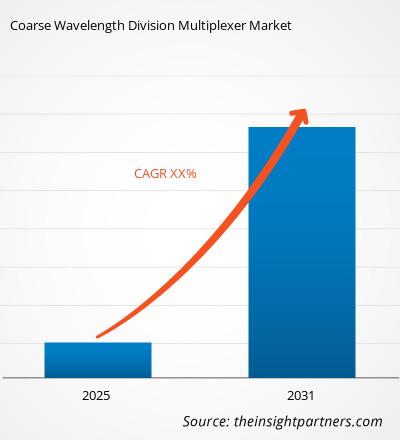
The Coarse Wavelength Division Multiplexer Market had a value of US$ 773.97 Million in 2025 and is estimated to touch US$ 1,180.46 Million by 2034, recording a CAGR of 5.42% between 2026–2034. The market is growing due to the usage of CWDM by service providers, enterprises, and critical infrastructures to enhance fiber capacity without laying down any new routes.
In North America, Coarse Wavelength Division Multiplexer Market size is expected to be moderate, backed by a regional CAGR rate between 5.0-5.8%. Fiber densification, metro access enhancements, cloud traffic, and broadband expansion drives the demand for low-cost optical bandwidth capacity. Fiber passings in the United States and broadband expansion in Canada drive CWDM usage in short hauls, access and enterprise networks.
Coarse Wavelength Division Multiplexer Market Assessment and Insights
- North America accounted for 31–34% share in 2025 and is growing at a CAGR range of 5.0–5.8% during 2026–2034, supported by FTTH expansion, metro aggregation upgrades, and cloud-edge interconnect demand.
- US represented 78–82% of North America in 2025 and is growing at a CAGR range of 5.1–5.9%, led by data center corridors and broadband funding.
- Europe held 24–27% share in 2025 and is growing at a CAGR range of 4.7–5.4%, with Germany, the UK, France, Italy, and Spain leading fiber modernization and enterprise network upgrades.
- Asia Pacific captured 28–31% share in 2025 and is growing at a CAGR range of 5.8–6.6%, driven by China, Japan, South Korea, India, and Australia investing in 5G, data centers, and broadband access.
- Largest Segment IT & Telecommunication held 52–56% market share in 2025, with a CAGR range of 5.4–6.1%, reflecting carrier transport, broadband, and data center demand.
- High Growth Segment Healthcare held 8–11% market share in 2025, with a CAGR range of 6.0–6.8%, as connected imaging, telehealth, and hospital campus networks increase bandwidth needs.
- Key companies analyzed in detail: EXFO Inc., Huawei Technologies Co., Ltd., Cisco Systems, Inc., Charles Industries, LLC, ViaLite Communications, FIBRAIN Sp. z o.o., ADVA Optical Networking SE, Pan Dacom Direkt GmbH, FS.COM LIMITED, ETL Systems Ltd.
Source: The Insight Partners' analysis based on proprietary research, government publications, company annual reports, investor presentations, industry databases, and expert interviews.
The network designers are moving from single CWDM modules to an optical transport system where the function of mux-demux, add-drop filters, monitoring, and pluggable optics is consolidated into one system. There is a growing trend in manufacturing to focus on reduced power consumption, standardized channel spacing, and modular inventory systems as telecommunication companies strive to increase their capacity without having to do any civil works. Therefore, the market growth would see a shift in its purchase behavior from components to a lifecycle approach involving test equipment, spares, and network assurance.
During the forecast period, there will be an increasing demand for Coarse Wavelength Division Multiplexers as new fiber routes open up in APAC and selective regions of the Middle East through densification and renewal cycles. Laws requiring broadband services, data management, smart grids, and healthcare connectivity will drive investments. Providers who can make deployment easy, assure optical performance, and multivendor compatibility will be favored.
Coarse Wavelength Division Multiplexer Market Report Scope
| Report Attribute | Details |
|---|---|
| Market size in 2025 | US$ 773.97 Million |
| Market Size by 2034 | US$ 1,180.46 Million |
| Global CAGR (2026 - 2034) | 5.42% |
| Historical Data | 2021-2024 |
| Forecast period | 2026-2034 |
Coarse Wavelength Division Multiplexer Market Analysis
Coarse Wavelength Division Multiplexer Market Share is driven by growing requirements to increase the bandwidth of available fiber cables, particularly in cases of route congestion, permit delays, and/or limited budgets. CWDM is still attractive for metro and access links due to wider channel spacing, which allows using uncooled lasers, easy installation, and reduced power consumption compared to dense optical systems.
The supply chain includes designing of optical filters, modules assembly, integration of transceivers, testing, distribution, and implementation services. The demand is still dominated by the IT and telecommunication sectors, however, the demand from the BFSI, energy, and healthcare segments has been growing, using CWDM for safe campus connections, remote operations, telemetry, and high-resolution information exchange.
Positioning of competition in the Coarse Wavelength Division Multiplexer Market Report is determined by optical portfolio width, testability, coverage of channels, and compatibility with carrier grade solutions. Huawei Technologies Co., Ltd. and Cisco Systems, Inc. are engaged in broad networking solutions, whereas EXFO Inc., ADVA Optical Networking SE, and FS.COM LIMITED have more specialized applications for deployments, testing, and components.
There is a trend in the investment flow toward more compact passive solutions, outdoor modules, and service packages lowering the need for manual field installation. Charles Industries, LLC, ViaLite Communications, FIBRAIN Sp. z o.o., Pan Dacom Direkt GmbH, and ETL Systems Ltd. provide specialized solutions for access, RF over Fiber, satellite and enterprise applications, thus forming an even competitive environment in standard and customized optical solutions.
● REPORT CUSTOMIZATION
Tailor This Report To Align With Your Specific Business Requirements
This report can be customized to align precisely with your business objectives, scope, and target markets. Customization options include tailored segmentation, geography, competitive analysis, and strategic insights to support informed decision-making.
Customize This Report →WHAT YOU CAN ADJUST
- ● Segmentations
- ● Geography
- ● Competitive Analysis
- ● Language Preferences
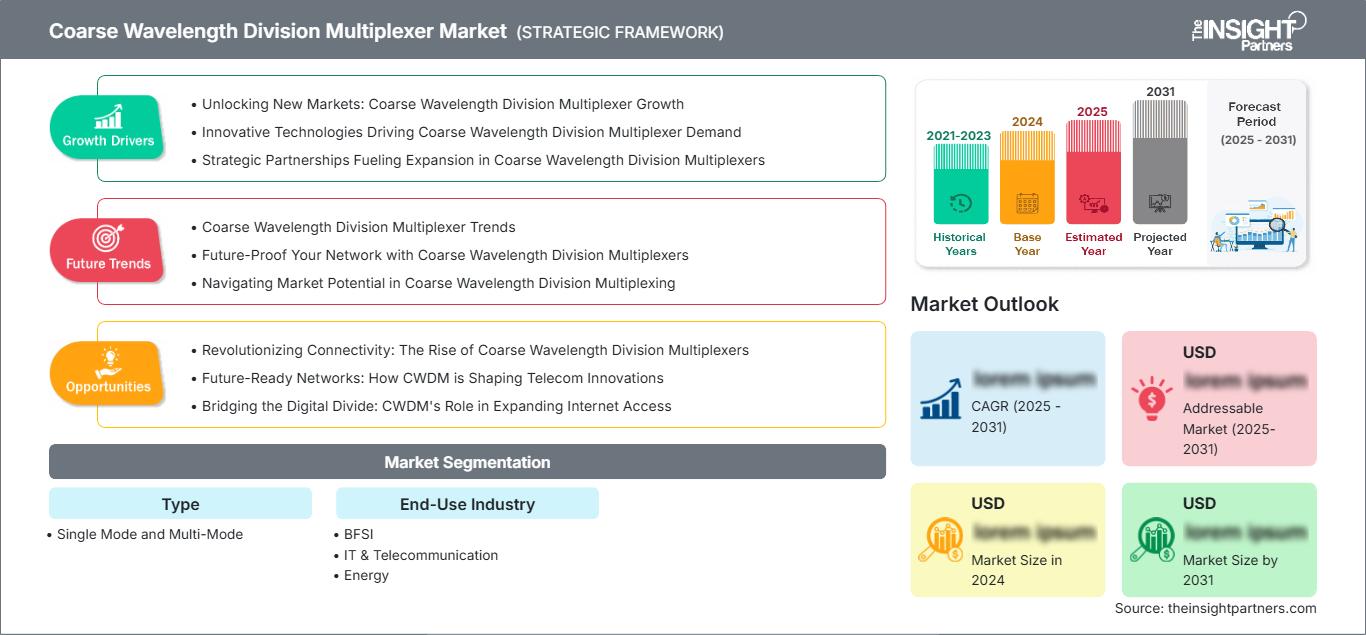
Coarse Wavelength Division Multiplexer Market: Strategic Insights
Regional Insights
North America Coarse Wavelength Division Multiplexer Market
North America's market share in 2025 was 31-34%, and is expected to rise at a CAGR of 5.0-5.8% from 2026-2034. Regional growth drivers include FTTH roll-outs, cloud region additions, carrier metropolitan networks, and private fiber for enterprises. Coarse Wavelength Division Multiplexer Market share is characterized by high installation density in both the U.S. and Canada.
Fiber installation records predicted for 2025 by the Fiber Broadband Association make up the basis of optical access trends in this region, and household fiber deployment in Canada contributes to passive transport network improvements. CWDM is widely used in metro rings, data center interconnections, education networks, and utility communication networks when it is economically feasible to increase wavelengths without deploying fibers.
U.S. Coarse Wavelength Division Multiplexer Market
The United States accounted for 78-82% of North America in 2025 and is projected to register a CAGR of 5.1-5.9% for the period 2026-2034. Demand centers on data center clusters, broadband overbuilds, municipal networks, and enterprise campuses requiring scalable short haul optical transport networks. CWDM is favored by network operators in cases where civil works are expensive.
The vendor landscape is quite wide with Cisco Systems, Inc., EXFO Inc., Charles Industries, LLC, and FS.COM LIMITED catering to equipment, testing, enclosures, and distribution respectively. The applications sector comprises mobile fronthaul, rural broadband aggregation, healthcare campus, and financial data links. Vendor interoperability and replacement availability become critical factors in procurement.
Europe Coarse Wavelength Division Multiplexer Market
The European region had a share of 24-27% in 2025 and is estimated to register a growth at CAGR of 4.7-5.4% up till 2034. The German market will dominate regional demand due to industrial connectivity, improved carrier connectivity, and digitization of enterprises. UK will have altnet fibre and financial network resiliency regulations within metropolitan areas.
Demand from France, Italy, and Spain will be driven by the need for broadband upgrade, digitization of government, and increased availability of cloud zones. Companies such as ADVA Optical Networking SE, Pan Dacom Direkt GmbH, FIBRAIN Sp. z o.o., and ETL Systems Ltd. provide regional specialization. Buyers in Europe stress on energy efficiency, standardization, and longevity of equipment.
APAC Coarse Wavelength Division Multiplexer Market
The APAC region accounted for a market share of 28–31% in 2025 and is anticipated to register the fastest growth at a CAGR of 5.8–6.6% over 2026–2034. China dominates in terms of volume demand, whereas Japan and South Korea focus on dense 5G and data center interconnects.
The volume demand will be fueled by India and Australia by means of broadband connectivity, cloud regions, smart cities, and industrial connectivity. Government policy in favor of digital infrastructure and manufacturing drives deployment visibility. Key players include Huawei Technologies Co., Ltd. and FS.COM LIMITED.
Middle East & Africa Coarse Wavelength Division Multiplexer Market
Middle East & Africa is expected to grow at a CAGR range of 5.2–6.0% during 2026–2034, led by the UAE and Saudi Arabia. Fiber transport demand is linked to data centers, oil and gas sites, smart cities, satellite gateways, and national digital infrastructure programs.
In South Africa and the Rest of MEA region, there is selective adoption for mobile backhaul, enterprise parks, and energy infrastructure applications that require a reliable optical connection. ViaLite Communications and ETL Systems Ltd. are providing solutions for RF-over-fiber and satellite applications, while CWDM helps in capacity expansion.
Segmentation Analysis
Type
The type segment is projected to grow at a CAGR range of 5.1–5.8% during 2026–2034. Coarse Wavelength Division Multiplexer Market scope across single mode and multi-mode systems reflects different distance, budget, and capacity requirements. Single mode supports carrier and metro links, while multi-mode remains relevant for shorter enterprise, campus, and facility networks where deployment simplicity matters.
- Single Mode leads demand in telecom, data center interconnect, and long campus routes because it supports longer reach, lower attenuation, and greater wavelength scalability across metro and access networks.
- Multi-Mode serves shorter enterprise and facility applications where installation cost, available cabling, and compact network footprints outweigh the need for extended-distance optical transport.
End-Use Industry
The end-use industry segment is forecast to grow at a CAGR range of 5.3–6.0% during 2026–2034. Adoption is led by telecom networks, but BFSI, energy, and healthcare are increasing CWDM deployment for secure, resilient, and bandwidth-intensive operations. Buyers prioritize uptime, low latency, route diversity, and lifecycle support as digital workflows become operationally critical.
- BFSI uses CWDM for secure branch connectivity, trading infrastructure, disaster recovery links, and data replication where predictable latency and separation of traffic streams support operational resilience.
- IT & Telecommunication remains the largest adopter, driven by fiber access, 5G transport, metro aggregation, data center interconnect, and carrier efforts to maximize existing fiber assets.
- Energy demand is rising across grid modernization, substations, renewable plants, offshore operations, and pipeline monitoring, where robust optical links carry telemetry and control data.
- Healthcare is gaining strategic importance as hospitals, imaging centers, and telehealth platforms require dependable high-capacity links for diagnostics, records exchange, and connected care environments.
Opportunity Snapshot
| End-Use Industry | Revenue Contribution | Trend Tag | Adoption Stage |
| BFSI | Medium | Secure Links | Scaling |
| IT & Telecommunication | High | Fiber Access | Mature |
| Energy | Medium | Grid Fiber | Scaling |
| Healthcare | Low | Connected Care | Emerging |
Coarse Wavelength Division Multiplexer Market Growth Drivers and Impact Analysis
Fiber Capacity Expansion Without New Routes
Operators are under pressure to increase bandwidth while controlling civil engineering cost, permitting delays, and disruption in dense metro areas. CWDM allows multiple wavelength channels over existing fiber, making it practical for access rings, enterprise campuses, and data center links. This driver has direct market impact because procurement can move from major route construction to modular optical upgrades. The approach improves return on fiber assets and shortens implementation timelines. In regions with high labor and construction costs, passive CWDM systems also reduce power and cooling requirements, supporting lower operating expenditure.
5G, Cloud, and Edge Traffic Densification
Mobile operators, cloud providers, and enterprises are distributing workloads closer to users, creating more short and medium-distance optical links. CWDM is well suited to these routes because it offers a cost-efficient bridge between basic single-channel fiber and higher-cost dense wavelength systems. The impact is visible in fronthaul, backhaul, edge data centers, and metro aggregation where traffic grows faster than average telecom revenue. Vendors that combine optical modules with testing and monitoring tools will gain advantage as networks become more distributed and service-level expectations become stricter.
Critical Infrastructure Digitization
Energy networks, hospitals, financial institutions, and public agencies are strengthening optical connectivity to support real-time data, redundancy, and secure communications. CWDM fits these environments because it separates traffic streams over dedicated wavelengths while avoiding unnecessary network complexity. The market impact is a broader customer base beyond telecom, especially where downtime carries operational or safety consequences. Grid automation, diagnostic imaging, remote monitoring, and disaster recovery links are practical adoption cases. Suppliers with hardened products, documentation, and compliance familiarity are positioned to capture these higher-value deployments.
Coarse Wavelength Division Multiplexer Market Future Trends
Integrated Monitoring in Passive Optical Links
Coarse Wavelength Division Multiplexer Market trends point toward passive optical links being paired with stronger visibility, diagnostics, and predictive maintenance workflows. As networks spread across edge sites, substations, hospitals, and enterprise branches, operators will require faster fault isolation and channel-level assurance. Vendors can differentiate by combining CWDM hardware with test access points, remote monitoring compatibility, and deployment documentation. This shift will not convert passive modules into active systems, but it will increase the importance of observability around installation, maintenance, and service-level validation.
Compact Outdoor and Edge-Ready Designs
Future product development will emphasize smaller, ruggedized, and installation-friendly CWDM units for cabinets, towers, utility sites, and edge facilities. Operators want optical capacity closer to traffic sources, but these locations often have limited space, power, and maintenance access. Compact outdoor designs will support faster rollouts and reduce the need for controlled indoor environments. The trend also favors pre-terminated assemblies, simplified labeling, and modular expansion paths that allow buyers to add channels as demand develops.
Coarse Wavelength Division Multiplexer Market Opportunities
Healthcare and Mission-Critical Campus Networks
Healthcare offers a targeted opportunity as imaging, remote consultation, connected devices, and electronic records increase traffic across hospital campuses and regional care networks. Coarse Wavelength Division Multiplexer Market Forecasts indicate that buyers will look for reliable bandwidth without replacing installed fiber. Vendors can pursue this opportunity through validated designs for redundant links, biomedical equipment traffic separation, and secure data exchange. Channel partners should focus on hospitals, diagnostic chains, and integrated care systems where network downtime affects patient workflow, compliance, and operational continuity.
Energy Infrastructure and Grid Modernization
Energy operators are modernizing substations, renewable generation sites, pipelines, and offshore assets with high-availability communications. CWDM can support protection signaling, telemetry, video surveillance, and operational data over existing fiber paths. The opportunity is strongest where utilities need deterministic connectivity but must manage long asset lifecycles and harsh environments. Suppliers can build traction by offering ruggedized modules, documentation for utility standards, and integration support with industrial networking partners. This creates recurring demand for upgrades, spares, and maintenance validation.
Recent Developments
- September 2023: Enablence launched a new family of low-cost, low-loss 4-channel CWDM optical demultiplexer devices for datacom applications. The solution supports transmission over single-mode fibre up to 2 km and is designed to improve bandwidth efficiency while reducing the cost and complexity of optical transceivers.
- June 2025: CERN unveiled its CWDM Link project to upgrade optical data transmission for the High-Luminosity Large Hadron Collider (HL-LHC). The new system enables data rates of up to 40 Gb/s per fibre by multiplexing four optical wavelengths, providing a high-bandwidth, radiation-tolerant solution for beam instrumentation.
Frequently Asked Questions

- Comprehensive Market Sizing and Forecast Analysis
- Detailed Segmentation Analysis
- In-Depth Market Dynamics Assessment
- Regional and Country-Level Insights
- Competitive Landscape and Company Benchmarking
- Strategic Business Intelligence
Recent Reports
Testimonials

The Insight Partners' SCADA System Market report is comprehensive, with valuable insights on current trends and future forecasts. The team was highly professional, responsive, and supportive throughout. We are very satisfied and highly recommend their services.
RAN KEDEM Partner, Reali Technologies LTDs
I requested a report on a very specific software market and the team produced the report in a few days. The information was very relevant and well presented. I then requested some changes and additions to the report. The team was again very responsive and I got the final report in less than a week.
JEAN-HERVE JENN Chairman, Future Analytica
We worked with The Insight Partners for an important market study and forecast. They gave us clear insights into opportunities and risks, which helped shape our plans. Their research was easy to use and based on solid data. It helped us make smart, confident decisions. We highly recommend them.
PIYUSH NAGPAL Sr. Vice President, High Beam Global
The Insight Partners delivered insightful, well-structured market research with strong domain expertise. Their team was professional and responsive throughout. The user-friendly website made accessing industry reports seamless. We highly recommend them for reliable, high-quality research services
YUKIHIKO ADACHI CEO, Deep Blue, LLC.
This is the first time I have purchased a market report from The Insight Partners.While I was unsure at first, I visited their web site and felt more comfortable to take the risk and purchase a market report.I am completely satisfied with the quality of the report and customer service. I had several questions and comments with the initial report, but after a couple of dialogs over email with their analyst I believe I have a report that I can use as input to our strategic planning process.Thank you so much for taking the extra time and making this a positive experience.I will definitely recommend your service to others and you will be my first call when we need further market data.
JOHN SUZUKI President and Chief Executive Officer, Board Director, BK Technologies
I wish to appreciate your support and the professionalism you displayed in the course of attending to my request for information regarding to infectious disease IVD market in Nigeria. I appreciate your patience, your guidance, and the fact that you were willing to offer a discount, which eventually made it possible for us to close a deal. I look forward to engaging The Insight Partners in the future, all thanks to the impression you have created in me as a result of this first encounter.
DR CHIJIOKE ONYIA MANAGING DIRECTOR, PineCrest Healthcare Ltd.Reason to Buy
- Informed Decision-Making
- Understanding Market Dynamics
- Competitive Analysis
- Identifying Emerging Markets
- Customer Insights
- Market Forecasts
- Risk Mitigation
- Boosting Operational Efficiency
- Strategic Planning
- Investment Justification
- Tracking Industry Innovations
- Aligning with Regulatory Trends





 Get Free Sample for