




2025年市场规模
112.1 亿美元
基准年值
2034 年预测
170.9 亿美元
预计到2034年
2026-2034年复合年增长率
4.79 %
增长率
目标市场
1284.1 亿美元
(2026-2034)
随着电力网络不断满足工业电气化、可再生能源发电、数据中心、交通运输和电网现代化等日益增长的需求,升压和降压变压器市场规模正稳步扩张。2025年,该市场规模为112.1亿美元,预计到2034年将达到170.9亿美元,2026年至2034年的复合年增长率(CAGR)为4.79%。该市场涵盖用于电力传输、配电、工业设施、商业基础设施和特殊电气应用的升压或降压变压器。
由于电网资产老化、电力消耗不断增长、数据中心建设、工业回流以及公用事业投资,北美已成为重要的需求中心。在变压器更换计划、新增产能、国内制造业投资以及公用事业和大负荷应用领域对可靠电压转换需求不断增长的推动下,预计到2034年,该地区市场将以约4%的复合年增长率增长。
升压和降压变压器市场评估与洞察
区域展望
- 北美: 2025 年约占全球升压和降压变压器市场份额的 32% | 2034 年前复合年增长率约为 4%。市场地位:北美仍然是一个重要的区域市场,这得益于老旧电力基础设施的更换、数据中心的发展、工业扩张、电网弹性计划以及对国内变压器制造能力的大量投资。
- 美国: 2025 年约占北美市场收入的 75% | 2034 年前复合年增长率约为 4%。市场地位:美国占北美需求的大部分,公用事业、超大规模数据中心、制造工厂和可再生能源项目对可靠的升压和降压电压转换设备的需求不断增长。
- 欧洲: 2025 年约占全球市场的 27% | 2034 年前年复合增长率约为 4%。市场地位:欧洲是一个成熟的变压器市场,以德国为首,其次是英国、法国、意大利和西班牙,可再生能源并网、电网加固、工业电气化和老旧设备的更换维持了市场需求。
- 亚太地区: 2025 年约占全球市场的 31% | 2034 年前复合年增长率约为 6%。市场地位:亚太地区是增长最快的区域市场,其增长动力来自发电扩张、工业化、可再生能源产能、城镇化和输电投资,其中中国引领区域需求,印度、日本和韩国则支撑着制造业深度。
细分市场展望
- 配电变压器: 2025 年市场份额约为 60% | 2034 年前复合年增长率约为 5%。市场地位:配电变压器占据主导地位,因为它们被广泛部署在公用事业配电网络、商业设施、工业厂房、住宅基础设施和需要本地电压转换的分布式可再生能源装置中。
- 电力变压器: 2025 年市场份额约为 40% | 2034 年前复合年增长率约为 5%。市场地位:电力变压器受益于输电扩容、可再生能源输送、互联项目、工业负荷和高容量数据中心,而较长的更换周期和复杂的制造要求促使现有供应商扩大产能。
具有竞争力的覆盖范围
ABB、伊顿、富士电机株式会社、GE Vernova Inc.、Hammond Power Solutions Inc.、三菱电机株式会社、Prima Transformers、施耐德电气、西门子股份公司、Synergy Transformers、日立能源有限公司
方法论
The Insight Partners 遵循数据收集和二手研究、一手研究、数据分析以及数据三角验证和最终审查,以验证市场估算和洞察。
资料来源: Insight Partners 根据专有研究、政府出版物、公司年报、投资者报告、行业数据库和专家访谈进行的分析。
升压和降压变压器市场正从简单的电压转换器向更复杂的设备转变,这些设备不仅能提供更高的能源效率和可靠性,还能优化散热性能,并与日益复杂的电力系统兼容。油冷式变压器适用于需要有效冷却且必须在户外运行的大型发电厂,而空冷式变压器仍然适用于室内、商业、工业和安全应用。由于制造周期长、零部件供应有限以及需要确保电力供应链的韧性,变压器制造工厂的本地化生产正变得越来越普遍。
As for future plans, investments are now being directed into countries where there is an urgent need for increasing consumption of electricity, building more renewable capacities, constructing new data centers, and electrifying industries. Asia Pacific is increasing its manufacturing capacity and grid capacity, whereas North America is building domestic transformer manufacturing facilities and upgrading its current infrastructure. Europe is busy with interconnections, integration with renewables, and replacement. The focus of regulators on efficiency, resilience, reducing carbon footprint, and security of supply chains encourages customers to evaluate transformer efficiency and lifetime costs.
Step Up And Step Down Transformer Market Report Scope
| Report Attribute | Details |
|---|---|
| Market size in 2025 | US$ 11.21 Billion |
| Market Size by 2034 | US$ 17.09 Billion |
| Global CAGR (2026 - 2034) | 4.79% |
| Historical Data | 2021-2024 |
| Forecast period | 2026-2034 |
Step Up And Step Down Transformer Market Analysis
The Step Up and Step Down Transformer Market dynamics are driven by the consumption of electricity and the necessity to transmit the power efficiently across the generation, transmission, distribution, and end-use voltage networks. Key players in the market's ecosystem encompass transformer producers, electrical components producers, utilities, EPC contractors, system integrators, distributors, and industry consumers. Key inputs into the production process include electric steel, copper or aluminum conductors, insulators, transformer oil, bushings, cooling systems, enclosure, and monitoring equipment. High demand occurs in regions where new capacity, replacement needs, and network reinforcement result in repeat orders for equipment.
Production capabilities increasingly affect the schedule of projects implementation. Specialized engineering, testing, labor skills, and long lead times are among factors associated with big transformer manufacturing, but smaller distribution transformers may be produced on a large scale and with high standardization. For that reason, manufacturers increase factory capacities, implement advanced manufacturing technologies, source more components locally, and increase production flexibility. The service aspect is also becoming increasingly important along the value chain.
The competition involves diversified groups of electrical equipment as well as specialty transformer manufacturers. ABB, Eaton, Siemens AG, Schneider Electric SE, Mitsubishi Electric Corporation, and Fuji Electric Co., Ltd. integrate transformers into their broader ranges of products for power grids and electricity infrastructure. GE Vernova Inc. and Hitachi Energy Ltd. have major involvement in high-capacity transmission equipment. Hammond Power Solutions Inc., Prima Transformers, and Synergy Transformers cater to special and regional needs. Competitive strategies rely more and more on manufacturing capacity, dependability, engineering skills, efficiency, customization, existing customer base, and service network.
Investments go towards capacity enhancement rather than productivity improvement. Examples of recent projects in the US, Europe, India, and Southeast Asia show that manufacturers are enhancing their capacity for producing transformers and components in order to meet the needs of electricity infrastructure. Positioning of the suppliers is becoming strategic with respect to regional manufacturing centers, localized supply chains, digital manufacturing processes, and cooperation with utility companies and electricity consumers.
● REPORT CUSTOMIZATION
Tailor This Report To Align With Your Specific Business Requirements
This report can be customized to align precisely with your business objectives, scope, and target markets. Customization options include tailored segmentation, geography, competitive analysis, and strategic insights to support informed decision-making.
Customize This Report →WHAT YOU CAN ADJUST
- ● Segmentations
- ● Geography
- ● Competitive Analysis
- ● Language Preferences
Step Up And Step Down Transformer Market:
自定义此报告以满足您的要求
您将免费获得任何报告的定制,包括本报告的部分内容,或国家级分析、Excel 数据包,以及为初创企业和大学提供超值优惠和折扣
升压变压器和降压变压器市场: 战略洞察
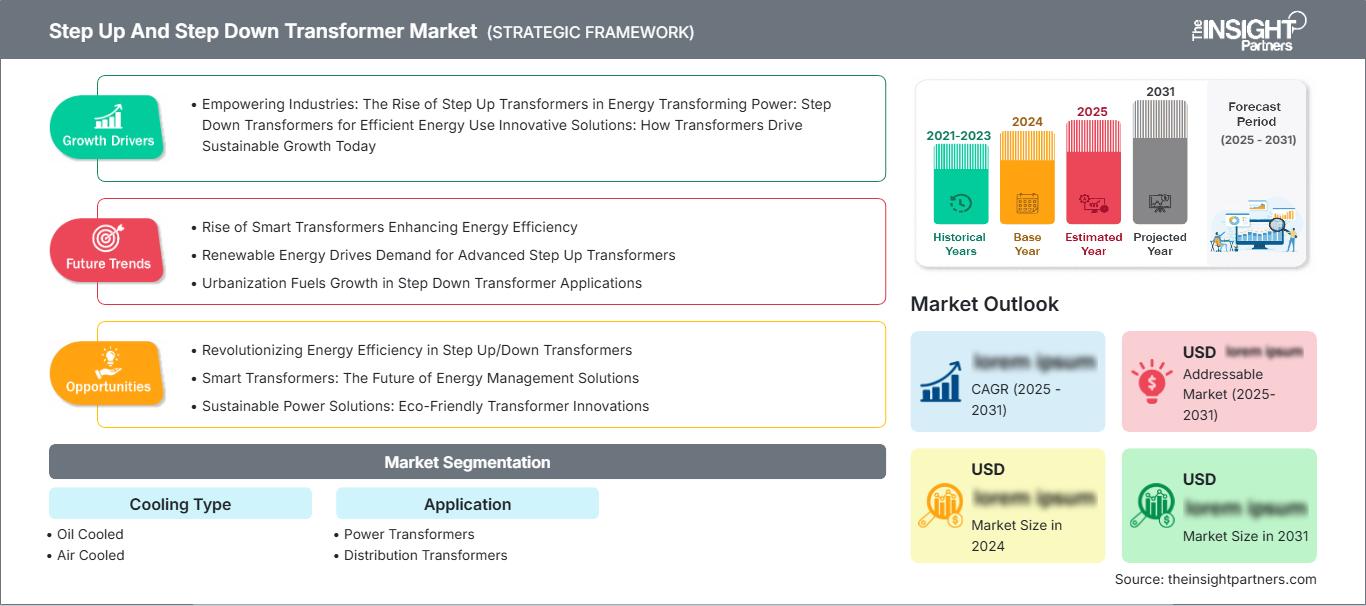
-
获取本报告的主要市场趋势。这个免费样本将包括数据分析,从市场趋势到估计和预测。
Regional Insights
North America Step Up and Step Down Transformer Market
North America accounted for approximately ~32% of the global Step Up and Step Down Transformer Market in 2025 and is expected to expand at approximately ~4% CAGR through 2034. The area is advantaged by the existence of a large installed base of transformers, needs for replacements, grid up-gradation, connection of renewables, and rising needs for electricity in data centers and advanced manufacturing. The investment made by utilities is moving more towards reliability and expansion of capacity than just maintenance of equipment.
US serves as the main driver of demand whereas Canada acts as the source of demand due to utility up-gradation, mining operations, industrial electrification, and the use of renewables. Manufacturers are ramping up production in order to meet the needs for transformers due to the constraint of availability and also reducing reliance on international logistics. Data centers act as another demand driver since high density computing centers need medium/high voltage transformers.
U.S. Step Up and Step Down Transformer Market
The US represented approximately ~75% of North American Step Up and Step Down Transformer Market revenue in 2025 and is expected to grow at approximately ~4% CAGR through 2034. Demand is concentrated around utility networks, transmission projects, data centers, semiconductor manufacturing, industrial facilities, renewable generation, and infrastructure replacement. Increasing electricity loads are encouraging utilities and large customers to secure transformer capacity earlier in project development.
ABB, Eaton, GE Vernova Inc., Hitachi Energy Ltd., Schneider Electric SE, and Siemens AG maintain substantial US electrical infrastructure capabilities. Recent manufacturing investments by leading suppliers indicate that domestic transformer production is becoming strategically important. The market also favors air-cooled transformers in indoor commercial and industrial installations where fire safety and reduced fluid handling are priorities, while oil-cooled units remain important for utility-scale and higher-capacity applications requiring efficient thermal management.
Europe Step Up and Step Down Transformer Market
Europe represented approximately ~27% of the global Step Up and Step Down Transformer Market in 2025 and is projected to expand at approximately ~4% CAGR through 2034. Germany is the leading country in Europe, supported by industrial electrification, renewable integration, grid investment, and a strong electrical equipment manufacturing base. The UK is also investing in transmission and distribution infrastructure as renewable generation and electrification increase requirements for network flexibility.
France benefits from grid modernization, industrial demand, and electricity infrastructure associated with a large low-carbon generation base. Italy is supported by renewable generation, industrial modernization, and distribution network investment, while Spain is experiencing increasing transformer requirements linked with renewable power projects and grid connections. Across Europe, transformer demand is also influenced by the replacement of aging equipment and the need to accommodate decentralized generation.
European manufacturers increasingly emphasize high efficiency, compact designs, dry-type technology, digital monitoring, and lifecycle performance. Air-cooled transformers have particular relevance in buildings, industrial premises, renewable facilities, and other locations where fire safety and environmental considerations influence equipment selection. Oil-cooled equipment remains important for outdoor utility and higher-capacity applications. Supply-chain localization and manufacturing investments are strengthening regional production capability while reducing exposure to long international delivery cycles.
APAC Step Up and Step Down Transformer Market
Asia Pacific accounted for approximately ~31% of the global Step Up and Step Down Transformer Market in 2025 and is the fastest-growing region, with approximately ~6% CAGR through 2034. China is the leading country in Asia Pacific, supported by extensive electricity infrastructure, manufacturing activity, renewable generation, urbanization, and grid expansion. India is another major demand center, with transmission additions, renewable integration, industrial development, and localized manufacturing supporting transformer procurement.
Japan and South Korea contribute through advanced industrial infrastructure, replacement demand, semiconductor investments, and technology-intensive electrical systems. Australia is supported by renewable generation, grid reinforcement, mining, and long-distance transmission requirements. Across the region, domestic manufacturing policies, renewable energy targets, and industrial investment are encouraging suppliers to expand production capacity and strengthen regional supply chains.
Middle East & Africa Step Up and Step Down Transformer Market
The Step Up and Step Down Transformer Market forecast shows that Middle East and Africa market is expected to expand at approximately ~6% CAGR through 2034. Saudi Arabia is the leading country in the Middle East & Africa region where evidence supports the strongest combination of infrastructure spending, power-system expansion, industrial diversification, and large-scale development projects. The UAE also contributes significantly through commercial construction, data centers, utilities, and infrastructure modernization.
South Africa represents an important African demand center because of grid reliability requirements, renewable integration, industrial applications, and replacement of aging electrical equipment. Rest of MEA demand is linked with electrification, new generation projects, transmission development, mining, water infrastructure, and industrial facilities. Oil-cooled transformers remain important for outdoor utility installations, while air-cooled configurations serve selected commercial and industrial applications.
Segmentation Analysis
Cooling Type
Cooling Type determines how transformer heat generated during electrical operation is dissipated and therefore influences efficiency, capacity, installation conditions, maintenance, safety, and lifecycle economics. Oil-cooled transformers remain important for utility and higher-capacity installations, while air-cooled units address applications where indoor deployment, fire safety, environmental considerations, or simplified maintenance are priorities. The segment is expected to expand at approximately ~5% CAGR through 2034.
- Oil Cooled: Oil-cooled transformers remain central to utility-scale transmission and distribution because insulating fluid provides effective heat transfer and electrical insulation. Demand is supported by outdoor substations, high-capacity networks, renewable interconnection projects, and industrial installations where thermal performance is critical.
- Air Cooled: Air-cooled transformers are important in commercial buildings, industrial facilities, data centers, and indoor electrical rooms. Their dry construction supports applications where reduced fire risk, environmental considerations, and simplified maintenance are prioritized.
Application
Application is divided into power transformers and distribution transformers according to the voltage-conversion role, capacity, installation environment, and position within electricity networks. Application requirements determine transformer design, insulation, cooling configuration, testing, and service needs. The segment is expected to expand at approximately ~5% CAGR through 2034.
- Power Transformers: Power transformers support transmission networks, generating stations, major substations, renewable power evacuation, and high-capacity industrial systems. Procurement is typically project-based and highly engineered, making delivery capability, testing infrastructure, reliability, and engineering customization strategically important.
- Distribution Transformers: Distribution transformers serve the final stages of electricity networks and are installed across utility feeders, commercial properties, industrial sites, residential infrastructure, and distributed generation systems. Their broad installed base generates recurring replacement demand and supports standardized manufacturing.
Opportunity Snapshot
|
Application |
Revenue Contribution |
Trend Tag |
Adoption Stage |
|---|---|---|---|
|
Power Transformers |
High |
Grid Expansion |
Scaling |
|
Distribution Transformers |
High |
Network Replacement |
Mature |
Step Up And Step Down Transformer Market Growth Drivers and Impact Analysis
Grid modernization and replacement of aging transformer fleets
推动电力系统发展的主要因素是需要更换老化的变压器,同时提升电网容量。成熟经济体的电力系统包含大量已安装的设备,这些设备在达到使用寿命终点时必须进行翻新或更换。现代化项目也需要增加变压器容量,例如在变电站扩建、可再生能源并网或电力需求增长的情况下。其影响不仅限于设备销售,因为更换项目还会产生对工程、安装、测试、调试、监控和维护服务的需求。拥有成熟客户群的供应商可以利用更换周期来维护客户关系,同时推出更高效率的产品和数字化状态监测功能。这创造了一个持续的设备和服务市场,而非一次性的资本支出机会。
数据中心和工业电气化带来的快速电力需求
数据中心、半导体工厂、先进制造工厂、电动交通基础设施以及其他电力密集型应用对可靠的电力转换提出了更高的要求。高密度负载需要精心设计的电力基础设施,以支持大规模且不稳定的电力需求,同时保持可靠性。因此,随着新建变电站、配电系统和专用电力基础设施的建设,变压器的需求也随之增长。在数据中心建设和工业投资速度超过现有电网容量承载能力的地区,市场受到的影响尤为显著。这促使企业更早地采购变压器,扩大项目规模,并加大对区域制造业的投资。能够提供工程设备、可预测的交付计划和集成电力基础设施的供应商,将有机会参与大型电力项目的各个阶段。
可再生能源发电和远距离输电扩建
太阳能、风能、水力发电和其他发电资产的扩张对电压变换和电力输送提出了更高的要求。可再生能源项目通常远离主要用电中心,这凸显了输电基础设施和变电站的重要性。升压变压器将发电设施连接到高压电网,而降压设备则满足配电和终端用电需求。因此,电网加固成为发电投资的必要补充。由此产生的需求不仅限于新建可再生能源设施,现有电网也可能需要增加变压器容量、更换变压器单元或升级变电站,以应对不断变化的电力流。这进一步强化了变压器作为电力系统扩展关键基础设施的作用,并增加了发达市场和新兴市场的采购机会。
升压和降压变压器市场未来趋势
数字变压器监控将推动采购转向全生命周期绩效
升压和降压变压器市场趋势表明,变压器采购很可能越来越多地采用状态监测、基于传感器的诊断、热测量、绝缘评估和分析等技术。电力公司和工业客户不再仅仅根据铭牌容量和采购成本来评估设备,而是越来越关注资产健康状况、故障风险、维护需求和预期使用寿命。数字化监测能够识别异常运行状况,从而在它们演变成重大故障之前就进行识别,进而支持基于状态的维护。随着时间的推移,这可以影响更换时间和维护计划,同时提高现有资产的利用率。对于大型变压器群而言,这一趋势尤为重要,因为意外故障可能会中断电力供应或工业生产。因此,能够将变压器与监测、分析、服务协议和全生命周期支持相结合的供应商,可以比单纯提供设备更能满足客户的需求。
效率更高、应用更精准的变压器设计将变得越来越重要。
效率要求和日益严苛的电气环境将促使更多采用优化的变压器设计。客户在选择设备时会评估电气损耗、热性能、空间需求、环境条件、噪声、防火安全性和生命周期成本。风冷变压器在室内和安全敏感型应用中更具优势,而油冷式设计对于许多大容量户外装置仍是必不可少的。与此同时,数据中心、可再生能源、储能和工业电气化等不断变化的负载需求,可能会促使更多针对特定应用的工程设计。制造商可能会扩展模块化设计、先进的绝缘系统、改进的冷却方案和数字接口。这种发展趋势可以提升工程和定制的价值,并在基本变压器容量之外创造差异化优势。
升压和降压变压器市场机遇
本地化变压器制造和区域供应链发展
随着公用事业公司和大型电力用户寻求更稳定的设备供应和交付时间表,区域化生产蕴藏着重要的商业机遇。北美产能的增加、欧洲生产现代化以及亚太地区的制造扩张,都体现了靠近主要客户的战略价值。本地化生产可以降低物流风险,提高对定制化需求的响应速度,并增强售后服务。投资者和制造商可以拓展变压器组装、电工钢加工、绝缘材料、套管、冷却系统、测试设施和专用部件等领域的商机,而不仅仅局限于整机生产。建立区域化生产还能使供应商的设计符合当地电网标准和采购要求,从而增强其参与长期公用事业和基础设施项目的能力。
适用于高密度和可再生能源应用的专用变压器解决方案
高密度数据中心、可再生能源发电、工业电气化以及复杂的电网互联为应用型变压器解决方案创造了机遇。客户对设备的需求日益增长,这些设备必须能够满足严苛的热工条件、可变负载、空间限制、高可靠性要求,并能与复杂的电气保护系统集成。制造商可以通过专业工程、紧凑设计、数字化监控、先进的绝缘技术和集成服务包来脱颖而出。可再生能源项目也为围绕发电特性和电网连接要求设计的变压器创造了机遇。这一机遇也延伸至改造应用,即在不完全重建基础设施的情况下升级现有变电站。因此,拥有强大工程和现场服务能力的供应商可以同时承接新建项目和现代化改造项目。
最新进展
- 2026年7月:ABB宣布完成对意大利专业中压变压器制造商Specialtrasfo SpA的收购。Specialtrasfo SpA的产品包括变流变压器和整流变压器。此次收购涵盖了Specialtrasfo SpA在意大利的三个生产基地和130多名员工。2025年,Specialtrasfo SpA的营业收入约为8000万欧元,其中ABB通过其一体化解决方案贡献了约一半的利润。
- 2026年7月:捷洲电力集团推出了一款先进的升压降压变压器,旨在优化电力分配,提高各行业的能源效率。这一创新体现了捷洲电力集团致力于提供高质量、可靠的电力解决方案,以满足现代电网不断变化的需求。
- 2024年4月:明电舍株式会社开发出一款154千伏、200兆伏安的变压器,该变压器采用油导向空气强制冷却(ODAF)系统¹,并使用环保型植物来源的棕榈脂肪酸酯(棕榈油)作为绝缘和冷却介质。据明电舍公司研究,这是世界上首款采用棕榈油作为绝缘和冷却介质的同级别变压器。
常见问题解答

Naveen 是一位经验丰富的市场研究与管理咨询专业人士,拥有超过12年的行业经验,致力于为不同行业的客户提供战略研究、市场情报分析及商业咨询解决方案。他的核心专业领域涵盖电子、科技、工业自动化、银行、金融服务与保险(BFSI)、汽车以及航空航天等多个行业。他尤其擅长市场评估、竞争情报分析、行业对标、增长战略制定、市场进入分析及商业机会评估,能够为企业提供全面的市场洞察与战略支持。
作为副总裁(Associate Vice President),Naveen 负责领导复杂的市场研究与咨询项目,管理重要的利益相关方关系,并全面监督项目从规划到交付的整个执行过程。他已成功为不同行业及地区的客户完成多个市场研究和管理咨询项目,帮助企业识别新兴市场机遇、深入了解市场竞争格局、评估投资潜力,并制定科学、合理的战略决策。
Naveen 拥有印度卡纳塔克邦维斯韦斯瓦拉亚理工大学(Visvesvaraya Technological University,VTU)的电子与通信工程学士学位,以及马尼帕尔大学(Manipal University)的市场营销与运营管理工商管理硕士(MBA)学位。凭借扎实的技术专业知识、丰富的跨行业经验以及深厚的战略咨询背景,他能够将复杂的市场数据转化为具有实际商业价值的深度洞察和可执行的战略建议,从而帮助客户推动业务增长、提升市场竞争力,并实现长期战略发展目标。
- 全面的市场规模与预测分析
- 详细的细分市场分析
- 深入的市场动态评估
- 区域及国家级洞察
- 竞争格局与企业对标分析
- 战略性商业情报
客户评价

The Insight Partners 提供了有价值的市场情报,帮助我们制定并推进全球市场进入战略。他们的团队专业、响应及时,并认真听取我们的反馈,在整个项目过程中提供了深入的分析和有帮助的方法论说明。
Junmo Kim 首席财务官(CFO), Enertech Co., Ltd.
Insight Partners 的 SCADA 系统市场报告内容全面,对当前趋势和未来预测提供了宝贵的见解。该团队始终高度专业、响应迅速且乐于助人。我们非常满意,强烈推荐他们的服务。
兰·凯德姆 伙伴, Reali Technologies LTD
我请求一份关于特定软件市场的报告,团队在几天内就完成了。报告信息非常相关,而且呈现得非常出色。之后,我请求对报告进行一些修改和补充。团队再次迅速响应,不到一周我就收到了最终报告。
让-埃尔韦·詹恩 主席, 未来分析公司
我们与 Insight Partners 合作进行了一项重要的市场研究和预测。他们清晰地洞察了机遇和风险,帮助我们制定了计划。他们的研究简单易用,数据可靠,帮助我们做出了明智而自信的决策。我们强烈推荐他们。
皮尤什·纳格帕尔 高级副总裁, 远光全球
Insight Partners 凭借其深厚的行业专业知识,提供了富有洞察力、结构合理的市场研究。他们的团队始终专业且响应迅速。用户友好的网站让访问行业报告变得顺畅无阻。我们强烈推荐他们可靠、高质量的研究服务。
安达幸彦 首席执行官, 深蓝有限责任公司
这是我第一次从The Insight Partners购买市场报告。起初我有些犹豫,但访问了他们的网站后,我更放心地冒险购买市场报告。我对报告的质量和客户服务非常满意。我对最初的报告有一些疑问和意见,但在与他们的分析师通过电子邮件沟通了几次后,我相信这份报告可以作为我们战略规划流程的参考。非常感谢您抽出宝贵的时间,让这次体验如此愉快。我一定会向其他人推荐你们的服务,当我们需要更多市场数据时,你们将是我的首选。
约翰·铃木 总裁兼首席执行官、董事会董事, BK科技
感谢您在处理我关于尼日利亚传染病体外诊断市场信息请求的过程中所展现的支持和专业精神。感谢您的耐心、指导,以及您愿意提供的折扣,最终促成了这笔交易。我期待未来与 Insight Partners 继续合作,这一切都要归功于您与我初次接触后留下的良好印象。
奇吉奥克博士 ONYIA 董事总经理, PineCrest 医疗保健有限公司购买理由
- 明智的决策
- 了解市场动态
- 竞争分析
- 客户洞察
- 市场预测
- 风险规避
- 战略规划
- 投资论证
- 识别新兴市场
- 优化营销策略
- 提升运营效率
- 顺应监管趋势




















 获取免费样品 -