Step Up And Step Down Transformer Market Size & Overview
The Step Up and Step Down Transformer Market size is undergoing steady expansion as electricity networks accommodate rising demand from industrial electrification, renewable generation, data centers, transportation, and grid modernization. The market is valued at US$ 11.21 Billion in 2025 and is projected to reach US$ 17.09 Billion by 2034, registering a 4.79% CAGR from 2026 to 2034. The market covers transformers used to increase or decrease voltage levels for power transmission, distribution, industrial facilities, commercial infrastructure, and specialized electrical applications.
North America represents a substantial demand center because of aging grid assets, increasing electricity consumption, data center construction, industrial reshoring, and utility investment. The regional market is projected to expand at approximately ~4% CAGR through 2034, supported by transformer replacement programs, capacity additions, domestic manufacturing investments, and increasing requirements for reliable voltage conversion across utility and large-load applications.
The Step Up and Step Down Transformer Market dynamics are driven by the consumption of electricity and the necessity to transmit the power efficiently across the generation, transmission, distribution, and end-use voltage networks. Key players in the market's ecosystem encompass transformer producers, electrical components producers, utilities, EPC contractors, system integrators, distributors, and industry consumers. Key inputs into the production process include electric steel, copper or aluminum conductors, insulators, transformer oil, bushings, cooling systems, enclosure, and monitoring equipment. High demand occurs in regions where new capacity, replacement needs, and network reinforcement result in repeat orders for equipment. Production capabilities increasingly affect the schedule of projects implementation. Specialized engineering, testing, labor skills, and long lead times are among factors associated with big transformer manufacturing, but smaller distribution transformers may be produced on a large scale and with high standardization. For that reason, manufacturers increase factory capacities, implement advanced manufacturing technologies, source more components locally, and increase production flexibility. The service aspect is also becoming increasingly important along the value chain.
The competition involves diversified groups of electrical equipment as well as specialty transformer manufacturers. ABB, Eaton, Siemens AG, Schneider Electric SE, Mitsubishi Electric Corporation, and Fuji Electric Co., Ltd. integrate transformers into their broader ranges of products for power grids and electricity infrastructure. GE Vernova Inc. and Hitachi Energy Ltd. have major involvement in high-capacity transmission equipment. Hammond Power Solutions Inc., Prima Transformers, and Synergy Transformers cater to special and regional needs. Competitive strategies rely more and more on manufacturing capacity, dependability, engineering skills, efficiency, customization, existing customer base, and service network. Investments go towards capacity enhancement rather than productivity improvement. Examples of recent projects in the US, Europe, India, and Southeast Asia show that manufacturers are enhancing their capacity for producing transformers and components in order to meet the needs of electricity infrastructure. Positioning of the suppliers is becoming strategic with respect to regional manufacturing centers, localized supply chains, digital manufacturing processes, and cooperation with utility companies and electricity consumers.
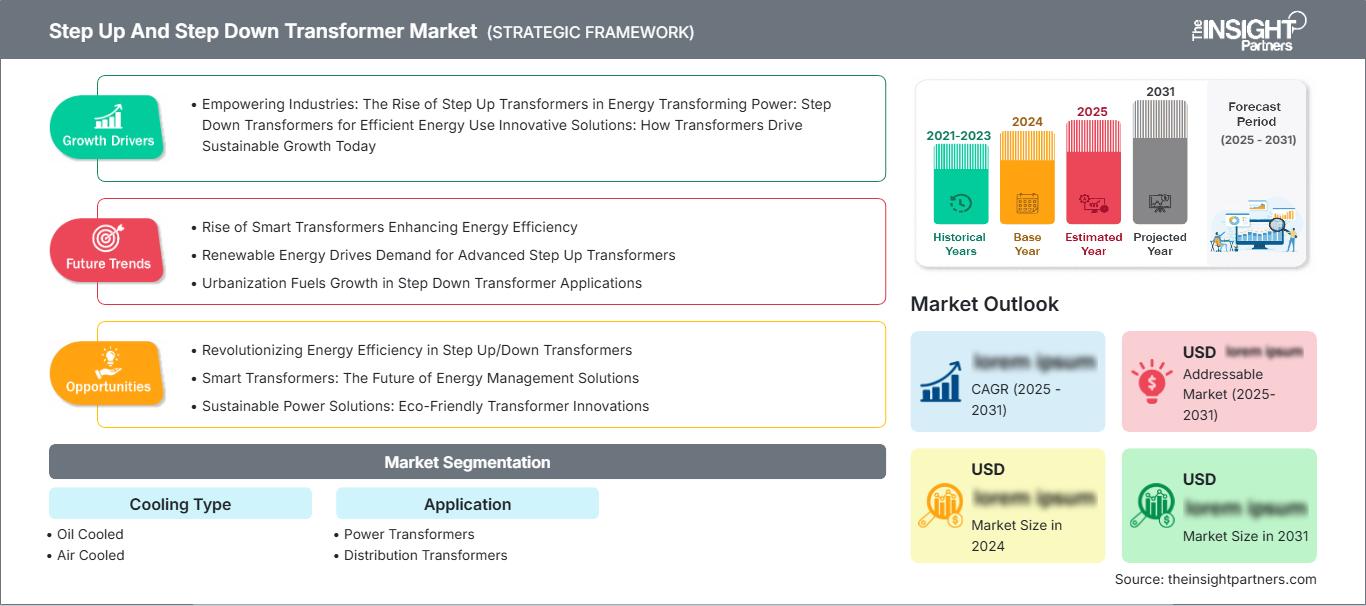
Step Up And Step Down Transformer Market Assessment and Insights
Regional Outlook
- North America: ~32% of the global Step Up and Step Down Transformer Market share in 2025 | ~4% CAGR through 2034. Market position: North America remains a major regional market, supported by replacement of aging electrical infrastructure, data center development, industrial expansion, grid resilience programs, and substantial investment in domestic transformer manufacturing capacity.
- US: ~75% of North American market revenue in 2025 | ~4% CAGR through 2034. Market position: The US accounts for most North American demand, with utilities, hyperscale data centers, manufacturing facilities, and renewable projects increasing requirements for dependable step-up and step-down voltage conversion equipment.
- Europe: ~27% of the global market in 2025 | ~4% CAGR through 2034. Market position: Europe is a mature transformer market led by Germany, followed by the UK, France, Italy, and Spain, with renewable integration, grid reinforcement, industrial electrification, and replacement of aging equipment sustaining demand.
- Asia Pacific: ~31% of the global market in 2025 | ~6% CAGR through 2034. Market position: Asia Pacific is the fastest-growing regional market, driven by power generation expansion, industrialization, renewable capacity, urbanization, and transmission investment, with China leading regional demand and India, Japan, and South Korea supporting manufacturing depth.
Segment Outlook
- Distribution Transformers: ~60% Share in 2025 | ~5% CAGR through 2034. Market position: Distribution transformers lead because they are deployed extensively across utility distribution networks, commercial facilities, industrial plants, residential infrastructure, and distributed renewable installations requiring localized voltage conversion.
- Power Transformers: ~40% Share in 2025 | ~5% CAGR through 2034. Market position: Power transformers benefit from transmission expansion, renewable power evacuation, interconnection projects, industrial loads, and high-capacity data centers, while long replacement cycles and complex manufacturing requirements encourage capacity expansion by established suppliers.
Competitive Coverage
ABB, Eaton, Fuji Electric Co., Ltd., GE Vernova Inc., Hammond Power Solutions Inc., Mitsubishi Electric Corporation, Prima Transformers, Schneider Electric SE, Siemens AG, Synergy Transformers, Hitachi Energy Ltd.
Methodology
The Insight Partners follows Data Collection & Secondary Research, Primary Research, Data Analysis, and Data Triangulation & Final Review to validate market estimates and insights.
Source: The Insight Partners' analysis based on proprietary research, government publications, company annual reports, investor presentations, industry databases, and expert interviews.
Step Up And Step Down Transformer Market Trends
Digital transformer monitoring will shift procurement toward lifecycle performance
The Step Up and Step Down Transformer Market trends indicate that transformer procurement is likely to increasingly incorporate condition monitoring, sensor-based diagnostics, thermal measurement, insulation assessment, and analytics. Instead of evaluating equipment solely through nameplate capacity and purchase cost, utilities and industrial customers are increasingly considering asset health, failure risk, maintenance requirements, and expected operating life. Digital monitoring can support condition-based maintenance by identifying abnormal operating conditions before they become major failures. Over time, this can influence replacement timing and maintenance scheduling while improving utilization of existing assets. The trend is particularly relevant for large transformer fleets where unexpected failures can disrupt electricity supply or industrial production. Suppliers that combine transformers with monitoring, analytics, service agreements, and lifecycle support can therefore address a broader customer requirement than equipment supply alone.
Higher-efficiency and application-specific transformer designs will gain importance
Efficiency requirements and increasingly demanding electrical environments will encourage greater adoption of optimized transformer designs. Customers are evaluating electrical losses, thermal behavior, space requirements, environmental conditions, noise, fire safety, and lifecycle cost when selecting equipment. Air-cooled transformers can benefit in indoor and safety-sensitive applications, while oil-cooled designs will remain essential for many high-capacity outdoor installations. At the same time, changing load profiles from data centers, renewable resources, energy storage, and industrial electrification can encourage more application-specific engineering. Manufacturers are likely to expand modular designs, advanced insulation systems, improved cooling arrangements, and digital interfaces. This evolution can increase the value of engineering and customization while creating differentiation beyond basic transformer capacity.
Step Up And Step Down Transformer Market Growth Factors
Grid modernization and replacement of aging transformer fleets
A major driver is the need to replace aging transformer fleets while increasing network capacity. Electricity systems in mature economies contain substantial installed equipment that must be refurbished or replaced as assets reach the end of their practical service lives. Modernization projects also require additional transformer capacity where substations are expanded, renewable generation is connected, or electricity demand increases. The impact extends beyond unit sales because replacement projects generate demand for engineering, installation, testing, commissioning, monitoring, and maintenance services. Suppliers with established installed bases can use replacement cycles to maintain customer relationships while introducing higher-efficiency products and digital condition-monitoring capabilities. This creates a recurring equipment and service market rather than a one-time capital expenditure opportunity.
Rapid electricity demand from data centers and industrial electrification
Data centers, semiconductor facilities, advanced manufacturing plants, electric transportation infrastructure, and other electricity-intensive applications are increasing requirements for dependable power conversion. High-density loads require carefully engineered electrical infrastructure capable of supporting large and variable power requirements while maintaining reliability. Transformer demand consequently expands alongside new substations, distribution systems, and dedicated power infrastructure. The market impact is particularly significant in locations where data center construction and industrial investment are occurring faster than existing grid capacity can accommodate. This encourages earlier transformer procurement, larger project pipelines, and investment in regional manufacturing. Suppliers able to provide engineered equipment, predictable delivery schedules, and integrated electrical infrastructure are positioned to participate across multiple stages of large electricity projects.
Renewable generation and long-distance power transmission expansion
The expansion of solar, wind, hydroelectric, and other generation assets creates additional requirements for voltage transformation and power evacuation. Renewable projects are frequently located away from major consumption centers, increasing the importance of transmission infrastructure and substations. Step-up transformers connect generation facilities to higher-voltage networks, while step-down equipment supports distribution and end-use requirements. Grid reinforcement therefore becomes a necessary complement to generation investment. The resulting demand is not limited to new renewable installations because existing networks may require additional transformer capacity, replacement units, or upgraded substations to manage changing power flows. This reinforces the role of transformers as essential infrastructure for electricity-system expansion and increases procurement opportunities across both developed and emerging markets.
Step Up And Step Down Transformer Market Opportunities
Localized transformer manufacturing and regional supply-chain development
Regional manufacturing offers an important commercial opportunity as utilities and large electricity users seek greater certainty around equipment availability and delivery schedules. North American capacity additions, European production modernization, and manufacturing expansion across Asia Pacific demonstrate the strategic value of proximity to major customers. Local production can reduce logistics exposure, improve responsiveness to customized requirements, and support after-sales service. Investors and manufacturers can pursue opportunities in transformer assembly, electrical steel processing, insulation materials, bushings, cooling systems, testing facilities, and specialized components rather than focusing exclusively on complete units. Establishing regional production also enables suppliers to align designs with local grid standards and procurement requirements, strengthening their ability to participate in long-duration utility and infrastructure programs.
Specialized transformer solutions for high-density and renewable applications
High-density data centers, renewable generation, industrial electrification, and complex grid interconnections create opportunities for application-specific transformer solutions. Customers increasingly require equipment that can accommodate demanding thermal conditions, variable loads, space constraints, high reliability requirements, and integration with sophisticated electrical protection systems. Manufacturers can differentiate through specialized engineering, compact designs, digital monitoring, advanced insulation, and integrated service packages. Renewable projects also create opportunities for transformers engineered around generation characteristics and grid connection requirements. The opportunity extends to retrofit applications, where existing substations can be upgraded without completely rebuilding infrastructure. Suppliers with strong engineering and field-service capabilities can therefore pursue both new-build projects and modernization programs.
Segmentation Analysis
Cooling Type
Cooling Type determines how transformer heat generated during electrical operation is dissipated and therefore influences efficiency, capacity, installation conditions, maintenance, safety, and lifecycle economics. Oil-cooled transformers remain important for utility and higher-capacity installations, while air-cooled units address applications where indoor deployment, fire safety, environmental considerations, or simplified maintenance are priorities. The segment is expected to expand at approximately ~5% CAGR through 2034.
- Oil Cooled: Oil-cooled transformers remain central to utility-scale transmission and distribution because insulating fluid provides effective heat transfer and electrical insulation. Demand is supported by outdoor substations, high-capacity networks, renewable interconnection projects, and industrial installations where thermal performance is critical.
- Air Cooled: Air-cooled transformers are important in commercial buildings, industrial facilities, data centers, and indoor electrical rooms. Their dry construction supports applications where reduced fire risk, environmental considerations, and simplified maintenance are prioritized.
Application
Application is divided into power transformers and distribution transformers according to the voltage-conversion role, capacity, installation environment, and position within electricity networks. Application requirements determine transformer design, insulation, cooling configuration, testing, and service needs. The segment is expected to expand at approximately ~5% CAGR through 2034.
- Power Transformers: Power transformers support transmission networks, generating stations, major substations, renewable power evacuation, and high-capacity industrial systems. Procurement is typically project-based and highly engineered, making delivery capability, testing infrastructure, reliability, and engineering customization strategically important.
- Distribution Transformers: Distribution transformers serve the final stages of electricity networks and are installed across utility feeders, commercial properties, industrial sites, residential infrastructure, and distributed generation systems. Their broad installed base generates recurring replacement demand and supports standardized manufacturing.
Opportunity Snapshot
| Application | Revenue Contribution | Trend Tag | Adoption Stage |
|---|---|---|---|
| Power Transformers | High | Grid Expansion | Scaling |
| Distribution Transformers | High | Network Replacement | Mature |
Regional Insights
North America Step Up and Step Down Transformer Market
North America accounted for approximately ~32% of the global Step Up and Step Down Transformer Market in 2025 and is expected to expand at approximately ~4% CAGR through 2034. The area is advantaged by the existence of a large installed base of transformers, needs for replacements, grid up-gradation, connection of renewables, and rising needs for electricity in data centers and advanced manufacturing. The investment made by utilities is moving more towards reliability and expansion of capacity than just maintenance of equipment.
US serves as the main driver of demand whereas Canada acts as the source of demand due to utility up-gradation, mining operations, industrial electrification, and the use of renewables. Manufacturers are ramping up production in order to meet the needs for transformers due to the constraint of availability and also reducing reliance on international logistics. Data centers act as another demand driver since high density computing centers need medium/high voltage transformers.
U.S. Step Up and Step Down Transformer Market
The US represented approximately ~75% of North American Step Up and Step Down Transformer Market revenue in 2025 and is expected to grow at approximately ~4% CAGR through 2034. Demand is concentrated around utility networks, transmission projects, data centers, semiconductor manufacturing, industrial facilities, renewable generation, and infrastructure replacement. Increasing electricity loads are encouraging utilities and large customers to secure transformer capacity earlier in project development.
ABB, Eaton, GE Vernova Inc., Hitachi Energy Ltd., Schneider Electric SE, and Siemens AG maintain substantial US electrical infrastructure capabilities. Recent manufacturing investments by leading suppliers indicate that domestic transformer production is becoming strategically important. The market also favors air-cooled transformers in indoor commercial and industrial installations where fire safety and reduced fluid handling are priorities, while oil-cooled units remain important for utility-scale and higher-capacity applications requiring efficient thermal management.
Europe Step Up and Step Down Transformer Market
Europe represented approximately ~27% of the global Step Up and Step Down Transformer Market in 2025 and is projected to expand at approximately ~4% CAGR through 2034. Germany is the leading country in Europe, supported by industrial electrification, renewable integration, grid investment, and a strong electrical equipment manufacturing base. The UK is also investing in transmission and distribution infrastructure as renewable generation and electrification increase requirements for network flexibility.
France benefits from grid modernization, industrial demand, and electricity infrastructure associated with a large low-carbon generation base. Italy is supported by renewable generation, industrial modernization, and distribution network investment, while Spain is experiencing increasing transformer requirements linked with renewable power projects and grid connections. Across Europe, transformer demand is also influenced by the replacement of aging equipment and the need to accommodate decentralized generation.
European manufacturers increasingly emphasize high efficiency, compact designs, dry-type technology, digital monitoring, and lifecycle performance. Air-cooled transformers have particular relevance in buildings, industrial premises, renewable facilities, and other locations where fire safety and environmental considerations influence equipment selection. Oil-cooled equipment remains important for outdoor utility and higher-capacity applications. Supply-chain localization and manufacturing investments are strengthening regional production capability while reducing exposure to long international delivery cycles.
APAC Step Up and Step Down Transformer Market
Asia Pacific accounted for approximately ~31% of the global Step Up and Step Down Transformer Market in 2025 and is the fastest-growing region, with approximately ~6% CAGR through 2034. China is the leading country in Asia Pacific, supported by extensive electricity infrastructure, manufacturing activity, renewable generation, urbanization, and grid expansion. India is another major demand center, with transmission additions, renewable integration, industrial development, and localized manufacturing supporting transformer procurement.
Japan and South Korea contribute through advanced industrial infrastructure, replacement demand, semiconductor investments, and technology-intensive electrical systems. Australia is supported by renewable generation, grid reinforcement, mining, and long-distance transmission requirements. Across the region, domestic manufacturing policies, renewable energy targets, and industrial investment are encouraging suppliers to expand production capacity and strengthen regional supply chains.
Middle East & Africa Step Up and Step Down Transformer Market
The Step Up and Step Down Transformer Market forecast shows that Middle East and Africa market is expected to expand at approximately ~6% CAGR through 2034. Saudi Arabia is the leading country in the Middle East & Africa region where evidence supports the strongest combination of infrastructure spending, power-system expansion, industrial diversification, and large-scale development projects. The UAE also contributes significantly through commercial construction, data centers, utilities, and infrastructure modernization.
South Africa represents an important African demand center because of grid reliability requirements, renewable integration, industrial applications, and replacement of aging electrical equipment. Rest of MEA demand is linked with electrification, new generation projects, transmission development, mining, water infrastructure, and industrial facilities. Oil-cooled transformers remain important for outdoor utility installations, while air-cooled configurations serve selected commercial and industrial applications.
Step Up And Step Down Transformer Market Report Scope
| Report Attribute | Details |
|---|---|
| Market size in 2025 | US$ 11.21 Billion |
| Market Size by 2034 | US$ 17.09 Billion |
| Global CAGR (2026 - 2034) | 4.79% |
| Historical Data | 2021-2024 |
| Forecast period | 2026-2034 |
| Segments Covered | Cooling Type, Application |
| Region scope | North America, Europe, Asia-Pacific, South and Central America, Middle East and Africa |
Recent Developments
- July 2026: ABB announces the completion of its acquisition of Specialtrasfo S.p.A., an Italy-based manufacturer of specialized medium voltage transformers, including converter and rectifier transformers. The acquisition includes three production sites in Italy and over 130 employees. In 2025, the company generated revenues of approximately 80 million euros, with ABB representing around half through its integrated offering.
- July 2026: JIEZOU POWER GROUP has introduced a cutting-edge Step Up Step Down Transformer, designed to optimize power distribution and improve energy efficiency across various sectors. This advancement underscores JIEZOU POWER GROUP’s commitment to delivering high-quality, reliable power solutions that meet the evolving demands of the modern electrical grid.
- April 2024: Meidensha Corporation has developed a 154 kV, 200 MVA transformer featuring an oil-directed, air-forced (ODAF) cooling system1 that uses eco‑friendly, plant-derived palm fatty acid esters (palm oil) as the insulating and cooling medium. According to a Meidensha study, it is the world’s first transformer of this class to adopt palm oil for insulation and cooling.
Frequently Asked Questions

Recent Reports






