
Aerospace Coating Market Analysis, Size, and Share by 2027
Published Report - Aerospace Coating Market Forecast to 2027 - COVID-19 Impact and Global Analysis By Resin Type (Epoxy, Polyurethane, and Others), by Technology (Liquid Coating and Powder Coating), and by End User (Commercial Aviation, Military Aviation, and General Aviation)
- Status : Published
- Report Code : TIPAR100001324
- Category : Chemicals and Materials
- No. of Pages : 157
- Available Report Formats :


- Last update date : June 13, 2024


2019 Market Size
US$ 1.81 Bn
Base year value
2027 Forecast
US$ 2.92 Bn
Projected by 2027
CAGR 2020-2027
6.3 %
Growth rate
Addressable Market
US$ 19.25 Bn
(2020-2027)
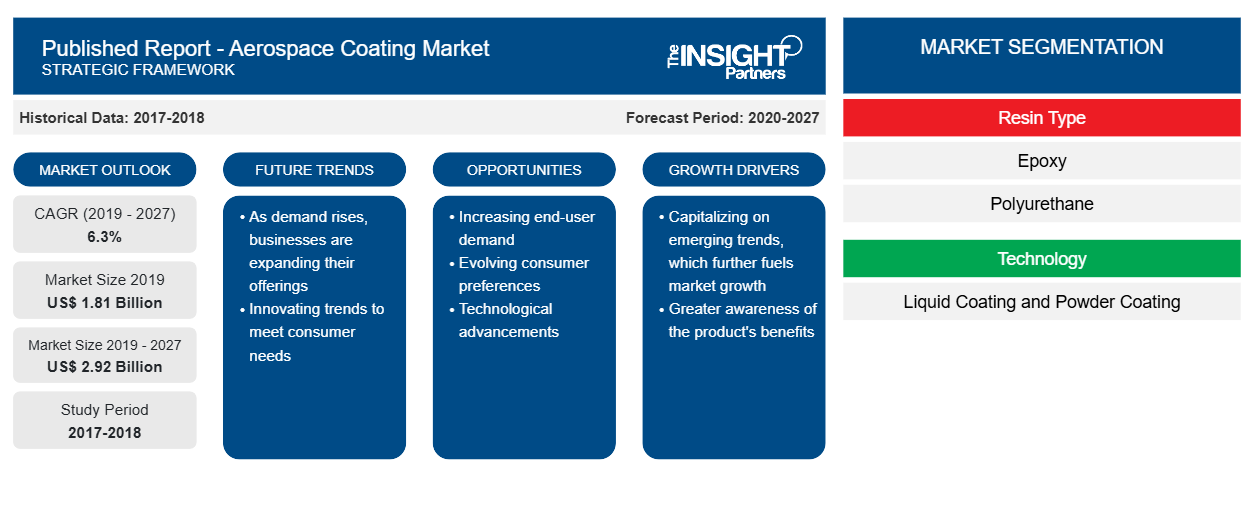
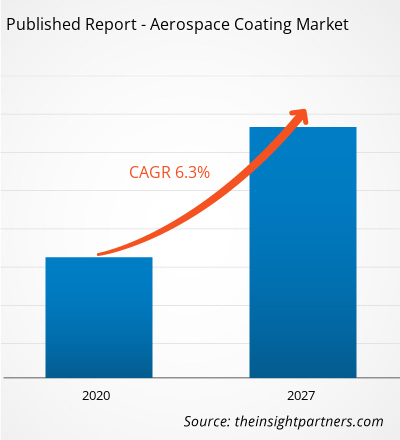
[Research Report] The aerospace coating market was valued at US$ 1,807.81 million in 2019 and is projected to reach US$ 2,924.50 million by 2027; it is expected to grow at a CAGR of 6.3% from 2020 to 2027.
Market Insights and Analyst View:
Aircrafts has to withstand high climatic stress which generally damages the metal surface resulting in frequent repairs and maintenance. Aerospace coatings provides high resistance against corrosion, ultraviolet rays and solar hear, fog and other adverse weather conditions. Aerospace coating not only provides protection the aircraft but also reduces the wright of the aircraft which helps in reducing CO2 emission. The requirement of coatings for aircraft is also due to the change in environment regulations. Aerospace coatings are designed in order to prevent temperature fluctuations, variable air pressure and variable air instabilities. Miniaturization, Precision and high strength has become the important features of aerospace coating.
Growth Drivers and Challenges:
North America is slowly and steadily becoming one of the largest markets for aerospace coatings. There has been an increase in the demand for aerospace coating products in this region due to the booming aerospace industry in the U.S. coupled with emergence of major aerospace players in the North American region. Companies like Airbus, Lockheed Martin and Boeing are major players in the aerospace coating market across the world. The government in the North American region has increased the spending on military aircraft which is expected to increase the demand for military aerospace coating products. The growing commercial aviation industry in countries like Canada and US is going to increase the demand for aerospace coating in these regions. The increasing exports of aerospace components to countries like China, France and Germany as well as increase in the robust spending by the consumers in the US is driving the manufacturing activities in the aerospace industry. Products with hydroxyapatite and lower VOC, such as polyurethane aerospace coatings are mostly used in the North American region due to the stringent regulations imposed by the government bodies. The manufacturers in this region has an ongoing research and development projects which focuses on reducing the emissions is expected to influence the aerospace coating market.
The coated aircraft basically have to be cleared or approved by various regulatory bodies due to the fact that coatings are not approved separately. The aircraft needs to undergo a design verification test in order to demonstrate that they meet the required specifications. Major coating manufacturers maintain a master file that basically shows all the proprietary ingredients as well as the process that was involved while making the product. The approval time for the aircraft depends upon the different types of aircraft. Mostly the regulatory bodies take several months in order to approve a coated aircraft. Any changes in the regulation will affect the timeline to which the manufacturers have to adhere and thus, creates a backlog in the aerospace industry. The regulations regarding coated aircraft are expected to become more expensive and complicated. Due to stringent regulations being imposed on harmful emission-causing chemicals, the use of solvent-based coatings has been limited in regions like North America and Europe. Coating products containing low VOC and hydroxyapatite are mostly used in the North American region due to the stringent regulations imposed by the government bodies. Raw materials such as aluminium, chromium and epoxy resins are used in the production of coating products only permitted when the safety regulations are stringently followed
● REPORT CUSTOMIZATION
Tailor This Report To Align With Your Specific Business Requirements
This report can be customized to align precisely with your business objectives, scope, and target markets. Customization options include tailored segmentation, geography, competitive analysis, and strategic insights to support informed decision-making.
Customize This Report →WHAT YOU CAN ADJUST
- ● Segmentations
- ● Geography
- ● Competitive Analysis
- ● Language Preferences
Published Report - Aerospace Coating Market: Strategic Insights
-
Get Top Key Market Trends of this report.This FREE sample will include data analysis, ranging from market trends to estimates and forecasts.
Report Segmentation and Scope:
The “Global Aerospace Coating Market” is segmented based on resin type, technology, end-user, and geography. Based on resin type, the aerospace coating market is segmented into epoxy, polyurethan, and others. Based in technology, the aerospace coating market is segmented into liquid coating and powder coating. On the basis of end-user, the market is segmented into commercial aviation, military aviation, and general aviation. The aerospace coating market based on geography is segmented into North America (US, Canada, and Mexico), Europe (Germany, France, Italy, UK, Russia, and Rest of Europe), Asia Pacific (Australia, China, Japan, India, South Korea, and Rest of Asia Pacific), Middle East & Africa (South Africa, Saudi Arabia, UAE, and Rest of Middle East & Africa), and South & Central America (Brazil, Argentina, and Rest of South & Central America).
Segmental Analysis:
Based on technology, the global aerospace coating market is segmented into liquid coating and powder coating. In 2019, the liquid coating aerospace coating segment accounted for the largest revenue in aerospace coating market share. Liquid Coating are majorly used for aerospace industry as it provides a superior coverage on the inside corners as well as hard to reach places, and also provides smooth and uniform finish. These coatings are mostly applied by dip spin, air spray or hand brush. These liquid coatings are used as a corrosion inhibiting layer which helps in atmospheric protection. Liquid coatings are basically of two types which are solvent based and water-based coatings. Solvent based coatings are mostly used in the aerospace industry due to it being less vulnerable towards harsh climate. Various stringent regulations as well as limitations on VOC emission by various government is going to increase the demand for liquid coating especially solvent based coatings
Based on end-user, the global aerospace coating market is segmented into commercial aviation, military aviation, and general aviation. In 2021, the commercial aviation segment accounted for the largest revenue share. The military aviation segment is also expected to account for the fastest growing compound annual growth rate over the forecast period.
Regional Analysis:
Based on geography, the aerospace coating market is divided into five key regions: North America, Europe, Asia Pacific, South & Central America, and Middle East & Africa. The global aerospace coating market was dominated by North America which accounted for US$ 610 million in 2021. Europe is a second major contributor in the global market. Asia Pacific is expected to register the considerable growth at a CAGR of 6.7% over the forecast period. Companies are constantly optimizing the overall business processes in order to satisfy consumer demand in the best possible way. Several domestic and foreign companies have a strong presence in the North American region. In the North American region, the United States is a major market for Aerospace coating s, followed by Canada and Mexico. Aerospace coatings are the materials used to enhance performance and protect the interior and exterior of the aircraft.
Industry Developments and Future Opportunities:
Various initiatives taken by the key players operating in the aerospace coating market are listed below:
- In July 2019, Akzo Nobel N.V. announced the acquisition of aerospace coating manufacturer Mapaero. The acquisition will help to strengthen its global position in aerospace coating.
Covid-19 Impact:
The COVID-19 pandemic affected industries in various countries, influencing their economic conditions. Lockdowns, travel bans, and business shutdowns in leading countries in North America, Europe, Asia Pacific (APAC), South & Central America (SAM), and the Middle East & Africa (MEA) negatively affected the growth of various industries, including chemicals and material industries. The shutdown of manufacturing units disturbed global supply chains, manufacturing activities, delivery schedules, and sales of various essential and non-essential products. In 2020, various companies announced possible delays in product deliveries and a slump in future sales of their products. In addition, the bans imposed by various governments in Europe, Asia, and North America on international travel forced the companies to put their collaboration and partnership plans on a temporary hold. All these factors hampered the chemicals and material industry in 2020 and early 2021, thereby restraining the growth of various markets related to this industry, including the global aerospace coating market.
In the pre-pandemic period, the aerospace coating market was mainly driven by high demand for from military and commercial aviation sector and various benefits offered by aerospace coating. However, many industries faced unprecedented challenges due to the COVID-19 outbreak in 2020. The chemicals and materials industry declined due to the shutdown of manufacturing units and supply chain disruption. The pandemic disturbed the manufacturing processes with restrictions imposed by government authorities in various countries. During the initial phase of the pandemic, almost all countries in the world proposed lockdowns in their respective economies, where people were restricted from going outside their houses.
Aerospace Coating
Published Report - Aerospace Coating Market Report Scope
| Report Attribute | Details |
|---|---|
| Market size in 2019 | US$ 1.81 Billion |
| Market Size by 2027 | US$ 2.92 Billion |
| Global CAGR (2019 - 2027) | 6.3% |
| Historical Data | 2017-2018 |
| Forecast period | 2020-2027 |
| Segments Covered |
By Resin Type
|
| Regions and Countries Covered |
North America
|
| Market leaders and key company profiles |
|
Published Report - Aerospace Coating Market Players Density: Understanding Its Impact on Business Dynamics
The Published Report - Aerospace Coating Market is growing rapidly, driven by increasing end-user demand due to factors such as evolving consumer preferences, technological advancements, and greater awareness of the product's benefits. As demand rises, businesses are expanding their offerings, innovating to meet consumer needs, and capitalizing on emerging trends, which further fuels market growth.
Competitive Landscape and Key Companies:
Some of the prominent players operating in the global aerospace coating industry are Akzo Nobel N.V., BASF SE, Hardide plc, Henkel AG & Co. KGaA, Hentzen Coatings, IHI Ionbond AG, Mankiewicz Group, PPG Industries, Inc., The Sherwin-Williams Company, Zircotec, among others. These players offer wide variety of aerospace coating with different specifictaions to attract a large number of consumers.
Frequently Asked Questions

- Comprehensive Market Sizing and Forecast Analysis
- Detailed Segmentation Analysis
- In-Depth Market Dynamics Assessment
- Regional and Country-Level Insights
- Competitive Landscape and Company Benchmarking
- Strategic Business Intelligence
Recent Reports
Testimonials

The Insight Partners' SCADA System Market report is comprehensive, with valuable insights on current trends and future forecasts. The team was highly professional, responsive, and supportive throughout. We are very satisfied and highly recommend their services.
RAN KEDEM Partner, Reali Technologies LTDs
I requested a report on a very specific software market and the team produced the report in a few days. The information was very relevant and well presented. I then requested some changes and additions to the report. The team was again very responsive and I got the final report in less than a week.
JEAN-HERVE JENN Chairman, Future Analytica
We worked with The Insight Partners for an important market study and forecast. They gave us clear insights into opportunities and risks, which helped shape our plans. Their research was easy to use and based on solid data. It helped us make smart, confident decisions. We highly recommend them.
PIYUSH NAGPAL Sr. Vice President, High Beam Global
The Insight Partners delivered insightful, well-structured market research with strong domain expertise. Their team was professional and responsive throughout. The user-friendly website made accessing industry reports seamless. We highly recommend them for reliable, high-quality research services
YUKIHIKO ADACHI CEO, Deep Blue, LLC.
This is the first time I have purchased a market report from The Insight Partners.While I was unsure at first, I visited their web site and felt more comfortable to take the risk and purchase a market report.I am completely satisfied with the quality of the report and customer service. I had several questions and comments with the initial report, but after a couple of dialogs over email with their analyst I believe I have a report that I can use as input to our strategic planning process.Thank you so much for taking the extra time and making this a positive experience.I will definitely recommend your service to others and you will be my first call when we need further market data.
JOHN SUZUKI President and Chief Executive Officer, Board Director, BK Technologies
I wish to appreciate your support and the professionalism you displayed in the course of attending to my request for information regarding to infectious disease IVD market in Nigeria. I appreciate your patience, your guidance, and the fact that you were willing to offer a discount, which eventually made it possible for us to close a deal. I look forward to engaging The Insight Partners in the future, all thanks to the impression you have created in me as a result of this first encounter.
DR CHIJIOKE ONYIA MANAGING DIRECTOR, PineCrest Healthcare Ltd.Reason to Buy
- Informed Decision-Making
- Understanding Market Dynamics
- Competitive Analysis
- Identifying Emerging Markets
- Customer Insights
- Market Forecasts
- Risk Mitigation
- Boosting Operational Efficiency
- Strategic Planning
- Investment Justification
- Tracking Industry Innovations
- Aligning with Regulatory Trends





 Get Free Sample for