
Biostimulants Market Segments and Growth by 2028
Published Report - Biostimulants Market Size and Forecasts (2022 - 2028), Global and Regional Growth Opportunity Analysis
- Status : Published
- Report Code : TIPAR00003199
- Category : Chemicals and Materials
- No. of Pages : 150
- Available Report Formats :


- Last update date : June 13, 2024


2022 Market Size
US$ 3.11 Bn
Base year value
2028 Forecast
US$ 5.8 Bn
Projected by 2028
CAGR 2023-2028
10.9 %
Growth rate
Addressable Market
US$ 27.22 Bn
(2023-2028)
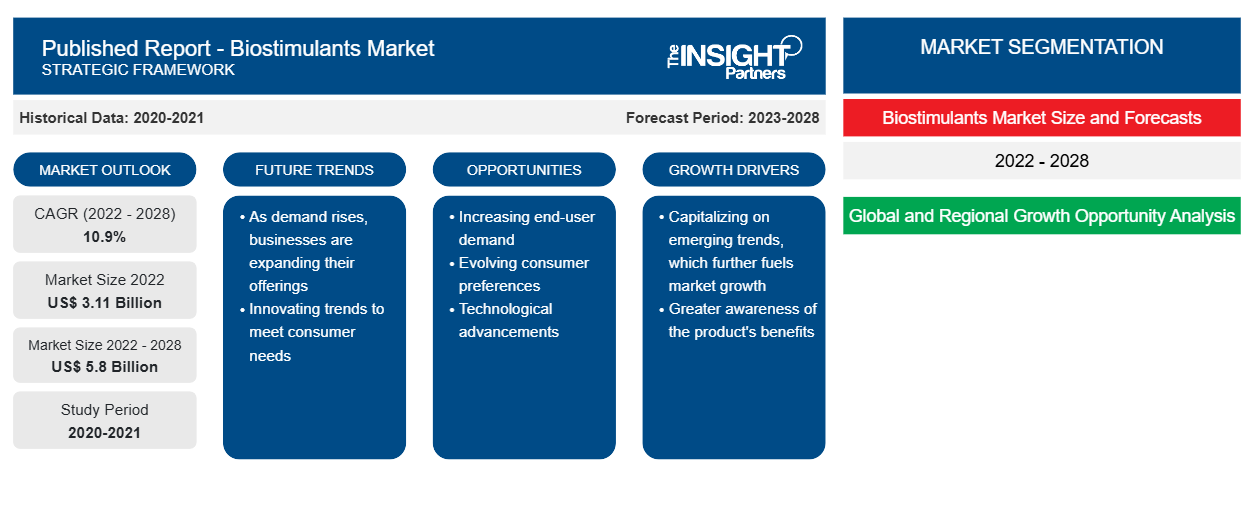
[Research Report] The biostimulants market is expected to grow from US$ 3,112.49 million in 2022 to US$ 5,796.94 million by 2028; it is estimated to grow at a CAGR of 10.9% from 2022 to 2028.
Market Insights and Analyst View:
Biostimulants are compounds or microorganisms that are administered to plants or soil to stimulate plant growth, health, and productivity. These chemicals contribute significantly to sustainable agriculture by increasing nutrient uptake, boosting stress tolerance, and improving overall plant performance. Various factors drive the market for biostimulants. Firstly, there is a growing demand for sustainable agricultural practices and environmentally friendly solutions. Biostimulants offer a viable alternative to synthetic chemicals, reducing the dependence on traditional fertilizers and pesticides. Additionally, biostimulants can help mitigate the effects of abiotic stresses such as drought, salinity, and extreme temperatures, which are becoming increasingly prevalent due to climate change. The agricultural industry has shifted towards organic and natural products, driven by consumer demand for healthier and more sustainable food. Biostimulants align with this trend, as they are derived from natural sources such as seaweed extracts, humic substances, and beneficial microorganisms. Adopting biostimulants by organic farmers and conventional growers alike has expanded the biostimulants market.
● REPORT CUSTOMIZATION
Tailor This Report To Align With Your Specific Business Requirements
This report can be customized to align precisely with your business objectives, scope, and target markets. Customization options include tailored segmentation, geography, competitive analysis, and strategic insights to support informed decision-making.
Customize This Report →WHAT YOU CAN ADJUST
- ● Segmentations
- ● Geography
- ● Competitive Analysis
- ● Language Preferences
Published Report - Biostimulants Market: Strategic Insights
-
Get Top Key Market Trends of this report.This FREE sample will include data analysis, ranging from market trends to estimates and forecasts.
Market Driver and Challenges:
Growing Demand for Sustainable Agriculture is Driving Biostimulants Market
Various factors, including environmental concerns, consumer preferences, and regulatory pressures, drive the increasing global demand for sustainable agricultural practices. Biostimulants support sustainable agriculture by providing effective and eco-friendly plant nutrition, growth enhancement, and stress management solutions. Biostimulants offer a sustainable alternative to traditional chemical inputs such as synthetic fertilizers and pesticides. They are derived from natural sources, including plant extracts, seaweeds, beneficial microorganisms, and other organic materials. Farmers can reduce their reliance on synthetic chemicals by utilizing biostimulants, minimizing the potential negative impacts on soil, water, and ecosystem health. In the context of sustainable agriculture, biostimulants also contribute to preserving and improving soil health. They can enhance soil structure, microbial activity, and nutrient cycling, improving soil fertility and long-term sustainability. Healthy soils promote better plant growth, reduce erosion, enhance water-holding capacity, and support biodiversity conservation. Hence, growing demand of sustainable agriculture is driving biostimulants market.
However, one notable restraint in the global biostimulants market is the stringent regulatory environment. Biostimulant products often fall within a regulatory gray area, as they do not fit neatly into existing pesticide or fertilizer categories. This ambiguity can lead to complex and time-consuming registration processes, resulting in product approvals and market entry delays. Additionally, varying regulatory standards across different regions and countries create additional barriers for manufacturers and hinder the global expansion of the biostimulant industry. The need for clear and harmonized regulations poses a significant challenge for market players, requiring them to navigate a complex compliance landscape and demonstrate their products' safety and efficacy. Overcoming these regulatory hurdles and establishing consistent global standards will be crucial in unlocking the full potential of the biostimulants market.
Report Segmentation and Scope:
Based on product, the global biostimulants market is segmented into humic substances, amino acids, microbial stimulants, seaweed extracts, and others. Based on the mode of application, the market is segmented into foliar spray, seed treatment, and soil application. Based on crop type, the global biostimulants market is segmented into cereals and grains, oilseeds and pulses, fruits and vegetables, turf and landscape, and others.
Segmental Analysis:
Based on product, the global biostimulants market is segmented into humic substances, amino acids, microbial stimulants, seaweed extracts, and others. In 2021, the seaweed extracts segment dominated the market. These extracts contain bioactive compounds such as growth hormones, micronutrients, amino acids, and polysaccharides that promote plant growth, enhance nutrient uptake, and improve stress tolerance. By stimulating cell division, improving nutrient absorption, and aiding in stress management, seaweed extracts contribute to higher crop productivity and quality. Furthermore, their use aligns with the growing demand for sustainable and organic agricultural practices, making them an attractive option for farmers and growers worldwide. As a result, the market for biostimulants incorporating seaweed extracts is experiencing significant growth as they provide effective and environmentally friendly solutions for enhancing agricultural outcomes.
Regional Analysis:
During the projection period, Asia Pacific is expected to be the fastest expanding region. Growing demand for biostimulants is being driven by the growing need to improve crop quality and productivity, rising environmental awareness, increased organic farming and demand for organic food, and the wide range of benefits of biostimulants in crop production. Asia's need for biostimulants is expanding due to rising demand for organic products and the requirement for organic farming. Furthermore, the Asia Pacific region's expanding population is expected to drive biostimulants market growth. China is a world leader in the production and distribution of biostimulants, owing to the country's huge fertiliser consumption. Moreover, other countries like India are one of the world's largest foodgrain producers. According to the Ministry of Agriculture & Farmers Welfare, total Foodgrain production in the country is estimated at a record 316.06 million tonnes, which is higher by 5.32 million tonnes than the foodgrain production during 2020-21. Moreover, these countries are encouraging farmers to shift toward organic farming. These factors are expected to boost the demand for biostimulants in Asia.
COVID-19 Impact:
The covid-19 pandemic has immensely impacted the global biostimulants market, leading to challenges and opportunities. On the one hand, disruptions in global supply chains, restrictions on movement, and reduced agricultural activities have resulted in temporary setbacks, causing delays in the production and distribution of biostimulant products. On the other hand, the crisis has heightened the awareness of sustainable agriculture practices and the need for improved crop resilience, leading to an increased demand for biostimulants as farmers seek innovative solutions to enhance plant growth, nutrient uptake, and stress tolerance. As the world gradually recovers from the pandemic, the biostimulants market is expected to rebound, and experience sustained growth, driven by the growing emphasis on sustainable farming practices and the need to enhance agricultural productivity in the face of future challenges.
Biostimulants
Published Report - Biostimulants Market Report Scope
| Report Attribute | Details |
|---|---|
| Market size in 2022 | US$ 3.11 Billion |
| Market Size by 2028 | US$ 5.8 Billion |
| Global CAGR (2022 - 2028) | 10.9% |
| Historical Data | 2020-2021 |
| Forecast period | 2023-2028 |
| Segments Covered |
By Biostimulants Market Size and Forecasts
|
| Regions and Countries Covered |
North America
|
| Market leaders and key company profiles |
|
Published Report - Biostimulants Market Players Density: Understanding Its Impact on Business Dynamics
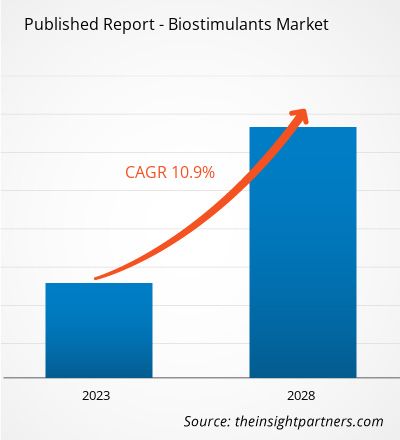
The Published Report - Biostimulants Market is growing rapidly, driven by increasing end-user demand due to factors such as evolving consumer preferences, technological advancements, and greater awareness of the product's benefits. As demand rises, businesses are expanding their offerings, innovating to meet consumer needs, and capitalizing on emerging trends, which further fuels market growth.
Industry Developments and Future Opportunities:
Inorganic and organic strategies such as mergers and acquisitions are highly adopted by companies in the biostimulants market. A few recent key market developments are listed below:
- In May 2022, UPL Limited made a partnership with Kimitec’s MAAVi Innovation Center to deliver Biosolutions in the United States.
- In October 2021, UPL Limited collaborated with Chr. Hansan, a global bioscience company, develops microbial-based Biosolutions (including biostimulants and biopesticides).
- In March 2021, Valagro, FarterSMART, and Alamics partnered together to develop a circular bioeconomic model. The project was focused on the recycling of waste from diapers and pads into biostimulants with high added value.
- In 2020 March, Valagro reported the send-off of Talete a new biostimulant, beginning from the select GeaPower innovation stage, to increment crop water efficiency; in five extra nations at a worldwide computerized occasion went to by specialists, clients, ranchers, and assessment pioneers from more than 12 nations across 5 mainlands. The extra nations are China, Australia Colombia, Greece, and France.
- In March 2020, BASF and Delair announced their collaboration to scale up BASF’s research and development projects for seeds, traits, and crop protection. The agreement has enabled BASF’s agricultural research stations worldwide to use the delair.ai cloud platform to streamline and standardize the information gained through drone-based field studies.
Competitive Landscape and Key Companies
The biostimulants market analysis consists of the players such as BASF SE, UPL Limited, Valagro, Gowan Company, Total Corbion PLA, FMC Corporation, ILSA S.p.A., Haifa Negev technologies LTD, ADAMA, Rallis India Limited, and AgriTecno Biostimulants and Plant Nutrition.
Frequently Asked Questions

- Comprehensive Market Sizing and Forecast Analysis
- Detailed Segmentation Analysis
- In-Depth Market Dynamics Assessment
- Regional and Country-Level Insights
- Competitive Landscape and Company Benchmarking
- Strategic Business Intelligence
Recent Reports
Testimonials

The Insight Partners' SCADA System Market report is comprehensive, with valuable insights on current trends and future forecasts. The team was highly professional, responsive, and supportive throughout. We are very satisfied and highly recommend their services.
RAN KEDEM Partner, Reali Technologies LTDs
I requested a report on a very specific software market and the team produced the report in a few days. The information was very relevant and well presented. I then requested some changes and additions to the report. The team was again very responsive and I got the final report in less than a week.
JEAN-HERVE JENN Chairman, Future Analytica
We worked with The Insight Partners for an important market study and forecast. They gave us clear insights into opportunities and risks, which helped shape our plans. Their research was easy to use and based on solid data. It helped us make smart, confident decisions. We highly recommend them.
PIYUSH NAGPAL Sr. Vice President, High Beam Global
The Insight Partners delivered insightful, well-structured market research with strong domain expertise. Their team was professional and responsive throughout. The user-friendly website made accessing industry reports seamless. We highly recommend them for reliable, high-quality research services
YUKIHIKO ADACHI CEO, Deep Blue, LLC.
This is the first time I have purchased a market report from The Insight Partners.While I was unsure at first, I visited their web site and felt more comfortable to take the risk and purchase a market report.I am completely satisfied with the quality of the report and customer service. I had several questions and comments with the initial report, but after a couple of dialogs over email with their analyst I believe I have a report that I can use as input to our strategic planning process.Thank you so much for taking the extra time and making this a positive experience.I will definitely recommend your service to others and you will be my first call when we need further market data.
JOHN SUZUKI President and Chief Executive Officer, Board Director, BK Technologies
I wish to appreciate your support and the professionalism you displayed in the course of attending to my request for information regarding to infectious disease IVD market in Nigeria. I appreciate your patience, your guidance, and the fact that you were willing to offer a discount, which eventually made it possible for us to close a deal. I look forward to engaging The Insight Partners in the future, all thanks to the impression you have created in me as a result of this first encounter.
DR CHIJIOKE ONYIA MANAGING DIRECTOR, PineCrest Healthcare Ltd.Reason to Buy
- Informed Decision-Making
- Understanding Market Dynamics
- Competitive Analysis
- Identifying Emerging Markets
- Customer Insights
- Market Forecasts
- Risk Mitigation
- Boosting Operational Efficiency
- Strategic Planning
- Investment Justification
- Tracking Industry Innovations
- Aligning with Regulatory Trends





 Get Free Sample for