
Microfluidics Market Drivers and Forecasts by 2027
Published Report - Microfluidics Market to 2027 � COVID-19 Impact and Global Analysis � by Product (Microfluidic Chips, Microfluidic Sensors, Devices, Micropumps, Microneedles, and Other Products), Material (PDMS, Polymers, Glass, Silicon, and Other Materials), and Application (In Vitro Diagnostics, Pharmaceutical and Life Science Research, Drug Discovery, and Other Applications)
- Status : Published
- Report Code : TIPAR100000953
- Category : Life Sciences
- No. of Pages : 182
- Available Report Formats :


- Last update date : June 12, 2024


2019 Market Size
US$ 11.85 Bn
Base year value
2027 Forecast
US$ 43.4 Bn
Projected by 2027
CAGR 2020-2027
17.9 %
Growth rate
Addressable Market
US$ 213.35 Bn
(2020-2027)
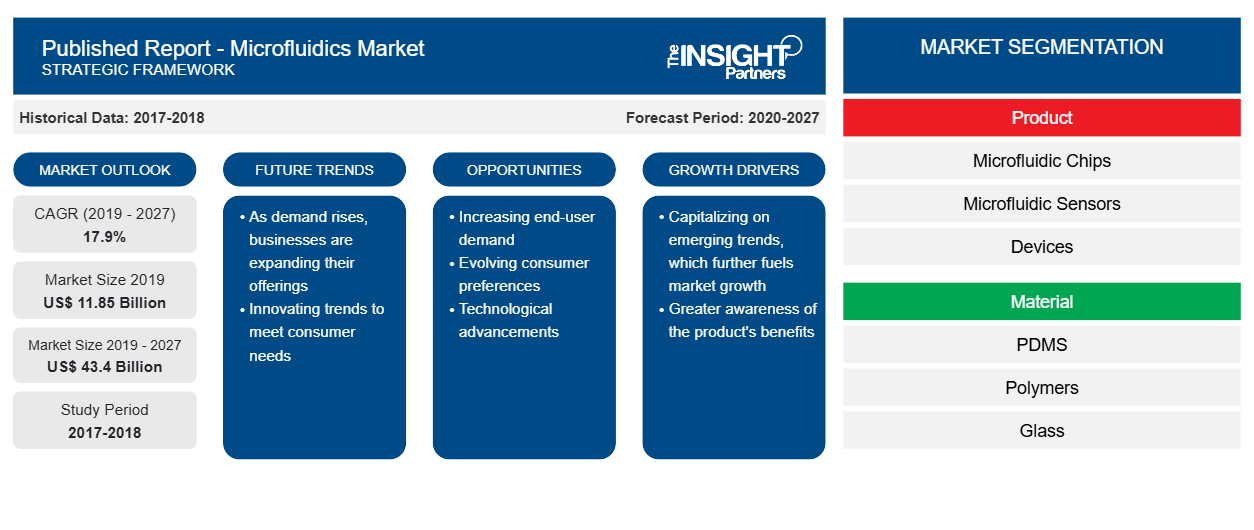
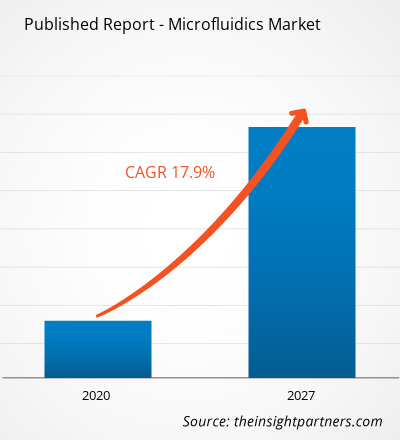
[Research Report] The microfluidics market size is estimated to reach US$ 43,398.7 million by 2027 from US$ 11,851.1 million in 2019; it is estimated to grow at a CAGR of 17.9% from 2019 to 2027.
Market Insights and Analyst View:
Microfluidics is both science and technology, as the science it studies the behavior of fluids through micro-channels, and as the technology of manufacturing microminiaturized devices containing chambers and tunnels through which fluids flow. Microfluidics deal with small volumes of fluids, down to femtoliters (fL), a quadrillionth liter. As more and more researchers realize the power of microfluidics, the technology is being applied to many new fields, thus saving money and time spent on research. Microfluidic systems are widely used in procedures such as isoelectric focusing, capillary electrophoresis, flow cytometry, immunoassays, sample injection in mass spectrometry, DNA analysis, PCR amplification, cell patterning, and separation and manipulation of cells. The rising demand for microfluidics technologies in point-of-care testing and innovation in the microfluidics product portfolio is expected to propel the microfluidics market growth during the forecast period.
Growth Drivers:
The advances in the design and development of microfluidics (MFs) devices have made it possible to miniaturize conventional biochemical laboratory protocols into a microchannel networking system, which has emerged as an efficient and cost-effective tool. Biomedical microdevices include integrated structures consisting of numerous micro- and nano-sized integrated devices, where many processes, from particle manipulation to sensing, take place in the platform. Although different types of microfluidic devices can perform similar tasks in biomedical applications, passive microfluidic systems are mainly used for particle manipulation and mixing liquids. In contrast, active types contribute more to particle trapping and sensing. One of the most promising applications of microfluidics in biomedical sciences is the diagnosis of diseases, including cancer diagnosis and infectious diseases. However, further development of microfabrication permits employing microfluidics devices in tissue engineering and organ-on-a-chip. Moreover, microfluidics–biosensing technology has become popular for applications such as point-of-care testing, biosensors, and cell manipulations.
Cancer is one of the leading causes of death globally. Microfluidics holds great promise in cancer diagnosis and is an emerging tool for understanding cancer biology. For instance, according to GLOBOCAN, in 2020, there were 19,282,789 new cancer cases worldwide, which is anticipated to rise to 28,887,940 cases by 2040. Microfluidics can be valuable for cancer investigation due to its high sensitivity, high throughput, less material consumption, low cost, and enhanced spatiotemporal control. The physical laws on the microscale offer an advantage enabling the control of physics, biology, chemistry, and physiology at a cellular level. Thus, an expected increase in cancer cases is anticipated to increase the demand for point-of-care diagnostics, propelling the market's growth.
● REPORT CUSTOMIZATION
Tailor This Report To Align With Your Specific Business Requirements
This report can be customized to align precisely with your business objectives, scope, and target markets. Customization options include tailored segmentation, geography, competitive analysis, and strategic insights to support informed decision-making.
Customize This Report →WHAT YOU CAN ADJUST
- ● Segmentations
- ● Geography
- ● Competitive Analysis
- ● Language Preferences
Published Report - Microfluidics Market: Strategic Insights
-
Get Top Key Market Trends of this report.This FREE sample will include data analysis, ranging from market trends to estimates and forecasts.
Report Segmentation and Scope:
The “Global Microfluidics Market” is segmented based on product, application, sector, and geography. Based on the product, the microfluidics market is segmented into microfluidic chips, microfluidic sensors, micropumps, microneedles, devices, and other products. Based on material, the microfluidics market is segmented into PDMS, polymers, glass, silicon, and others. Based on application, the microfluidics market is divided into vitro diagnostics, pharmaceutical and life science research, drug discovery, and other applications. The microfluidics market based on geography is segmented into North America (US, Canada, and Mexico), Europe (Germany, France, Italy, UK, Russia, and Rest of Europe), Asia Pacific (Australia, China, Japan, India, South Korea, and Rest of Asia Pacific), Middle East & Africa (South Africa, Saudi Arabia, UAE, and Rest of Middle East & Africa), and South & Central America (Brazil, Argentina, and Rest of South & Central America)
Segmental Analysis:
The microfluidics market by product is segmented into microfluidic chips, microfluidic sensors, micropumps, microneedles, devices, and other products. The devices segment held the largest share of the market in 2019. However, microfluidic chips are anticipated to register the highest CAGR in the market during the forecast period. Microfluidic devices have great potential to synthesize nanoparticles and nanocomposites due to the efficient heat and mass transfers and spatial limitations in microfluidic devices, convenient parameter adjustments, and in situ process monitoring in microreactors. Many nanoparticles with controllable sizes, size distributions, and morphologies, such as organic, inorganic, and hybrid, have been successfully synthesized in microfluidic devices. Also, the microfluidic devices used for biomedical applications include single-cell trapping, automated micro-robotic injection, and drug discovery and analysis. Thus, the factors mentioned above are likely to anticipate the growth of devices in the market.
Based on material, the microfluidics market is segmented into PDMS, polymers, glass, silicon, and others. The PDMS segment held the largest share of the market in 2019. and is anticipated to register the highest CAGR in the market during the forecast period. PDMS has been commonly used for rapid prototyping in microfluidics since it is simple to produce, bonds tightly to glass and PDMS substrates, and has excellent optical clarity and elastomeric properties. PDMS is used in research laboratories due to its rapid fabrication, reasonable cost, and ease of implementation. PDMS is also susceptible to nonspecific adsorption and permeation by hydrophobic molecules due to its intrinsic hydrophobic nature causes. Thus, these many advantages of PDMS are likely to anticipate the market's growth.
Based on application, the microfluidics market is divided into in vitro diagnostics, pharmaceutical, and life science research, drug discovery, and other applications. The In-vitro diagnostics segment held the largest share of the market in 2019. and the same segment is anticipated to register the highest CAGR in the market during the forecast period. Microfluidics, or lab-on-a-chip technology, is a tool that sits at the intersection of automation, biotechnology, and functional integration. By using photolithography and other CMOS fabrication techniques to make fluid flow cells, microfluidic devices can shuttle the picoliter, and smaller volumes of fluids into functional regions, enabling powerful in vitro diagnostics (IVD) harnessing everything from digital biology, to next-generation sequencing, to organs-on-a-chip, to high throughput cell-based assays, to high-density multifunctional chips for drug discovery and bioanalysis, for the shrinking sample and reagent volumes. The microfluidics materials used in in vitro diagnostics are primarily glass, silicon, and polymers (plastics and photoresists).
Regional Analysis:
Based on geography, the microfluidics market is divided into five key regions: North America, Europe, Asia Pacific, South & Central America, and Middle East & Africa. The north bioinformatics market has been analyzed based on three major countries — the US, Canada, and Mexico. The US is estimated to hold the largest microfluidics market share during the forecast period. The growth of the market in the country is primarily driven by technological advancements, the launch of new and advanced products, and increasing R&D activities in the country.
Asia Pacific is the fastest-growing market for microfluidics. The market growth in this region is attributed to several growth opportunities, such as product launches, a rise in R&D investments, and increasing government initiatives. Additionally, the presence of major players fuels the market's growth.
Microfluidics Market Trend:
Microfluidic chips are microchannels engraved on glass, silicone, and polymer materials. The small size makes them attractive for laboratory and point‐of‐care (POC) settings. 3D printing is increasingly being adopted to fabricate microfluidic chips as the technology greatly reduces the transition time. In the last few years, 3D printing has emerged as a promising alternative for fabricating microfluidic devices, overcoming some of the limitations of conventional soft-lithography. Due to their availability and affordability, Stereolithography (SLA), inkjet 3D printing, and extrusion-based technology are three of the broadly used 3D printing technologies. Microfluidic devices can be 3D printed using four fundamental manufacturing approaches: direct printing, mold-based, modular, and hybrid. Using a broad spectrum of additive manufacturing materials, 3D-printed microfluidic devices have been implemented in various fields, including biological, chemical, and material synthesis.
A few examples of 3D printing in Microfluidics are mentioned below:
In June 2020, researchers at the University of California pioneered a new droplet-based 3D printing technology using microfluidics. This approach will help the researchers print finely-tuned flexible materials with applications in tissue engineering, soft robotics, and wearable technology.
In June 2020, scientists at the Montana State University’s Department of Mechanical and Industrial Engineering developed a new method for 3D printing microfluidic devices. This method is capable of 3D printing directly onto a glass substrate to create thin fluid channels measuring less than a millimeter in width. The novel process is faster and cheaper than other conventional microfluidic production methods.
Covid-19 Impact:
Coronavirus diagnostic with microfluidics has gained a lot of attention. For instance, US-based researchers from Broad Institute have developed a CRISPR-based molecular diagnostics stage with the help of microfluidics chips to detect viruses in human samples. This single chip has the potential to detect a single virus in more than 1,000 samples at a time. Additionally, it can search a smaller number of samples for more than 160 different viruses, including SARS-CoV-2, the virus accountable for the COVID-19 pandemic. Moreover, many organizations are contributing their efforts to the detection of COVID-19; for instance, SkyWater Technology and SEMI-Fab Owners Alliance are on the front lines in providing a necessary microfluidic MEMS component used in COVID-19 testing and research to identify mutations of the virus. US-based SkyWater has been working with genomics sequencing leader MGI to supply a component used in an ultra-high-throughput sequencing system, namely, MGI's DNBSEQ-T7. The component provided is a microfluidic MEMS device that uses microscopic channels to perform small-scale chemical reactions in the genetic sequencing platform.
Moreover, nanomaterials have been used in several real-time sensing platforms. However, academic researchers and the nanotechnology industry are creating point-of-care devices that use nanomaterial as the sensing element. These devices were created as either microfluidic-based devices or nanosensor devices. Such microfluidic-based devices have helped fight against COVID-19, prevented severe shortages of healthcare resources, provided a real-time diagnosis of this disease, and minimized death rates.
Microfluidics
Published Report - Microfluidics Market Report Scope
| Report Attribute | Details |
|---|---|
| Market size in 2019 | US$ 11.85 Billion |
| Market Size by 2027 | US$ 43.4 Billion |
| Global CAGR (2019 - 2027) | 17.9% |
| Historical Data | 2017-2018 |
| Forecast period | 2020-2027 |
| Segments Covered |
By Product
|
| Regions and Countries Covered |
North America
|
| Market leaders and key company profiles |
|
Published Report - Microfluidics Market Players Density: Understanding Its Impact on Business Dynamics
The Published Report - Microfluidics Market is growing rapidly, driven by increasing end-user demand due to factors such as evolving consumer preferences, technological advancements, and greater awareness of the product's benefits. As demand rises, businesses are expanding their offerings, innovating to meet consumer needs, and capitalizing on emerging trends, which further fuels market growth.
Competitive Landscape and Key Companies:
Agilent Technologies, Inc., BD, Bio-Rad Laboratories Inc., Danaher, Dolomite Microfluidics (Blacktrace Holdings Ltd.), Fludigm Corporation, Illumina, Inc. microfluidic ChipShop GmbH, Perkin Elmer, Inc., and Thermo Fisher Scientific Inc. are the microfluidics companies operating in the market. Microfluidics companies focus on new technologies, existing product advancements, and geographical expansions to meet the growing consumer demand worldwide and increase their product range in specialty portfolios. For instance, in March 2022, Miroculus, Inc. announced the formal launch of the Miro Canvas. This compact, easy-to-use digital microfluidics platform enables on-demand automation of complex next-generation sequencing (NGS) sample preparation protocols.
- In October 2021, LumiraDx submitted the LumiraDx SARS-CoV-2 & Flu A/B Test to the Food and Drug Administration (FDA) for Emergency Use Authorization (EUA). The microfluidic immunofluorescence assay can quickly verify infection for patients suspected of flu and COVID-19 to aid in diagnosis and clinical decision-making.
- In January 2021, LexaGene launched the MiQLab system from research-only use to POC use to detect the SARS-CoV-2 virus after receiving emergency use authorization (EUA) in the United States.
Frequently Asked Questions

- Comprehensive Market Sizing and Forecast Analysis
- Detailed Segmentation Analysis
- In-Depth Market Dynamics Assessment
- Regional and Country-Level Insights
- Competitive Landscape and Company Benchmarking
- Strategic Business Intelligence
Recent Reports
Testimonials

The Insight Partners' SCADA System Market report is comprehensive, with valuable insights on current trends and future forecasts. The team was highly professional, responsive, and supportive throughout. We are very satisfied and highly recommend their services.
RAN KEDEM Partner, Reali Technologies LTDs
I requested a report on a very specific software market and the team produced the report in a few days. The information was very relevant and well presented. I then requested some changes and additions to the report. The team was again very responsive and I got the final report in less than a week.
JEAN-HERVE JENN Chairman, Future Analytica
We worked with The Insight Partners for an important market study and forecast. They gave us clear insights into opportunities and risks, which helped shape our plans. Their research was easy to use and based on solid data. It helped us make smart, confident decisions. We highly recommend them.
PIYUSH NAGPAL Sr. Vice President, High Beam Global
The Insight Partners delivered insightful, well-structured market research with strong domain expertise. Their team was professional and responsive throughout. The user-friendly website made accessing industry reports seamless. We highly recommend them for reliable, high-quality research services
YUKIHIKO ADACHI CEO, Deep Blue, LLC.
This is the first time I have purchased a market report from The Insight Partners.While I was unsure at first, I visited their web site and felt more comfortable to take the risk and purchase a market report.I am completely satisfied with the quality of the report and customer service. I had several questions and comments with the initial report, but after a couple of dialogs over email with their analyst I believe I have a report that I can use as input to our strategic planning process.Thank you so much for taking the extra time and making this a positive experience.I will definitely recommend your service to others and you will be my first call when we need further market data.
JOHN SUZUKI President and Chief Executive Officer, Board Director, BK Technologies
I wish to appreciate your support and the professionalism you displayed in the course of attending to my request for information regarding to infectious disease IVD market in Nigeria. I appreciate your patience, your guidance, and the fact that you were willing to offer a discount, which eventually made it possible for us to close a deal. I look forward to engaging The Insight Partners in the future, all thanks to the impression you have created in me as a result of this first encounter.
DR CHIJIOKE ONYIA MANAGING DIRECTOR, PineCrest Healthcare Ltd.Reason to Buy
- Informed Decision-Making
- Understanding Market Dynamics
- Competitive Analysis
- Identifying Emerging Markets
- Customer Insights
- Market Forecasts
- Risk Mitigation
- Boosting Operational Efficiency
- Strategic Planning
- Investment Justification
- Tracking Industry Innovations
- Aligning with Regulatory Trends





 Get Free Sample for