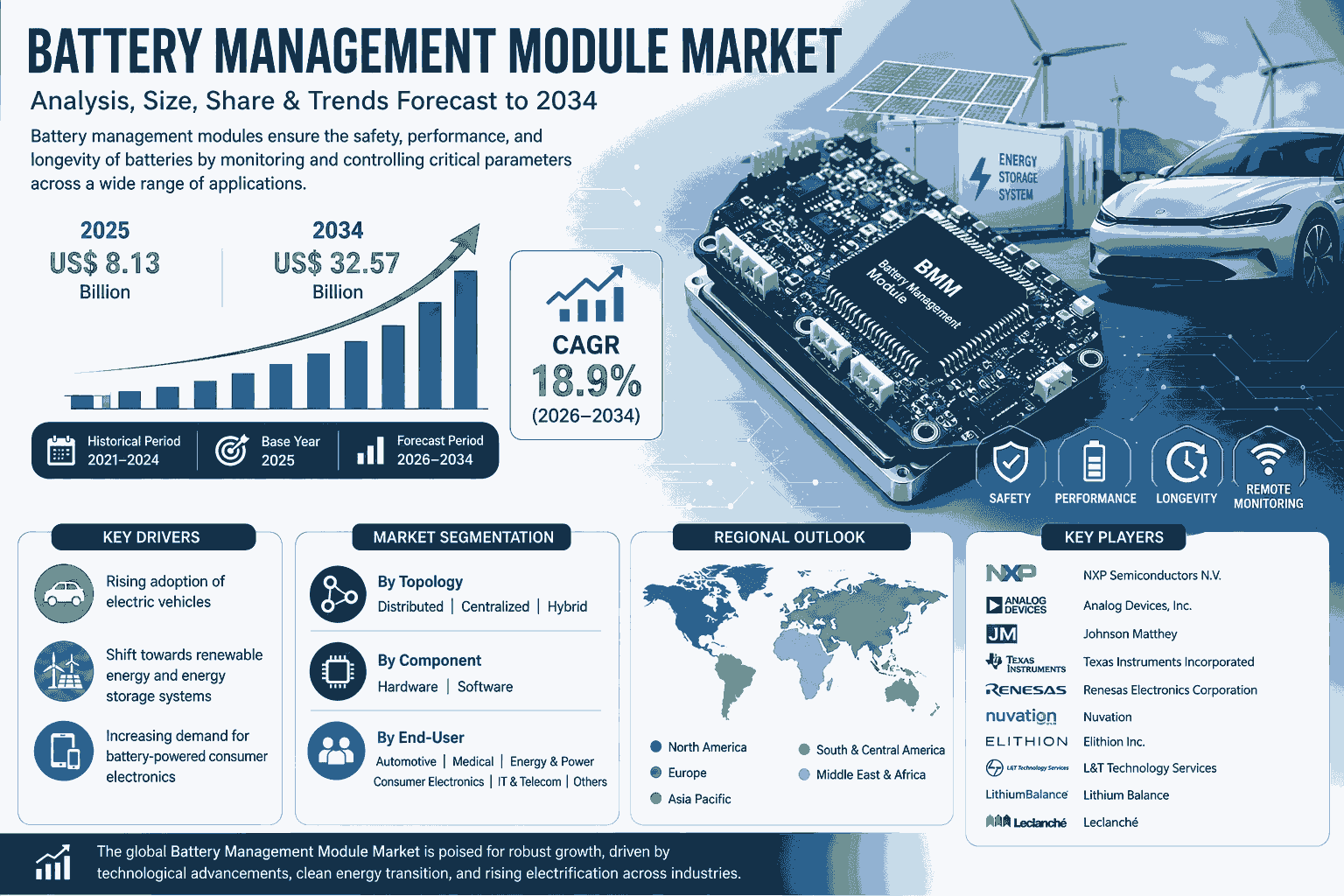
The global Battery Management Module Market is experiencing remarkable growth, driven by the increasing adoption of electric vehicles, expansion of renewable energy infrastructure, and rising demand for advanced battery-powered electronic devices. Battery management modules (BMMs) play a vital role in ensuring battery safety, performance, and longevity by continuously monitoring parameters such as voltage, temperature, current, and state of charge. As industries increasingly rely on lithium-ion batteries and energy storage technologies, the demand for intelligent battery management solutions continues to rise.
According to market estimates, the Battery Management Module Market was valued at US$ 8.13 billion in 2025 and is projected to reach US$ 32.57 billion by 2034, registering a strong CAGR of 18.9% during 2026–2034. Growing investments in electric mobility and clean energy technologies are expected to support sustained market expansion throughout the forecast period.
Battery Management Module Market Overview
Battery management modules are electronic systems designed to monitor and control battery charging and discharging processes while protecting batteries from overcharging, overheating, deep discharge, and excessive current flow. These systems help optimize battery performance and extend battery life, making them essential components in electric vehicles, energy storage systems, medical devices, consumer electronics, and industrial applications. In multi-cell battery packs, battery management modules also perform cell balancing functions to ensure uniform charging and discharging across all cells, thereby improving reliability and efficiency.
The increasing need for efficient energy utilization and battery safety has significantly accelerated the adoption of battery management modules across various sectors. Their ability to enhance performance, reduce maintenance requirements, and support remote monitoring capabilities makes them increasingly valuable in modern battery-powered systems.
Market Drivers
One of the major factors driving the Battery Management Module Market is the rapid growth of the electric vehicle industry. Governments across countries such as the United States, India, China, and several European nations are promoting EV adoption through subsidies and investments in charging infrastructure. Since battery management systems are crucial for maintaining battery health and improving vehicle range, rising EV production is directly contributing to market growth.
Another significant growth factor is the increasing shift toward renewable energy and battery energy storage systems. Solar and wind energy generation often face fluctuations in supply, creating the need for efficient energy storage solutions. Battery management modules enable effective storage and distribution of renewable energy while maintaining battery safety and efficiency. As countries pursue carbon neutrality goals and reduce dependence on fossil fuels, demand for advanced battery management solutions is expected to increase substantially.
Market Segmentation Analysis
Based on topology, the market is segmented into distributed, centralized, and hybrid architectures. Among these, the centralized segment is anticipated to register the highest growth rate owing to its cost-effectiveness and simpler design structure. Depending on components, the market is divided into hardware and software segments, with hardware accounting for the largest share in 2025 due to the growing demand for sensors, controllers, and communication interfaces.
By end-user, the automotive segment is expected to witness the highest CAGR during the forecast period. The increasing production of electric vehicles, coupled with stringent emission regulations and expanding charging infrastructure, is fueling demand for battery management modules. Other major end-user industries include energy and power, consumer electronics, medical devices, and IT & telecommunications, all of which are increasingly relying on advanced battery technologies.
Regional Analysis
Asia Pacific is projected to emerge as the fastest-growing region in the Battery Management Module Market. Countries such as China, India, Japan, and South Korea are witnessing significant growth in electric vehicle manufacturing and renewable energy installations, creating strong demand for battery management systems. Furthermore, the presence of major battery manufacturers and electronics companies strengthens the region's market position.
North America also represents a prominent market, supported by rising investments in clean energy projects and electric mobility. Europe is witnessing steady growth due to stringent environmental regulations and the rapid expansion of battery production facilities. Meanwhile, countries in the Middle East, Africa, and South America are gradually adopting energy storage technologies, creating additional opportunities for market participants.
Competitive Landscape
The Battery Management Module Market is characterized by intense competition and continuous technological advancements. Leading companies are focusing on innovation, strategic partnerships, and product development to strengthen their market positions. Prominent players operating in the market include NXP Semiconductors N.V., Analog Devices, Inc., Johnson Matthey, Texas Instruments Incorporated, Renesas Electronics Corporation, Nuvation, Elithion Inc., L&T Technology Services, Lithium Balance, and Leclanché. These companies are actively investing in advanced battery technologies and intelligent management systems to address evolving customer requirements.
Recent Developments
Recent developments indicate a growing focus on advanced and wireless battery management solutions. In 2023, Sensata Technologies introduced the c-BMS24X system designed for industrial applications and low-voltage electric vehicles, offering improved battery health and performance. Nuvation Energy launched its 1500-volt battery management system optimized for stationary energy storage applications, while Marelli expanded its portfolio with a wireless distributed battery management system that enhances flexibility and reduces wiring complexity. These innovations demonstrate the industry's ongoing efforts to improve battery efficiency, safety, and cost-effectiveness.
Future Outlook
The future of the Battery Management Module Market appears highly promising, supported by the rapid expansion of electric vehicles, energy storage systems, and smart electronic devices. Emerging technologies such as wireless battery management systems, artificial intelligence-based monitoring, and cloud-connected battery platforms are expected to transform the industry over the coming years. As battery technologies continue to evolve and sustainability goals become increasingly important worldwide, battery management modules will play a critical role in ensuring safe, reliable, and efficient energy storage solutions.
.png)
.png)
.png)
.png)
.png)
.png)
.png)
.png)