
Battery Management Module Market Analysis, Size, and Share by 2034
Coverage: By Topology (Distributed, Centralized, and Hybrid); Component (Hardware and Software); End-User (Automotive, Medical, Energy & Power, Consumer Electronics, IT & Telecom, and Others), and Geography
- Status : Data Released
- Report Code : TIPTE100000176
- Category : Electronics and Semiconductor
- No. of Pages : 150
- Available Report Formats :


- Last update date : July 15, 2026


2025 Market Size
US$ 11.49 Bn
Base year value
2034 Forecast
US$ 54.59 Bn
Projected by 2034
CAGR 2026-2034
18.9 %
Growth rate
Addressable Market
US$ 271.02 Bn
(2026-2034)
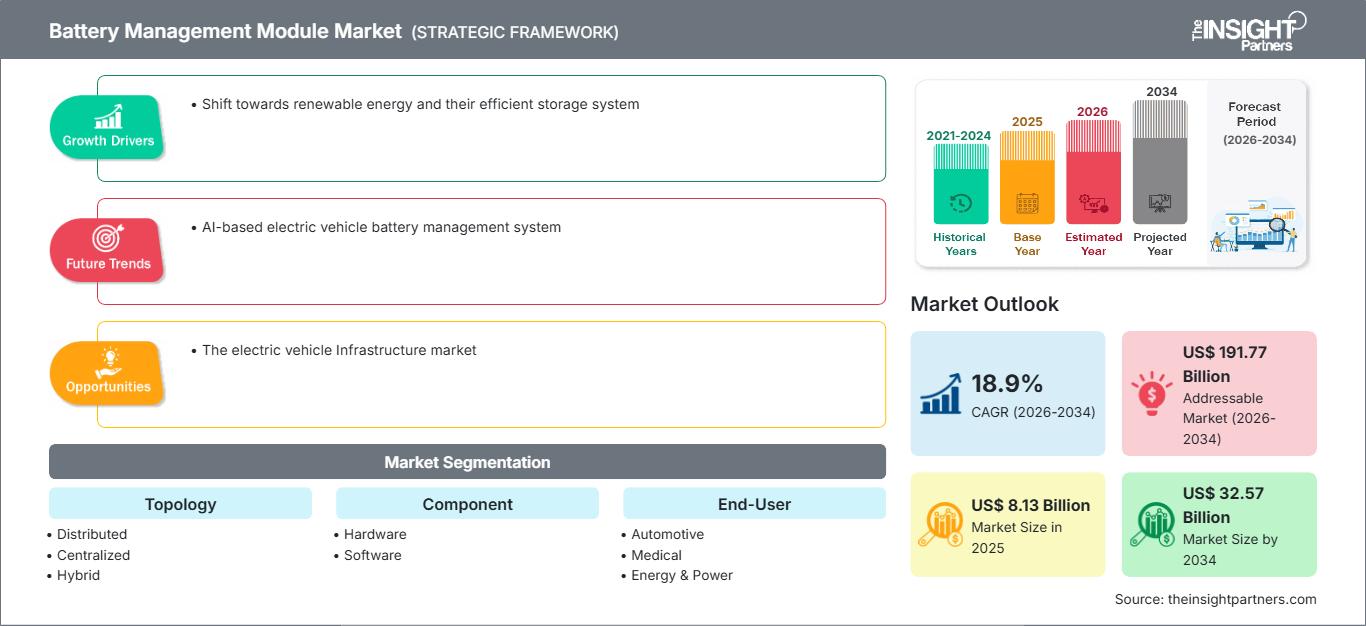
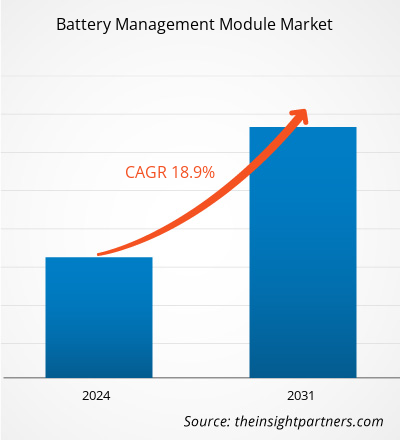
The Battery Management Module Market is gaining strategic importance as electrification expands across mobility, energy storage, and digital devices. The market is valued at US$ 11.49 Billion in 2025 and is projected to reach US$ 54.59 Billion by 2034, registering a CAGR of 18.9% during 2026–2034. Growth is underpinned by the increasing complexity of battery architectures and the need for precise monitoring, safety assurance, and lifecycle optimization across lithium-ion and next-generation chemistries.
North America represents a structurally strong region for the Battery Management Module Market, supported by an estimated CAGR of approximately 17.5% through 2034. Growth is driven by rapid electric vehicle (EV) adoption and grid-scale energy storage deployments. Additionally, regulatory emphasis on battery safety and domestic supply chain resilience is accelerating investments in advanced battery management systems across automotive and stationary storage applications.
Battery Management Module Market Assessment and Insights
- North America accounted for 32–36% share in 2025 and is growing at a CAGR of 16–19% during 2026–2034, supported by EV adoption and battery manufacturing expansion.
- US held 70–74% of North America in 2025 and is projected to grow at 16–18% CAGR due to EV ecosystem and energy storage deployment.
- Europe represented 24–28% share in 2025, growing at 17–20% CAGR, led by Germany, France, and the UK driven by decarbonization mandates.
- Asia Pacific dominated with 34–38% share in 2025 and is expanding at 19–22% CAGR, driven by China, Japan, and South Korea.
- Largest Segment Automotive held 42–46% share in 2025, growing at 18–21% CAGR due to EV proliferation.
- High Growth Segment Energy & Power is projected at 20–23% CAGR with 18–22% share in 2025 driven by grid storage systems.
- Key companies analyzed in detail: NXP Semiconductors N.V., Analog Devices, Inc., Johnson Matthey Plc, Texas Instruments Incorporated, Renesas Electronics Corporation, Nuvation Energy, Elithion Inc., L&T Technology Services Limited, Lithium Balance A/S, Leclanché SA, Infineon Technologies AG, Panasonic Holdings Corporation
Source: The Insight Partners' analysis based on proprietary research, government publications, company annual reports, investor presentations, industry databases, and expert interviews.
Battery management modules have evolved from basic voltage monitoring units into intelligent control systems embedded within complex energy ecosystems. The transition toward high-density battery packs and fast-charging capabilities has elevated the importance of thermal management, cell balancing, and predictive diagnostics. Market participants are increasingly focusing on modular architectures that allow scalability across vehicle platforms and energy storage systems.
The outlook remains strongly aligned with electrification and decentralization trends. As battery costs decline and deployment volumes increase, demand for advanced management modules will intensify across industries. Integration with digital platforms, edge computing, and remote diagnostics is expected to redefine value propositions, shifting the market toward software-centric differentiation alongside hardware innovation.
Battery Management Module Market Report Scope
| Report Attribute | Details |
|---|---|
| Market size in 2025 | US$ 11.49 Billion |
| Market Size by 2034 | US$ 54.59 Billion |
| Global CAGR (2026 - 2034) | 18.9% |
| Historical Data | 2021-2024 |
| Forecast period | 2026-2034 |
Battery Management Module Market Analysis
The Battery Management Module Market is shaped by a combination of technological, regulatory, and operational dynamics. Rising adoption of electric vehicles, renewable energy storage systems, and portable electronics is driving demand for efficient battery monitoring solutions. The value chain spans semiconductor providers, system integrators, software developers, and OEMs, creating a layered ecosystem where interoperability and reliability are critical.
Another key dynamic involves safety and compliance requirements, particularly in automotive and energy storage sectors. Manufacturers are investing in advanced sensing technologies and fail-safe mechanisms to prevent thermal runaway and extend battery life. This has led to increased collaboration between hardware and software providers to deliver integrated solutions that ensure both performance and safety.
The competitive landscape is characterized by a mix of semiconductor leaders and specialized system developers. Companies such as NXP Semiconductors N.V., Analog Devices, Inc., and Renesas Electronics Corporation are strengthening their portfolios with integrated circuits and reference designs. Meanwhile, firms like Nuvation and Elithion Inc are focusing on customizable battery management solutions tailored to niche applications.
Investment trends indicate growing interest in software-driven differentiation, particularly in predictive analytics and cloud-based battery monitoring. Strategic partnerships between technology providers and automotive OEMs are becoming more common, enabling faster innovation cycles. Companies are also exploring vertical integration strategies to gain control over both hardware and software layers of battery management systems.
● REPORT CUSTOMIZATION
Tailor This Report To Align With Your Specific Business Requirements
This report can be customized to align precisely with your business objectives, scope, and target markets. Customization options include tailored segmentation, geography, competitive analysis, and strategic insights to support informed decision-making.
Customize This Report →WHAT YOU CAN ADJUST
- ● Segmentations
- ● Geography
- ● Competitive Analysis
- ● Language Preferences
Battery Management Module Market: Strategic Insights
Regional Insights
North America Battery Management Module Market
The North America region accounted for 32–36% share in 2025 and is expected to grow at a CAGR of 16–19% through 2034. Strong EV adoption, particularly in the US and Canada, is driving demand for advanced battery management systems. Investments in domestic battery manufacturing facilities and grid-scale energy storage projects are further strengthening regional demand dynamics.
Technological innovation is a defining characteristic, with companies focusing on advanced battery diagnostics and safety systems. The presence of leading semiconductor and software firms enhances the region’s capability to develop integrated battery management solutions tailored for high-performance applications.
U.S. Battery Management Module Market
The US accounted for 70–74% of the North America market in 2025 and is projected to grow at a CAGR of 16–18% during the forecast period. Growth is driven by large-scale EV adoption, supported by federal incentives and infrastructure development. The presence of leading technology companies is further strengthening innovation capabilities in the market.
The presence of key players such as Texas Instruments Incorporated and Analog Devices, Inc. strengthens the domestic ecosystem. Applications are expanding beyond automotive into grid storage and industrial backup systems, where advanced battery management modules are essential for ensuring operational reliability and efficiency.
Europe Battery Management Module Market
Europe represents a mature yet evolving market, holding an estimated share of 25%–30% globally. The region is expected to grow at a CAGR of around 16.5%, supported by stringent emission regulations and aggressive electrification targets.
The market is characterized by strong collaboration between automotive OEMs and technology providers. Regulatory frameworks emphasizing battery recycling and lifecycle management are influencing the design of advanced battery management modules.
In the UK, the focus is on innovation and research-driven development, with increasing investments in battery technologies. Growth is supported by EV adoption and government-backed initiatives promoting clean energy systems.
Germany leads the European market due to its robust automotive industry and strong manufacturing base. Companies are investing heavily in next-generation battery technologies and integrated management systems to maintain global competitiveness.
France, Italy, and Spain are witnessing steady growth, driven by renewable energy integration and EV adoption. These countries are focusing on improving battery efficiency and safety through advanced management solutions.
APAC Battery Management Module Market
Asia Pacific dominated the market with 34–38% share in 2025 and is expected to grow at 19–22% CAGR. China remains the largest contributor due to its EV ecosystem and battery manufacturing capacity.
China leads the region due to its large-scale EV production and battery manufacturing capabilities. Government policies supporting electrification and energy storage are key growth drivers.
Japan and South Korea are focusing on technological innovation, particularly in high-performance battery systems. India and Australia are emerging markets, with increasing investments in renewable energy and electric mobility creating new opportunities for battery management solutions.
Middle East & Africa Battery Management Module Market
The Middle East & Africa region is gradually expanding in the Battery Management Module Market, with a projected CAGR of around 15%. Growth is driven by increasing investments in renewable energy and infrastructure development.
Saudi Arabia and the UAE are leading markets, supported by large-scale solar and energy storage projects. These countries are adopting advanced battery management systems to ensure efficiency and reliability.
South Africa is witnessing growing demand for battery storage solutions to address power supply challenges. The rest of the region is expected to see gradual adoption as energy infrastructure continues to evolve.
Segmentation Analysis
By Topology
- Distributed: Enables cell-level monitoring and enhanced fault detection, making it suitable for high-performance systems. It is widely adopted in electric vehicles and large-scale energy storage where accuracy and scalability are critical.
- Centralized: Provides a cost-efficient solution by consolidating control functions into a single unit. It is typically used in smaller battery systems where design simplicity and cost considerations outweigh scalability requirements.
- Hybrid: Combines features of distributed and centralized architectures, offering flexibility and improved performance. Increasingly adopted in complex applications requiring both scalability and cost optimization.
By Component
- Hardware: Includes sensors, controllers, and communication units forming the physical backbone of battery management systems. Advances in semiconductor design are improving accuracy, efficiency, and durability of hardware components.
- Software: Plays a growing role in enabling predictive analytics, real-time monitoring, and performance optimization. Software innovation is driving differentiation, particularly through AI-enabled battery diagnostics and lifecycle management.
By End-User
- Automotive: Dominates the market due to rapid EV adoption. Battery management modules are essential for ensuring battery safety, performance, and longevity in electric vehicles.
- Medical: Supports reliable operation of critical medical devices. Increasing adoption of portable and wearable healthcare technologies is driving demand for advanced battery management solutions.
- Energy & Power: Driven by renewable energy storage systems, this segment requires efficient battery monitoring for grid stability and energy optimization.
- Consumer Electronics: Growth is supported by widespread use of portable devices. Battery management modules enhance efficiency, safety, and user experience.
- IT & Telecom: Used in backup power systems for data centers and telecom infrastructure. Increasing digitalization is driving demand in this segment.
- Others: Includes aerospace, defense, and industrial sectors where reliability and precision are essential. These applications offer opportunities for specialized solutions.
Opportunity Snapshot
| End-User | Revenue Contribution | Trend Tag | Adoption Stage |
| Automotive | High | Electrification | Mature |
| Medical | Medium | Miniaturization | Scaling |
| Energy & Power | High | Grid Storage | Scaling |
| Consumer Electronics | Medium | Portability | Mature |
| IT & Telecom | Medium | Backup Power | Mature |
| Others | Low | Industrial Use | Emerging |
Battery Management Module Market Growth Drivers and Impact Analysis
Expansion of Electric Mobility Ecosystem
The rapid expansion of electric mobility is a primary driver of the Battery Management Module Market. As EV adoption accelerates globally, the need for efficient battery monitoring and control systems becomes critical. Battery management modules ensure optimal performance, safety, and longevity of battery packs, which are central to EV functionality. Increasing battery capacities and fast-charging requirements further amplify the need for advanced modules capable of real-time monitoring and predictive diagnostics.
This trend has significant market implications, as automotive OEMs increasingly integrate sophisticated battery management systems into their platforms. Companies such as NXP Semiconductors N.V. and Renesas Electronics Corporation are developing advanced semiconductor solutions to support these requirements. The impact extends beyond passenger vehicles to commercial fleets and electric buses, creating a broad demand base and accelerating innovation across the ecosystem.
Growth of Renewable Energy Storage Systems
The integration of renewable energy sources into power grids is driving demand for energy storage systems, thereby boosting the Battery Management Module Market. Solar and wind energy require efficient storage solutions to manage intermittency, and battery management modules play a critical role in ensuring reliability and efficiency.
This driver is particularly impactful in regions investing heavily in grid modernization and energy transition initiatives. Companies like Leclanche and Lithium Balance are focusing on solutions tailored for large-scale storage applications. The market impact includes increased adoption of modular battery systems and the development of advanced analytics for energy optimization, positioning battery management modules as a core component of future energy infrastructure.
Advancements in Battery Technologies
Ongoing advancements in battery chemistries, including solid-state and high-density lithium-ion batteries, are creating new requirements for battery management systems. These technologies demand precise monitoring and control to ensure safety and performance, driving innovation in battery management modules.
The market impact is reflected in increased R&D investments and the development of next-generation solutions. Companies such as Analog Devices, Inc. and Texas Instruments Incorporated are introducing advanced integrated circuits and software platforms to support evolving battery technologies. This driver is expected to enhance system efficiency and open new application areas, further expanding the market.
Battery Management Module Market Future Trends
Integration of AI and Predictive Analytics
The integration of artificial intelligence and predictive analytics is transforming the Battery Management Module Market. Advanced algorithms enable real-time monitoring, fault detection, and predictive maintenance, significantly improving battery performance and lifespan. These capabilities are becoming essential as battery systems grow more complex and are deployed in critical applications.
Looking ahead, AI-driven battery management systems are expected to become standard across industries. Companies are investing in cloud-connected platforms that enable remote monitoring and data-driven decision-making. This trend will enhance operational efficiency and create new revenue streams through software-based services, shifting the market toward a more digital and service-oriented model.
Shift Toward Modular and Scalable Architectures
Modular and scalable architectures are emerging as a key trend in the Battery Management Module Market. These designs allow manufacturers to adapt battery systems for different applications without significant redesign, improving flexibility and cost efficiency.
Future developments will likely focus on standardization and interoperability, enabling seamless integration across platforms. This trend is particularly relevant for automotive and energy storage applications, where scalability is critical. Companies such as Nuvation and Elithion Inc are actively developing modular solutions, positioning themselves to capitalize on this evolving market demand.
Battery Management Module Market Opportunities
Emerging Markets in Energy Storage Deployment
Emerging markets present significant opportunities for the Battery Management Module Market, particularly in regions investing in renewable energy and grid infrastructure. Countries in Asia-Pacific, the Middle East, and Africa are increasingly adopting energy storage systems to support energy transition goals.
This creates opportunities for companies to develop cost-effective and scalable battery management solutions tailored to local requirements. Investment in localized manufacturing and partnerships with regional stakeholders can enhance market penetration. The opportunity extends to both utility-scale projects and distributed energy systems, offering diverse growth avenues.
Expansion into Non-Automotive Applications
While automotive remains the dominant segment, expanding into non-automotive applications offers substantial growth potential. Industries such as medical devices, industrial automation, and telecom infrastructure require reliable battery management systems for critical operations.
Companies can leverage their expertise to develop specialized solutions for these sectors, addressing unique requirements such as compact design, high reliability, and regulatory compliance. This diversification strategy can reduce dependence on the automotive sector and create new revenue streams, strengthening long-term market positioning.
Frequently Asked Questions

- Comprehensive Market Sizing and Forecast Analysis
- Detailed Segmentation Analysis
- In-Depth Market Dynamics Assessment
- Regional and Country-Level Insights
- Competitive Landscape and Company Benchmarking
- Strategic Business Intelligence
Recent Reports
Testimonials

The Insight Partners' SCADA System Market report is comprehensive, with valuable insights on current trends and future forecasts. The team was highly professional, responsive, and supportive throughout. We are very satisfied and highly recommend their services.
RAN KEDEM Partner, Reali Technologies LTDs
I requested a report on a very specific software market and the team produced the report in a few days. The information was very relevant and well presented. I then requested some changes and additions to the report. The team was again very responsive and I got the final report in less than a week.
JEAN-HERVE JENN Chairman, Future Analytica
We worked with The Insight Partners for an important market study and forecast. They gave us clear insights into opportunities and risks, which helped shape our plans. Their research was easy to use and based on solid data. It helped us make smart, confident decisions. We highly recommend them.
PIYUSH NAGPAL Sr. Vice President, High Beam Global
The Insight Partners delivered insightful, well-structured market research with strong domain expertise. Their team was professional and responsive throughout. The user-friendly website made accessing industry reports seamless. We highly recommend them for reliable, high-quality research services
YUKIHIKO ADACHI CEO, Deep Blue, LLC.
This is the first time I have purchased a market report from The Insight Partners.While I was unsure at first, I visited their web site and felt more comfortable to take the risk and purchase a market report.I am completely satisfied with the quality of the report and customer service. I had several questions and comments with the initial report, but after a couple of dialogs over email with their analyst I believe I have a report that I can use as input to our strategic planning process.Thank you so much for taking the extra time and making this a positive experience.I will definitely recommend your service to others and you will be my first call when we need further market data.
JOHN SUZUKI President and Chief Executive Officer, Board Director, BK Technologies
I wish to appreciate your support and the professionalism you displayed in the course of attending to my request for information regarding to infectious disease IVD market in Nigeria. I appreciate your patience, your guidance, and the fact that you were willing to offer a discount, which eventually made it possible for us to close a deal. I look forward to engaging The Insight Partners in the future, all thanks to the impression you have created in me as a result of this first encounter.
DR CHIJIOKE ONYIA MANAGING DIRECTOR, PineCrest Healthcare Ltd.Reason to Buy
- Informed Decision-Making
- Understanding Market Dynamics
- Competitive Analysis
- Identifying Emerging Markets
- Customer Insights
- Market Forecasts
- Risk Mitigation
- Boosting Operational Efficiency
- Strategic Planning
- Investment Justification
- Tracking Industry Innovations
- Aligning with Regulatory Trends





 Get Free Sample for