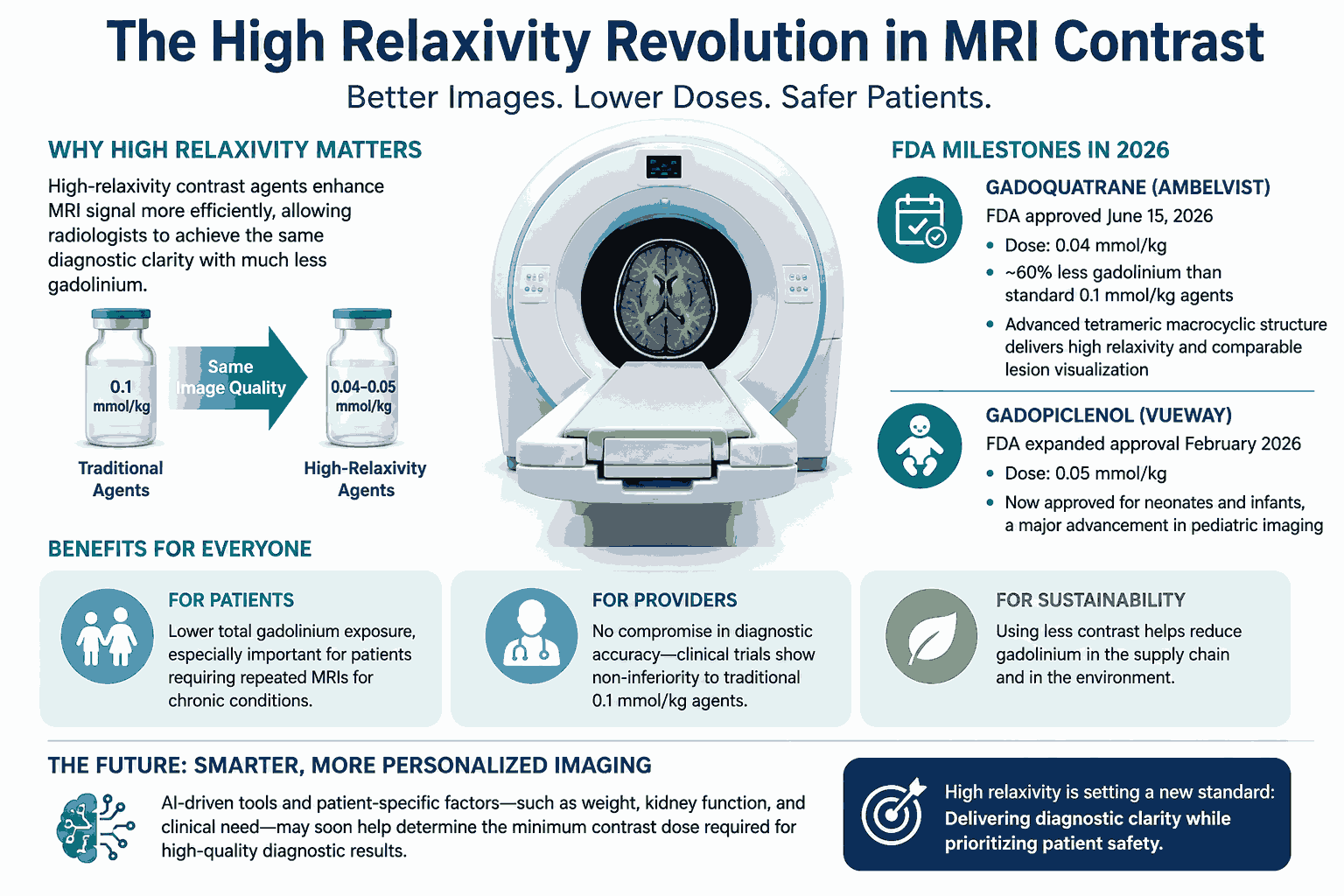
For years, radiologists have faced a difficult challenge: delivering the clearest possible MRI images while limiting a patient’s exposure to gadolinium-based contrast agents. The goal has always been to strike the right balance between diagnostic accuracy and long-term patient safety. Today, thanks to major advances in contrast agent technology, the industry may be entering a new era—one where exceptional image quality and lower gadolinium doses can coexist.
At the center of this transformation is a concept known as high relaxivity.
MRI Contrast Media Market Poised for Robust Growth (2026-20234)
The MRI contrast media market is witnessing steady growth as healthcare providers increasingly adopt advanced, high-relaxivity contrast agents that deliver superior diagnostic performance while reducing gadolinium exposure. Rising demand for early and accurate disease diagnosis, expanding MRI utilization across oncology, neurology, and cardiovascular imaging, along with continuous regulatory approvals for next-generation low-dose contrast agents, are fueling market expansion. As a result, the MRI contrast media market is projected to grow from US$ 578.03 million in 2025 to US$ 1,163.91 million by 2034, registering a CAGR of 8.1% during 2026–2034. This growth reflects the industry's ongoing shift toward safer, more efficient imaging solutions that improve patient outcomes while supporting sustainable healthcare practices.
Why High Relaxivity Matters
To appreciate the significance of recent developments, it helps to understand how MRI contrast agents work. Gadolinium-based contrast agents (GBCAs) improve image clarity by influencing the magnetic behavior of water molecules in the body. The efficiency with which an agent enhances MRI signals is measured by its relaxivity.
Traditional contrast agents typically required a dose of 0.1 mmol/kg to produce enough signal enhancement for reliable lesion detection. Because these agents had relatively lower relaxivity, a larger amount of gadolinium was necessary to achieve the desired image brightness.
High-relaxivity agents are changing that equation. Since they are significantly more efficient at enhancing MRI signals, they can deliver comparable diagnostic performance using much smaller amounts of gadolinium. This breakthrough is paving the way for a new generation of low-dose contrast agents.
Recent FDA Milestones Shaping the Market
The first half of 2026 has brought notable progress, with several key regulatory approvals highlighting the industry's shift toward more efficient, macrocyclic contrast agents.
Gadoquatrane (Ambelvist)
One of the most significant milestones came on June 15, 2026, when the FDA approved Bayer’s Ambelvist (gadoquatrane).
What makes this approval particularly noteworthy is the dramatically reduced dosage requirement. Gadoquatrane is administered at 0.04 mmol/kg, representing approximately 60% less gadolinium than conventional 0.1 mmol/kg agents.
Its innovative tetrameric macrocyclic structure enables exceptionally high relaxivity, allowing radiologists to achieve lesion visualization comparable to older contrast agents while using a substantially lower gadolinium dose.
Gadopiclenol (Vueway)
Before gadoquatrane entered the market, gadopiclenol had already established itself as a leading low-dose contrast option, demonstrating strong performance at 0.05 mmol/kg.
A major development occurred in February 2026 when the FDA expanded its approval to include neonates and infants. This was particularly important for pediatric imaging, where minimizing cumulative gadolinium exposure is a critical consideration. The expanded indication provides healthcare providers with a lower-dose option for some of the most vulnerable patient populations.
What These Advances Mean for Patients and Providers
The shift toward high-relaxivity agents represents far more than the introduction of new products. It reflects the medical community’s ongoing commitment to addressing concerns about gadolinium retention in the body.
Research over the past decade has shown that small amounts of gadolinium can remain in tissues such as the brain and bones long after an MRI examination. As a result, healthcare providers have increasingly focused on using the lowest effective contrast dose needed to achieve diagnostic-quality images.
High-relaxivity agents help support that objective while maintaining clinical performance.
For patients, lower gadolinium exposure is especially valuable for individuals who require repeated MRI scans, such as those living with multiple sclerosis, cancer, or other chronic conditions that demand ongoing monitoring.
For healthcare providers, these agents offer confidence that reducing the contrast dose does not mean compromising image quality. Clinical studies, including the Phase 3 QUANTI program evaluating gadoquatrane, have demonstrated diagnostic performance comparable to the traditional 0.1 mmol/kg standard.
For the environment, lower contrast utilization may also contribute to sustainability efforts by reducing the amount of gadolinium entering manufacturing processes and eventually reaching wastewater systems.
Looking Ahead
The future of MRI contrast imaging is moving beyond the traditional one-size-fits-all approach. As high-relaxivity agents become more widely adopted, the next phase of innovation may involve AI-assisted personalized dosing strategies.
Imagine MRI systems capable of analyzing factors such as a patient’s body weight, kidney function, and specific clinical indication to recommend the minimum contrast dose needed for a diagnostic-quality scan. Such advancements could further optimize patient safety while preserving diagnostic confidence.
The high-relaxivity era is no longer a future concept—it is becoming the new standard. By improving efficiency and reducing unnecessary exposure, the latest generation of contrast agents is helping healthcare providers deliver better imaging outcomes while taking a more thoughtful approach to patient care.
.png)
.png)
.png)
.png)
.png)
.jpg)
.png)
.png)