
MRI Contrast Media Market Size, Share & Forecast by 2034
Coverage: By Type [Paramagnetic (Gadobutrol, Gadoterate, Gadoteridol, Gadopiclenol, Gadobenate, Gadoxetate, and Others), Super Paramagnetic (Ferucarbotran, Ferumoxytol, and Others)], Route of Administration (Intra-articular, Oral and IV, and Others), Application {Magnetic Resonance Arthrography (MRA) [Shoulder, Hip, Knee, Wrist, and Ankle], Magnetic Resonance Cholangiopancreatography (MRCP), Magnetic Resonance Lymphangiography (MRL) [Lymphoscintigraphy, Indocyanine Green (ICG) Lymphography, and Others]}, Indication [Magnetic Resonance Arthrography (Rotator Cuff Tears, Shoulder Instability, Labral Tears, Post-surgical Evaluation, and Others), Magnetic Resonance Cholangiopancreatography (Lymphedema, Post-oncology lymphedema, Lymphatic Malformations, Chylothorax / Lymphatic Leakage, and Others), Magnetic Resonance Lymphangiography (Gallstones, Bile Duct Obstruction, Acute Pancreatitis, Pancreatic Tumors, Post-Surgical Biliary Complications, and Others), End User (Hospital and Clinics, Diagnostic and Imaging Centers, Research Institutes, and Others), and Geography (North America, Europe, Asia Pacific, and the Rest of World)
- Status : Published
- Report Code : TIPRE00043445
- Category : Life Sciences
- No. of Pages : 432
- Available Report Formats :


- Last update date : June 22, 2026


2025 Market Size
US$ 578.03 Mn
Base year value
2034 Forecast
US$ 1,163.91 Mn
Projected by 2034
CAGR 2026-2034
8.1 %
Growth rate
Addressable Market
US$ 7,835.51 Mn
(2026-2034)
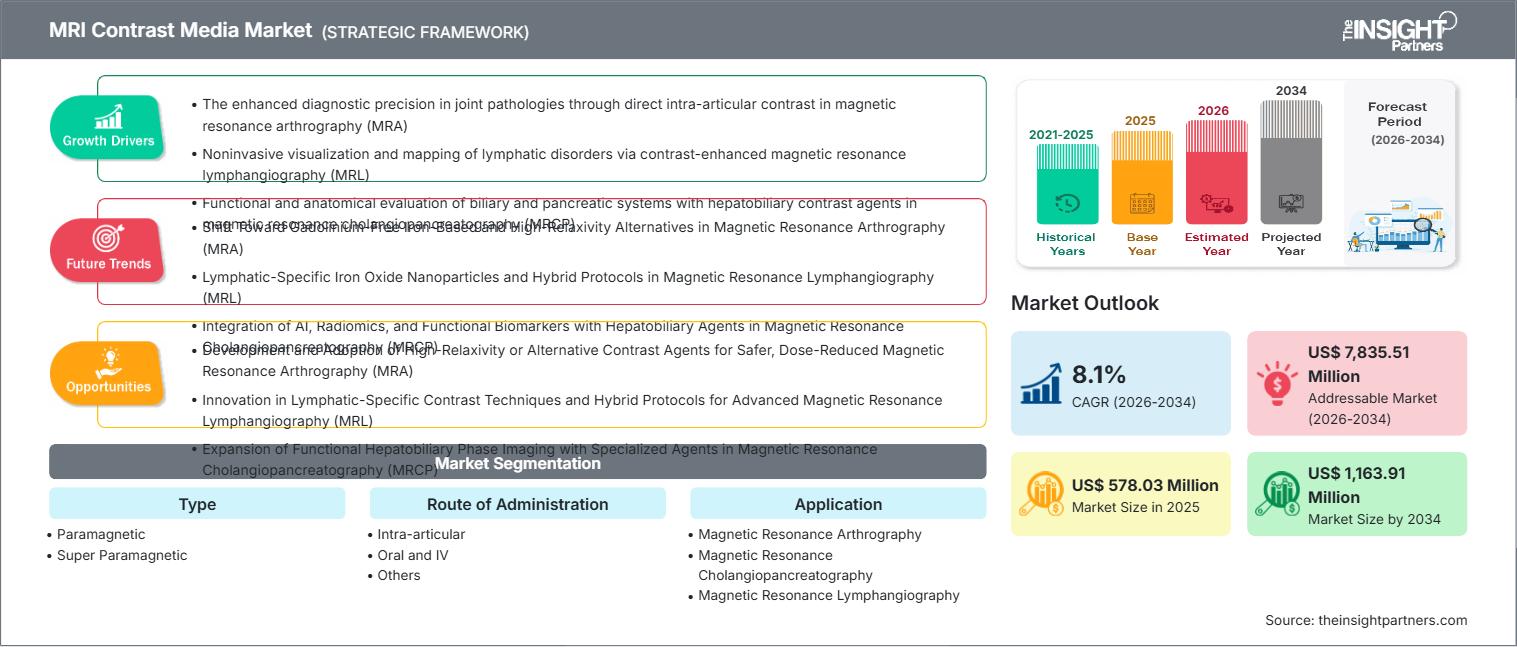
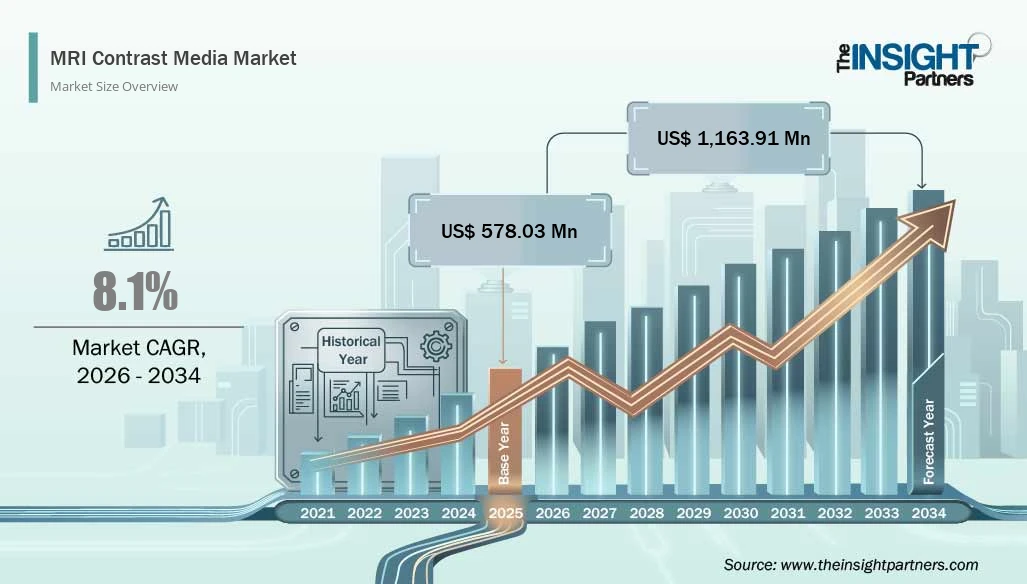
The MRI contrast media market size is projected to reach US$ 1,163.91 million by 2034 from US$ 578.03 million in 2025. The market is expected to register a CAGR of 8.1% during 2026–2034.
MRI Contrast Media Market Analysis
The MRI contrast media market is expanding as demand rises for more precise, less invasive diagnostic imaging across multiple clinical applications. In magnetic resonance arthrography (MRA), direct intra-articular contrast improves the detection of joint disorders such as labral tears, cartilage damage, and ligament injuries, supporting more accurate diagnosis and treatment planning. In magnetic resonance lymphangiography (MRL), contrast-enhanced imaging enables clear, noninvasive visualization of lymphatic vessels and related disorders, improving disease mapping and clinical decision-making. In magnetic resonance cholangiopancreatography (MRCP), hepatobiliary contrast agents enhance both functional and anatomical assessment of the biliary and pancreatic systems, helping clinicians identify leaks, strictures, stones, and other abnormalities. In addition, the development of high-relaxivity, alternative, and lower-dose contrast agents is creating new growth opportunities by improving safety, broadening clinical use, and supporting innovation in advanced MRI procedures.
MRI Contrast Media Market Overview
The MRI contrast media market is being driven by growing demand for advanced diagnostic imaging, the rising prevalence of chronic diseases, and the increasing preference for minimally invasive diagnostic procedures. As healthcare providers seek more accurate and efficient imaging solutions, contrast-enhanced MRI continues to gain importance across a wide range of clinical settings. Technological developments, including high-performance MRI systems, the integration of artificial intelligence into imaging workflows, and the availability of portable MRI units, are significantly improving diagnostic precision and operational efficiency. These innovations are helping clinicians detect abnormalities earlier and make more informed treatment decisions. In addition, the expansion of healthcare infrastructure worldwide, particularly in emerging markets, is increasing access to MRI services and supporting broader adoption of contrast media. Together, these factors are strengthening market growth and creating favorable conditions for continued advancement in MRI-based diagnostics.
Market Assessment and Insights
- North America dominated the market with 46.1% share in 2025.
- Asia Pacific is poised to grow at a CAGR of 8.6% over the forecast period.
- United States market is projected to grow at a CAGR of 8.1% over the forecast period.
- By Type, the Paramagnetic segment accounted for the largest market share of 97.2% in 2025.
- By Paramagnetic, the Gadobutrol segment is anticipated to witness the fastest growth, registering a CAGR of 8.6% over the forecast period
- By Super Paramagnetic, the Ferumoxytol segment accounted for the largest market share of 79.4% in 2025.
- By Route Of Administration, the Intra-articular segment is anticipated to witness the fastest growth, registering a CAGR of 8.3% over the forecast period
- By Application, the Magnetic Resonance Arthrography (MRA) segment accounted for the largest market share of 94.8% in 2025.
- By Magnetic Resonance Arthrography (MRA), the Shoulder segment is anticipated to witness the fastest growth, registering a CAGR of 8.6% over the forecast period
- By Shoulder, the Labrum (SLAP Lesions) segment accounted for the largest market share of 45.7% in 2025.
- By Magnetic Resonance Lymphangiography (MRL), the Indocyanine Green (ICG) Lymphography segment is anticipated to witness the fastest growth, registering a CAGR of 4.8% over the forecast period
- By Indication, the Magnetic Resonance Arthrography segment accounted for the largest market share of 94.8% in 2025.
- By Magnetic Resonance Arthrography, the Rotator Cuff Tears segment is anticipated to witness the fastest growth, registering a CAGR of 8.7% over the forecast period
- By Magnetic Resonance Lymphangiography, the Lymphedema segment accounted for the largest market share of 46% in 2025.
- By Magnetic Resonance Cholangiopancreatography, the Gallstones segment is anticipated to witness the fastest growth, registering a CAGR of 7.6% over the forecast period
- By End User, the Hospital and Clinics segment accounted for the largest market share of 59.8% in 2025.
- The report profiles key industry players such as Bayer AG, GE HealthCare Technologies Inc, Bracco Imaging S.p.A, Guerbet SA, JB Pharma, BioPAL, Inc., Subhra Pharma Pvt Ltd, SANOCHEMIA Pharmazeutika GmbH, Beijing Beilu Pharmaceutical Co., Ltd., Azurity Pharmaceuticals, Inc., while also analyzing key developments in novel ideas, disruptive products, and innovative services that could reshape the future market and reveal emerging themes across the industry.
Source: The Insight Partners' analysis based on proprietary research, government publications, company annual reports, investor presentations, industry databases, and expert interviews.
● REPORT CUSTOMIZATION
Tailor This Report To Align With Your Specific Business Requirements
This report can be customized to align precisely with your business objectives, scope, and target markets. Customization options include tailored segmentation, geography, competitive analysis, and strategic insights to support informed decision-making.
Customize This Report →WHAT YOU CAN ADJUST
- ● Segmentations
- ● Geography
- ● Competitive Analysis
- ● Language Preferences
MRI Contrast Media Market: Strategic Insights
-
Get Top Key Market Trends of this report.This FREE sample will include data analysis, ranging from market trends to estimates and forecasts.
MRI Contrast Media Market Drivers and Opportunities
Market Drivers:
- Enhanced Diagnostic Precision in Magnetic Resonance Arthrography (MRA): Magnetic resonance arthrography (MRA) enhances the ability to obtain images of the joints via intra-articular gadolinium contrast enhancement, which allows for highly accurate identification of labral tears, cartilage defects, and ligament injuries and will be pivotal in pre-operative planning and decreasing reliance on invasive diagnostic arthroscopy.
- Noninvasive Visualization in Magnetic Resonance Lymphangiography (MRL): Using gadolinium-based agents, contrast-enhanced magnetic resonance lymphangiography provides superior visualization of lymphatic vessels and lymphatic disorders, allowing for accurate diagnosis and pre-operative planning and monitoring of treatment of lymphedema, developmental abnormalities, and conditions resulting from lymphatic leaks.
- Functional Assessment in Magnetic Resonance Cholangiopancreatography (MRCP): The introduction of hepatobiliary contrast agents has enhanced the use of MRCP by providing both functional and anatomical imaging of the biliary and pancreatic systems, which allows for the accurate diagnosis of leaks, strictures, stones, and neoplasms, while reducing the need for invasive diagnostic tests.
Market Opportunities:
- Safer Dose-Reduced Contrast Agents for Magnetic Resonance Arthrography (MRA): Non-gadolinium-based high-relaxivity contrast agents help in performing magnetic resonance arthrography using lower doses of contrast material with diagnostic accuracy, resulting in expanded potential uses in pediatrics, shallower repeat imaging, sports medicine, and orthopedic surgical planning.
- Advanced Lymphatic Imaging through Hybrid Contrast Techniques in MRL: Innovative lymphatic-specific contrast agents coupled with advanced hybrid imaging protocols will produce better images of lymphatic disorders, allow for accurate mapping of the lymphatic system, assist in planning surgical interventions, and support the use of magnetic resonance lymphangiography in clinical uses without radiation.
- Functional Hepatobiliary Imaging Expansion in Contrast-Enhanced MRCP: Hepatobiliary-specific contrast agents will enhance functional MRCP by making it easier to evaluate biliary and pancreatic disease, decreasing the need for invasive procedures, and better supporting the quantification of liver assessment through a comprehensive, patient-friendly diagnostic imaging workflow.
MRI Contrast Media Market Report Segmentation Analysis
The MRI contrast media market is segmented into distinct categories to provide a clearer understanding of its operations, growth potential, and current trends. Below is the standard segmentation approach used in industry reports:
By Type:
- Paramagnetic By enhancing visualization in the areas (arthrography, lymphangiography, MRCP) with the help of gadolinium-based paramagnetic contrast agents, advanced MRI applications of this noninvasive medical imaging technique will allow the physician to improve their ability to conduct functional imaging, perform accurate diagnoses, plan for surgery, and assess musculoskeletal disorders, lymphatic disorders, and/or hepatobiliary disorders more accurately than previously.
- Super Paramagnetic Superparamagnetic iron oxide contrast agents are more secure than gadolinium-based agents and allow for repeatable high-resolution MRI of the joints, lymphatics, and certain liver imaging, and reduce the amount of time and safety issues associated with long-term retention.
By Route of Administration:
- Intra-articular
- Oral and IV
- Others
By Application:
- Magnetic Resonance Arthrography (MRA)
- Magnetic Resonance Cholangiopancreatography (MRCP)
- Magnetic Resonance Lymphangiography (MRL)
By Indication:
- Magnetic Resonance Arthrography
- Magnetic Resonance Cholangiopancreatography
- Magnetic Resonance Lymphangiography
By End User:
- Hospital and Clinics
- Diagnostic and Imaging Centers
- Research Institutes
- Others
By Geography:
- North America
- Europe
- Asia Pacific
- Rest of World
MRI Contrast Media Market Report Scope
| Report Attribute | Details |
|---|---|
| Market size in 2025 | US$ 578.03 Million |
| Market Size by 2034 | US$ 1,163.91 Million |
| Global CAGR (2026 - 2034) | 8.1% |
| Historical Data | 2021-2024 |
| Forecast period | 2026-2034 |
| Segments Covered |
By Type
|
| Regions and Countries Covered |
North America
|
| Market leaders and key company profiles |
|
MRI Contrast Media Market Players Density: Understanding Its Impact on Business Dynamics
The MRI Contrast Media Market is growing rapidly, driven by increasing end-user demand due to factors such as evolving consumer preferences, technological advancements, and greater awareness of the product's benefits. As demand rises, businesses are expanding their offerings, innovating to meet consumer needs, and capitalizing on emerging trends, which further fuels market growth.
MRI Contrast Media Market Share Analysis by Geography
The market is expected to grow at the fastest rate in APAC. Emerging markets in the Rest of World have untapped opportunities for MRI contrast media to expand.
The growth of the MRI contrast media market varies across regions due to increasing prevalence of various conditions, expanding healthcare infrastructure, and the adoption of advanced medical technologies. Below is a summary of market share and trends by region:
1. North America
- Market Share: Holds a significant portion of the global market
- Key Drivers: Increasing neurological, cardiovascular, and cancer-related disorders are stimulating the demand for additive MRI procedures.
- Trends: Increased use of macrocyclic gadolinium-based agents and AI-imaging technologies within diagnostic imaging centers.
2. Europe
- Market Share: Substantial market share
- Key Drivers: Strong focus on early disease diagnosis and providing for the patient safety through regulations is promoting the use of MRI contrast agents in diagnostic testing.
- Trends: Progression toward the use of low-dose, safe MRI contrast agents
3. Asia Pacific
- Market Share: Fastest-growing region with an annually increasing market share
- Key Drivers: Acquiring advanced imaging systems is driving market development at a fast pace, due to the rate of growth of the infrastructure for healthcare
- Trends: Increasing installations of high-field MRI scanners provide an opportunity for contrast imaging.
4. Rest of World
- Market Share: Steadily growing market share
- Key Drivers: Increasing healthcare Investments and surging public awareness for early detection imaging, increasing the use of MRI contrast media
- Trends: The growth of private diagnostic imaging facilities is leading to the gradual adoption of MRI technologies by developing regions
High Market Density and Competition
Competition is strong due to the presence of established players such as GE HealthCare Technologies Inc, Bayer AG, Bracco Imaging S.p.A, and Guerbet SA. Regional and niche providers add to the competitive landscape across regions.
The high level of competition urges companies to stand out by offering:
- Advanced products and services
- Compliance with regulatory guidelines
Opportunities and Strategic Moves
- The development of alternative methods of contrast, the expansion of emerging markets, and the increased demand for accurate imaging for oncology/neuro/musculoskeletal disorders, as well as the development of AI-based diagnostic imaging.
- Investing in safer contrast agents, working with MRI manufacturers to create partnerships, expanding into developing countries, advancing research and development of iron oxide and macrocyclic contrast agents, and obtaining regulatory approval.
Other companies analyzed during the course of research:
- Siemens Healthineers
- Mallinckrodt Pharmaceuticals
- Daiichi Sankyo Company, Ltd.
- Sanofi
- Eisai Co., Ltd.
- Spago Nanomedical AB
- Advanced Accelerator Applications (Novartis)
- Taejoon Pharm Co., Ltd.
- Yantai Luyin Pharmaceutical Co., Ltd.
- Jiangsu Hengrui Pharmaceuticals
- Hovione
- NanoPET Pharma GmbH
- NanoPharmaceutics LLC
- Nanobiotix S.A.
- Ferroport Systems
- Agfa-Gevaert Group
- Fujifilm Holdings Corporation
- Hitachi Ltd.
- Canon Medical Systems Corporation
- Seno Medical Instruments
- Claris Lifesciences
- Unijules Life Sciences Ltd.
- LBS (Laboratoire de Biopharmacie Spécialisée)
- Resonance Health Ltd.
- Nanomab Corporation
- NanoTherm GmbH
- Meito Sangyo Co., Ltd.
- Taiyo Nippon Sanso Corporation
- Navidea Biopharmaceuticals
- PHARMALEX GmbH
MRI Contrast Media Market News and Recent Developments
- In February 2026, Guerbet received approval from the U.S. Food and Drug Administration (FDA) to expand the label for its Elucirem (gadopiclenol) gadolinium-based contrast agent to include pediatric patients age 2 and younger, including term neonates.
- In May 2026, Beilu Pharma received the Notice of Approval for Marketing Application of Chemical API for Gadobutrol, issued by the National Medical Products Administration (NMPA). The approval of the Gadobutrol API indicates that it has met the relevant national technical evaluation standards. Upon compliance with Good Manufacturing Practice (GMP) requirements, it can be manufactured and sold in the domestic market and utilized in the production of related gadolinium-based contrast media.
MRI Contrast Media Market Report Coverage and Deliverables
The "MRI Contrast Media Market Size and Forecast (2021–2034)" report provides a detailed analysis of the market covering below areas:
- Market size and forecast at global, regional, and country levels for all the key market segments covered under the scope
- Market trends, as well as market dynamics such as drivers, restraints, and opportunities
- Detailed PEST and SWOT analysis
- Market analysis covering key trends, global and regional framework, major players, regulations, and recent market developments
- Industry landscape and competition analysis covering market concentration, heat map analysis, prominent players, and recent developments for the MRI contrast media market
- Detailed company profiles
Frequently Asked Questions

- Comprehensive Market Sizing and Forecast Analysis
- Detailed Segmentation Analysis
- In-Depth Market Dynamics Assessment
- Regional and Country-Level Insights
- Competitive Landscape and Company Benchmarking
- Strategic Business Intelligence
Recent Reports
Testimonials

The Insight Partners' SCADA System Market report is comprehensive, with valuable insights on current trends and future forecasts. The team was highly professional, responsive, and supportive throughout. We are very satisfied and highly recommend their services.
RAN KEDEM Partner, Reali Technologies LTDs
I requested a report on a very specific software market and the team produced the report in a few days. The information was very relevant and well presented. I then requested some changes and additions to the report. The team was again very responsive and I got the final report in less than a week.
JEAN-HERVE JENN Chairman, Future Analytica
We worked with The Insight Partners for an important market study and forecast. They gave us clear insights into opportunities and risks, which helped shape our plans. Their research was easy to use and based on solid data. It helped us make smart, confident decisions. We highly recommend them.
PIYUSH NAGPAL Sr. Vice President, High Beam Global
The Insight Partners delivered insightful, well-structured market research with strong domain expertise. Their team was professional and responsive throughout. The user-friendly website made accessing industry reports seamless. We highly recommend them for reliable, high-quality research services
YUKIHIKO ADACHI CEO, Deep Blue, LLC.
This is the first time I have purchased a market report from The Insight Partners.While I was unsure at first, I visited their web site and felt more comfortable to take the risk and purchase a market report.I am completely satisfied with the quality of the report and customer service. I had several questions and comments with the initial report, but after a couple of dialogs over email with their analyst I believe I have a report that I can use as input to our strategic planning process.Thank you so much for taking the extra time and making this a positive experience.I will definitely recommend your service to others and you will be my first call when we need further market data.
JOHN SUZUKI President and Chief Executive Officer, Board Director, BK Technologies
I wish to appreciate your support and the professionalism you displayed in the course of attending to my request for information regarding to infectious disease IVD market in Nigeria. I appreciate your patience, your guidance, and the fact that you were willing to offer a discount, which eventually made it possible for us to close a deal. I look forward to engaging The Insight Partners in the future, all thanks to the impression you have created in me as a result of this first encounter.
DR CHIJIOKE ONYIA MANAGING DIRECTOR, PineCrest Healthcare Ltd.Reason to Buy
- Informed Decision-Making
- Understanding Market Dynamics
- Competitive Analysis
- Identifying Emerging Markets
- Customer Insights
- Market Forecasts
- Risk Mitigation
- Boosting Operational Efficiency
- Strategic Planning
- Investment Justification
- Tracking Industry Innovations
- Aligning with Regulatory Trends





 Get Free Sample for