For centuries, the story of shipbuilding was written in wood, iron, and steel. But as we look toward the next decade of maritime engineering, a profound material shift is taking place below and above the waterline. Faced with aggressive climate targets, soaring fuel costs, and the relentless erosive power of saltwater, shipbuilders are moving away from traditional metals.
Instead, they are turning to advanced composite materials.
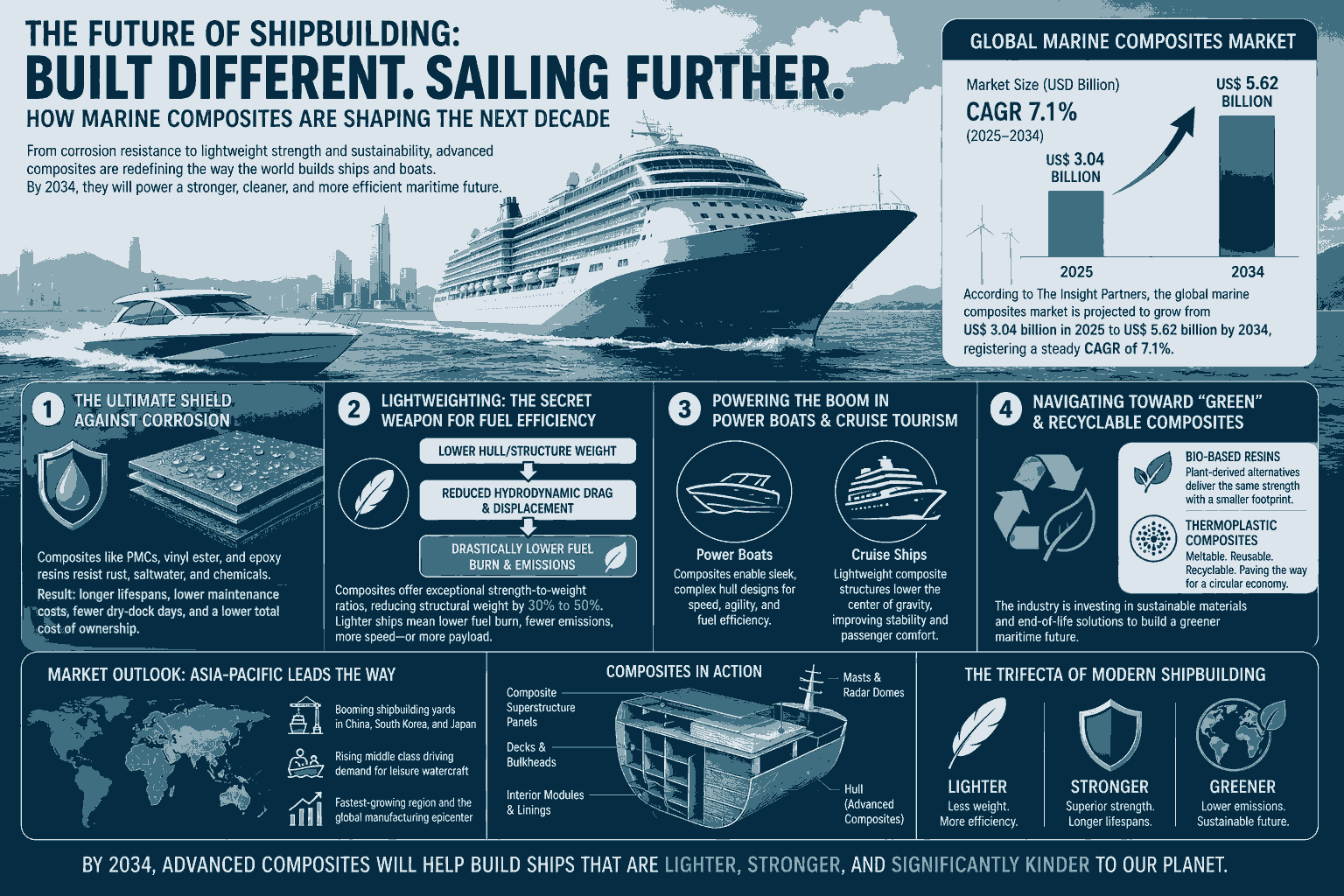
According to data from The Insight Partners, the global marine composites market size is projected to climb from US$ 3.04 billion in 2025 to US$ 5.62 billion by 2034. Registering a steady compound annual growth rate (CAGR) of 7.1%, this market is doing far more than growing in financial value—it is actively redefining the structural limits, efficiency, and lifespans of modern vessels.
Here is a deep dive into how marine composites are transforming shipbuilding as we approach 2034.
1. The Ultimate Shield Against Corrosion
The harshest enemy of any ocean-going vessel is the marine environment itself. Saltwater, humidity, and constant exposure to oxygen cause steel and aluminum hulls to rust and degrade rapidly. Keeping a metal ship seaworthy requires an exhausting, continuous loop of dry-docking, sandblasting, and toxic anti-corrosion painting.
Composites present a radically different reality. Materials like Polymer Matrix Composites (PMCs), utilized alongside specialized vinyl ester and epoxy resins, inherently resist galvanic corrosion and chemical degradation.
By building complex components, and even entire hulls—out of marine composites, shipbuilders are engineering vessels with vastly superior lifespans. For ship owners, this translates directly to slashed maintenance costs, fewer days lost to dry-dock repairs, and a significantly lower total cost of ownership across a fleet.
2. Lightweighting: The Secret Weapon for Fuel Efficiency
The international shipping and maritime tourism sectors are under intense pressure to decarbonize. Marine transport is responsible for a significant share of global emissions, and regulatory bodies are strictly enforcing tighter carbon caps.
To burn less fuel, a vessel must become more efficient. While engine innovations help, reducing the weight of the vessel itself yields immediate, compounding benefits.
[ Lower Hull/Structure Weight ]
             │
             ▼
[ Reduced Hydrodynamic Drag & Displacement ]
             │
             ▼
[ Drastically Lower Fuel Burn & Emissions ]
Marine composites provide an exceptional strength-to-weight ratio. By replacing heavy steel bulkheads, decks, and superstructures with glass-fiber or high-performance carbon fiber composites, shipbuilders can reduce structural weight by 30% to 50%.
With a lighter displacement, power boats and cruise ships can travel faster while using a fraction of the energy. Alternatively, commercial operators can convert that saved structural weight into extra payload capacity, increasing the profitability of every voyage.
3. Catering to the Boom in Power Boats and Cruise Tourism
The composition of the global fleet is evolving, heavily driven by a massive post-pandemic surge in global marine tourism and leisure water sports.
The Insight Partners highlight that the power boats segment is experiencing rapid acceleration. Leisure consumers demand fast, sleek, agile, and fuel-efficient watercraft. Fiber-reinforced plastics allow manufacturers to mold highly complex, hydrodynamic hull shapes that would be incredibly difficult or expensive to form using traditional sheet metals.
Simultaneously, the luxury cruise line industry is expanding. Modern cruise ships are essentially floating cities. By integrating lightweight composite panels into upper decks and internal architecture, engineers can lower the vessel's center of gravity. This structural adjustment greatly improves the ship’s stability in rough seas, making the voyage safer and vastly more comfortable for passengers.
4. Navigating Toward "Green" and Recyclable Composites
Historically, one of the primary criticisms directed at the composites industry was the difficulty of recycling components at the end of their lifecycle. Glass and carbon fibers bound tightly within thermoset resins usually ended up in landfills.
However, looking forward to 2034, the market is aggressively pivoting toward structural sustainability. Leading global manufacturers—such as Hexcel Corporation, Owens Corning, Solvay, and Gurit—are investing heavily in eco-friendly material alternatives.
The industry is rapidly innovating in two major areas:
-
Bio-based Resins: Substituting petroleum-based inputs with plant-derived alternatives that offer identical structural integrity.
-
Thermoplastic Composites: Unlike traditional thermosets, thermoplastics can be melted down and re-formed. This breakthrough paves the way for a fully circular economy in decommissioning older boats.
Looking Across the Horizon
Geographically, while mature maritime markets in North America and Europe remain foundational hubs for high-tech composite research and development, the Asia-Pacific region is expected to witness the fastest growth, driven by expanding shipbuilding activities, increasing investments in advanced marine materials, and rising demand for modern vessels. Backed by booming commercial shipbuilding yards in China, South Korea, and Japan, alongside a rising middle class investing in leisure watercraft, the APAC market is quickly becoming the global manufacturing epicenter.
By 2034, the ships charting our oceans will look fundamentally different from those of the past century. Through the clever deployment of advanced composites, the maritime industry is achieving the ultimate trifecta of modern engineering: building vessels that are lighter, stronger, and significantly kinder to our planet.
.png)
.png)
.png)
.png)
.png)
.jpg)
.png)