
Allergy Relieving Eye Drops Market Growth, Demand & Size by 2034
Allergy Relieving Eye Drops Market Size and Forecasts (2021 - 2034), Global and Regional Share, Trends, and Growth Opportunity Analysis Report Coverage : by Drug Class (Antihistamines, Non-steroidal anti-inflammatory Drugs, Vasoconstrictors); Type (Seasonal and Perennial Allergic Conjunctivitis, Vernal Keratoconjunctivitis, Atopic Keratoconjunctivitis, Giant Papillary Conjunctivitis); and Geography (North America, Europe, Asia Pacific, and South and Central America)
- Status : Data Released
- Report Code : TIPRE00040794
- Category : Life Sciences
- No. of Pages : 150
- Available Report Formats :


- Last update date : July 10, 2026


2025 Market Size
US$ 1.45 Bn
Base year value
2034 Forecast
US$ 2.37 Bn
Projected by 2034
CAGR 2026-2034
5.62 %
Growth rate
Addressable Market
US$ 17.32 Bn
(2026-2034)
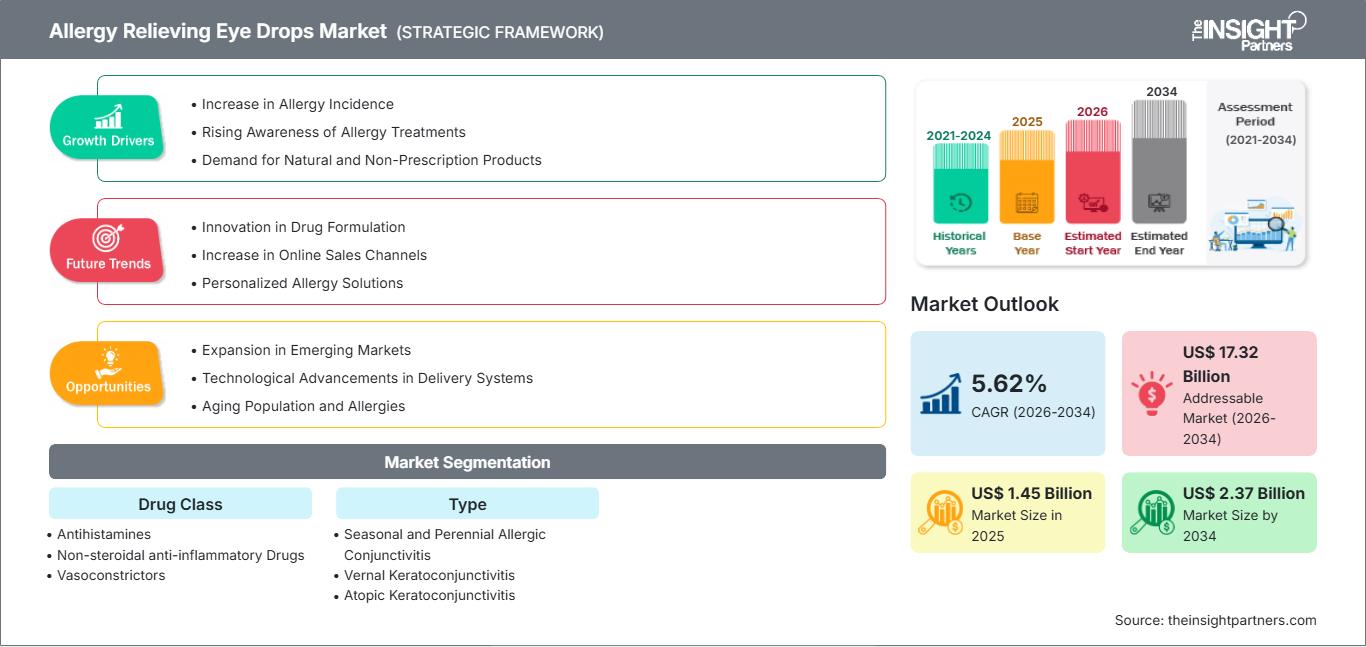
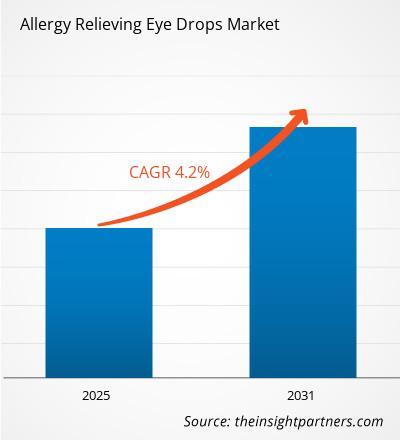
The Allergy Relieving Eye Drops Market is projected to grow from US$ 1.45 Billion in 2025 to US$ 2.37 Billion by 2034, registering a CAGR of 5.62% during 2026–2034. Demand is supported by rising allergic conjunctivitis prevalence, broader over-the-counter access, increasing pollen exposure, and stronger consumer preference for targeted ocular therapies over systemic allergy medication.
The Allergy Relieving Eye Drops Market in North America is anticipated to grow at a 5.2-5.8% Compound Annual Growth Rate during the period 2022-2034 due to the presence of high levels of self-medication practice, effective drug dispensation from pharmacies, and seasonal pollens. There has been an increase in repeat purchasing due to easy availability of preservative-free products and antihistamines.
Allergy Relieving Eye Drops Market Assessment and Insights
- North America accounted for 38–41% share in 2025 and is growing at a CAGR range of 5.2–5.8% between 2026–2034, driven by OTC switches, high diagnosis rates, and strong retail pharmacy penetration.
- US represented 78–82% of North America in 2025 and is growing at a CAGR range of 5.1–5.7% between 2026–2034, supported by branded antihistamine loyalty.
- Europe held 26–29% share in 2025 and is growing at a CAGR range of 4.7–5.3% between 2026–2034, led by Germany, the UK, France, Italy, and Spain.
- Asia Pacific captured 21–24% share in 2025 and is growing at a CAGR range of 6.3–7.1% between 2026–2034, led by China, Japan, India, South Korea, and Australia.
- Largest Segment Antihistamines held 55–60% market share in 2025, with CAGR range of 5.4–6.0% between 2026–2034, reflecting rapid itch relief and OTC accessibility.
- High Growth Segment Vernal Keratoconjunctivitis held 12–15% market share in 2025, with CAGR range of 6.4–7.2% between 2026–2034, driven by pediatric and specialist-care demand.
- Key companies analyzed in detail: Alcon Inc., Novartis AG, Johnson & Johnson Vision Care, Inc., Bausch + Lomb Corporation, AbbVie Inc., Merck & Co., Inc., Santen Pharmaceutical Co., Ltd., Pfizer Inc., Perrigo Company plc, F. Hoffmann-La Roche AG.
Source: The Insight Partners' analysis based on proprietary research, government publications, company annual reports, investor presentations, industry databases, and expert interviews.
Formulation approaches have shifted from short-term anti-redness products to combined antihistamine and mast-cell stabilizer solutions that provide relief from itchiness, tearing, and conjunctival inflammation. Manufacturing is driven by advances in multi-dose sterile packaging, preservative-free solutions, and rising standards for ophthalmic solutions. The growth of the Allergy Relieving Eye Drops Market is further driven by prolonged allergy seasons due to climatic factors, overlap with computer-related digital eye irritation, and competition from both branded and non-branded solutions on retail shelves.
Growth in demand during the forecast period will extend beyond the USA, Western Europe, and Japan, driven by air pollution, increased awareness of allergies, and the availability of e-pharmacy services in the Asia Pacific and certain Middle Eastern countries. Regulation will receive the greatest boost in countries where OTC products and pharmacist-based self-medication are available, while the importance of prescription products will remain high for severe cases of conjunctivitis.
Allergy Relieving Eye Drops Market Report Scope
| Report Attribute | Details |
|---|---|
| Market size in 2025 | US$ 1.45 Billion |
| Market Size by 2034 | US$ 2.37 Billion |
| Global CAGR (2026 - 2034) | 5.62% |
| Historical Data | 2021-2024 |
| Forecast period | 2026-2034 |
Allergy Relieving Eye Drops Market Analysis
While consumer demand is related to episodic conditions, recurring purchases are relevant due to allergic conjunctivitis recurrence in response to pollen, dust, mold, and pet dander. The value chain includes API production, sterile fill-finish operations, ophthalmic packaging, retail pharmacies, e-commerce sites, optometrists, and ophthalmologists. Medication availability is influenced by medication categorization, where OTC antihistamines increase access but prescription anti-inflammatories are still relevant for moderate/severe conditions.
The supply dynamics work in the favor of those companies which have the ability to offer their products in a sterile ophthalmic form of production with a good consumer-health brand reputation and with bottle technology that reduces the risk of contamination. The Allergy Relieving Eye Drops Market research is an example of a market wherein the factors of price, efficacy, and convenience of use affect brand switching.
Competition lies with known companies in eye care and pharmaceuticals with their unique advantages. For instance, Alcon Inc. is able to draw on its consumer eye care awareness, and Bausch + Lomb Corporation has bolstered its position in the ocular surface market through the launch of preservative free products. Santen Pharmaceutical Co., Ltd. maintains its clinical relevance in allergic conjunctivitis innovation, especially in Japan. AbbVie Inc., Pfizer Inc., Merck & Co., Inc., Novartis AG, Johnson & Johnson Vision Care, Inc., Perrigo Company plc, and F. Hoffmann-La Roche AG play important roles in this ecosystem.
The investment trend highlights the need for Rx-to-OTC life cycle management, private label equivalents, preservative-free differentiation, and clinical education based on the disease severity. The strategic positioning trend has evolved from just providing symptomatic relief to building a platform for eye health, which includes all allergies, dry eyes, redness, and contact lens related discomfort.
● REPORT CUSTOMIZATION
Tailor This Report To Align With Your Specific Business Requirements
This report can be customized to align precisely with your business objectives, scope, and target markets. Customization options include tailored segmentation, geography, competitive analysis, and strategic insights to support informed decision-making.
Customize This Report →WHAT YOU CAN ADJUST
- ● Segmentations
- ● Geography
- ● Competitive Analysis
- ● Language Preferences
Allergy Relieving Eye Drops Market: Strategic Insights
Regional Insights
North America Allergy Relieving Eye Drops Market
North America held 38–41% share in 2025 and is projected to grow at a CAGR range of 5.2–5.8% between 2026–2034. Allergy Relieving Eye Drops Market share benefits from extensive retail pharmacy coverage, seasonal allergy awareness, and high adoption of OTC antihistamine products. Frequent pollen exposure, indoor allergens, and contact lens use sustain recurring consumer demand among urban and suburban populations.
The region also benefits from active ophthalmology networks and strong consumer health investments. The regulatory pathways that support the availability of OTC products have made things easier for patients with mild to moderate eye itch. Preservative-free products are becoming increasingly relevant amongst consumers, while brand products remain competitive with store brands.
U.S. Allergy Relieving Eye Drops Market
The US accounted for 78–82% of North America in 2025 and is expected to grow at a CAGR range of 5.1–5.7% between 2026–2034. The country’s position reflects high direct-to-consumer awareness, broad retail shelf availability, and frequent physician or pharmacist recommendations. Seasonal allergic conjunctivitis generates peak demand during spring and fall, while perennial allergen exposure supports baseline sales.
Company presence is especially strong in branded OTC drops, private-label olopatadine generics, and redness-relief products, as well as the related dry-eye product portfolio. The main competitors of this company are Alcon Inc., Bausch + Lomb Corporation, Johnson & Johnson Vision Care, Inc., Perrigo Company plc, and AbbVie Inc. The application trend includes once daily dosing and preservative-free options.
Europe Allergy Relieving Eye Drops Market
The Europe region accounted for 26-29% market share in 2025 and is estimated to register a CAGR of 4.7–5.3% from 2026 to 2034. Germany is the major market in the region, supported by high involvement of pharmacies, high rates of allergy diagnosis, and a preference for regulated ophthalmic medicines. The UK has seen consistent OTC sales, with people seeking pharmacists' advice to treat itchy and watery eyes during pollen season.
In addition to the above, France, Italy, and Spain contribute to market demand due to high urban pollution, an aging population, and growing awareness of allergic conjunctivitis. The environment in Southern Europe allows allergens to remain present for longer. Reimbursement policies and pharmacy regulations affect access to prescription medicines in the European region.
APAC Allergy Relieving Eye Drops Market
APAC was estimated to hold 21–24% market share in 2025 and is expected to experience a CAGR of 6.3–7.1% from 2026–2034. Leading APAC countries include China, fueled by urban air pollution, increased pharmacy accessibility, and increasing self-care trend. Japan will continue being important for advanced allergy eye drops due to treatment of allergic conjunctivitis and India provides volume opportunities via expansion in retail pharmacies and e-pharmacy segment.
South Korea and Australia provide market contribution through high healthcare access and awareness about seasonal allergies. Local manufacturing policies, accelerated drug approval process, and growth of e-pharmacies can improve availability of the products. Increasing demand is driven by pediatric allergies treatment, contact lens care, and interest in preservative-free products.
Middle East & Africa Allergy Relieving Eye Drops Market
Middle East & Africa is expected to grow at a CAGR range of 4.9–5.5% between 2026–2034, with Saudi Arabia as the leading country. UAE demand benefits from private healthcare access, expatriate consumer bases, and high pharmacy availability. Dust exposure, air-conditioning, and dry climates intensify ocular irritation that may overlap with allergic symptoms.
In Sub-Saharan countries, South Africa ensures that there is organized pharmacy chains and availability of ophthalmology services to drive demand for the products. The Rest of MEA market is still not consistent due to unaffordability issues and limited access to specialists. Investments in infrastructure in these three key segments will ensure greater visibility of the product range.
Segmentation Analysis
Drug Class
The Drug Class is forecasted to grow at a rate of CAGR of 5.3-5.9% during the 2026-2034 period. The Scope of Allergy Relieving Eye Drops Market in terms of the drug class depends on the extent of symptoms, efficacy, OTC nature, and safety considerations. Antihistamine eye drops account for most repeat prescriptions, while NSAIDs and decongestants are prescribed for specific conditions.
- Antihistamines hold the strongest position because they directly address ocular itching and are widely available through OTC channels, making them central to seasonal allergy management and repeat consumer purchasing.
- Non-steroidal anti-inflammatory Drugs support patients needing inflammation-focused relief, particularly when specialist guidance is required, but adoption is moderated by prescription dependence and careful clinical positioning.
- Vasoconstrictors remain relevant for short-term redness reduction, although safety concerns around rebound redness encourage more selective use and strengthen demand for differentiated redness-relief alternatives.
Type
Type is expected to register a CAGR range of 5.5–6.1% between 2026–2034. Demand depends upon the level of chronicity of the disease, age group of patients and role of specialists. Seasonal and perennial allergic conjunctivitis will have the largest population of patients while vernal and atopic keratoconjunctivitis will need more organized management.
- Seasonal and Perennial Allergic Conjunctivitis represents the core demand base, supported by recurring pollen, dust, mold, and pet-dander exposure, with high reliance on fast-acting OTC antihistamine products.
- Vernal Keratoconjunctivitis is strategically important because it often affects children and young adults, requiring specialist oversight, adherence support, and products that address recurrent severe inflammation.
- Atopic Keratoconjunctivitis creates demand for longer-term management because symptoms may persist with systemic atopy, making physician-guided selection and safety monitoring important for treatment continuity.
- Giant Papillary Conjunctivitis is linked to contact-lens wear, ocular prostheses, and chronic mechanical irritation, supporting demand where allergen control and lens-hygiene interventions accompany pharmacologic relief.
Opportunity Snapshot
| Type | Revenue Contribution | Trend Tag | Adoption Stage |
| Seasonal and Perennial Allergic Conjunctivitis | High | Pollen Peaks | Mature |
| Vernal Keratoconjunctivitis | Medium | Pediatric Care | Scaling |
| Atopic Keratoconjunctivitis | Medium | Chronic Atopy | Scaling |
| Giant Papillary Conjunctivitis | Low | Lens Irritation | Emerging |
Allergy Relieving Eye Drops Market Growth Drivers and Impact Analysis
Longer Allergy Seasons and Higher Urban Allergen Exposure
The variability of the climate, air pollution in cities, and extended pollen seasons are contributing to more occurrences and persistence of allergic eye irritation cases. WHO air-quality issues and national programs of pollen monitoring highlight the greater degree of interrelation between allergens and conjunctivitis incidents. The resulting trend implies the presence of an increased number of patients with repeated occurrences that require prompt treatment when their symptoms arise and continuous treatment for year-round problems. It is manifested through higher seasonal product stock in stores, increased search activity of consumers at peak pollen periods, and growing demand for products that relieve symptoms of itching, redness, and watering without drowsiness.
Rx-to-OTC Accessibility and Pharmacist-Led Self-Care
The increasing availability of OTCs for existing antihistamines is an important structure influence since it will lessen the resistance experienced by the consumers suffering from mild to moderate allergic conjunctivitis. Consumers can acquire medications without making appointments with doctors, while pharmacists can help them understand the differences between symptoms caused by an allergy, infections, and dry eyes. In such an environment, it is essential to have reliable brands, effective dosage, and clear instructions on packages. It is especially relevant in the USA and Europe, although APAC nations are also adopting the approach of self-medication.
Shift Toward Preservative-Free and Adherence-Friendly Formats
Frequent users are increasingly attentive to preservative exposure, bottle hygiene, and dosing convenience. Ophthalmologists and optometrists often recommend preservative-free formats for patients with sensitive ocular surfaces, contact-lens use, or overlapping dry eye symptoms. This driver is reshaping product development toward multi-dose preservative-free systems, unit-dose vials, and longer-acting formulations. The market impact is premiumization, especially among consumers who use drops repeatedly during prolonged allergy periods. Manufacturers also benefit from stronger clinical positioning because preservative-free claims align with safety and comfort messaging. Over time, adherence-friendly formats may reduce switching, improve patient satisfaction, and create higher-value niches beyond basic antihistamine products.
Allergy Relieving Eye Drops Market Future Trends
Precision Symptom Positioning Across Allergy and Dry Eye Overlap
Future Allergy Relieving Eye Drops Market trends will increasingly reflect the blurred boundary between allergic conjunctivitis, dry eye, redness, and contact-lens discomfort. Companies are expected to refine labels, education, and clinical claims to help consumers identify symptom clusters rather than relying on single-symptom messaging. Products positioned for itch plus ocular surface comfort may gain stronger repeat use, provided they remain clinically credible. Eye-care professionals will play a larger role in guiding patients who self-treat unsuccessfully. This trend will favor portfolios that combine allergy relief with broader ocular surface expertise, enabling manufacturers to serve patients across seasonal episodes and chronic irritation patterns.
Digital Pharmacy, Pollen Forecasting, and Demand Prediction
Retail execution will become more data-led as e-commerce platforms, pollen forecasts, and localized allergy alerts influence purchase timing. Manufacturers and retailers can use predictive demand signals to allocate inventory before seasonal spikes, reducing stockouts and improving conversion. Digital pharmacy also gives smaller brands and private-label products more visibility, increasing price competition. In APAC and MEA, online channels can expand access where physical pharmacy density is uneven. The longer-term effect will be more dynamic promotion, subscription replenishment for recurrent users, and targeted education when allergen levels rise. This trend rewards companies that integrate consumer analytics with compliant medical communication.
Allergy Relieving Eye Drops Market Opportunities
Preservative-Free Premiumization in High-Frequency Users
A major opportunity lies in targeting high-frequency users who experience recurring symptoms across multiple allergy seasons or perennial exposure. These consumers are more likely to value comfort, hygiene, and safety claims, making preservative-free products commercially attractive. Allergy Relieving Eye Drops Market Forecasts indicate that premium formats can capture incremental value even in markets where generic antihistamines pressure price. Companies should invest in evidence-backed packaging, clear labeling, and clinician education to justify premium positioning. Partnerships with pharmacy chains and optometry networks can improve recommendation rates. The opportunity is strongest among contact-lens wearers, pediatric caregivers, and patients with ocular surface sensitivity.
Emerging Market Expansion Through Pharmacy and E-Commerce Channels
Emerging markets offer a practical expansion opportunity as urbanization, pollution exposure, and allergy awareness increase. Companies can prioritize scalable pharmacy distribution, affordable pack sizes, and digital education that helps consumers distinguish allergy symptoms from infection or dryness. India, China, Gulf countries, and selected African markets present different access challenges, so portfolio localization is essential. Investment should focus on regulatory readiness, supply reliability, and pharmacist training rather than only broad advertising. Store-brand partnerships may also unlock volume where price sensitivity is high. Firms that combine clinically trusted ingredients with accessible pricing can build early loyalty before categories become crowded.
Recent Developments
- February 2026: Bausch + Lomb Corporation — Ophthalmology and Therapy published a global review highlighting rising noninfectious ocular redness linked to digital strain, dry eye, allergies, contact-lens wear, and environmental exposure. The company noted the differentiated role of LUMIFY and referenced its preservative-free brimonidine tartrate 0.025% formulation introduced in 2025, strengthening its ocular surface and redness-relief positioning
- May 2025: Alcon Inc. received US FDA approval for TRYPTYR, acoltremon ophthalmic solution 0.003%, for signs and symptoms of dry eye disease. Although not an allergy-specific product, the approval strengthens Alcon’s prescription ophthalmic presence and supports broader ocular surface expertise relevant to patients with overlapping irritation, dryness, and allergy-like symptoms
- May 2024: Santen Pharmaceutical Co., Ltd. launched Alesion Eyelid Cream 0.5% in Japan for allergic conjunctivitis. The product is described as the world’s first cream-type allergic conjunctivitis treatment, requiring once-daily periocular application, and was developed to reduce the burden of frequent eyedrop administration
Frequently Asked Questions

- Comprehensive Market Sizing and Forecast Analysis
- Detailed Segmentation Analysis
- In-Depth Market Dynamics Assessment
- Regional and Country-Level Insights
- Competitive Landscape and Company Benchmarking
- Strategic Business Intelligence
Recent Reports
Testimonials

The Insight Partners' SCADA System Market report is comprehensive, with valuable insights on current trends and future forecasts. The team was highly professional, responsive, and supportive throughout. We are very satisfied and highly recommend their services.
RAN KEDEM Partner, Reali Technologies LTDs
I requested a report on a very specific software market and the team produced the report in a few days. The information was very relevant and well presented. I then requested some changes and additions to the report. The team was again very responsive and I got the final report in less than a week.
JEAN-HERVE JENN Chairman, Future Analytica
We worked with The Insight Partners for an important market study and forecast. They gave us clear insights into opportunities and risks, which helped shape our plans. Their research was easy to use and based on solid data. It helped us make smart, confident decisions. We highly recommend them.
PIYUSH NAGPAL Sr. Vice President, High Beam Global
The Insight Partners delivered insightful, well-structured market research with strong domain expertise. Their team was professional and responsive throughout. The user-friendly website made accessing industry reports seamless. We highly recommend them for reliable, high-quality research services
YUKIHIKO ADACHI CEO, Deep Blue, LLC.
This is the first time I have purchased a market report from The Insight Partners.While I was unsure at first, I visited their web site and felt more comfortable to take the risk and purchase a market report.I am completely satisfied with the quality of the report and customer service. I had several questions and comments with the initial report, but after a couple of dialogs over email with their analyst I believe I have a report that I can use as input to our strategic planning process.Thank you so much for taking the extra time and making this a positive experience.I will definitely recommend your service to others and you will be my first call when we need further market data.
JOHN SUZUKI President and Chief Executive Officer, Board Director, BK Technologies
I wish to appreciate your support and the professionalism you displayed in the course of attending to my request for information regarding to infectious disease IVD market in Nigeria. I appreciate your patience, your guidance, and the fact that you were willing to offer a discount, which eventually made it possible for us to close a deal. I look forward to engaging The Insight Partners in the future, all thanks to the impression you have created in me as a result of this first encounter.
DR CHIJIOKE ONYIA MANAGING DIRECTOR, PineCrest Healthcare Ltd.Reason to Buy
- Informed Decision-Making
- Understanding Market Dynamics
- Competitive Analysis
- Identifying Emerging Markets
- Customer Insights
- Market Forecasts
- Risk Mitigation
- Boosting Operational Efficiency
- Strategic Planning
- Investment Justification
- Tracking Industry Innovations
- Aligning with Regulatory Trends





 Get Free Sample for