
Barrier Materials Market Size, Growth & Trends by 2034
Barrier Materials Market Size and Forecasts (2021–2034), Global and Regional Share, Trends, and Growth Opportunity Analysis Report Coverage : by Type (Polyvinylidene Chloride, Ethylene Vinyl Alcohol (EVOH) Polyethylene Naphthalate); Application (Food and Beverage, Pharmaceutical, Cosmetics, Agriculture); and Geography (North America, Europe, Asia Pacific, and South and Central America)
- Status : Data Released
- Report Code : TIPRE00040415
- Category : Chemicals and Materials
- No. of Pages : 150
- Available Report Formats :


- Last update date : August 18, 2026


2025 Market Size
US$ 3.92 Bn
Base year value
2034 Forecast
US$ 5.99 Bn
Projected by 2034
CAGR 2026-2034
5.44 %
Growth rate
Addressable Market
US$ 46.41 Bn
(2026-2034)
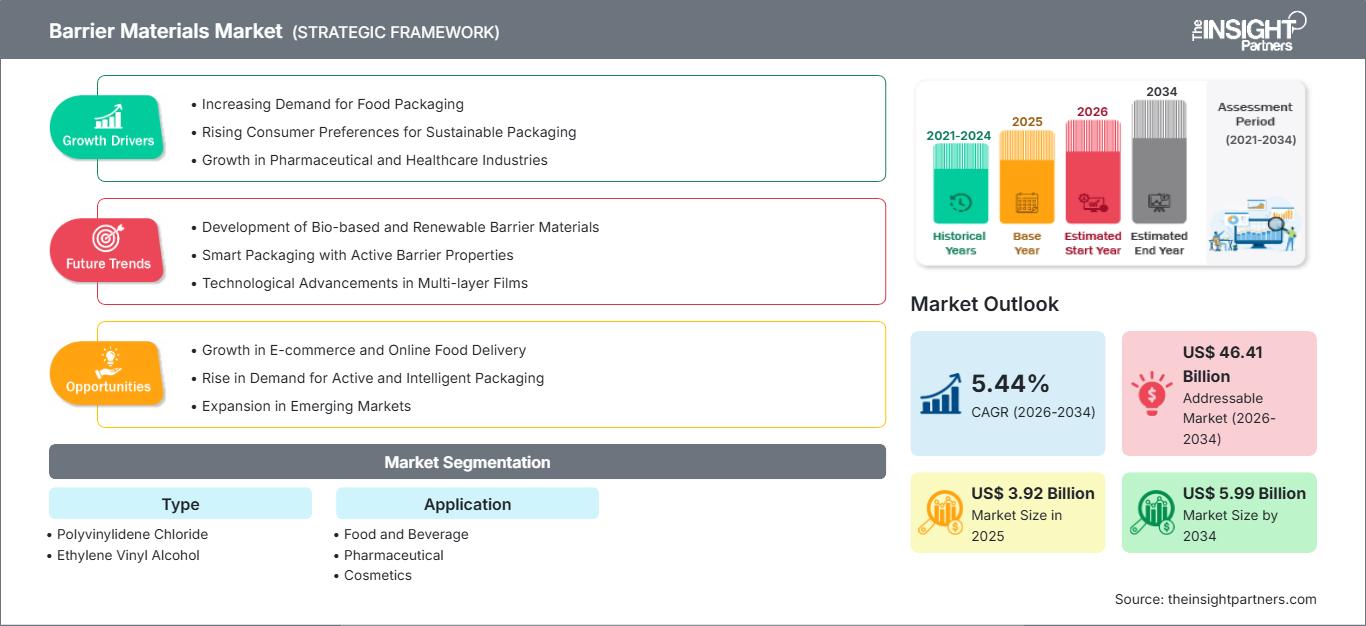
The Barrier Materials Market size was valued at US$ 3.92 Billion in 2025 and is projected to reach US$ 5.99 Billion by 2034, expanding at a CAGR of 5.44% during 2026–2034. The market continues to evolve as packaging manufacturers, pharmaceutical companies, and industrial processors increase the adoption of high-performance oxygen and moisture barrier materials to improve product protection, extend shelf life, and comply with increasingly stringent packaging sustainability and product safety requirements.
North America represents a technologically advanced regional market supported by strong demand from food packaging, pharmaceutical packaging, and specialty industrial applications. The Barrier Materials size in the region continues to expand at an estimated CAGR of 4.8–5.3% through 2034, driven by investments in recyclable multilayer packaging, growing adoption of modified atmosphere packaging, and regulatory emphasis on food safety and pharmaceutical product integrity.
Barrier Materials Market Assessment and Insights
- North America: Accounted for a 26–30% share in 2025 and is expected to expand at a CAGR of 4.8–5.3% during 2026–2034. Strong packaged food production, advanced pharmaceutical manufacturing, and continuous innovation in high-barrier flexible packaging support regional demand.
- U.S.: Represented 74–78% of North American demand in 2025 and is anticipated to register a CAGR of 4.7–5.2% through 2034, supported by major packaging converters, healthcare packaging investments, and increasing demand for sustainable barrier solutions.
- Europe: Held 24–28% share in 2025 and is projected to grow at a CAGR of 4.5–5.0%. Germany, France, Italy, and the UK continue leading regional consumption owing to strong food processing, pharmaceutical manufacturing, and recyclable packaging initiatives.
- Asia Pacific: Accounted for a 40–44% share in 2025 while registering the highest CAGR of 6.3–6.8% during 2026–2034. China, Japan, South Korea, and India continue benefiting from expanding food processing industries, growing healthcare manufacturing, and increasing investments in advanced packaging technologies.
- Largest Segment: Food and Beverage captured 54–58% market share in 2025 and is projected to grow at a CAGR of 5.1–5.6%, supported by rising demand for longer shelf life, reduced food waste, and improved oxygen and moisture protection.
- High Growth Segment: Pharmaceutical accounted for 18–22% market share in 2025 and is anticipated to register the fastest CAGR of 5.8–6.3% through 2034 due to increasing biologics production, sterile packaging requirements, and regulatory compliance.
- Key companies analyzed in detail: Asahi Kasei Corporation, Chang Chun Petrochemical Co., Ltd., Dow Inc., DuPont de Nemours, Inc., Kureha Corporation, Kuraray Co., Ltd., Mitsubishi Chemical Group Corporation, Solvay SA, Teijin Limited, Zhejiang Juhua Co., Ltd.
Source: The Insight Partners' analysis based on proprietary research, government publications, company annual reports, investor presentations, industry databases, and expert interviews.
Recent developments in polymer technology, co-extrusion processes, and recyclable barriers have greatly impacted the Barrier Materials industry within the last decade. Manufacturers of materials now pay much more attention to developing improved barrier properties against oxygen, odors, water vapor, and chemicals, while making the package lighter and more recyclable. The increased use of EVOH, PVDC, and PEN in flexible packaging structures is driven by new regulation policies and consumer demands to prolong product shelf life in food, pharmaceutical, and specialty industrial sectors.
Further growth will be generated more by manufacturing centers in the Asia Pacific region, new pharmaceutical production sites, and sustainable packaging infrastructure investments. Policies encouraging the development of recyclable materials, circular economy models, and food waste reduction will continue to drive innovations in mono-material packaging solutions featuring barrier resins. Expansion of capacity at leading resin producers and collaborations between material suppliers and packaging converters are anticipated throughout the forecast period.
Barrier Materials Market Report Scope
| Report Attribute | Details |
|---|---|
| Market size in 2025 | US$ 3.92 Billion |
| Market Size by 2034 | US$ 5.99 Billion |
| Global CAGR (2026 - 2034) | 5.44% |
| Historical Data | 2021-2024 |
| Forecast period | 2026-2034 |
Barrier Materials Market Analysis
Barrier Materials Market is expected to experience growth due to the increasing demand for packaging solutions that are effective in protecting products against oxygen, moisture, light, and contamination. Food and beverage producers are using advanced barrier materials to extend the shelf-life and reduce product losses. Pharmaceutical companies have also been seen to increase the use of barrier solutions in their products. Some of the major participants in the value chain include raw material suppliers, polymer producers, film producers, coating technologies, and end-users. Companies have been seen to invest more in sustainable packaging technologies, and hence the approach towards developing barrier materials has been seen to change significantly.
Supply dynamics will be determined by the availability of specialty polymers like Polyvinylidene Chloride (PVDC), Ethylene Vinyl Alcohol (EVOH), and Polyethylene Naphthalate (PEN). Multilayer film technology and coating technology are some of the emerging trends that have been seen. Major chemical companies have increased their production capacities in order to meet changing customer requirements.
Nevertheless, there is still the issue of reconciling performance and sustainability issues, especially as the regulatory environment becomes even stricter in regard to packaging waste and recyclability. The trend towards mono-material barrier packaging and fiber packaging offers both opportunities and challenges to the material and packaging solutions suppliers.
According to the Barrier Materials Market analysis, today competition focuses not only on pricing but mainly on innovation, sustainability, and building business relationships with customers. In fact, leading players constantly work on development of advanced barrier resins, recyclable multilayer films, and customized solutions meeting ever-changing regulatory requirements and performance demands. Strategic alliances between resin manufacturers and packaging converters also facilitate the launch of the next generation of barrier solutions.
Major companies, including Asahi Kasei Corporation, Kuraray Co., Ltd., Mitsubishi Chemical Group Corporation, Dow Inc., DuPont de Nemours, Inc., Kureha Corporation, Chang Chun Petrochemical Co., Ltd., Solvay SA, Teijin Limited, and Zhejiang Juhua Co., Ltd., continue strengthening competitive positioning through production expansion, product innovation, and research collaborations. Their investments in advanced polymer technologies and sustainable packaging materials are expected to support long-term market competitiveness while addressing evolving customer requirements across global packaging industries.
● REPORT CUSTOMIZATION
Tailor This Report To Align With Your Specific Business Requirements
This report can be customized to align precisely with your business objectives, scope, and target markets. Customization options include tailored segmentation, geography, competitive analysis, and strategic insights to support informed decision-making.
Customize This Report →WHAT YOU CAN ADJUST
- ● Segmentations
- ● Geography
- ● Competitive Analysis
- ● Language Preferences
Barrier Materials Market: Strategic Insights
Regional Insights
North America Barrier Materials Market
North America accounted for 26–30% of the global Barrier Materials Market share in 2025 and is projected to expand at a CAGR of 4.8–5.3% during 2026–2034. Demand is primarily supported by the region's highly developed food processing, pharmaceutical manufacturing, and healthcare packaging industries. Growing adoption of high-barrier flexible packaging for ready-to-eat meals, frozen foods, dairy products, and medical products continues to stimulate consumption of EVOH, PVDC, and PEN-based materials.
The United States and Canada continue investing in sustainable packaging innovations, recyclable multilayer films, and advanced resin technologies to comply with evolving environmental regulations. Food manufacturers increasingly require barrier materials that minimize oxygen and moisture transmission while maintaining product freshness. Pharmaceutical companies are also expanding the use of advanced barrier polymers in blister packs, pouches, and sterile packaging, contributing to stable regional demand throughout the forecast period.
U.S. Barrier Materials Market
The U.S. represented 74–78% of North American demand in 2025 and is anticipated to register a CAGR of 4.7–5.2% through 2034. The country's extensive packaged food production, pharmaceutical manufacturing capacity, and sophisticated packaging industry continue driving consumption of high-performance barrier materials. Increasing demand for extended shelf-life products and stringent quality standards further encourage adoption across multiple industrial sectors.
Leading material suppliers and packaging converters continue expanding investments in recyclable packaging technologies, specialty polymer development, and high-performance multilayer structures. Food and beverage applications remain the primary consumption area, while pharmaceutical packaging demonstrates strong growth supported by increasing biologics manufacturing, healthcare expenditure, and regulatory emphasis on product integrity. Continuous research into mono-material recyclable packaging solutions is expected to further strengthen market expansion during the forecast period.
Europe Barrier Materials Market
Europe held 24–28% of the global market in 2025 and is expected to expand at a CAGR of 4.5–5.0% during 2026–2034. Germany remains the leading regional market owing to its advanced packaging industry, strong chemical manufacturing base, and significant food processing sector. The country's investments in recyclable packaging materials and circular economy initiatives continue to support demand for advanced barrier polymers.
The United Kingdom maintains steady demand through its mature food retail and pharmaceutical sectors, where manufacturers increasingly adopt high-barrier packaging to reduce food waste and improve product preservation. France, Italy, and Spain collectively contribute substantial regional demand through expanding processed food production, cosmetics manufacturing, and pharmaceutical packaging applications. Regulatory initiatives encouraging recyclable materials and sustainable packaging continue driving innovation across the European value chain.
APAC Barrier Materials Market
Asia Pacific accounted for 40–44% of the global market in 2025 and is projected to register the fastest CAGR of 6.3–6.8% during 2026–2034. China leads regional demand, followed by Japan, South Korea, and India, supported by expanding food processing, pharmaceutical manufacturing, and consumer goods industries.
Government support for advanced manufacturing, growing exports of packaged food products, and increasing investments in healthcare infrastructure continue to strengthen regional consumption. Australia also contributes through demand for premium food packaging and sustainable materials, while ongoing industrial expansion across Southeast Asia further enhances long-term growth opportunities.
Middle East & Africa Barrier Materials Market
The Middle East & Africa market is projected to expand at a CAGR of 4.9–5.4% during 2026–2034. Saudi Arabia leads regional demand owing to investments in food processing, petrochemicals, and industrial manufacturing, while the United Arab Emirates continues strengthening its packaging and logistics industries through infrastructure development.
South Africa remains an important consumer driven by packaged food production and pharmaceutical manufacturing. The rest of the Middle East & Africa is witnessing the gradual adoption of advanced barrier packaging solutions as governments invest in food security, healthcare infrastructure, and domestic manufacturing capabilities, supporting consistent market development over the forecast period.
Segmentation Analysis
Type
The Type segment accounted for a significant share of the Barrier Materials market, with an estimated CAGR of 5.3–5.7% during 2026–2034. Material selection depends on oxygen barrier performance, moisture resistance, transparency, processability, recyclability, and end-use requirements. The Barrier Materials Market scope continues to broaden as manufacturers develop advanced resin formulations that balance barrier efficiency with sustainability objectives. Growing demand for recyclable flexible packaging and high-performance pharmaceutical packaging is encouraging continuous innovation across polymer technologies.
- Polyvinylidene Chloride (PVDC): PVDC remains widely utilized owing to its exceptional oxygen, moisture, and aroma barrier properties. The material is extensively adopted in food packaging films, pharmaceutical blister packaging, and specialty industrial applications requiring long product shelf life.
- Ethylene Vinyl Alcohol (EVOH): EVOH demonstrates excellent oxygen barrier performance while supporting lightweight and recyclable multilayer packaging structures. Increasing adoption in food packaging, medical packaging, and retort applications continues strengthening its strategic importance across global packaging value chains.
- Polyethylene Naphthalate (PEN): PEN provides superior thermal stability, mechanical strength, and gas barrier characteristics compared to conventional polyester materials. The polymer is increasingly used in specialty packaging, electronics, and pharmaceutical applications where dimensional stability and long-term product protection are essential.
Application
The Application segment is projected to register a CAGR of 5.4–5.9% during 2026–2034 as demand expands across food preservation, pharmaceutical protection, premium cosmetics, and agricultural packaging. Performance requirements continue evolving toward longer shelf life, enhanced product safety, reduced material usage, and compatibility with sustainable packaging initiatives. Food and healthcare industries remain the primary consumers due to stringent regulatory requirements and increasing adoption of high-barrier packaging technologies.
- Food and Beverage: This application represents the largest demand center because high-barrier materials significantly extend shelf life, preserve freshness, reduce oxygen transmission, and minimize food waste across flexible packaging, trays, pouches, and vacuum packaging solutions.
- Pharmaceutical: Pharmaceutical manufacturers increasingly adopt barrier materials for blister packs, medical pouches, sachets, and sterile packaging to protect moisture-sensitive formulations, biologics, and high-value medicines throughout storage and distribution.
- Cosmetics: Cosmetic packaging manufacturers utilize advanced barrier materials to preserve product stability, prevent fragrance loss, and protect formulations from oxygen, moisture, and environmental contamination, particularly in premium skincare and personal care products.
- Agriculture: Agricultural applications employ barrier materials for agrochemical packaging, seed protection, fertilizer packaging, and specialty films requiring resistance to moisture, chemicals, and harsh storage conditions while ensuring product integrity throughout the supply chain.
Opportunity Snapshot
| Application | Revenue Contribution | Trend Tag | Adoption Stage |
|---|---|---|---|
| Food and Beverage | High | Shelf-Life Extension | Mature |
| Pharmaceutical | High | Sterile Packaging | Scaling |
| Cosmetics | Medium | Premium Protection | Scaling |
| Agriculture | Low | Agro Packaging | Emerging |
Barrier Materials Market Growth Drivers and Impact Analysis
Growing Demand for High-Performance Food Packaging
The international food industry remains focused on creating packaging options that increase shelf-life and minimize food spoilage and waste throughout the retailing and e-commerce supply chains. Barrier films offer protection from oxygen, moisture, aroma, and contaminants, and are therefore vital in flexible pouches, trays, vacuum packs, and modified atmosphere packing systems. Rising consumption of processed foods, ready-to-eat meals, frozen foods, dairy products, and packaged beverages has increased demand for innovative barrier plastics. Regulatory bodies are also promoting packaging methods that increase safety of foods by minimizing food spoilage in the course of transit and storage. Ongoing development of recyclable barrier films and mono-materials packages is ensuring that companies meet both their sustainable and performance goals, which facilitates market growth in developed and developing nations.
Expansion of Pharmaceutical and Healthcare Packaging Applications
Pharmaceutical manufacturers require packaging materials capable of protecting medicines from moisture, oxygen, light, and microbial contamination throughout increasingly complex global distribution networks. High-barrier polymers play an essential role in blister packs, sachets, pouches, intravenous solution packaging, and sterile medical packaging. Rising production of biologics, vaccines, specialty medicines, and temperature-sensitive formulations is strengthening demand for advanced barrier technologies. Regulatory compliance related to product stability, patient safety, and packaging integrity continues to encourage the adoption of high-performance materials. Investments in pharmaceutical manufacturing facilities across Asia Pacific, North America, and Europe further support demand for innovative barrier solutions that combine superior protection with lightweight structures and compatibility with sustainable packaging initiatives.
Advancements in Sustainable High-Barrier Polymer Technologies
Packaging producers increasingly focus on developing recyclable, lightweight, and resource-efficient materials without compromising barrier performance. Advances in EVOH formulations, recyclable multilayer structures, bio-based polymers, and solvent-free coating technologies are transforming the competitive landscape. Governments worldwide continue implementing regulations promoting circular economy practices, packaging waste reduction, and recyclable material usage. Brand owners are simultaneously seeking packaging formats that reduce carbon emissions while maintaining product quality and extending shelf life. These developments encourage resin manufacturers and packaging converters to invest in research, production expansion, and strategic partnerships. Continuous innovation in sustainable barrier technologies is expected to create new commercial opportunities while supporting regulatory compliance and long-term competitiveness across multiple end-use industries.
Barrier Materials Market Future Trends
Development of Recyclable High-Barrier Packaging Solutions
Packaging manufacturers are increasingly replacing conventional multilayer structures that are difficult to recycle with mono-material and recyclable high-barrier solutions. The Barrier Materials Market trends indicate growing investment in advanced EVOH technologies, functional coatings, and polymer compatibilizers that maintain oxygen and moisture barrier performance while improving recyclability. Brand owners in the food, pharmaceutical, and personal care industries are aligning packaging strategies with circular economy objectives and extended producer responsibility regulations. Material suppliers continue collaborating with packaging converters to commercialize sustainable barrier films that reduce environmental impact without compromising product protection. As recycling infrastructure improves globally, recyclable barrier materials are expected to become a mainstream packaging solution across developed and emerging markets.
Increasing Integration of Smart and Functional Packaging Materials
Barrier material technologies are evolving beyond passive protection to support smart packaging applications that improve supply chain visibility and product quality monitoring. Manufacturers are integrating high-barrier polymers with intelligent labels, freshness indicators, traceability systems, and active packaging technologies that help preserve sensitive products during transportation and storage. Pharmaceutical and premium food packaging applications are expected to drive the fastest commercialization due to stringent quality requirements and increasing digitalization across logistics networks. Continuous innovation in material engineering and packaging design will accelerate the adoption of multifunctional barrier materials capable of delivering improved safety, operational efficiency, and enhanced consumer confidence throughout the product lifecycle.
Barrier Materials Market Opportunities
Expansion of Barrier Packaging in Emerging Healthcare Manufacturing Hubs
Rapid investments in pharmaceutical manufacturing across Asia Pacific, Latin America, and the Middle East are creating significant opportunities for suppliers of advanced barrier materials. Barrier Materials Market Forecasts indicate that increasing production of biologics, vaccines, injectable medicines, and specialty pharmaceuticals will require sophisticated packaging capable of protecting sensitive formulations throughout storage and international distribution. Governments are strengthening domestic pharmaceutical manufacturing capabilities while encouraging investments in healthcare infrastructure and high-value packaging production. Material manufacturers can capitalize on these developments by expanding regional production capacities, introducing application-specific barrier polymers, and establishing long-term partnerships with pharmaceutical packaging converters to address evolving regulatory and quality requirements.
Commercialization of Sustainable Specialty Barrier Resins
Growing environmental regulations and corporate sustainability commitments are encouraging the development of recyclable, lightweight, and bio-based barrier materials. Companies investing in specialty resin technologies, solvent-free coatings, and advanced multilayer structures compatible with existing recycling systems are expected to strengthen their competitive position. Demand from food, cosmetics, and consumer goods manufacturers continues to increase for packaging materials that simultaneously improve product protection and reduce environmental impact. Strategic investments in research and development, pilot-scale production, and collaborative innovation with packaging converters provide significant opportunities to accelerate commercialization while addressing evolving global sustainability objectives and changing consumer expectations.
Recent Developments
- April 2026: Dow Inc. and RDM Group introduced Multiboard CirculaRR, a fiber-based food barrier packaging solution made exclusively with recycled cartonboard and ISCC PLUS-certified recycled polyethylene. Designed for food-contact applications, the packaging supports recyclability within existing paper recycling streams and helps brand owners prepare for the EU Packaging and Packaging Waste Regulation (PPWR).
- September 2025: Sappi expanded its Guard Pro portfolio with the launch of Guard Pro OHS and Guard Pro OMH, recyclable high-barrier mono-material papers for primary packaging. The products provide protection against oxygen, water vapor, grease, and mineral oil while serving as paper-based alternatives to plastic and multilayer packaging for food and consumer goods applications.
- May 2025: SIG Group AG launched an aluminum-layer-free full-barrier packaging material for multi-serve aseptic cartons. The innovation maintains oxygen, light, moisture, and aroma protection while reducing the carbon footprint of aseptic cartons by eliminating the conventional aluminum barrier layer, supporting more sustainable beverage packaging solutions.
Frequently Asked Questions

- Comprehensive Market Sizing and Forecast Analysis
- Detailed Segmentation Analysis
- In-Depth Market Dynamics Assessment
- Regional and Country-Level Insights
- Competitive Landscape and Company Benchmarking
- Strategic Business Intelligence
Recent Reports
Testimonials

The Insight Partners' SCADA System Market report is comprehensive, with valuable insights on current trends and future forecasts. The team was highly professional, responsive, and supportive throughout. We are very satisfied and highly recommend their services.
RAN KEDEM Partner, Reali Technologies LTDs
I requested a report on a very specific software market and the team produced the report in a few days. The information was very relevant and well presented. I then requested some changes and additions to the report. The team was again very responsive and I got the final report in less than a week.
JEAN-HERVE JENN Chairman, Future Analytica
We worked with The Insight Partners for an important market study and forecast. They gave us clear insights into opportunities and risks, which helped shape our plans. Their research was easy to use and based on solid data. It helped us make smart, confident decisions. We highly recommend them.
PIYUSH NAGPAL Sr. Vice President, High Beam Global
The Insight Partners delivered insightful, well-structured market research with strong domain expertise. Their team was professional and responsive throughout. The user-friendly website made accessing industry reports seamless. We highly recommend them for reliable, high-quality research services
YUKIHIKO ADACHI CEO, Deep Blue, LLC.
This is the first time I have purchased a market report from The Insight Partners.While I was unsure at first, I visited their web site and felt more comfortable to take the risk and purchase a market report.I am completely satisfied with the quality of the report and customer service. I had several questions and comments with the initial report, but after a couple of dialogs over email with their analyst I believe I have a report that I can use as input to our strategic planning process.Thank you so much for taking the extra time and making this a positive experience.I will definitely recommend your service to others and you will be my first call when we need further market data.
JOHN SUZUKI President and Chief Executive Officer, Board Director, BK Technologies
I wish to appreciate your support and the professionalism you displayed in the course of attending to my request for information regarding to infectious disease IVD market in Nigeria. I appreciate your patience, your guidance, and the fact that you were willing to offer a discount, which eventually made it possible for us to close a deal. I look forward to engaging The Insight Partners in the future, all thanks to the impression you have created in me as a result of this first encounter.
DR CHIJIOKE ONYIA MANAGING DIRECTOR, PineCrest Healthcare Ltd.Reason to Buy
- Informed Decision-Making
- Understanding Market Dynamics
- Competitive Analysis
- Identifying Emerging Markets
- Customer Insights
- Market Forecasts
- Risk Mitigation
- Boosting Operational Efficiency
- Strategic Planning
- Investment Justification
- Tracking Industry Innovations
- Aligning with Regulatory Trends





 Get Free Sample for