
Cancer Therapy Market Size, Share & Growth by 2034
Cancer Therapy Market Size and Forecasts (2021–2034), Global and Regional Share, Trends, and Growth Opportunity Analysis Report Coverage : by Type of Therapy (Chemotherapy. Immunotherapy, Targeted Therapy, Hormonal Therapy); Cancer Type (Lung Cancer, Breast Cancer, Prostate Cancer, Colorectal Cancer, Leukemia and Lymphoma); End-User (Hospitals, Oncology Clinics, Research Institutes); and Geography (North America, Europe, Asia Pacific, and South and Central America)
- Status : Data Released
- Report Code : TIPRE00040638
- Category : Life Sciences
- No. of Pages : 150
- Available Report Formats :


- Last update date : August 17, 2026


2025 Market Size
US$ 199.68 Bn
Base year value
2034 Forecast
US$ 365.06 Bn
Projected by 2034
CAGR 2026-2034
7.83 %
Growth rate
Addressable Market
US$ 2,669.75 Bn
(2026-2034)
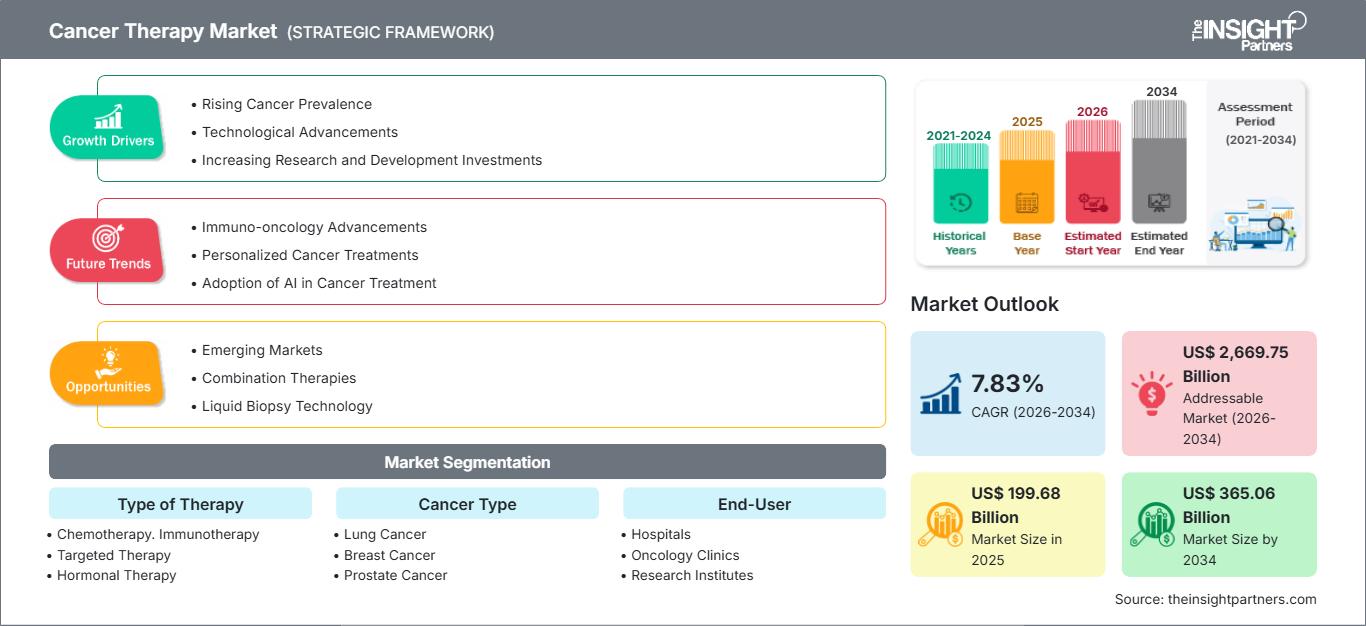
The global Cancer Therapy Market size is forecasted to be worth US$ 199.68 Billion in 2025 and expected to further increase up to US$ 365.06 Billion by 2034, growing at a CAGR of 7.83% between 2026 and 2034. Growth drivers include an increase in cancer incidence rates, expanded biomarker screening, the early use of immunotherapies and targeted drugs, and increasing treatment capability in hospitals, oncology clinics, and clinically validated cancer care networks.
North America is still the leading innovative regional market, with its estimated CAGR of 7.1-7.6% during the forecast period of 2034. The regional market is driven by high numbers of oncology drug approval, insurance coverage of specialty biologicals, and a large number of clinical trials. Data from WHO and IARC show that there were almost 20 million new cancer cases and 9.7 million cancer deaths in 2022.
Cancer Therapy Market Assessment and Insights
- North America: The region accounted for 41–44% Cancer Therapy Market share in 2025 and is projected to grow at a CAGR between 7.1–7.6% during 2026–2034, led by genomic testing, reimbursement depth, and rapid adoption of novel biologics.
- US: The US held 83–86% of North America in 2025 and is expected to record a CAGR between 7.0–7.5% through 2034, supported by approvals and oncology trial density.
- Europe: Europe represented 23–26% share in 2025 and is forecast to grow at a CAGR between 6.6–7.2%, with Germany, France, the UK, Italy, and Spain leading uptake.
- Asia Pacific: Asia Pacific captured 22–25% share in 2025 and is projected to expand at a CAGR between 8.7–9.4%, driven by China, Japan, India, South Korea, and Australia.
- Largest Segment: Targeted Therapy held 34–37% market share in 2025 and is projected to expand at a CAGR between 8.2–8.8%, reflecting biomarker-linked prescribing and companion diagnostics.
- High Growth Segment: Immunotherapy accounted for 28–31% market share in 2025 and is expected to grow at a CAGR between 9.1–9.8%, supported by checkpoint inhibitor expansion.
- Key companies analyzed in detail: F. Hoffmann-La Roche Ltd, Bristol Myers Squibb Company, Merck & Co., Inc., Pfizer Inc., Johnson & Johnson Services, Inc., Novartis AG, AstraZeneca plc, Eli Lilly and Company, Amgen Inc., Gilead Sciences, Inc.
Source: The Insight Partners' analysis based on proprietary research, government publications, company annual reports, investor presentations, industry databases, and expert interviews.
Innovations in therapeutic areas have steered oncology towards the direction of biomarker-driven drug sequencing, immuno-modulation, and antibody-drug conjugates. There is also a shift in manufacturing dynamics as biological drugs, cell therapies, and high potency drug payloads will demand specialized fill finish capabilities, cold chain logistics and quality control procedures. This makes the Cancer Therapy Market more driven by clinical data, availability of diagnostics, treatment facility capability, and the manufacturer's ability to scale the complex therapies.
The future of the Cancer Therapy Market will also see contributions from emerging markets to incremental patient starts due to increased screenings, insurance coverages and investment into oncology facilities. Regulators will also focus on expedited approval process where there is clear indication that the treatment delivers benefits in selected population. The market will gain from earlier line therapy movements, increased use of real world evidence, and policies aimed at reducing access disparity in cancer diagnosis and treatments.
Cancer Therapy Market Report Scope
| Report Attribute | Details |
|---|---|
| Market size in 2025 | US$ 199.68 Billion |
| Market Size by 2034 | US$ 365.06 Billion |
| Global CAGR (2026 - 2034) | 7.83% |
| Historical Data | 2021-2024 |
| Forecast period | 2026-2034 |
Cancer Therapy Market Analysis
The first demand side is growing due to increased cancer cases and prolonged survival after diagnosis, which requires multi-line therapies. Another factor behind the growth of the Cancer Therapy Market is the development of drugs used in combination therapies that go from the metastatic environment to adjuvant and neoadjuvant settings. The value chain comprises developers of biomarkers, pharmaceutical producers, contract manufacturers, hospital pharmacies, specialty distributors, oncologists, and payers.
Supply factors are becoming more sophisticated with the advent of monoclonal antibodies, antibody-drug conjugates, and oral drugs that have different supply economics than traditional chemotherapy. FDA oncology activity was at a peak in 2025 with over 50 approvals in oncology applications.
Competition exists among companies with diverse oncology franchises and platform capabilities. The market report shows that companies like Merck & Co., Inc., Bristol Myers Squibb Company, AstraZeneca plc, F. Hoffmann-La Roche Ltd, and Novartis AG have been able to position themselves through immuno-oncology, hematology, targeted therapy, and companion diagnostic platforms.
Investments have been shifting towards differentiated approaches, such as ADCs, bispecific antibodies, tumor agnostic targeted therapies, and oral degraders. Companies like Pfizer Inc., Johnson & Johnson Services, Inc., Eli Lilly and Company, Amgen Inc., and Gilead Sciences, Inc. are investing in pipeline depth, licensing, and evidence-based lifecycle management to preserve market share amidst pricing pressures.
● REPORT CUSTOMIZATION
Tailor This Report To Align With Your Specific Business Requirements
This report can be customized to align precisely with your business objectives, scope, and target markets. Customization options include tailored segmentation, geography, competitive analysis, and strategic insights to support informed decision-making.
Customize This Report →WHAT YOU CAN ADJUST
- ● Segmentations
- ● Geography
- ● Competitive Analysis
- ● Language Preferences
Cancer Therapy Market: Strategic Insights
Regional Insights
North America Cancer Therapy Market
North America is expected to constitute 41–44% of 2025’s revenue and be estimated at a CAGR of 7.1–7.6% from 2026 through 2034. Factors contributing to the market share include high rates of diagnoses, cancer care facilities, genome sequencing, as well as financial reimbursement allowing people to use expensive treatments and medications. FDA approvals facilitate the adoption of novel regimens.
Trials, their infrastructure, and accessibility are among factors underpinning regional dominance. As per ASCO, clinical trials raise a problem of equitable access but are crucial for turning scientific discoveries into benefits for patients.
U.S. Cancer Therapy Market
The US held an 83-86% share of North America in 2025 and is projected to achieve a CAGR of 7.0-7.5% during 2026-2034. High density of specialists, oncology pathways sponsored by payers, and quick label adoptions are the factors supporting their dominance. Drug approval of subcutaneous Pembrolizumab and combination therapy are examples of changing practices.
In the company landscape, there is a strong presence of Merck & Co., Inc., Pfizer Inc., Bristol Myers Squibb Company, Amgen Inc., Gilead Sciences, Inc., and Johnson & Johnson Services, Inc. Hospitals and oncology clinics are using shorter administration regimens to handle infusion capacity.
Europe Cancer Therapy Market
The European region occupied the 23-26% market share in 2025 and will grow at a CAGR of 6.6-7.2%, with Germany being the top country on account of extensive reimbursement, strong oncology infrastructure in hospitals, and use of precision diagnostics. The UK is developing genomic medicine via national testing platforms, which helps to classify molecularly and prescribe treatment consistently.
Germany continues to be the main contributor owing to higher oncology costs per patient and quick integration of new therapies after their health technology assessment. France is the second-largest player with strong immunotherapy and hematology uptake, facilitated by cancer programs and centralized specialist centers. Italy and Spain are still increasing their oncology networks in regions, though availability might depend on payers and budgets of hospitals.
APAC Cancer Therapy Market
Asia Pacific held 22–25% share in 2025 and is expected to grow at a CAGR of 8.7–9.4%, the fastest regional pace. China is the leading country because of rising cancer screening, domestic oncology innovation, hospital capacity expansion, and broader inclusion of cancer medicines in reimbursement frameworks.
Japan and South Korea maintain strong adoption of targeted and immuno-oncology therapies, while India expands oncology clinics and biosimilar access. Australia contributes through clinical research participation, high-quality cancer registries, and reimbursement pathways for selected innovative medicines.
Middle East & Africa Cancer Therapy Market
Middle East & Africa is forecast to grow at a CAGR of 6.9–7.5% during 2026–2034, with Saudi Arabia leading regional demand. Oncology investments are linked to hospital modernization, medical city development, and national health transformation programs that expand specialist care capacity.
The UAE is strengthening private oncology services and cross-border treatment appeal, while South Africa remains the largest sub-Saharan access hub. Rest of MEA markets are improving gradually as diagnostic infrastructure, energy-funded healthcare budgets, and public-private hospital projects advance.
Segmentation Analysis
Type of Therapy
The Type of Therapy segment is projected to grow at a CAGR of 8.0–8.6% during 2026–2034. The Cancer Therapy Market scope across treatment types is widening as combination regimens blend cytotoxic agents, checkpoint inhibitors, targeted drugs, and hormone-directed therapies. Adoption depends on tumor biology, payer policies, clinical guideline updates, and therapy administration requirements.
- Chemotherapy: Chemotherapy remains essential in first-line, adjuvant, and palliative care, especially where biomarker testing access is limited or tumors respond well to established cytotoxic protocols.
- Immunotherapy: Immunotherapy demand is rising as checkpoint inhibitors expand into earlier disease stages, combination regimens, and tumor types with validated immune-related biomarkers.
- Targeted Therapy: Targeted therapy leads adoption in biomarker-defined cancers because it aligns drug selection with genomic alterations, improving treatment precision and supporting companion diagnostic use.
- Hormonal Therapy: Hormonal therapy remains strategically important in breast and prostate cancer, where long treatment duration, oral administration, and combination potential support broad utilization.
Cancer Type
The Cancer Type segment is forecast to grow at a CAGR of 7.4–8.1% from 2026 to 2034. Lung, breast, colorectal, prostate, leukemia, and lymphoma indications represent high treatment intensity because they involve large patient populations, recurrent therapy lines, and strong clinical research activity. WHO data identifies lung, breast, colorectal, and prostate cancers among the most common global cancers.
- Lung Cancer: Lung cancer drives substantial therapy demand due to high incidence, molecular subtyping, immunotherapy use, and repeated treatment sequencing in advanced non-small cell lung cancer.
- Breast Cancer: Breast cancer remains a major therapeutic area, supported by hormone receptor, HER2, triple-negative, and metastatic subgroups requiring differentiated treatment strategies.
- Prostate Cancer: Prostate cancer sustains demand through hormonal agents, radioligand approaches, androgen receptor pathway inhibitors, and long-term disease management in advanced cases.
- Colorectal Cancer: Colorectal cancer treatment is increasingly biomarker-led, with targeted combinations addressing defined mutations and later-line options for metastatic disease.
- Leukemia and Lymphoma: Leukemia and lymphoma benefit from immunotherapies, targeted hematology drugs, cellular therapies, and specialized academic-center treatment pathways.
End-User
The End-User segment is expected to grow at a CAGR of 7.2–7.9% over 2026–2034. Hospitals dominate complex administration, adverse event management, and multidisciplinary care, while oncology clinics are scaling infusion and chronic therapy management. Research institutes influence early adoption by running trials and translating molecular discoveries into clinical protocols.
- Hospitals: Hospitals generate high revenue contribution because they manage surgery-linked treatment, infusion biologics, inpatient complications, and complex multi-specialty oncology pathways.
- Oncology Clinics: Oncology clinics are scaling as outpatient administration, subcutaneous injections, oral therapies, and survivorship monitoring shift care closer to patients.
- Research Institutes: Research institutes are strategically important because they conduct early-phase studies, validate biomarkers, and support investigator-led treatment innovation.
Opportunity Snapshot
| Segment Name | Revenue Contribution | Trend Tag | Adoption Stage |
| Hospitals | High | Infusion Capacity | Mature |
| Oncology Clinics | Medium | Outpatient Care | Scaling |
| Research Institutes | Medium | Trial Access | Scaling |
Cancer Therapy Market Growth Drivers and Impact Analysis
Rising Cancer Burden and Longer Treatment Pathways
Trends in the incidence and survivorship of cancer are resulting in an expansion of the treated population in terms of both developed and developing healthcare environments. According to the estimation of IARC, there were close to 20 million newly diagnosed cases of cancer in 2022 and annual incidences might be up to 35 million in 2050 due to aging populations and risk factor exposures. It means that there will be increasing demand for first-, maintenance-, recurrent-, and late-line treatments. Market effects can be observed in the constant application of multi-drug sequencing, increased time on treatment for metastatic disease, and increased requirements for supportive oncology facilities.
Precision Medicine and Biomarker-Directed Prescribing
Precision oncology is changing commercial and clinical decision-making by linking drug eligibility to tumor mutations, protein expression, and immune markers. Companion diagnostics now influence many treatment pathways, particularly in lung, breast, colorectal, leukemia, and lymphoma care. The FDA approvals in 2025 of treatments for KRAS G12C-mutated colorectal cancer and Trop-2-expressing breast cancer, among others, illustrate the continued influence of population definitions by biomarker or target. The effect on the market is differentiation of therapies with a strong rationale for patient selection. It also increases the need for improved pathology services, next generation sequencing, and payer models that integrate diagnostics and drugs into one cost structure.
Shift Toward Convenient and Capacity-Efficient Administration
Treatment delivery models are evolving as health systems face infusion chair constraints, oncology workforce pressure, and patient preference for shorter visits. Subcutaneous formulations and oral targeted therapies can reduce administration time, improve site flexibility, and support community-based care. In September 2025, FDA approved subcutaneous pembrolizumab and berahyaluronidase alfa-pmph for adult and pediatric solid tumor indications aligned with intravenous pembrolizumab, with dosing designed for shorter administration. This creates a measurable operating impact for clinics by freeing infusion capacity for complex regimens. Manufacturers that combine clinical efficacy with easier delivery can strengthen adoption among providers managing high patient volumes.
Cancer Therapy Market Future Trends
Earlier-Line Use of Immunotherapy and Targeted Combinations
The Cancer Therapy Market trends point toward earlier use of immunotherapy, targeted combinations, and ADCs before widespread metastatic progression. Regulatory and clinical strategies are increasingly testing active agents in neoadjuvant and adjuvant settings, where preventing recurrence can deliver larger survival and economic benefits. The July 2026 approval of pembrolizumab-based perioperative treatment with enfortumab vedotin in muscle-invasive bladder cancer illustrates this direction, although adoption will depend on toxicity management, surgical coordination, and payer acceptance. Over time, earlier-line movement may redistribute revenue from late-stage treatment toward curative-intent pathways and increase demand for integrated diagnostics.
Real-World Evidence in Access and Lifecycle Decisions
Real-world evidence will become more important as payers evaluate high-cost oncology medicines beyond pivotal trial populations. Manufacturers are expected to invest in registries, claims-linked outcomes, and treatment sequencing studies that demonstrate durability, safety, and resource impact in routine practice. This trend is especially relevant for therapies entering crowded classes, where small trial differences may not justify broad premium pricing. Health systems can use real-world evidence to refine pathway placement, monitor adverse events, and identify populations most likely to benefit. For companies, evidence generation after launch will become a competitive requirement rather than a compliance exercise.
Cancer Therapy Market Opportunities
Expanding Oncology Capacity in Emerging Health Systems
Emerging markets offer actionable growth opportunities where cancer diagnosis is increasing faster than treatment infrastructure. The Cancer Therapy Market Forecasts indicate that Asia Pacific will outpace mature regions as China, India, and Southeast Asian countries expand hospital networks, oncology clinics, and reimbursement coverage. Investors can prioritize scalable models that combine diagnostics, infusion services, biosimilars, and specialist training. Partnerships with public hospitals and regional cancer centers can reduce access barriers while supporting sustainable volume growth. Companies that adapt pricing, packaging, and evidence requirements to local payer realities are better positioned than those relying only on premium urban demand.
Platform-Based Pipelines and Strategic Collaborations
Platform strategies create opportunities to reuse biological, linker, payload, antibody, or immune-modulation capabilities across multiple tumor types. ADCs, bispecific antibodies, radioligands, and targeted oral therapies allow companies to build pipelines that are broader than a single asset. Collaborations between large pharmaceutical companies and biotechnology innovators can accelerate clinical development, manufacturing readiness, and global commercialization. This opportunity is particularly relevant where target validation is strong but development risk remains high. Firms with integrated diagnostics, regulatory expertise, and specialty distribution capabilities can capture disproportionate value by moving promising assets through indication expansion and combination studies.
Recent Developments
- July 2026: Merck & Co., Inc. announced that FDA approved KEYTRUDA and KEYTRUDA QLEX, each with Padcev, as treatment before and after surgery for adults with muscle-invasive bladder cancer regardless of cisplatin eligibility. The approval was based on Phase 3 KEYNOTE-B15, which showed event-free and overall survival improvements versus neoadjuvant chemotherapy and surgery.
- May 2026: AstraZeneca plc announced US approval of Datroway for adult patients with unresectable or metastatic triple-negative breast cancer who are not candidates for PD-1 or PD-L1 inhibitor therapy. The approval followed Priority Review and was based on TROPION-Breast02 data evaluating datopotamab deruxtecan against chemotherapy in first-line metastatic disease.
- January 2025: Amgen Inc. announced FDA approval of LUMAKRAS in combination with Vectibix for adults with KRAS G12C-mutated metastatic colorectal cancer after prior fluoropyrimidine, oxaliplatin, and irinotecan-based chemotherapy. The CodeBreaK 300 trial showed median progression-free survival of 5.6 months versus 2.0 months with standard care.
Frequently Asked Questions

- Comprehensive Market Sizing and Forecast Analysis
- Detailed Segmentation Analysis
- In-Depth Market Dynamics Assessment
- Regional and Country-Level Insights
- Competitive Landscape and Company Benchmarking
- Strategic Business Intelligence
Recent Reports
Testimonials

The Insight Partners' SCADA System Market report is comprehensive, with valuable insights on current trends and future forecasts. The team was highly professional, responsive, and supportive throughout. We are very satisfied and highly recommend their services.
RAN KEDEM Partner, Reali Technologies LTDs
I requested a report on a very specific software market and the team produced the report in a few days. The information was very relevant and well presented. I then requested some changes and additions to the report. The team was again very responsive and I got the final report in less than a week.
JEAN-HERVE JENN Chairman, Future Analytica
We worked with The Insight Partners for an important market study and forecast. They gave us clear insights into opportunities and risks, which helped shape our plans. Their research was easy to use and based on solid data. It helped us make smart, confident decisions. We highly recommend them.
PIYUSH NAGPAL Sr. Vice President, High Beam Global
The Insight Partners delivered insightful, well-structured market research with strong domain expertise. Their team was professional and responsive throughout. The user-friendly website made accessing industry reports seamless. We highly recommend them for reliable, high-quality research services
YUKIHIKO ADACHI CEO, Deep Blue, LLC.
This is the first time I have purchased a market report from The Insight Partners.While I was unsure at first, I visited their web site and felt more comfortable to take the risk and purchase a market report.I am completely satisfied with the quality of the report and customer service. I had several questions and comments with the initial report, but after a couple of dialogs over email with their analyst I believe I have a report that I can use as input to our strategic planning process.Thank you so much for taking the extra time and making this a positive experience.I will definitely recommend your service to others and you will be my first call when we need further market data.
JOHN SUZUKI President and Chief Executive Officer, Board Director, BK Technologies
I wish to appreciate your support and the professionalism you displayed in the course of attending to my request for information regarding to infectious disease IVD market in Nigeria. I appreciate your patience, your guidance, and the fact that you were willing to offer a discount, which eventually made it possible for us to close a deal. I look forward to engaging The Insight Partners in the future, all thanks to the impression you have created in me as a result of this first encounter.
DR CHIJIOKE ONYIA MANAGING DIRECTOR, PineCrest Healthcare Ltd.Reason to Buy
- Informed Decision-Making
- Understanding Market Dynamics
- Competitive Analysis
- Identifying Emerging Markets
- Customer Insights
- Market Forecasts
- Risk Mitigation
- Boosting Operational Efficiency
- Strategic Planning
- Investment Justification
- Tracking Industry Innovations
- Aligning with Regulatory Trends





 Get Free Sample for