
Construction Repaint Market Growth, Trends & Demand by 2034
Construction Repaint Market Size and Forecasts (2021–2034), Global and Regional Share, Trends, and Growth Opportunity Analysis Report Coverage : by Product Type (Interior Paints, Exterior Paints, Specialty Coatings); End-User (Residential, Commercial, Industrial, Institutional, Infrastructure); and Geography (North America, Europe, Asia Pacific, and South and Central America)
- Status : Data Released
- Report Code : TIPRE00040559
- Category : Chemicals and Materials
- No. of Pages : 150
- Available Report Formats :


- Last update date : August 27, 2026


2025 Market Size
US$ 49.06 Bn
Base year value
2034 Forecast
US$ 87.34 Bn
Projected by 2034
CAGR 2026-2034
7.48 %
Growth rate
Addressable Market
US$ 644.34 Bn
(2026-2034)
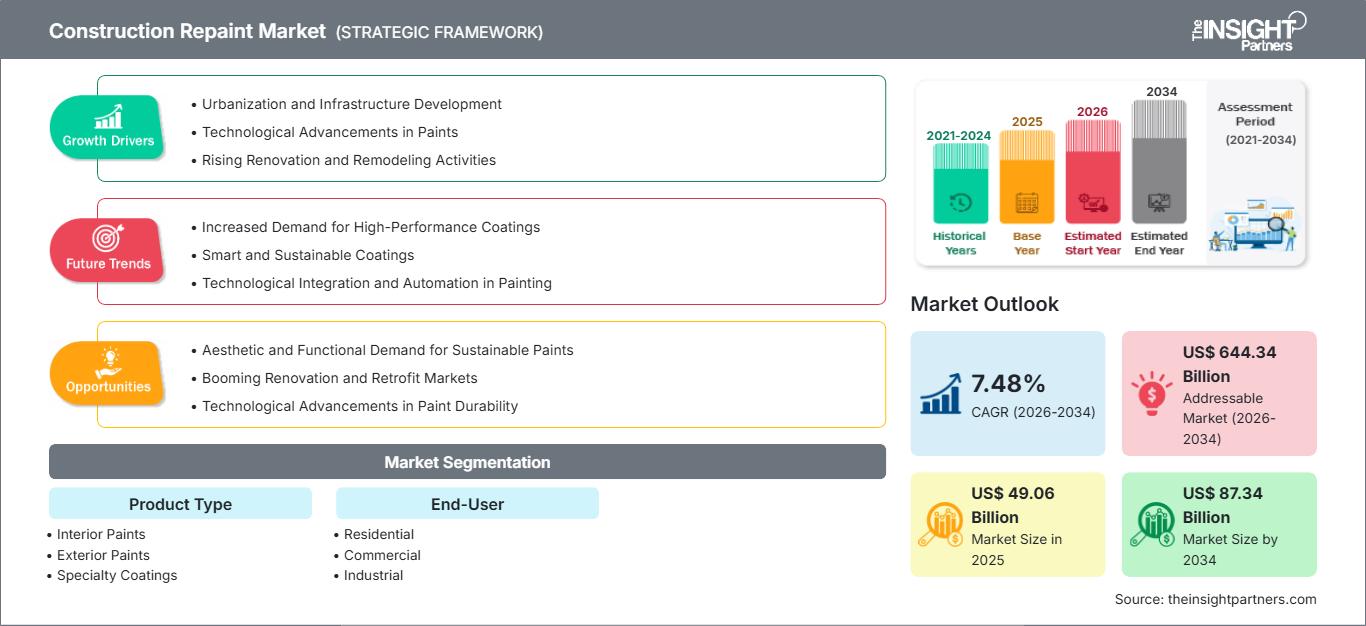
The Construction Repaint Market demand is being shaped by a large installed building base, recurring maintenance cycles, and a gradual shift toward higher-performance formulations. The Construction Repaint Market was valued at US$ 49.06 Billion in 2025 and is projected to reach US$ 87.34 Billion by 2034, expanding at a CAGR of 7.48% during 2026–2034. Growth reflects renovation activity alongside new construction and infrastructure maintenance across major economies.
North American demand is supported by aging housing stock, recurring remodeling expenditure, commercial refurbishment, and stricter environmental requirements. The Construction Repaint Market size in the region is expected to expand at an estimated 6.2–6.8% CAGR between 2026–2034. Water-borne formulations, premium exterior finishes, and contractor-led repainting are strengthening value realization as owners prioritize durability and lower maintenance frequency.
Construction Repaint Market Assessment and Insights
- North America: North America represented approximately 10–14% share in 2025 and is projected to expand at a 6.2–6.8% CAGR during 2026–2034, supported by remodeling, repainting, commercial maintenance, and premium coating adoption.
- US: The US accounted for approximately 82–86% of North American demand in 2025 and is expected to grow at a 6.3–6.9% CAGR during 2026–2034, led by residential repainting and renovation spending.
- Europe: Europe held approximately 14–18% share in 2025 and is expected to register a 5.5–6.2% CAGR through 2034, with Germany, the UK, France, Italy, and Spain supported by renovation and energy-efficiency programs.
- Asia Pacific: Asia Pacific represented approximately 50–54% share in 2025 and is forecast to grow at a 7.0–7.8% CAGR, with China, India, Japan, and South Korea benefiting from urban redevelopment, housing, and infrastructure activity.
- Largest Segment: Residential held approximately 55–60% market share in 2025 and is projected to grow at a 7.2–7.6% CAGR, supported by recurring repaint and renovation cycles.
- High Growth Segment: Infrastructure represented approximately 8–12% share in 2025 and is expected to advance at an 8.0–8.7% CAGR, reflecting public asset maintenance and protective refurbishment.
- Key companies analyzed in detail: The Sherwin-Williams Company, PPG Industries, Inc., Akzo Nobel N.V., RPM International Inc., Benjamin Moore & Co., Behr Paints, Nippon Paint Holdings Co., Ltd., Asian Paints Limited, Valspar Corporation, Hempel A/S, DuluxGroup, Jotun Group, Kansai Paint Co., Ltd., BASF Coatings GmbH, and Farrow & Ball.
Source: The Insight Partners' analysis based on proprietary research, government publications, company annual reports, investor presentations, industry databases, and expert interviews.
Advances in technology have favored water-based acrylic resins, low-VOCs, higher hiding power, stain resistance, weather-resistance, and fast drying. Technology advances that favor pigment dispersion, rheology and applicability are aimed at minimizing labor intensity and maximizing uniformity of coating finishes. The need for repaint services is greatly facilitated by existing construction networks and tinting technology. The architectural coatings market was a significant share of the coatings market in the US, while manufacturers in Europe were increasingly favoring sustainability and renovation specifications.
For the future, refurbishment-oriented countries will generate significantly higher repeat demands, and new Asian markets will offer volume opportunities. Research and investments will be focused on automated manufacturing, digital color specification, low-emissions, and local manufacturing. The renovation policy in Europe is highly significant because nearly 75% of the structures have poor energy performances and the rate of renovation per year stands at 1%.
Construction Repaint Market Report Scope
| Report Attribute | Details |
|---|---|
| Market size in 2025 | US$ 49.06 Billion |
| Market Size by 2034 | US$ 87.34 Billion |
| Global CAGR (2026 - 2034) | 7.48% |
| Historical Data | 2021-2024 |
| Forecast period | 2026-2034 |
Construction Repaint Market Analysis
Residential maintenance, commercial refurbishment, infrastructure renewal, and institutional upgrades form the core demand ecosystem. The Construction Repaint Market growth is therefore less dependent on new building completions than new-build coatings alone, because installed structures repeatedly require surface protection and aesthetic renewal. Paint companies procure resin, pigment, solvents, additives, and containers before they formulate, tint, distribute, and have their products applied by contractors. Pigment titanium dioxide, acrylic resin, and special additives continue to be critical cost components. Procurement efficiency and formulation efficiency continue to be key issues.
The supply chain continues to favor those companies which are able to combine regional manufacturing and wide distribution networks. The use of water-borne technology continues to become more significant as environmental demands and indoor air quality expectations increase, although there continue to be applications which require solvents for their properties. Industry statistics show that water-borne systems constituted more than 50 percent of architectural coatings production in 2025.
Competition is characterized by global scale, strong brands, contractor relationships, technical service, and localized manufacturing. The Construction Repaint Market analysis indicates that The Sherwin-Williams Company benefits from extensive professional distribution, while PPG Industries, Inc. emphasizes technology-led architectural solutions and international reach. Akzo Nobel N.V. continues to position decorative coatings around sustainability and operational efficiency, while Asian Paints Limited, Nippon Paint Holdings Co., Ltd., and Kansai Paint Co., Ltd. provide strong Asian market exposure.
Positioning is becoming more reliant on premiumization, product formulation differentiation, and control over distribution channels. While BASF Coatings GmbH and Hempel A/S enhance their capacity to offer specialty technologies, RPM International Inc. ensures diversified access through coating specialties. Investment is further made in automation, sustainable sourcing of raw materials, and energy-efficient production. In 2025, PPG focused on innovative architectural coatings and sustainable solutions, while AkzoNobel has been investing in the efficient production of decorative paints.
● REPORT CUSTOMIZATION
Tailor This Report To Align With Your Specific Business Requirements
This report can be customized to align precisely with your business objectives, scope, and target markets. Customization options include tailored segmentation, geography, competitive analysis, and strategic insights to support informed decision-making.
Customize This Report →WHAT YOU CAN ADJUST
- ● Segmentations
- ● Geography
- ● Competitive Analysis
- ● Language Preferences
Construction Repaint Market: Strategic Insights
Regional Insights
North America Construction Repaint Market
North America accounted for approximately 10–14% of the global Construction Repaint Market share in 2025 and is expected to expand at a 6.2–6.8% CAGR through 2034. This is complemented by well-entrenched repaint cycles, residential remodeling and maintenance activities, and professional contractor penetration. Projected spending on home improvement in the US market was estimated to be US$509 billion in 2025, which presents an ongoing large pool for coating use in renovations.
Demand drivers include aging buildings, climate-related exterior maintenance, and increasing VOC regulations. In Canada, renovation and energy efficiency improvements drive growth, while Mexico offers incremental volume from urbanization and the construction of houses. There is growing demand for high-performance interior coating finishes, exterior elastomeric coatings, and waterborne coatings as property owners require longer maintenance cycles.
U.S. Construction Repaint Market
The US represented approximately 82–86% of North American demand in 2025 and is forecast to grow at a 6.3–6.9% CAGR through 2034. Repainting residential buildings is still the primary use, driven by old buildings and considerable spending on home improvement. According to the American Coatings Association, architectural paints are anticipated to face pressure on value in 2025 but will bounce back with 3.9% value growth in 2026.
The industry is dominated by companies such as The Sherwin-Williams Company, PPG Industries, Inc., Benjamin Moore & Co., Behr Paints, and RPM International Inc. The interior painting segment is driven by remodeling activities, while the exterior segment benefits from weather exposure and maintenance. Contractors continue to be strategically significant, since they play an essential role in determining product choice, tinting needs, efficiency of application and repeat purchase of products.
Europe Construction Repaint Market
Europe held approximately 14–18% share in 2025 and is projected to grow at a 5.5–6.2% CAGR through 2034, with Germany serving as a leading market. The demand in the UK is driven by the aging of buildings and the need for refurbishment. The Germans renovate their buildings in terms of industry and energy efficiency, while France, Italy, and Spain enjoy demand through renovation of residential properties, holiday homes, and maintenance of public buildings.
The UK is shifting towards using low-emission decorative materials and long-lasting external cladding, whereas Germany focuses on energy-efficient renovations and long-lasting building materials. The demand for France comes from maintenance of residential and infrastructure renovations, while Italy and Spain add demand through renovation of old residential and hospitality buildings. It is important from the viewpoint of EU policy since the EU seeks to speed up building renovation at a pace of 1% per year.
APAC Construction Repaint Market
APAC represented approximately 50–54% share in 2025 and is expected to grow at a 7.0–7.8% CAGR, making it the leading regional market. China is still the biggest country market in terms of size, while India, Japan, South Korea, and Australia come next. Urban renewal, house building, construction spending, and middle-class consumption growth contribute to the need for periodic repainting.
China supplies the scale needed, while India shows a lot of promise in the future due to urbanization and house building. Japan places emphasis on refurbishment and premium quality and longevity, while South Korea and Australia help create demand through maintenance in commercial and residential areas.
Middle East & Africa Construction Repaint Market
Middle East and Africa accounted for approximately 8–10% of global demand in 2025 and is expected to expand at a 6.5–7.2% CAGR through 2034. The biggest market within the region is Saudi Arabia due to its extensive infrastructure development plans, whereas the United Arab Emirates takes advantage of the commercial, hospitality, and residential building activity.
Demand is greatly impacted by heat, ultraviolet rays, dust, and the presence. Development plans in Saudi Arabia offer scope for repaints as protection against harsh weather conditions, whereas premium architectural paints have been the focus of the United Arab Emirates. South Africa and the other parts of MEA are rather fragmented in nature.
Segmentation Analysis
Product Type
The Product Type segment of the Construction Repaint Market is projected to expand at a 6.0–6.4% CAGR during 2026–2034. Water-based products dominate routine architectural repainting because of lower VOC emissions, reduced odor, easier cleanup, and improved performance. Solvent-based systems remain relevant where substrate conditions, curing requirements, or durability specifications justify their use. The Construction Repaint Market scope therefore, continues to broaden as formulators improve water-borne performance.
- Interior Paints: Interior paints represent a core recurring category because walls, ceilings, and trim require periodic aesthetic and maintenance repainting. Demand is supported by residential refurbishment, hospitality upgrades, offices, and institutional facilities.
- Exterior Paints: Exterior paints require resistance to ultraviolet exposure, moisture, temperature variation, and weathering. Their strategic importance rises in regions experiencing severe climatic conditions and where property owners prioritize longer maintenance intervals.
- Specialty Coatings: Specialty coatings address functional requirements, including waterproofing, stain resistance, thermal performance, antimicrobial protection, and high durability. Their adoption supports premiumization and creates differentiation beyond conventional decorative finishes.
End-User
The End-User segment of the Construction Repaint Market is expected to register a 7.2–7.6% CAGR through 2034. Residential applications provide the largest recurring base, while commercial and institutional repainting offers specification-driven demand. Infrastructure is positioned for faster expansion as governments and asset owners increase maintenance of public structures. The Construction Repaint Market scope increasingly includes coatings selected for lifecycle performance rather than appearance alone.
- Residential: Residential repainting remains the largest application base, supported by routine interior refreshes, exterior maintenance, property upgrades, and renovation. Contractor loyalty, retail availability, digital color tools, and premium finishes influence purchasing decisions.
- Commercial: Commercial repainting covers offices, retail facilities, hospitality properties, and mixed-use buildings. Buyers prioritize low odor, quick return to service, durability, and coordinated color specifications to minimize operational disruption.
- Industrial: Industrial facilities require coatings capable of handling abrasion, chemicals, humidity, and frequent cleaning. Repainting is often linked to asset maintenance schedules, plant upgrades, safety requirements, and corrosion-control programs.
- Institutional: Schools, hospitals, government buildings, and other institutional assets create recurring demand for washable, low-emission, durable finishes. Procurement increasingly incorporates indoor-air-quality considerations and total maintenance costs.
- Infrastructure: Infrastructure repainting includes bridges, public facilities, transportation assets, and other long-life structures. Protective performance, weather resistance, and maintenance-cycle extension make this category strategically important for public and private asset owners.
Opportunity Snapshot
| End-User | Revenue Contribution | Trend Tag | Adoption Stage |
| Residential | High | Repaint Cycles | Mature |
| Commercial | Medium | Asset Refurbishment | Mature |
| Industrial | Medium | Plant Maintenance | Scaling |
| Institutional | Medium | Facility Renewal | Scaling |
| Infrastructure | Low | Asset Protection | Scaling |
Construction Repaint Market Growth Drivers and Impact Analysis
Aging Building Stock Increases Recurring Repaint Requirements
Aging structures form a stable consumption source since the process not only enhances the visual appeal but also protects the underlying materials against moisture, UV radiation, abrasions, and degradation. For developed economies, the existing building stock plays a greater role in the formation of coating demand compared to new additions to the stock annually. The US is one such economy where over 50% of owner-occupied structures have been established for more than 40 years. Aging is therefore conducive to repainting, even in situations where the transaction volume or new construction changes. This means that there is a tendency for manufacturers to produce coatings with longevity, ease of use, and adherence to substrate.
Environmental Regulation Accelerates Water-Borne Formulation Adoption
Product economics are being reshaped by environmental regulation through the creation of increased demand for low-VOC and waterborne coatings. Suppliers are developing acrylic dispersions, advanced rheology additives, coalescing technologies, and pigments to bridge traditional performance deficits with solvent-borne coatings. This has implications beyond the product formulation, affecting plant layout, waste management, packaging, and the training of contractors. Waterborne coatings account for a large part of architectural paint sales, and their position will be further bolstered by the need for indoor air quality. This influence is widespread through the value chain, as the raw material providers have to deliver chemistry in line with the regulations, and the manufacturers have to prove performance under challenging application conditions.
Infrastructure Maintenance Expands Protective Repainting Demand
As more infrastructure owners view the process of coating maintenance as a lifecycle management task and not merely a cosmetic one, there are chances for manufacturers who offer long-lasting products to benefit from. It is important to maintain the coating of bridges, buildings, transportation infrastructure, utilities, and other assets in order to avoid corrosion, water leaks, surface deterioration, and early replacements. This provides an opening for producers of high-performance external coatings, elastomeric coatings, protective primers, and other specialized types of coatings. In addition, infrastructure projects tend to be bigger compared to single house paint jobs; however, the purchasing cycle is more time-consuming and demanding. In this case, it is crucial to provide proper technical documentation, specifications, training for contractors, and project implementation.
Construction Repaint Market Future Trends
Digital Color Specification and Data-Led Product Selection
Digital color visualization, mobile ordering, automated tinting, and contractor management platforms are expected to become increasingly integrated into repaint purchasing. These tools can reduce specification errors, shorten quotation cycles, and improve color consistency across multi-site projects. Manufacturers may connect digital color systems with inventory information, technical documentation, and customer histories, creating more measurable purchasing journeys. The Construction Repaint Market trends are therefore likely to shift from product availability toward integrated service ecosystems. Retailers can use digital tools to increase premium product conversion, while professional distributors can improve replenishment accuracy. Over time, data collected from project-level transactions may also help manufacturers forecast regional color preferences, seasonal demand, and product substitution patterns, enabling more responsive production and inventory planning.
Functional Finishes Become More Important in Repainting
Repaints will be designed to offer more functions than just the traditional colors and appearances of the products. The functions like thermal-reflective paints, anti-microbial paint, stain-resistant property, self-cleaning property, water-resistant property, and weatherability property will allow owners of buildings to fulfill their operational needs by choosing the right type of paints. Such paints will be particularly useful for commercial, institutional, and infrastructure assets whose cost of maintenance can be higher than the cost of materials after a period of time. Suppliers need to provide multifunctional paints in order to reduce any difficulty in the application process. Premium functional paints will also serve as differentiators for suppliers in mature markets. The Construction Repaint Market trends will consequently favor products positioned around measurable performance outcomes, especially where owners can justify higher upfront costs through reduced maintenance frequency.
Construction Repaint Market Opportunities
Premium Repaint Systems for Aging Residential Properties
Manufacturers can target aging residential properties with bundled repaint systems combining primers, interior finishes, exterior protection, and complementary surface-preparation products. Such packages can simplify contractor selection while increasing average transaction value. Opportunity is strongest where homeowners are renovating older properties rather than relocating, because repainting becomes part of a broader maintenance decision. Suppliers can segment offerings by climate, substrate, and expected service interval, allowing premium products to address specific homeowner concerns. The Construction Repaint Market Forecasts point toward stronger value opportunities where brands demonstrate measurable coverage, durability, washability, and color retention rather than competing solely on price. Retailers and professional distributors can reinforce the strategy through project calculators, color visualization, technical support, and loyalty programs targeted at repeat contractors.
Localized Production for High-Growth Emerging Markets
Localized manufacturing and product formulation are possible in emerging markets due to variations in climate, substrate material, application methods, and cost considerations. Localized manufacturing allows for reduced risks in transport and quick responses to market needs as well as product formulations based on regional climate, substrate material, temperatures, and price. The markets in India and Southeast Asia present great prospects owing to an increased demand arising from increased construction and renovations, whereas in the Middle East, there is a need for specialized product performance on exteriors. Construction Repaint Market Forecasts can support location decisions by comparing regional renovation intensity, contractor density, housing growth, and infrastructure pipelines. Flexible production lines can further reduce risk by allowing manufacturers to serve both mainstream decorative and higher-margin specialty categories.
Recent Developments
- July 2026: M3M India partnered with Zydex Paints to introduce KEIM Regalan, a silicate mineral paint system from Germany-based KEIM, across its premium developments. The collaboration is expected to generate about ₹100 crore in exterior façade painting works over the next three years.
- June 2026: Beckers Group through its joint venture Berger-Becker Coatings opened a state-of-the-art resin manufacturing plant in Nagpur, India. The plant, which was inaugurated by Fabio Pedrazzi, CEO of Lindéngruppen, on May 28, 2026, is part of Beckers Group’s long-term strategy to expand production capacity, enhance supply chain resilience and accelerate the adoption of more sustainable coating technologies globally.
Frequently Asked Questions

- Comprehensive Market Sizing and Forecast Analysis
- Detailed Segmentation Analysis
- In-Depth Market Dynamics Assessment
- Regional and Country-Level Insights
- Competitive Landscape and Company Benchmarking
- Strategic Business Intelligence
Recent Reports
Testimonials

The Insight Partners' SCADA System Market report is comprehensive, with valuable insights on current trends and future forecasts. The team was highly professional, responsive, and supportive throughout. We are very satisfied and highly recommend their services.
RAN KEDEM Partner, Reali Technologies LTDs
I requested a report on a very specific software market and the team produced the report in a few days. The information was very relevant and well presented. I then requested some changes and additions to the report. The team was again very responsive and I got the final report in less than a week.
JEAN-HERVE JENN Chairman, Future Analytica
We worked with The Insight Partners for an important market study and forecast. They gave us clear insights into opportunities and risks, which helped shape our plans. Their research was easy to use and based on solid data. It helped us make smart, confident decisions. We highly recommend them.
PIYUSH NAGPAL Sr. Vice President, High Beam Global
The Insight Partners delivered insightful, well-structured market research with strong domain expertise. Their team was professional and responsive throughout. The user-friendly website made accessing industry reports seamless. We highly recommend them for reliable, high-quality research services
YUKIHIKO ADACHI CEO, Deep Blue, LLC.
This is the first time I have purchased a market report from The Insight Partners.While I was unsure at first, I visited their web site and felt more comfortable to take the risk and purchase a market report.I am completely satisfied with the quality of the report and customer service. I had several questions and comments with the initial report, but after a couple of dialogs over email with their analyst I believe I have a report that I can use as input to our strategic planning process.Thank you so much for taking the extra time and making this a positive experience.I will definitely recommend your service to others and you will be my first call when we need further market data.
JOHN SUZUKI President and Chief Executive Officer, Board Director, BK Technologies
I wish to appreciate your support and the professionalism you displayed in the course of attending to my request for information regarding to infectious disease IVD market in Nigeria. I appreciate your patience, your guidance, and the fact that you were willing to offer a discount, which eventually made it possible for us to close a deal. I look forward to engaging The Insight Partners in the future, all thanks to the impression you have created in me as a result of this first encounter.
DR CHIJIOKE ONYIA MANAGING DIRECTOR, PineCrest Healthcare Ltd.Reason to Buy
- Informed Decision-Making
- Understanding Market Dynamics
- Competitive Analysis
- Identifying Emerging Markets
- Customer Insights
- Market Forecasts
- Risk Mitigation
- Boosting Operational Efficiency
- Strategic Planning
- Investment Justification
- Tracking Industry Innovations
- Aligning with Regulatory Trends





 Get Free Sample for