
Construction Silicone Sealants Market Growth, Trends & Forecast by 2034
Construction Silicone Sealants Market Size and Forecasts (2021–2034), Global and Regional Share, Trends, and Growth Opportunity Analysis Report Coverage : by Type (One component and Two component); Application (Windows & Doors System, Structural Bonding, Decoration, Insulating Glass); End Use (Residential, Commercial, Industrial); and Geography (North America, Europe, Asia Pacific, and South and Central America)
- Status : Data Released
- Report Code : TIPRE00040323
- Category : Chemicals and Materials
- No. of Pages : 150
- Available Report Formats :


- Last update date : September 01, 2026


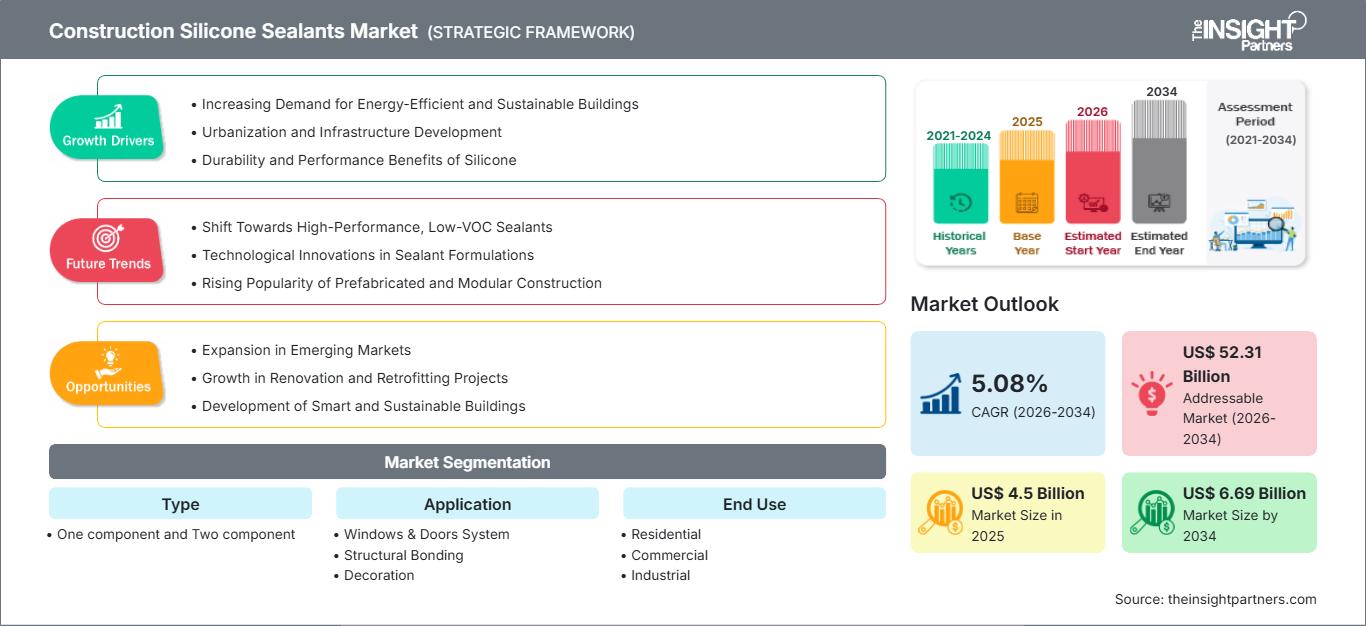
2025 Market Size
US$ 4.5 Bn
Base year value
2034 Forecast
US$ 6.69 Bn
Projected by 2034
CAGR 2026-2034
5.08 %
Growth rate
Addressable Market
US$ 52.31 Bn
(2026-2034)
The Construction Silicone Sealants Market size is valued at US$ 4.5 Billion in 2025 and is projected to reach US$ 6.69 Billion by 2034, registering a CAGR of 5.08% from 2026 to 2034. Demand is anchored in building envelopes, glazing, façades, windows, doors, and insulating glass, where silicone provides durable weather resistance, elastic movement capability, adhesion, and long service performance across demanding construction environments.
North America is expected to maintain steady momentum, with the construction silicone sealants size supported by renovation of aging commercial buildings, energy-efficiency requirements, and continued demand for high-performance façade and glazing systems. The regional market is estimated to expand at a 4.2–4.6% CAGR between 2026 and 2034. Structural drivers include building-envelope retrofits and stricter requirements for airtightness, moisture control, and long-term joint performance.
Construction Silicone Sealants Market Assessment and Insights
- North America: North America is expected to represent a 21–24% Construction Silicone Sealants Market share in 2025 and grow at a 4.2–4.6% CAGR between 2026 and 2034, supported by renovation, commercial glazing, energy-performance upgrades, and durable façade specifications.
- US: The US accounts for approximately 78–82% of North American demand in 2025 and is projected to grow at a 4.1–4.5% CAGR between 2026 and 2034, led by commercial retrofits and glazing.
- Europe: Europe is estimated to hold a 19–22% share in 2025 and expand at a 3.6–4.0% CAGR between 2026 and 2034, with Germany, the UK, France, Italy, and Spain supported by renovation and energy-efficiency requirements.
- Asia Pacific: Asia Pacific is estimated to command a 44–48% share in 2025 and record a 5.6–6.0% CAGR between 2026 and 2034, led by China, India, Japan, and South Korea amid urban construction and manufacturing investment.
- Largest Segment: One component is estimated to hold a 64–68% market share in 2025, supported by ready-to-use installation, and grow at a 4.5–4.9% CAGR through 2034.
- High Growth Segment: Two component formulations are estimated at a 32–36% share in 2025 and are projected to grow at a 5.8–6.3% CAGR through 2034, driven by structural applications.
- Key companies analyzed in detail: BASF SE, Dow Inc., Wacker Chemie AG, Elkem ASA, Momentive Performance Materials Inc., Shin-Etsu Chemical Co., Ltd., Sika AG, Bostik SA, H.B. Fuller Company, and KCC Corporation.
Source: The Insight Partners' analysis based on proprietary research, government publications, company annual reports, investor presentations, industry databases, and expert interviews.
The global market for construction silicone sealants has changed from standard joint sealing products to more sophisticated envelope solutions that need specific properties such as control of modulus, better adherence to substrates, movement tolerance, resistance to environmental factors, and compatibility with glass, aluminum, concrete, stone, and other coatings. Silicone products include neutral curing formulas, low modulus types, structural glazing materials, and enhanced toolability features.
Potential future demand will probably be limited to areas experiencing extensive renovations and growing urbanization in Asia. Due to stricter regulations on building performance and certification of green buildings, along with façade engineering requirements and lifecycle costs analysis, there is a trend towards greater significance of longevity rather than lower cost of the product itself. Localization of capacity is another strategic factor as the production of silicones needs to consider the construction cycle, raw material availability, logistics expenses, and customer qualifications in various regions.
Construction Silicone Sealants Market Report Scope
| Report Attribute | Details |
|---|---|
| Market size in 2025 | US$ 4.5 Billion |
| Market Size by 2034 | US$ 6.69 Billion |
| Global CAGR (2026 - 2034) | 5.08% |
| Historical Data | 2021-2024 |
| Forecast period | 2026-2034 |
Construction Silicone Sealants Market Analysis
Construction Silicone Sealants Market growth is heavily influenced by construction, façade complexity, glazing penetration, and renovation investment. The demand starts from silicones intermediates and formulation components prior to moving down the value chain including formulation, packaging, distributors, specialist applicators, façade contractors, window makers, and building owners. Product choice considerations include compatibility of the substrates, movement, cure requirements, weathering, and specifications.
Supply factors increasingly reward manufacturers that offer in-house silicone technology, local manufacturing, technical services, and qualification history. Cost of raw materials, energy, and shipping influence the economics of formulations, while the customers in the construction industry require reliable supply in long-running projects. Local manufacturing may provide an advantage especially in the growing markets in Asia Pacific and Middle East.
The Construction Silicone Sealants market is experiencing competition in the areas of chemical performance, application engineering, certification, geographical distribution, and technical service. Dow Inc. and Wacker Chemie AG have a competitive advantage in silicone technology; however, BASF SE, Elkem ASA, Momentive Performance Materials Inc., and Shin-Etsu Chemical Co., Ltd. have extensive expertise in silicone and special materials technologies. Sika AG, Bostik SA, H.B. Fuller Company, and KCC Corporation are competing through their construction systems, formulated sealants, distribution channels, and specification capabilities.
More strategic positioning in the Construction Silicone Sealants Market is being done based on application-specific products, rather than generic sealants. Investments are being made in regional manufacturing, formulation labs, technical centers, and sustainability claims. Acquisition of business will be an important factor that will increase access to the construction industry, and special grade product development will help companies protect margin from commodity competition.
● REPORT CUSTOMIZATION
Tailor This Report To Align With Your Specific Business Requirements
This report can be customized to align precisely with your business objectives, scope, and target markets. Customization options include tailored segmentation, geography, competitive analysis, and strategic insights to support informed decision-making.
Customize This Report →WHAT YOU CAN ADJUST
- ● Segmentations
- ● Geography
- ● Competitive Analysis
- ● Language Preferences
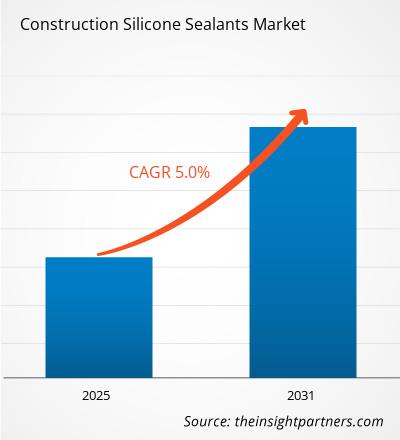
Construction Silicone Sealants Market: Strategic Insights
Regional Insights
North America Construction Silicone Sealants Market
North America is estimated to account for a 21–24% share in 2025 and is expected to expand at a 4.2–4.6% CAGR through 2034. The US represents the principal demand center, while Canada contributes through commercial construction, residential renovation, institutional buildings, and infrastructure-related activity. Demand increasingly comes from replacement windows, curtain walls, façades, and building-envelope rehabilitation.
Advantages of the regional Construction Silicone Sealants Market include advanced standards, experienced contractors, and high standards for weatherproofing and accommodating movement. Retrofits of commercial buildings provide a relatively resilient demand foundation during slowdowns in the construction cycle. Silicone systems with low staining, no primer adhesion, wide temperature range, and performance history are especially important in the context of stone, masonry, glass, and aluminum substrates.
U.S. Construction Silicone Sealants Market
The US represents approximately 78–82% of North American Construction Silicone Sealants Market in 2025 and is projected to grow at a 4.1–4.5% CAGR through 2034. Renovation of construction works, commercial glazing, institutional constructions, and refurbishment of deteriorating building envelopes drive consumption.
Product certification depends on specification requirements, ASTM standards, façade engineering practices, and familiarity of contractors with reputable brand names.
International companies such as Sika AG, Dow Inc., H.B. Fuller Company, Bostik SA and others maintain both commercial and technical footprint throughout the country. Usage areas involve glazing and fenestration systems, bonding applications, decorative purposes and insulated glass units. Specialized usage involves construction of data centers, health care facilities, offices, and multi-family residential constructions where durability and resistance to weather conditions take priority.
Europe Construction Silicone Sealants Market
Europe is estimated to hold a 19–22% Construction Silicone Sealants Market in 2025 and is expected to register a 3.6–4.0% CAGR through 2034. Germany constitutes one of the most prominent markets, being backed up by industrial capacity and the need for refurbishment. Markets of the UK, France, Italy, and Spain are also driven by refurbishment of residential properties, commercial facades, windows, and energy-saving measures.
In the UK market, building refurbishment and concern about energy efficiency plays an important role. Germany has a solid background of facade engineering, production of windows, and industrial construction. France, Italy, and Spain are characterized by renovation schemes combined with commercial and residential construction, although the demand depends on each country’s cycle of construction.
APAC Construction Silicone Sealants Market
APAC is estimated to represent a 44–48% Construction Silicone Sealants Market in 2025 and is projected to grow at a 5.6–6.0% CAGR through 2034. China is still the leading player, whereas India, Japan, South Korea, and Australia offer considerable demand. Building developments, facades constructions, windows production, and industries create regional demand.
China has big constructions projects coupled with strong silicone manufacturing industry. Housing, commercial buildings, and infrastructure development drive the growth in India, while Japan and South Korea focus on quality materials. Residential construction drives the demand in Australia. There is a trend in local production and technological services from manufacturers in the region along with increased energy efficiency.
Middle East & Africa Construction Silicone Sealants Market
Middle East and Africa demand is expected to expand at a 5.7–6.1% CAGR through 2034, with Saudi Arabia and the UAE serving as leading markets. Large commercial developments, hospitality projects, transportation infrastructure, and high-rise construction support consumption of durable façade and glazing sealants.
South Africa remains an important African market, while the rest of the region offers selective opportunities tied to urbanization and infrastructure investment. Extreme heat, ultraviolet exposure, dust, and temperature variation increase the importance of weather-resistant formulations. Saudi Arabia's large development pipeline and the UAE's concentration of high-value commercial projects provide particularly attractive applications for structural glazing, insulating glass, and façade weatherproofing.
Segmentation Analysis
Type
Type segmentation in the Construction Silicone Sealants Market distinguishes one-component and two-component technologies according to formulation and curing requirements. The segment is expected to grow at a 4.8–5.2% CAGR between 2026 and 2034. Ready-to-use products remain important for conventional applications, while two-component systems gain relevance where controlled curing and high-performance structural bonding are required.
- One component: One-component sealants remain widely adopted because they are ready to apply, require limited site preparation, and cure through atmospheric moisture. They are strategically important for windows, doors, decoration, and general façade sealing.
- Two component: Two-component formulations support controlled curing and are suited to demanding structural and factory-applied applications. Their importance increases where productivity, deeper-section curing, and consistent performance are priorities.
Application
Application demand is expected to expand at a 5.0–5.4% CAGR during 2026–2034, reflecting broader use of silicone in building envelopes and architectural systems. Product selection depends on movement, substrate compatibility, aesthetic requirements, curing conditions, and required service life.
- Windows & Doors System: Silicone sealants provide weather resistance and flexible joint performance around window and door assemblies. Demand benefits from replacement programs, façade upgrades, improved thermal envelopes, and higher-quality fenestration systems.
- Structural Bonding: Structural bonding uses high-performance silicone to connect façade components while accommodating movement and environmental exposure. Adoption is strategically significant in curtain walls, architectural glazing, and engineered façade systems.
- Decoration: Decorative applications include perimeter sealing, trim interfaces, and aesthetically sensitive joints. Color availability, low staining, smooth tooling, and substrate adhesion influence product selection in residential and commercial interiors.
- Insulating Glass: Insulating-glass applications require dependable adhesion, moisture control, and long-term seal integrity. Demand is supported by energy-efficient glazing, improved window systems, and building-envelope specifications emphasizing thermal performance.
End Use
End-use demand is projected to increase at a 4.9–5.3% CAGR through 2034. Commercial projects remain strategically important because façades, glazing, and complex building envelopes consume higher-performance formulations. Residential renovation provides recurring volume, while industrial projects require specialized performance.
- Residential: Residential demand is supported by new housing, window replacement, kitchen and bathroom applications, and refurbishment. Ease of application and long-lasting weather resistance remain important purchasing considerations.
- Commercial: Commercial construction represents the strongest value pool because offices, retail buildings, hotels, healthcare facilities, and high-rise developments use extensive glazing and façade systems requiring specification-grade sealants.
- Industrial: Industrial demand includes factories, warehouses, specialized facilities, and infrastructure-related buildings. Applications prioritize durability, substrate compatibility, temperature resistance, and reliable performance under demanding operating conditions.
Opportunity Snapshot
| Application | Revenue Contribution | Trend Tag | Adoption Stage |
|---|---|---|---|
| Windows & Doors System | High | Envelope Retrofit | Mature |
| Structural Bonding | High | Façade Engineering | Scaling |
| Decoration | Medium | Aesthetic Sealing | Mature |
| Insulating Glass | High | Thermal Glazing | Scaling |
Construction Silicone Sealants Market Growth Drivers and Impact Analysis
Energy-efficient building envelopes and renovation requirements
The Construction Silicone Sealants Market forecast indicates that energy-efficiency policies are increasing attention on leakage, moisture intrusion, thermal bridging, and envelope durability. Sealants form a relatively small material component of a building but can influence the performance of joints around glazing, façades, windows, and doors. Renovation programs therefore create demand even when new-build construction slows. The commercial advantage is most pronounced with those materials that have the potential to provide longevity of service, proven mobility and compatibility with contemporary substrates. For suppliers, this allows for the bundling of their sealants with overall façade or waterproofing systems, providing specification on a project rather than single-product level. Such a trend will move purchasing towards technical competence, warranty backing and performance over the life cycle of the building. As such, the growing awareness of operating costs will allow for justified premium pricing.
Expansion of architectural glazing and high-performance façades
The trend toward large glazing surfaces, curtain walls, prefabricated façades, and complicated interfaces of glass, metal, stone, concrete, and composite materials characterizes contemporary architecture. In order to absorb any possible differential movements while remaining bonded and resistant to the weather, sealants with such properties are needed. This need makes silicone especially popular since its elasticity and resistance to the environment are suitable for exposed joints. In addition, more stringent quality control is necessary for structural and insulating-glass applications compared to standard caulking. Thus, there is an opportunity for manufacturers of sealants to develop products for certain façade constructions as well as provide assistance in their proper design to architects, façade designers, fabricators, and contractors.
Regionalization of silicone production and construction supply chains
The need for reliable material supply in construction projects is becoming more pressing due to the potential of delays of specialized components in affecting installation timetables and project turnovers. Consequently, silicone companies are finding themselves caught between centralization of their chemical production and regionalization of formulation, packaging, technical services, and distribution. Asia-Pacific will continue to be a priority for mass production capacity, whereas Europe, North America, and the Middle East will have to rely on regional capacity due to their specification-heavy projects. Regional capacity may offer reduced exposure to transport risks, faster response time, and customization according to climatic conditions and local standards. Regional capacity will also allow for suppliers' involvement in the project design phase via technical centers and applications testing facilities. The effect on the market is a slow transition from pure price competition to supply reliability, certification, technical services, and application engineering.
Construction Silicone Sealants Market Future Trends
Low-carbon and documentation-ready silicone formulations
The Construction Silicone Sealants Market trends are moving toward products supported by clearer environmental documentation, lower emissions, and lifecycle-oriented performance evidence. Architects, contractors, and building owners increasingly need product information compatible with green-building assessments and procurement requirements. Future formulations are likely to emphasize reduced embodied impacts while maintaining adhesion, movement capability, durability, and weather resistance. Product carbon footprint declarations, environmental product documentation, and transparent ingredient information could become more influential in specification decisions. Manufacturers will increasingly differentiate products through verified environmental performance rather than broad sustainability claims. This shift can favor technically integrated suppliers that control formulation, manufacturing, testing, and documentation. It may also encourage closer collaboration among silicone producers, façade manufacturers, architects, and certification organizations to establish application-specific benchmarks for durability and environmental performance.
Automation and factory-applied façade sealing
The Construction Silicone Sealants Market report shows that factory-controlled construction processes are expected to influence product development by increasing demand for consistent rheology, predictable curing, automated dispensing, and repeatable adhesion. Prefabricated façades and modular window systems can reduce installation time while transferring more quality control from construction sites to manufacturing facilities. Sealant suppliers will therefore need to formulate products compatible with automated equipment, controlled humidity, robotic dispensing, and defined production cycles. Two-component technologies may gain strategic relevance where rapid or independently controlled curing improves throughput. Digital quality records could also connect material batches with production parameters and installation documentation. For suppliers, this trend creates opportunities to move upstream into manufacturing-system integration rather than competing only at the cartridge level. The resulting business model can include formulation, dispensing guidance, testing, and process support.
Construction Silicone Sealants Market Opportunities
Localized production for emerging construction corridors
The construction silicone sealants Forecasts indicate opportunities for suppliers that establish formulation and distribution capabilities close to rapidly developing construction corridors. India, Southeast Asia, the Middle East, and selected Eastern European markets combine expanding urban development with increasing use of modern façades and energy-efficient windows. Local facilities can shorten delivery times, reduce inventory requirements, and improve responsiveness to regional climate and substrate conditions. Investors should prioritize locations offering access to silicone intermediates, skilled formulation personnel, construction-material distributors, and large project pipelines. Partnerships with window manufacturers and façade contractors can accelerate product qualification and improve recurring sales. Rather than competing primarily through low prices, suppliers can target specialized grades for high-temperature exposure, insulating glass, structural glazing, and low-emission buildings. This approach supports stronger margins while reducing dependence on imported finished products.
Specification partnerships across façade and glazing ecosystems
A second opportunity lies in building stronger specification relationships with architects, façade consultants, glass processors, window manufacturers, and engineering contractors. Product selection frequently occurs before material procurement, meaning early technical acceptance can influence downstream purchasing for the duration of a project. Suppliers can develop application-specific technical packages covering substrate compatibility, movement capability, curing, joint design, testing, and maintenance requirements. Training programs for fabricators and installers can further reduce application failures and strengthen brand preference. Strategic account teams can prioritize developers with standardized building designs, hotel chains, commercial property groups, and large façade contractors where product replication creates recurring demand. The approach also enables suppliers to gather field-performance data, refine formulations, and identify emerging requirements before they become standardized specifications across major construction programs.
Recent Developments
- August 2026: H.B. Fuller Company (“H.B. Fuller” or “the Company”) (NYSE: FUL), the world’s largest pureplay adhesives company, confirmed receipt of an unsolicited proposal today from Ancora Holdings Group to acquire its Building Adhesives Solutions (“BAS”) business for between $1.1 billion and $1.2 billion in cash.
- May 2026: Euro Panel Products, known as Eurobond, incorporated Euro Sealant Private as a majority-owned subsidiary, marking its diversification from aluminium composite panels into the sealants market. The company said Euro Sealant will offer professional-grade silicone sealants for applications across glass, metal, brick, concrete, aluminium, composites and panel materials. The products are designed for sealing, waterproofing and structural bonding in modern construction.
Frequently Asked Questions

- Comprehensive Market Sizing and Forecast Analysis
- Detailed Segmentation Analysis
- In-Depth Market Dynamics Assessment
- Regional and Country-Level Insights
- Competitive Landscape and Company Benchmarking
- Strategic Business Intelligence
Recent Reports
Testimonials

The Insight Partners' SCADA System Market report is comprehensive, with valuable insights on current trends and future forecasts. The team was highly professional, responsive, and supportive throughout. We are very satisfied and highly recommend their services.
RAN KEDEM Partner, Reali Technologies LTDs
I requested a report on a very specific software market and the team produced the report in a few days. The information was very relevant and well presented. I then requested some changes and additions to the report. The team was again very responsive and I got the final report in less than a week.
JEAN-HERVE JENN Chairman, Future Analytica
We worked with The Insight Partners for an important market study and forecast. They gave us clear insights into opportunities and risks, which helped shape our plans. Their research was easy to use and based on solid data. It helped us make smart, confident decisions. We highly recommend them.
PIYUSH NAGPAL Sr. Vice President, High Beam Global
The Insight Partners delivered insightful, well-structured market research with strong domain expertise. Their team was professional and responsive throughout. The user-friendly website made accessing industry reports seamless. We highly recommend them for reliable, high-quality research services
YUKIHIKO ADACHI CEO, Deep Blue, LLC.
This is the first time I have purchased a market report from The Insight Partners.While I was unsure at first, I visited their web site and felt more comfortable to take the risk and purchase a market report.I am completely satisfied with the quality of the report and customer service. I had several questions and comments with the initial report, but after a couple of dialogs over email with their analyst I believe I have a report that I can use as input to our strategic planning process.Thank you so much for taking the extra time and making this a positive experience.I will definitely recommend your service to others and you will be my first call when we need further market data.
JOHN SUZUKI President and Chief Executive Officer, Board Director, BK Technologies
I wish to appreciate your support and the professionalism you displayed in the course of attending to my request for information regarding to infectious disease IVD market in Nigeria. I appreciate your patience, your guidance, and the fact that you were willing to offer a discount, which eventually made it possible for us to close a deal. I look forward to engaging The Insight Partners in the future, all thanks to the impression you have created in me as a result of this first encounter.
DR CHIJIOKE ONYIA MANAGING DIRECTOR, PineCrest Healthcare Ltd.Reason to Buy
- Informed Decision-Making
- Understanding Market Dynamics
- Competitive Analysis
- Identifying Emerging Markets
- Customer Insights
- Market Forecasts
- Risk Mitigation
- Boosting Operational Efficiency
- Strategic Planning
- Investment Justification
- Tracking Industry Innovations
- Aligning with Regulatory Trends





 Get Free Sample for