
Flexographic Printing Market Trends, Share & Demand by 2034
Flexographic Printing Market Size and Forecasts (2021–2034), Global and Regional Share, Trends, and Growth Opportunity Analysis Report Coverage : By Offering (Flexographic Printing Machine, Flexographic Printing Ink), Application (Corrugated Packaging, Flexible Packaging, Labels & Tags), Automation Type (Automatic, Semi-automatic)
- Status : Data Released
- Report Code : TIPRE00039436
- Category : Electronics and Semiconductor
- No. of Pages : 150
- Available Report Formats :


- Last update date : September 09, 2026


2025 Market Size
US$ 9.69 Bn
Base year value
2034 Forecast
US$ 13.84 Bn
Projected by 2034
CAGR 2026-2034
4.04 %
Growth rate
Addressable Market
US$ 106.87 Bn
(2026-2034)
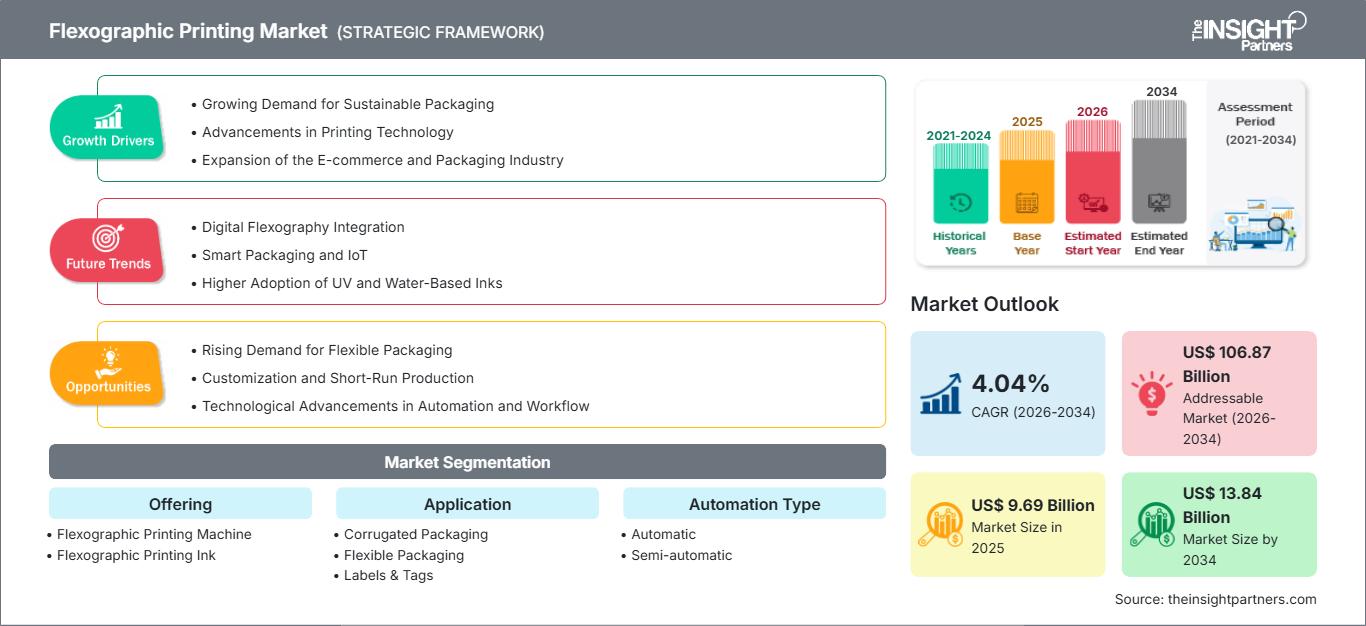
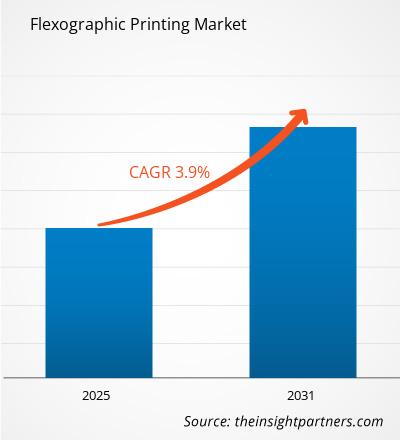
The Flexographic Printing Market size is undergoing a measured expansion as packaging converters prioritize high-throughput production, substrate versatility, and automated process control. The market is valued at US$ 9.69 Billion in 2025 and is projected to reach US$ 13.84 Billion by 2034, advancing at a CAGR of 4.04% during 2026–2034. Demand is supported by sustained packaging consumption, modernization of installed press capacity, and improvements in inks, plates, drying, registration, and workflow automation.
North America remains an established demand center, with an estimated 2.0–2.5% CAGR through 2034. The region benefits from sophisticated packaging converters, established corrugated production, and investment in automated presses that reduce setup waste and operator dependency. Growing requirements for shorter production cycles, consistent color reproduction, and recyclable packaging structures are encouraging converters to upgrade equipment rather than rely solely on legacy press configurations.
Flexographic Printing Market Assessment and Insights
- North America: North America is estimated to hold a 25–29% Flexographic Printing Market share in 2025 and grow at a 2.0–2.5% CAGR between 2026–2034, supported by mature packaging conversion, equipment replacement, automation, and high-value label production.
- US: The US represents 82–86% of North America's 2025 market, expanding at a 2.0–2.4% CAGR between 2026–2034 as converters modernize capacity and optimize packaging workflows.
- Europe: Europe accounts for a 24–28% share in 2025 and is expected to grow at a 1.8–2.3% CAGR between 2026–2034, led by Germany, Italy, the UK, France, and Spain, where automation and sustainable packaging requirements influence equipment investment.
- Asia Pacific: Asia Pacific holds a 36–40% share in 2025 and is projected to expand at a 5.0–5.5% CAGR between 2026–2034, with China, India, and Japan benefiting from packaging conversion capacity, exports, and industrial modernization.
- Largest Segment: Flexographic Printing Machine is estimated at a 62–66% market share in 2025, growing at a 4.0–4.5% CAGR during 2026–2034 as converters replace aging equipment.
- High Growth Segment: Labels & Tags holds a 18–22% market share in 2025 and is expected to grow at a 4.8–5.3% CAGR between 2026–2034, supported by SKU proliferation and shorter runs.
- Key companies analyzed in detail: Bobst Group SA, Mark Andy, Inc., Windmöller & Hölscher KG, Heidelberger Druckmaschinen AG, MPS Systems B.V., Nilpeter A/S, Amcor plc, Rotatek S.A., Koenig & Bauer AG, Comexi Industries S.A.U.
Source: The Insight Partners' analysis based on proprietary research, government publications, company annual reports, investor presentations, industry databases, and expert interviews.
Flexographic Printing Market has shifted from a process dominated by mechanical aspects in the pressroom to one that incorporates digital monitoring and servo control of processes. Progress has been achieved through improvements in plate making, anilox, ink feeding, drying, registration, and automatic make-ready, resulting in greater attainable consistency and reduction in downtime. Packaging applications continue to serve as the primary production basis, namely corrugated and flexible packaging. The recent data shows that packaging and labels made up 62% of the overall printing market in 2025, out of which flexography comprised 43%.
Through the forecast period, investment will be directed towards connected presses, reduced-waste production processes, aqueous and energy-saving curing systems, and presses suitable for varied substrates. The Asian region will show more growth than Western markets, whereas European regulation on recycling packaging will affect press and ink selection. Converters in North America will be more concerned with increased efficiency and labor-saving, and the need to replace old equipment.
Flexographic Printing Market Report Scope
| Report Attribute | Details |
|---|---|
| Market size in 2025 | US$ 9.69 Billion |
| Market Size by 2034 | US$ 13.84 Billion |
| Global CAGR (2026 - 2034) | 4.04% |
| Historical Data | 2021-2024 |
| Forecast period | 2026-2034 |
Flexographic Printing Market Analysis
Flexographic Printing Market growth will continue to be strongly correlated with packaging production, where the majority of market opportunity will come from large ongoing markets for corrugated board, flexible packaging, and label printing. The industry ecosystem includes press OEMs, consumables suppliers, material suppliers, converters, brand owners, and other players. Packaging print demand is resilient due to requirements for continuous print on food, beverages, healthcare, household goods, and e-commerce products. Growth in the industry is thus more robust than discretionary commercial print volume.
Supply factors in the Flexographic Printing Market are increasingly being driven by automation, component availability, efficiency, and service capability. Competition among press OEMs centers on changeover time, substrate range, inline inspection, and remote diagnostics, whereas competition for consumables is based on ink and plate performance characteristics. Converters evaluate total cost per job rather than only machine speed, which favors the integrated equipment ecosystems and drives development of long-term relationships between press manufacturers and packaging producers.
Market assessment shows that the competitive landscape of the Flexographic Printing Market consists of two segments – diversified packaging technology groups and press manufacturers specializing in flexographic equipment. Among diversified companies, Bobst Group SA, Mark Andy, Inc., Windmöller & Hölscher KG, Heidelberger Druckmaschinen AG, and Koenig & Bauer AG compete via press platforms, automation, workflow integration, and global service networks. MPS Systems B.V., Nilpeter A/S, Rotatek S.A., and Comexi Industries S.A.U. have stronger specialist positions in labels and flexible packaging; whereas Amcor plc is participating in the market as packaging converter and technology provider.
Investment strategies in the Flexographic Printing Market are increasingly focusing on hybridization, automation, and waste reduction opportunities. Mark Andy is expanding digital-hybrid solutions in addition to conventional flexographic platform; HEIDELBERG is incorporating automated plate inspection and high-volume inline flexo printing; BOBST and Comexi are focusing on automated set-up and production efficiency. Competitive advantage is thus moving away from stand-alone press specifications to integration into workflow, flexibility, response capability, and sustainable substrate change management.
● REPORT CUSTOMIZATION
Tailor This Report To Align With Your Specific Business Requirements
This report can be customized to align precisely with your business objectives, scope, and target markets. Customization options include tailored segmentation, geography, competitive analysis, and strategic insights to support informed decision-making.
Customize This Report →WHAT YOU CAN ADJUST
- ● Segmentations
- ● Geography
- ● Competitive Analysis
- ● Language Preferences
Flexographic Printing Market: Strategic Insights
Regional Insights
North America Flexographic Printing Market
North America held an estimated 25–29% share in 2025 and is projected to expand at a 2.0–2.5% CAGR through 2034. The US market leads in regional demand, thanks to big converters, flexible packaging companies, and experienced label suppliers. Canada is also contributing with its food, beverage, and industrial packaging applications. The need for replacements is still strong with converters keeping the balance between old equipment and automation.
Growth will be linked more and more to labor productivity and flexibility of production. Printers of packaging are introducing servo controls, automation for registration, inspection, and faster changeovers of machines in order to cope with short runs without adding to personnel. E-commerce and food distribution ensure the demand for corrugated packaging, while healthcare and consumer goods ensure the demand for labels and flexible packaging.
U.S. Flexographic Printing Market
The US represented an estimated 82–86% of North America's 2025 market and is forecast to grow at a 2.0–2.4% CAGR through 2034. Demand is driven by corrugated packaging, flexible packaging, and label converting companies producing products for food and beverages, health care, household, and industrial sectors. Packaging organizations are using automation to optimize their production processes.
Companies have a wide geographical presence and include Bobst Group SA, Mark Andy, Inc., Heidelberger Druckmaschinen AG, Amcor plc, and Koenig & Bauer AG catering to diverse needs of presses and packaging. Technology trends are moving towards machines that can handle a variety of job lengths and substrates. There is a definite business opportunity when automation can lower manpower costs without compromising press efficiency.
Europe Flexographic Printing Market
Europe accounted for an estimated 24–28% share in 2025 and is expected to grow at a 1.8–2.3% CAGR through 2034, with Germany serving as a leading market. The UK and Germany maintain substantial packaging conversion bases, while France, Italy, and Spain provide important equipment and flexible packaging demand.
The UK combines mature label and packaging conversion with investment in efficient short-run production. Germany benefits from advanced machinery manufacturing, packaging engineering, and strong automation adoption. France has an established label and flexible packaging base, while Italy and Spain remain significant equipment and converter markets. Across these countries, recyclable structures, energy efficiency, waste minimization, and digital workflow integration increasingly shape capital expenditure. European regulatory pressure reinforces investment in processes compatible with evolving packaging materials and environmental requirements.
APAC Flexographic Printing Market
APAC held an estimated 36–40% share in 2025 and is projected to grow at a 5.0–5.5% CAGR through 2034, making China the leading regional market. Whereas China merges high domestic demand with export-oriented packaging, Japan and South Korea focus on high-precision manufacturing.
The other regions are India and Australia where additional demand is generated via consumer packaging, foodstuffs, and industries. Regional growth is fueled by increased manufacturing activity, urbanization, organized retailing, and packaging upgrade. Automated press machines are gaining investment as these allow for more throughput, registration, and substrate diversity.
Middle East & Africa Flexographic Printing Market
Middle East and Africa is projected to expand at a 3.0–3.5% CAGR through 2034, led by Saudi Arabia. UAE packaging converters benefit from logistics and re-export activity, while Saudi Arabia is supported by industrial diversification and food packaging demand. South Africa remains the principal African production center.
Rest of MEA demand is influenced by consumer goods, food processing, agriculture, and infrastructure investment. Flexible packaging and labels are increasingly important where local manufacturing replaces imported finished products. Equipment purchases are generally selective, emphasizing reliability, service availability, substrate flexibility, and energy performance rather than maximum installed capacity.
Segmentation Analysis
Offering
Offering comprises Flexographic Printing Machine and Flexographic Printing Ink. The segment is projected to grow at a 4.0–4.5% CAGR during 2026–2034. Machine demand reflects replacement and automation cycles, while ink demand follows packaging volumes and shifts toward water-based, UV, and lower-emission formulations. The Flexographic Printing Market scope increasingly spans equipment, consumables, workflow controls, and integrated production economics.
- Flexographic Printing Machine: Press purchases remain strategically important where converters require higher uptime, rapid changeovers, automated registration, and wider substrate compatibility. Demand is strongest among packaging producers modernizing established production lines.
- Flexographic Printing Ink: Ink demand follows packaging output while formulation development increasingly emphasizes low migration, water-based systems, curing efficiency, color consistency, and compatibility with recyclable substrates.
Application
Application includes Corrugated Packaging, Flexible Packaging, and Labels & Tags. The segment is estimated to grow at a 4.3–4.7% CAGR during 2026–2034. Packaging remains the principal demand base, but application requirements are diverging as converters address shorter runs, higher graphics quality, lightweight substrates, and changing brand specifications.
- Corrugated Packaging: Corrugated remains the largest application base because flexography handles board efficiently at high throughput. E-commerce, food distribution, shelf-ready formats, and customized cartons sustain equipment utilization.
- Flexible Packaging: Flexible packaging requires accurate printing across films, laminates, and lightweight structures. Converters increasingly prioritize tension control, drying efficiency, solvent reduction, and compatibility with recyclable mono-material packaging.
- Labels & Tags: Labels and tags benefit from SKU proliferation, personalization, premium graphics, and variable production requirements. Hybrid and narrow-web configurations strengthen flexography's relevance where converters need both productivity and application versatility.
Automation Type
Automation Type covers Automatic and Semi-automatic systems. The segment is expected to expand at a 4.6–5.0% CAGR during 2026–2034. Automation adoption is driven by skilled-labor constraints, tighter waste targets, repeatability requirements, and shorter setup cycles. Automatic systems gain strategic importance where high utilization and complex job scheduling justify greater capital intensity.
- Automatic: Automatic presses integrate register control, presetting, inspection, job memory, and automated changeovers. They are increasingly selected by high-volume converters seeking lower waste and consistent output across frequent production transitions.
- Semi-automatic: Semi-automatic systems remain relevant for cost-sensitive converters and facilities with mixed production requirements. They provide selected productivity improvements without the capital intensity and integration complexity of fully automated platforms.
Opportunity Snapshot
| Application | Revenue Contribution | Trend Tag | Adoption Stage |
|---|---|---|---|
| Corrugated Packaging | High | E-commerce Boxes | Mature |
| Flexible Packaging | High | Recycle-ready Films | Scaling |
| Labels & Tags | Medium | SKU Proliferation | Scaling |
Flexographic Printing Market Growth Drivers and Impact Analysis
Expansion of packaging-intensive consumer and industrial supply chains
Packaging consumption provides the strongest underlying demand mechanism because food, beverages, healthcare products, household goods, and shipped merchandise require continuous printed substrates. Corrugated packaging is boosted by e-commerce logistics, while flexible packaging and labels are driven by product diversity and retailing needs. In the industry, it can be noted that the production of flexo is more resistant due to the share of packaging in flexo production being greater than that of the categories of declining commercial printing. Thus, for converters, this leads to fairly constant equipment use and repeatable consumable consumption. This effect is especially visible in Asia, as manufacturing growth contributes both to local and export packaging needs. The slower volumes of growth but continuing replacement need is observed in North America and Europe due to the existing converters requiring productivity improvements from installed equipment.
Automation responds to labor constraints and shorter production cycles
Automation is becoming a realistic economic necessity, rather than a mere efficiency tool. Package converters deal with more common job changeovers, greater SKU complexity, and the need for keeping production levels up with limited availability of skilled manpower. Automated register adjustment, impression set, plate insertion, inspection, and job recall mean less dependence on manual operations, which in turn means less time lost in startup. This will have a direct effect on material usage since the waste resulting from startup is something that is related to the cost of using expensive films, coated papers, and special materials. The impact on the market will become especially evident in the case of narrow web label printing and flexible packaging with many short and medium-run jobs in the schedule.
Sustainability requirements reshape inks, substrates, and drying systems
Sustainability in packaging technology changes technical requirements for flexo printing machines and supplies. Recyclable structure, reduced material use, reduced emissions, and better compatibility with waste management systems are some of the demands brand owners place. The demand impacts the choice of inks, drying system, coating and print registration because lighter and monomaterial structures may require special handling. Water-based inks, efficient drying, LED curing and less solvent processes gain importance in equipment design because of these sustainability demands. Impact is not universal since different materials, such as flexible films, corrugated board and labels, have different performance expectations. Still, sustainability becomes an important factor along with speed and quality in capital spending decisions. Machine makers that design machinery taking environmental impact into account will find a larger number of converter projects feasible.
Flexographic Printing Market Future Trends
AI-assisted process control and predictive press optimization
Future Flexographic Printing Market trends will focus more on production intelligence driven by software and not necessarily on mechanical advances. The presses will have sensors, cameras, historical records of jobs, and machine learning algorithms that will be able to detect any deviation in the register, impression, color, tension, and drying before it becomes a physical defect. The predictive maintenance will also employ operating signatures for detecting the wear and tear of components to avoid any unforeseen shutdowns. This kind of a system may help novice operators to produce consistent results through guided setup and automated selection of parameters. The business impact of this technology goes beyond just the efficiency of the machine, as the converters can tie up the information from the machine with scheduling and quality control management systems.
Hybrid production architectures broaden flexographic capabilities
Hybrid architectures are expected to connect flexographic printing with digital print, embellishment, inspection, and finishing within coordinated production workflows. The objective is not necessarily to replace flexography, but to allocate variable and fixed elements of a job to the most efficient process. This approach is particularly relevant for labels, short-run packaging, and products requiring versioning or personalized content. Future platforms may increasingly use common workflow management, shared color standards, and automated substrate handling so operators can switch between conventional and digital production with limited intervention. Such integration should improve asset utilization while reducing the economic penalty of shorter runs. As brand owners demand more variants without proportionate inventory increases, converters with flexible hybrid capabilities could gain a stronger position in mixed-volume packaging markets.
Flexographic Printing Market Opportunities
Investment in high-efficiency packaging conversion capacity
Investors and converters can target modernization projects where aging equipment limits throughput, substrate range, or labor efficiency. Priority opportunities exist in regions with expanding packaging manufacturing, especially where domestic production is replacing imported packaging or supporting export industries. New installations can be designed around automated setup, efficient drying, integrated inspection, and flexible configuration rather than simply increasing press speed. The strongest returns are likely where several packaging applications share common assets, allowing converters to balance demand across corrugated, flexible, and label work. Equipment suppliers can strengthen their position by offering modular upgrades, remote service, operator training, and lifecycle support. Flexographic Printing Market Forecasts should therefore be evaluated through utilization, waste, labor, energy, and product mix rather than equipment revenue alone, particularly for capital-intensive packaging investments.
Localized technology ecosystems in emerging packaging hubs
Emerging packaging centers create opportunities for suppliers that combine machinery, consumables, training, and technical service with localized support. India, Southeast Asia, the Middle East, and selected African markets can attract investment as food processing, consumer goods manufacturing, and organized retail expand. The opportunity is not limited to greenfield plants because established converters may require staged upgrades that preserve existing equipment while adding automation or higher-performance print units. Vendors can develop regional demonstration capabilities and partnerships with converters, plate suppliers, ink producers, and service organizations to shorten adoption cycles. Commercial strategies should emphasize total cost of ownership, operator capability, spare-parts availability, and application engineering. This model can reduce perceived technology risk and support broader adoption among medium-sized converters that may otherwise defer major capital expenditure.
Recent Developments
- August 2026: FPI Group AB completed the acquisition of Reproflex Scandinavia A/S, a Danish provider of products and services across the flexographic printing value chain, from design and prepress through to printing-form production. Reproflex serves brand owners and printing houses across 18 countries and generates approximately €11 million in annual revenue, with operations in Denmark and Finland.
- June 2026: Siegwerk completed its acquisition of Hi-Tech Inks, creating the largest player in India’s flexible packaging inks market with more than 20% market share. The acquisition adds Hi-Tech Inks’ portfolio of solvent- and water-based inks, metallic and special-effect inks, varnishes and overprint varnishes, while expanding Siegwerk’s manufacturing footprint through facilities in Bhiwadi, Rajasthan and Vapi, Gujarat.
- April 2026: Lohmann expanded its flexographic printing portfolio with a new DuploFLEX adhesive option, OVX, designed for wide-web flexible packaging printers to reduce make-ready time and improve process efficiency. The solution enables bubble-free plate mounting without primer or additional edge-reinforcement tape, using an air-release liner that allows trapped air to escape during mounting and eliminates manual bubble removal.
Frequently Asked Questions

- Comprehensive Market Sizing and Forecast Analysis
- Detailed Segmentation Analysis
- In-Depth Market Dynamics Assessment
- Regional and Country-Level Insights
- Competitive Landscape and Company Benchmarking
- Strategic Business Intelligence
Recent Reports
Testimonials

The Insight Partners' SCADA System Market report is comprehensive, with valuable insights on current trends and future forecasts. The team was highly professional, responsive, and supportive throughout. We are very satisfied and highly recommend their services.
RAN KEDEM Partner, Reali Technologies LTDs
I requested a report on a very specific software market and the team produced the report in a few days. The information was very relevant and well presented. I then requested some changes and additions to the report. The team was again very responsive and I got the final report in less than a week.
JEAN-HERVE JENN Chairman, Future Analytica
We worked with The Insight Partners for an important market study and forecast. They gave us clear insights into opportunities and risks, which helped shape our plans. Their research was easy to use and based on solid data. It helped us make smart, confident decisions. We highly recommend them.
PIYUSH NAGPAL Sr. Vice President, High Beam Global
The Insight Partners delivered insightful, well-structured market research with strong domain expertise. Their team was professional and responsive throughout. The user-friendly website made accessing industry reports seamless. We highly recommend them for reliable, high-quality research services
YUKIHIKO ADACHI CEO, Deep Blue, LLC.
This is the first time I have purchased a market report from The Insight Partners.While I was unsure at first, I visited their web site and felt more comfortable to take the risk and purchase a market report.I am completely satisfied with the quality of the report and customer service. I had several questions and comments with the initial report, but after a couple of dialogs over email with their analyst I believe I have a report that I can use as input to our strategic planning process.Thank you so much for taking the extra time and making this a positive experience.I will definitely recommend your service to others and you will be my first call when we need further market data.
JOHN SUZUKI President and Chief Executive Officer, Board Director, BK Technologies
I wish to appreciate your support and the professionalism you displayed in the course of attending to my request for information regarding to infectious disease IVD market in Nigeria. I appreciate your patience, your guidance, and the fact that you were willing to offer a discount, which eventually made it possible for us to close a deal. I look forward to engaging The Insight Partners in the future, all thanks to the impression you have created in me as a result of this first encounter.
DR CHIJIOKE ONYIA MANAGING DIRECTOR, PineCrest Healthcare Ltd.Reason to Buy
- Informed Decision-Making
- Understanding Market Dynamics
- Competitive Analysis
- Identifying Emerging Markets
- Customer Insights
- Market Forecasts
- Risk Mitigation
- Boosting Operational Efficiency
- Strategic Planning
- Investment Justification
- Tracking Industry Innovations
- Aligning with Regulatory Trends





 Get Free Sample for