
전기 퓨즈 시장: 잠재력, 성장 및 동향 (2034년)
전기 퓨즈 시장 규모 및 전망(2021년~2034년), 글로벌 및 지역별 점유율, 트렌드 및 성장 기회 분석 보고서 내용: 유형별(전력 퓨즈 및 퓨즈 링크, 배전 차단기, 카트리지 및 플러그 퓨즈, 기타), 전압 범위별(저전압, 중전압), 최종 사용자별(전력 회사, 주거용, 상업용, 산업용, 운송용), 지역별(북미, 유럽, 아시아 태평양, 남미 및 중미)
- 상태 : 데이터 공개
- 보고서 코드 : TIPRE00004339
- 범주 : 전자 및 반도체
- 페이지 수 : 150
- 사용 가능한 보고서 형식 :


- 최종 업데이트 일자 : August 10, 2026


2025 Market Size
US$ 5.1 Bn
Base year value
2034 Forecast
US$ 7.06 Bn
Projected by 2034
CAGR 2026-2034
3.68 %
Growth rate
Addressable Market
US$ 55.23 Bn
(2026-2034)
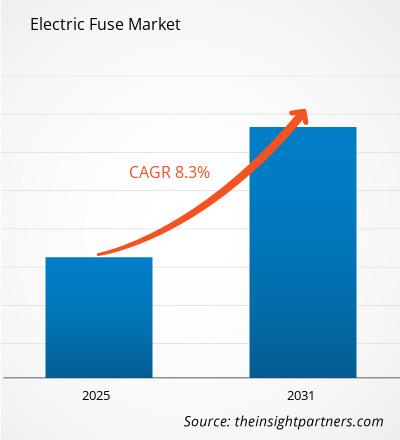
The global Electric Fuse market was valued at US$ 5.1 billion in 2025 and is expected to reach US$ 7.06 billion by 2034; it is estimated to record a CAGR of 3.68% during 2026-2034.
Electric Fuse Market Assessment and Insights
- North America held 24–28% share in 2025 and is growing at a CAGR range of 3.9–4.5% during 2026–2034, supported by grid hardening, EV charging, and utility replacement.
- US represented 78–82% of North America in 2025 and is growing at a CAGR range of 4.0–4.6%, led by power, telecom, healthcare, and construction.
- Europe accounted for 21–25% share in 2025 and is advancing at a CAGR range of 3.6–4.2%, with Germany, the UK, France, Italy, and Spain leading upgrades.
- Asia Pacific captured 39–43% share in 2025 and is expanding at a CAGR range of 4.6–5.2%, led by China, Japan, India, and South Korea across manufacturing and grids.
- Largest Segment Low Voltage held 48–52% market share in 2025 and is growing at a CAGR range of 3.8–4.4%, supported by buildings, electronics, and industrial equipment.
- High Growth Segment DC Fuses held 28–32% market share in 2025 and is growing at a CAGR range of 4.9–5.5%, driven by EVs, batteries, solar, and data centers.
- Key companies analyzed in detail: ABB Ltd, Bel Fuse Inc., Eaton Corporation plc, Legrand SA, Littelfuse, Inc., Mersen SA, S&C Electric Company, Schneider Electric SE, SCHURTER Holding AG, and Siemens AG.
Source: The Insight Partners' analysis based on proprietary research, government publications, company annual reports, investor presentations, industry databases, and expert interviews.
Market development is moving towards engineered applications that combine interrupting ability, thermal response, selectivity, and small size for application protection. The Market is driven by manufacturing trends for copper, silver, ceramic bodies, molded cases, and automatic production lines. The manufacturers will upgrade their product range for fast action, current limiting, photovoltaic, semiconductor, and EV fuses to meet the increasing density of electrical system.
Future demand would gain momentum in new manufacturing belts of Asia, strengthening grids of North America, and renewable energy interconnection initiatives of Europe. Development of power distribution, e-mobility, hospitals, telecommunications towers, and mining electrification will ensure constant replacement of fuses. The regulatory push in electrical safety, arc-flash prevention, building regulations, and reliable grid will benefit compliance-oriented products tested according to international standards.
Electric Fuse Market Report Scope
| Report Attribute | Details |
|---|---|
| Market size in 2025 | US$ 5.1 Billion |
| Market Size by 2034 | US$ 7.06 Billion |
| Global CAGR (2026 - 2034) | 3.68% |
| Historical Data | 2021-2024 |
| Forecast period | 2026-2034 |
Electric Fuse Market Analysis
Growth of Electric Fuse market can be attributed to increasing electricity usage, generation of power from renewables, EV charging stations, industrial automation, and higher need for protection coordination. Value chain involves metal suppliers, ceramic and plastic suppliers, fuse element makers, switchgear OEMs, assembly units, wholesalers, utility companies, and end consumers. Factors influencing the supply side include the availability of metals with high conductivity, calibration capabilities, short circuit testing facilities, and standards compliance.
Applications that demand minimal downtime, fire risks, and losses from equipment damage have higher demand for fuses. Fuses still retain their attractiveness due to fast tripping, well-defined breaking performance, and replacement cost effectiveness. Demand for protective devices is fueled by rapid increase in energy usage and grid modernization according to IEA analysis.
According to the Electric Fuse Market report, the competition is focused on the range of products, standards compliance, channel availability, and application expertise. ABB Ltd, Eaton Corporation plc, Schneider Electric SE, Siemens AG, and Legrand SA are competing in electrical distribution ecosystems, whereas Littelfuse, Inc., Mersen SA, Bel Fuse Inc., SCHURTER Holding AG, and S&C Electric Company have their advantages in circuit protection, power electronics, and utility protection.
The investment directions include fast-acting DC protection, small-size low voltage devices, medium voltage utility fuses, and customized solutions for electric mobility and renewable systems. The suppliers should position themselves based on the lifecycle performance, not on the price of one unit since protection coordination is required for increasingly sophisticated networks. Cooperation with OEMs, utilities, and panel manufacturers will ensure specification-driven demand.
● REPORT CUSTOMIZATION
Tailor This Report To Align With Your Specific Business Requirements
This report can be customized to align precisely with your business objectives, scope, and target markets. Customization options include tailored segmentation, geography, competitive analysis, and strategic insights to support informed decision-making.
Customize This Report →WHAT YOU CAN ADJUST
- ● Segmentations
- ● Geography
- ● Competitive Analysis
- ● Language Preferences
Electric Fuse Market:
요구 사항에 맞게 이 보고서를 사용자 정의하십시오.
이 보고서의 일부, 국가 수준 분석, Excel 데이터 팩을 포함하여 모든 보고서에 대한 사용자 정의를 무료로 받을 수 있을 뿐만 아니라 스타트업 및 대학을 위한 훌륭한 제안 및 할인을 이용할 수 있습니다
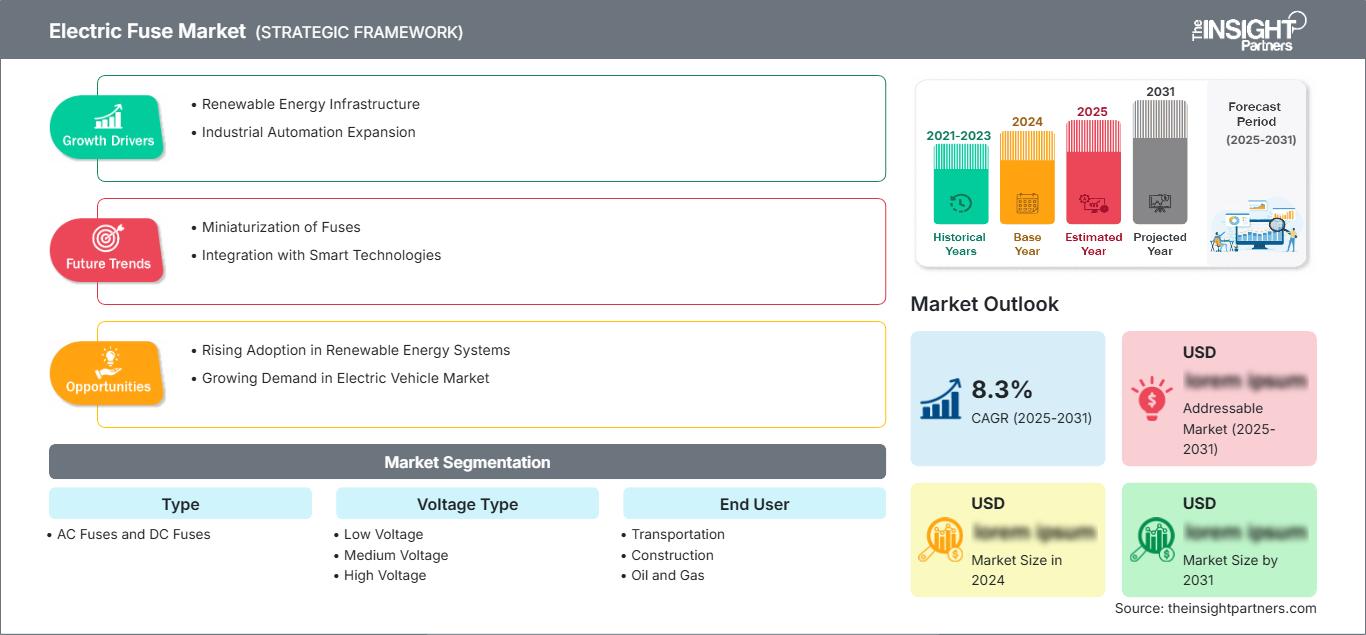
전기 퓨즈 시장: 전략적 통찰력
-
이 보고서의 주요 주요 시장 동향을 확인하세요.이 무료 샘플에는 시장 동향부터 추정 및 예측에 이르기까지 데이터 분석이 포함됩니다.
Regional Insights
North America Electric Fuse Market
The North American market is currently holding 24-28% market share and has a projected CAGR of 3.9-4.5% up until 2034. Factors supporting electric fuse market share include utility grid hardening, capacity additions for data centers, semiconductor fabs, EV charging corridors, and healthcare facilities. The region also includes pre-existing electrical codes requiring overcurrent protection coordination in commercial and industrial applications.
The structural demand drivers include replacing aging distribution equipment, increasing adoption of decentralized generation facilities, and overcurrent protection for telecom and transportation grids. The US is still the largest country within the region, with Canada contributing additional market demand through mining, renewable power, and public works applications. Certifications from UL and IEC are preferred, in addition to other applicationspecific certifications.
U.S. Electric Fuse Market
The US represented 78–82% of North America in 2025 and is projected to grow at a CAGR range of 4.0–4.6%. Demand is anchored by grid reinforcement, hyperscale data centers, residential construction, EV charging, defense electronics, and hospital power continuity. Eaton Corporation plc, Littelfuse, Inc., Bel Fuse Inc., ABB Ltd, Schneider Electric SE, and Siemens AG maintain strong product, distribution, or customer presence.
The application includes Class J, Class RK, semiconductor, photovoltaic, and medium voltage fuses applied in switchboards, inverters, machinery, telecommunications power systems, and charging stations. Utilities and contractors make decisions on fuse products based on fault current availability, coordination studies, and replacement time. As a result, preference for the manufacturer who has wide range of products is increasing.
Europe Electric Fuse Market
Europe has a 21–25% market share in 2025 and will continue to see a CAGR range of 3.6–4.2%. Germany takes the lead through machine construction, industrial automation, renewable energy, and automotive electrical architecture. UK has a contribution through grid strengthening, rail electrification, healthcare infrastructure, and data center development, while France makes contributions in nuclear energy, renewable energy, aerospace, and electrical construction in buildings.
Italy and Spain are witnessing growing adoption through solar panel installation, production upgrade, construction, and transport electrification. The Europeans prioritize CE certification, IEC performance, small size panels, and energy transition projects. Mersen SA, Legrand SA, Schneider Electric SE, Siemens AG, ABB Ltd, and SCHURTER Holding AG have an edge since the buyers in the region prefer certified protection equipment that is part of the electrical system.
APAC Electric Fuse Market
APAC was estimated to account for 39-43% share in 2025 and expected to expand at a CAGR of 4.6-5.2%. China is the front-runner due to manufacturing capacity, grid expansion, solar, EV, and electronic production. Japan and South Korea provide high precision electronics and automobile demand, whereas India and Australia offer construction, mining, transportation, and renewable energy.
The factors driving the market include domestic manufacturing capacity, grid expansion, industrial electrification, and renewable energy capacity expansion. The Market will be driven by local supply chain, manufacturing equipment, and replacements of the product. The end-users prefer efficient fuses with testing capabilities, quality products, and availability in LV, MV, and HV.
Middle East & Africa Electric Fuse Market
Middle East & Africa is projected to grow at a CAGR range of 3.7–4.3% as Saudi Arabia, the UAE, South Africa, and the rest of MEA invest in power generation, substations, desalination, mining, oil and gas, and transport infrastructure. Saudi Arabia leads demand through utility, industrial, and megaproject electrical systems.
There are energy and infrastructure environments that create fuses demand in switchgear, transformers, panels, telecommunication power, and harsh environment applications. This varies based on project cycles and import availability; however, there is an increasing need for reliability. Manufacturers of certified products, local distributors, and engineering services can capture projects in the utility, construction, and industrial markets.
Segmentation Analysis
Type
Type is projected to grow at a CAGR range of 4.0–4.6% during 2026–2034 as AC systems remain broad-based while DC protection gains urgency. Electric Fuse Market scope covers alternating-current distribution, direct-current batteries, solar arrays, EV chargers, electronics, and industrial equipment. Selection depends on current direction, voltage, interruption rating, arc behavior, and coordination with adjacent protection devices.
- AC Fuses retain the larger installed base because buildings, utilities, machinery, and conventional distribution networks use alternating-current architectures requiring proven, coordinated, and readily replaceable overcurrent protection.
- DC Fuses are strategically important for solar, batteries, EV charging, rail, telecom, and data-center systems where direct-current arcs demand specialized interruption design and higher technical qualification.
Voltage Type
Voltage Type is forecast to grow at a CAGR range of 3.9–4.5% during 2026–2034 as protection requirements span equipment panels, distribution feeders, substations, and high-energy infrastructure. Low-voltage demand is volume-intensive, medium-voltage use is tied to utility and industrial networks, and high-voltage applications require rigorous engineering for system reliability and personnel safety.
- Low Voltage leads volumes in buildings, electronics, machinery, healthcare, telecom, and food processing because standardized panels and equipment require economical, compact, and frequently replaced protection products.
- Medium Voltage is important in distribution grids, mining, construction projects, oil and gas sites, and renewable interconnections where feeder reliability and selective fault clearing are essential.
- High Voltage serves substations, power generation, transmission interfaces, and specialized industrial systems where fault energy is severe and validated interruption performance is mission-critical.
End User
End User is expected to grow at a CAGR range of 4.1–4.7% during 2026–2034 as electrification expands across infrastructure, industrial, and service sectors. Demand varies by system criticality, replacement frequency, voltage class, and regulatory scrutiny. Power generation and electrical and electronics remain central, while transportation, telecom, healthcare, mining, and food and beverage add specialized protection needs.
- Transportation uses fuses in rail, EV charging, onboard electronics, and transit power systems where compact protection and safe fault isolation support uptime and passenger safety.
- Construction requires fuses for switchboards, temporary power, commercial buildings, and infrastructure projects where code compliance and scalable electrical distribution remain procurement priorities.
- Oil and Gas depends on reliable fuses for refineries, pipelines, terminals, and offshore facilities where hazardous environments and continuity requirements demand rugged certified protection.
- Power Generation represents high revenue contribution through generators, transformers, balance-of-plant systems, renewables, and storage, where coordinated protection prevents costly equipment damage.
- Telecom needs DC and low-voltage fuses for towers, data centers, backup power, and network equipment where service continuity and compact installation are critical.
- Electrical and Electronics drives volume through appliances, industrial controls, power supplies, circuit boards, and consumer devices that need miniaturized fast-acting protection.
- Healthcare uses fuses in backup power, imaging systems, lab equipment, and facility panels where electrical reliability supports patient safety and operational continuity.
- Mining requires protection for conveyors, pumps, ventilation, mobile equipment, and substations operating under dust, vibration, moisture, and high-load electrical conditions.
- Food and Beverage applies fuses in processing lines, refrigeration, packaging, and facility power systems where hygiene-sensitive operations need reliable uptime and easy maintenance.
Opportunity Snapshot
|
End User |
Revenue Contribution |
Trend Tag |
Adoption Stage |
|
Transportation |
Medium |
EV Charging |
Scaling |
|
Construction |
Medium |
Code Panels |
Mature |
|
Oil and Gas |
Medium |
Hazard Safety |
Mature |
|
Power Generation |
High |
Grid Protection |
Mature |
|
Telecom |
Medium |
DC Backup |
Scaling |
|
Electrical and Electronics |
High |
Mini Protection |
Mature |
|
Healthcare |
Medium |
Critical Power |
Scaling |
|
Mining |
Low |
Rugged Loads |
Scaling |
|
Food and Beverage |
Low |
Line Uptime |
Mature |
|
Others |
Low |
Specialty Use |
Emerging |
Electric Fuse Market Growth Drivers and Impact Analysis
Grid Modernization Requires Coordinated Fault Protection
Utilities are increasing the capabilities of their distribution networks to address increased electrical power loads, renewable integration, and resiliency demands. According to the IEA study, power grids require considerable investments in transmission and distribution, and as such, there is a clear need to protect feeders, transformers, substations, and distributed generation facilities. In terms of market opportunities, there will be a consistent need for medium voltage and high voltage fuses that are capable of interrupting excessive fault current while maintaining selectivity. Additionally, utilities need fuses that are compatible with reclosers, switchgear, and transformers, based on dynamic load changes.
Electrified Transport and Storage Increase DC Protection Needs
The demand for DC fuses which will have capabilities to interrupt arcs that are much more challenging than their AC counterparts is on the rise because of electric cars, charging points, railway electrification, battery storage, and inverters from renewable sources. The market implications include faster migration towards DC fuses for high-speed applications, high voltage ratings, and applicationspecific certification for power electronics. Safety is critical for transportation and battery storage businesses due to rapid escalation of problems associated with battery failure, while in charging systems there is always an issue of reducing downtime.Fuse manufacturers may realize the value of producing compact units with low power dissipation and temperature stabilization.
Industrial Safety Codes Reinforce Replacement Demand
There are improvements in the electrical infrastructure of industrial facilities, commercial buildings, hospitals, food establishments, and mining operations due to regulatory standards, insurance requirements, and continuity objectives. Fuses are important since they have a predetermined clearing time, low incident energy, and can be used in protecting equipment below when proper coordination has been achieved. The implications for the business include recurrently replacing them in panels, motors, control, transformers, and backup generators. Users are becoming wary of fake fuses and therefore prefer those with verifiable quality assurance systems. There is also increased demand when new technologies such as automation, drives, UPS units, and other electronics need protection from short circuits and overloads.
Electric Fuse Market Future Trends
Smart Fuse Monitoring Moves into Critical Electrical Assets
Electric Fuse Market trends will increasingly include connected monitoring around fuse status, temperature, and fault events in data centers, utilities, hospitals, and industrial plants. Traditional fuses are simple devices, but surrounding holders, panels, and monitoring modules can provide alerts that reduce troubleshooting time. Over the forecast period, operators will prefer protection systems that help maintenance teams identify blown fuses quickly and understand root causes. This will support demand for fuse accessories, sensor-enabled panels, and software-integrated maintenance workflows. Suppliers that combine reliable fuse elements with practical monitoring interfaces can improve differentiation in applications where outage time is expensive and technical labor is limited.
High-Speed Protection Expands with Power Electronics
Power electronics are spreading across EV chargers, solar inverters, battery energy storage, variable-speed drives, medical equipment, and industrial automation. These systems need fuses that react rapidly enough to protect semiconductors before catastrophic damage occurs. Future demand will therefore favor ultra-rapid, low-loss, thermally stable designs that coordinate with silicon carbide and advanced inverter architectures. The trend will also increase custom product development because OEMs need protection matched to compact layouts and higher operating voltages. Fuse manufacturers with testing laboratories, application engineering, and early design-in relationships will gain influence before equipment platforms reach mass production.
Electric Fuse Market Opportunities
Utility and Renewable Interconnection Programs
Utility and renewable interconnection programs create an actionable opportunity for medium-voltage, high-voltage, and photovoltaic fuse suppliers. Electric Fuse Market Forecasts indicate that replacement and new-build demand will remain tied to substations, solar farms, battery storage, and feeder upgrades. Suppliers can target utilities, EPC contractors, and switchgear OEMs with pre-qualified products, engineering documentation, and regional inventory. Opportunity is strongest where interconnection queues require reliable protection for transformers, collection systems, and inverter equipment. Companies that provide tested coordination data, short lead times, and application support can improve specification rates and protect margins in project-based purchasing environments.
Custom Protection for Electronics and E-Mobility OEMs
Electronics and e-mobility OEMs represent a high-value opportunity because they often need compact, fast-acting, and thermally optimized protection designed into platforms early. Fuse suppliers can invest in co-development with charger makers, battery-pack integrators, industrial drive companies, medical equipment producers, and telecom power manufacturers. The commercial opportunity extends beyond component sales because design-in positions can create multi-year supply streams. Success depends on technical responsiveness, simulation support, qualification data, and manufacturing consistency. Companies that deliver application-specific fuses for DC circuits, semiconductor protection, and high-density electronics can capture premium demand as electrified products scale globally.
Recent Developments
- June 2026: Mersen has enhanced its 1,000 VDC fuse platform for electric vehicle applications, delivering improved technical performance while helping reduce the total cost of ownership. Designed to meet the evolving demands of modern e-mobility systems, the new generation of EV fuses provides advanced circuit protection, increased reliability, and optimized system efficiency.
- July 2025: Littelfuse, Inc. reported second-quarter 2025 net sales of US$ 613 million, up 9.8% year over year, with organic growth of 6.2% and strong bookings. The update supports its positioning in circuit protection for safe and efficient electrical energy transfer across industrial, transportation, and electronics applications.
- September 2025: Eaton’s expanded fuse portfolio for electrified vehicles includes low-voltage fuses for systems below 70 Vdc and high-voltage fuses rated at 500 Vdc (EVR), 900 Vdc (EVHD), and 1,000 Vdc (EVKR). The portfolio also features active and dual-trigger pyro fuses rated for 650 Vdc and 1,000 Vdc. Fuse sizes in the Bussmann series range from compact 10×38 mm up to larger sizes with rated currents from 5 A to 1000 A depending on the application. These fuses are designed to coordinate with vehicle electrical architectures featuring time constants around 2 ms.
Frequently Asked Questions

나빈은 맞춤형, 신디케이트 및 컨설팅 프로젝트 전반에 걸쳐 9년 이상의 전문 지식을 보유한 시장 조사 및 컨설팅 전문가입니다. 현재 부사장으로 재직 중이며, 프로젝트 가치 사슬 전반의 이해관계자들을 성공적으로 관리해 왔으며, 100편 이상의 연구 보고서와 30건 이상의 컨설팅 업무를 수행했습니다. 그는 산업 및 정부 프로젝트 전반에 걸쳐 다양한 업무를 수행하며 고객 성공과 데이터 기반 의사 결정에 크게 기여하고 있습니다.
나빈은 카르나타카주 VTU에서 전자통신 공학 학위를, 마니팔 대학교에서 마케팅 및 운영 MBA를 취득했습니다. 그는 9년 동안 IEEE 회원으로 활발하게 활동하며 컨퍼런스, 기술 심포지엄에 참여하고 지역 및 지역 차원에서 자원봉사 활동을 해왔습니다. 현재 직책을 맡기 전에는 IndustryARC에서 준전략 컨설턴트로, 휴렛팩커드(HP Global)에서 산업용 서버 컨설턴트로 근무했습니다.
- 포괄적인 시장 규모 산정 및 전망 분석
- 상세 시장 세분화 분석
- 심층적인 시장 동향 및 요인 분석
- 지역 및 국가별 인사이트
- 경쟁 구도 및 기업 벤치마킹
- 전략적 비즈니스 인텔리전스
사용 후기

The Insight Partners는 당사의 글로벌 시장 진출 전략을 뒷받침하는 가치 있는 시장 정보를 제공했습니다. 담당 팀은 전문적이고 신속하게 대응했으며 당사의 의견을 세심하게 반영했습니다. 또한 프로젝트 전반에 걸쳐 깊이 있는 분석과 유용한 방법론적 설명을 제공했습니다.
Junmo Kim 최고재무책임자(CFO), Enertech Co., Ltd.
Insight Partners의 SCADA 시스템 시장 보고서는 포괄적이며, 현재 동향과 미래 전망에 대한 귀중한 통찰력을 제공합니다. 팀은 매우 전문적이고, 신속하게 대응하며, 처음부터 끝까지 지원해 주었습니다. 저희는 매우 만족하며 Insight Partners의 서비스를 적극 추천합니다.
란 케뎀 파트너, Reali Technologies LTDs
아주 구체적인 소프트웨어 시장에 대한 보고서를 요청했는데, 팀에서 며칠 만에 보고서를 작성해 주셨습니다. 정보는 매우 관련성이 높고 잘 정리되어 있었습니다. 그 후 보고서에 몇 가지 수정과 추가 사항을 요청했습니다. 팀원들의 응답도 매우 빨랐고, 일주일도 채 되지 않아 최종 보고서를 받았습니다.
장-에르브 젠 의장, 퓨처 애널리티카
The Insight Partners와 함께 중요한 시장 조사 및 예측 작업을 진행했습니다. Insight Partners는 기회와 위험에 대한 명확한 통찰력을 제공하여 계획을 세우는 데 큰 도움이 되었습니다. The Insight Partners의 조사는 사용하기 쉬웠고, 탄탄한 데이터를 기반으로 했습니다. 덕분에 현명하고 자신 있는 결정을 내릴 수 있었습니다. The Insight Partners를 강력 추천합니다.
피유시 나그팔 수석 부사장, 하이빔 글로벌
Insight Partners는 탄탄한 분야 전문성을 바탕으로 통찰력 있고 체계적인 시장 조사를 제공했습니다. Insight Partners 팀은 처음부터 끝까지 전문적이고 신속하게 대응했습니다. 사용자 친화적인 웹사이트 덕분에 업계 보고서에 쉽게 접근할 수 있었습니다. 신뢰할 수 있고 고품질의 조사 서비스를 원하신다면 Insight Partners를 강력 추천합니다.
아다치 유키히코 대표이사, 딥블루 주식회사
The Insight Partners에서 시장 보고서를 구매한 것은 이번이 처음입니다. 처음에는 확신이 없었지만, 웹사이트를 방문하고 나서 위험을 감수하고 시장 보고서를 구매하는 것이 더 편하다는 것을 알게 되었습니다. 보고서의 품질과 고객 서비스에 매우 만족합니다. 처음 보고서를 보고 몇 가지 질문과 의견이 있었지만, 분석가와 이메일로 몇 차례 대화를 나눈 후, 전략 기획 과정에 참고할 수 있는 보고서를 확보했다고 생각합니다. 시간을 내어 긍정적인 경험을 선사해 주셔서 정말 감사합니다. 다른 사람들에게도 귀사의 서비스를 적극 추천할 것이며, 추가적인 시장 데이터가 필요할 때면 가장 먼저 귀사에 연락하겠습니다.
존 스즈키 사장 겸 최고 경영자, 이사회 이사, BK 테크놀로지스
나이지리아 감염성 질환 IVD 시장 관련 정보 요청에 응해 주신 귀사의 지원과 전문성에 감사드립니다. 귀사의 인내심과 지도, 그리고 할인 혜택을 기꺼이 제공해 주셔서 결국 계약을 성사시킬 수 있었습니다. 첫 만남을 통해 귀사가 저에게 심어주신 좋은 인상을 바탕으로 앞으로도 The Insight Partners와 함께할 수 있기를 기대합니다.
치지오케 박사 오니아 전무이사, 파인크레스트 헬스케어 유한회사구매 이유
- 정보에 기반한 의사 결정
- 시장 역학 이해
- 경쟁 분석
- 고객 인사이트
- 시장 예측
- 위험 완화
- 전략 기획
- 투자 타당성 분석
- 신흥 시장 파악
- 마케팅 전략 강화
- 운영 효율성 향상
- 규제 동향에 발맞춰 대응




















 무료 샘플 받기 -