
Electric Fuse Market Demand, Trends & Forecast by 2034
Coverage: by Type (Power Fuse and Fuse Link, Distribution Cutout, Cartridge and Plug Fuse, Others); Voltage Range (Low Voltage, Medium Voltage); End-User (Utilities, Residential, Commercial, Industrial, Transportation) , and Geography (North America, Europe, Asia Pacific, and South and Central America)
- Status : Data Released
- Report Code : TIPRE00004339
- Category : Electronics and Semiconductor
- No. of Pages : 150
- Available Report Formats :


- Last update date : August 10, 2026


2025 Market Size
US$ 5.1 Bn
Base year value
2034 Forecast
US$ 7.06 Bn
Projected by 2034
CAGR 2026-2034
4.16 %
Growth rate
Addressable Market
US$ 56.59 Bn
(2026-2034)
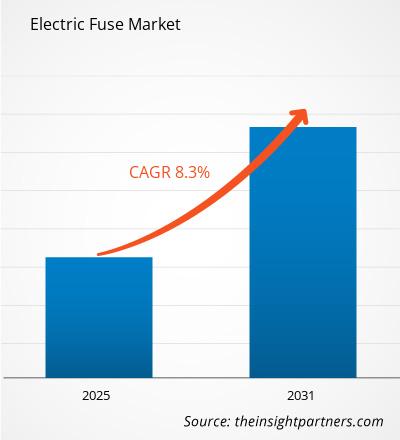
The Electric Fuse Market was estimated to be at US$ 5.1 Billion in 2025 and forecasted to touch US$ 7.06 Billion by 2034, growing at a CAGR of 4.16% between 2026 and 2034. The Market is growing due to the modernization of grids, electrification of transport, installation of renewable energy sources, and industrial safety standards, which call for efficient overcurrent protection in low, medium, and high voltage networks.
In North America, the Electric Fuse Market size is estimated to grow at a CAGR of 3.9-4.5% until 2034, driven by utility replacement cycles, EV charging stations, and advanced industrial automation. Growth drivers include a need for effective protection coordination in data centers, health care, telecom, and distributed power generation facilities..
Electric Fuse Market Assessment and Insights
- North America held 24–28% share in 2025 and is growing at a CAGR range of 3.9–4.5% during 2026–2034, supported by grid hardening, EV charging, and utility replacement.
- US represented 78–82% of North America in 2025 and is growing at a CAGR range of 4.0–4.6%, led by power, telecom, healthcare, and construction.
- Europe accounted for 21–25% share in 2025 and is advancing at a CAGR range of 3.6–4.2%, with Germany, the UK, France, Italy, and Spain leading upgrades.
- Asia Pacific captured 39–43% share in 2025 and is expanding at a CAGR range of 4.6–5.2%, led by China, Japan, India, and South Korea across manufacturing and grids.
- Largest Segment Low Voltage held 48–52% market share in 2025 and is growing at a CAGR range of 3.8–4.4%, supported by buildings, electronics, and industrial equipment.
- High Growth Segment DC Fuses held 28–32% market share in 2025 and is growing at a CAGR range of 4.9–5.5%, driven by EVs, batteries, solar, and data centers.
- Key companies analyzed in detail: ABB Ltd, Bel Fuse Inc., Eaton Corporation plc, Legrand SA, Littelfuse, Inc., Mersen SA, S&C Electric Company, Schneider Electric SE, SCHURTER Holding AG, and Siemens AG.
Source: The Insight Partners' analysis based on proprietary research, government publications, company annual reports, investor presentations, industry databases, and expert interviews.
Market development is moving towards engineered applications that combine interrupting ability, thermal response, selectivity, and small size for application protection. The Market is driven by manufacturing trends for copper, silver, ceramic bodies, molded cases, and automatic production lines. The manufacturers will upgrade their product range for fast action, current limiting, photovoltaic, semiconductor, and EV fuses to meet the increasing density of electrical system.
Future demand would gain momentum in new manufacturing belts of Asia, strengthening grids of North America, and renewable energy interconnection initiatives of Europe. Development of power distribution, e-mobility, hospitals, telecommunications towers, and mining electrification will ensure constant replacement of fuses. The regulatory push in electrical safety, arc-flash prevention, building regulations, and reliable grid will benefit compliance-oriented products tested according to international standards.
Electric Fuse Market Report Scope
| Report Attribute | Details |
|---|---|
| Market size in 2025 | US$ 5.1 Billion |
| Market Size by 2034 | US$ 7.06 Billion |
| Global CAGR (2026 - 2034) | 4.16% |
| Historical Data | 2021-2024 |
| Forecast period | 2026-2034 |
Electric Fuse Market Analysis
Growth of Electric Fuse market can be attributed to increasing electricity usage, generation of power from renewables, EV charging stations, industrial automation, and higher need for protection coordination. Value chain involves metal suppliers, ceramic and plastic suppliers, fuse element makers, switchgear OEMs, assembly units, wholesalers, utility companies, and end consumers. Factors influencing the supply side include the availability of metals with high conductivity, calibration capabilities, short circuit testing facilities, and standards compliance.
Applications that demand minimal downtime, fire risks, and losses from equipment damage have higher demand for fuses. Fuses still retain their attractiveness due to fast tripping, well-defined breaking performance, and replacement cost effectiveness. Demand for protective devices is fueled by rapid increase in energy usage and grid modernization according to IEA analysis.
According to the Electric Fuse Market report, the competition is focused on the range of products, standards compliance, channel availability, and application expertise. ABB Ltd, Eaton Corporation plc, Schneider Electric SE, Siemens AG, and Legrand SA are competing in electrical distribution ecosystems, whereas Littelfuse, Inc., Mersen SA, Bel Fuse Inc., SCHURTER Holding AG, and S&C Electric Company have their advantages in circuit protection, power electronics, and utility protection.
The investment directions include fast-acting DC protection, small-size low voltage devices, medium voltage utility fuses, and customized solutions for electric mobility and renewable systems. The suppliers should position themselves based on the lifecycle performance, not on the price of one unit since protection coordination is required for increasingly sophisticated networks. Cooperation with OEMs, utilities, and panel manufacturers will ensure specification-driven demand.
● REPORT CUSTOMIZATION
Tailor This Report To Align With Your Specific Business Requirements
This report can be customized to align precisely with your business objectives, scope, and target markets. Customization options include tailored segmentation, geography, competitive analysis, and strategic insights to support informed decision-making.
Customize This Report →WHAT YOU CAN ADJUST
- ● Segmentations
- ● Geography
- ● Competitive Analysis
- ● Language Preferences
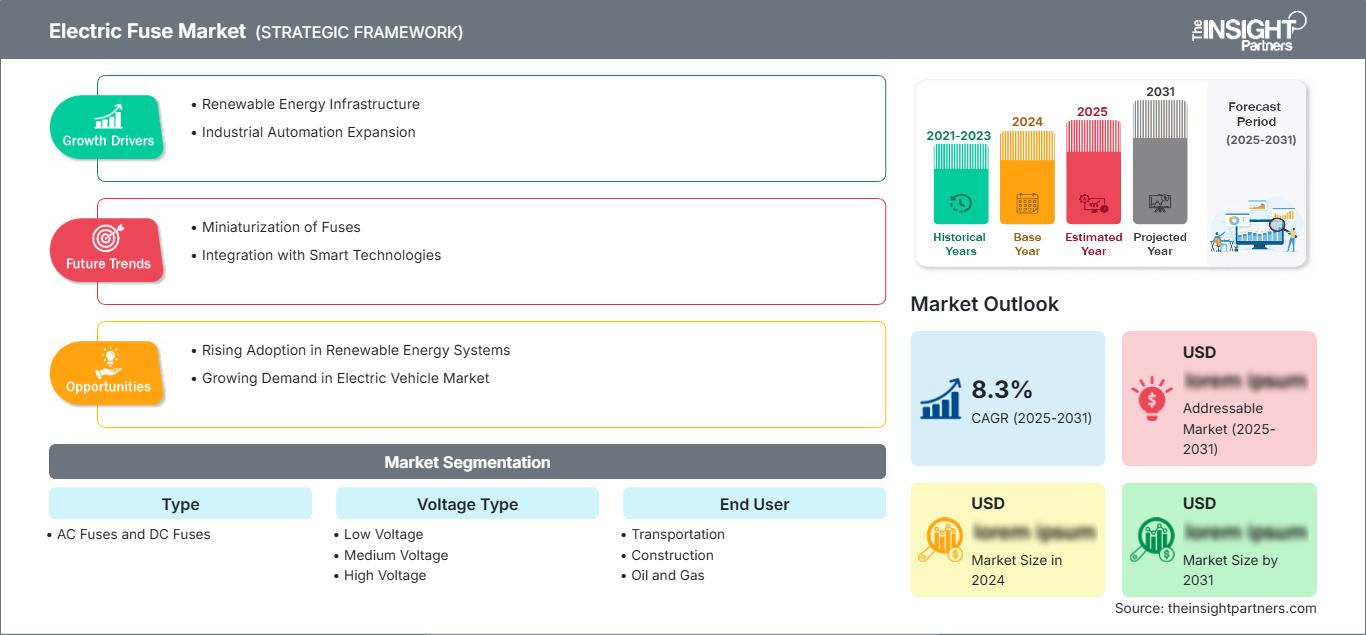
Electric Fuse Market: Strategic Insights
Regional Insights
North America Electric Fuse Market
The North American market is currently holding 24-28% market share and has a projected CAGR of 3.9-4.5% up until 2034. Factors supporting electric fuse market share include utility grid hardening, capacity additions for data centers, semiconductor fabs, EV charging corridors, and healthcare facilities. The region also includes pre-existing electrical codes requiring overcurrent protection coordination in commercial and industrial applications.
The structural demand drivers include replacing aging distribution equipment, increasing adoption of decentralized generation facilities, and overcurrent protection for telecom and transportation grids. The US is still the largest country within the region, with Canada contributing additional market demand through mining, renewable power, and public works applications. Certifications from UL and IEC are preferred, in addition to other applicationspecific certifications.
U.S. Electric Fuse Market
The US represented 78–82% of North America in 2025 and is projected to grow at a CAGR range of 4.0–4.6%. Demand is anchored by grid reinforcement, hyperscale data centers, residential construction, EV charging, defense electronics, and hospital power continuity. Eaton Corporation plc, Littelfuse, Inc., Bel Fuse Inc., ABB Ltd, Schneider Electric SE, and Siemens AG maintain strong product, distribution, or customer presence.
The application includes Class J, Class RK, semiconductor, photovoltaic, and medium voltage fuses applied in switchboards, inverters, machinery, telecommunications power systems, and charging stations. Utilities and contractors make decisions on fuse products based on fault current availability, coordination studies, and replacement time. As a result, preference for the manufacturer who has wide range of products is increasing.
Europe Electric Fuse Market
Europe has a 21–25% market share in 2025 and will continue to see a CAGR range of 3.6–4.2%. Germany takes the lead through machine construction, industrial automation, renewable energy, and automotive electrical architecture. UK has a contribution through grid strengthening, rail electrification, healthcare infrastructure, and data center development, while France makes contributions in nuclear energy, renewable energy, aerospace, and electrical construction in buildings.
Italy and Spain are witnessing growing adoption through solar panel installation, production upgrade, construction, and transport electrification. The Europeans prioritize CE certification, IEC performance, small size panels, and energy transition projects. Mersen SA, Legrand SA, Schneider Electric SE, Siemens AG, ABB Ltd, and SCHURTER Holding AG have an edge since the buyers in the region prefer certified protection equipment that is part of the electrical system.
APAC Electric Fuse Market
APAC was estimated to account for 39-43% share in 2025 and expected to expand at a CAGR of 4.6-5.2%. China is the front-runner due to manufacturing capacity, grid expansion, solar, EV, and electronic production. Japan and South Korea provide high precision electronics and automobile demand, whereas India and Australia offer construction, mining, transportation, and renewable energy.
The factors driving the market include domestic manufacturing capacity, grid expansion, industrial electrification, and renewable energy capacity expansion. The Market will be driven by local supply chain, manufacturing equipment, and replacements of the product. The end-users prefer efficient fuses with testing capabilities, quality products, and availability in LV, MV, and HV.
Middle East & Africa Electric Fuse Market
Middle East & Africa is projected to grow at a CAGR range of 3.7–4.3% as Saudi Arabia, the UAE, South Africa, and the rest of MEA invest in power generation, substations, desalination, mining, oil and gas, and transport infrastructure. Saudi Arabia leads demand through utility, industrial, and megaproject electrical systems.
There are energy and infrastructure environments that create fuses demand in switchgear, transformers, panels, telecommunication power, and harsh environment applications. This varies based on project cycles and import availability; however, there is an increasing need for reliability. Manufacturers of certified products, local distributors, and engineering services can capture projects in the utility, construction, and industrial markets.
Segmentation Analysis
Type
Type is projected to grow at a CAGR range of 4.0–4.6% during 2026–2034 as AC systems remain broad-based while DC protection gains urgency. Electric Fuse Market scope covers alternating-current distribution, direct-current batteries, solar arrays, EV chargers, electronics, and industrial equipment. Selection depends on current direction, voltage, interruption rating, arc behavior, and coordination with adjacent protection devices.
- AC Fuses retain the larger installed base because buildings, utilities, machinery, and conventional distribution networks use alternating-current architectures requiring proven, coordinated, and readily replaceable overcurrent protection.
- DC Fuses are strategically important for solar, batteries, EV charging, rail, telecom, and data-center systems where direct-current arcs demand specialized interruption design and higher technical qualification.
Voltage Type
Voltage Type is forecast to grow at a CAGR range of 3.9–4.5% during 2026–2034 as protection requirements span equipment panels, distribution feeders, substations, and high-energy infrastructure. Low-voltage demand is volume-intensive, medium-voltage use is tied to utility and industrial networks, and high-voltage applications require rigorous engineering for system reliability and personnel safety.
- Low Voltage leads volumes in buildings, electronics, machinery, healthcare, telecom, and food processing because standardized panels and equipment require economical, compact, and frequently replaced protection products.
- Medium Voltage is important in distribution grids, mining, construction projects, oil and gas sites, and renewable interconnections where feeder reliability and selective fault clearing are essential.
- High Voltage serves substations, power generation, transmission interfaces, and specialized industrial systems where fault energy is severe and validated interruption performance is mission-critical.
End User
End User is expected to grow at a CAGR range of 4.1–4.7% during 2026–2034 as electrification expands across infrastructure, industrial, and service sectors. Demand varies by system criticality, replacement frequency, voltage class, and regulatory scrutiny. Power generation and electrical and electronics remain central, while transportation, telecom, healthcare, mining, and food and beverage add specialized protection needs.
- Transportation uses fuses in rail, EV charging, onboard electronics, and transit power systems where compact protection and safe fault isolation support uptime and passenger safety.
- Construction requires fuses for switchboards, temporary power, commercial buildings, and infrastructure projects where code compliance and scalable electrical distribution remain procurement priorities.
- Oil and Gas depends on reliable fuses for refineries, pipelines, terminals, and offshore facilities where hazardous environments and continuity requirements demand rugged certified protection.
- Power Generation represents high revenue contribution through generators, transformers, balance-of-plant systems, renewables, and storage, where coordinated protection prevents costly equipment damage.
- Telecom needs DC and low-voltage fuses for towers, data centers, backup power, and network equipment where service continuity and compact installation are critical.
- Electrical and Electronics drives volume through appliances, industrial controls, power supplies, circuit boards, and consumer devices that need miniaturized fast-acting protection.
- Healthcare uses fuses in backup power, imaging systems, lab equipment, and facility panels where electrical reliability supports patient safety and operational continuity.
- Mining requires protection for conveyors, pumps, ventilation, mobile equipment, and substations operating under dust, vibration, moisture, and high-load electrical conditions.
- Food and Beverage applies fuses in processing lines, refrigeration, packaging, and facility power systems where hygiene-sensitive operations need reliable uptime and easy maintenance.
Opportunity Snapshot
| End User | Revenue Contribution | Trend Tag | Adoption Stage |
| Transportation | Medium | EV Charging | Scaling |
| Construction | Medium | Code Panels | Mature |
| Oil and Gas | Medium | Hazard Safety | Mature |
| Power Generation | High | Grid Protection | Mature |
| Telecom | Medium | DC Backup | Scaling |
| Electrical and Electronics | High | Mini Protection | Mature |
| Healthcare | Medium | Critical Power | Scaling |
| Mining | Low | Rugged Loads | Scaling |
| Food and Beverage | Low | Line Uptime | Mature |
| Others | Low | Specialty Use | Emerging |
Electric Fuse Market Growth Drivers and Impact Analysis
Grid Modernization Requires Coordinated Fault Protection
Utilities are increasing the capabilities of their distribution networks to address increased electrical power loads, renewable integration, and resiliency demands. According to the IEA study, power grids require considerable investments in transmission and distribution, and as such, there is a clear need to protect feeders, transformers, substations, and distributed generation facilities. In terms of market opportunities, there will be a consistent need for medium voltage and high voltage fuses that are capable of interrupting excessive fault current while maintaining selectivity. Additionally, utilities need fuses that are compatible with reclosers, switchgear, and transformers, based on dynamic load changes.
Electrified Transport and Storage Increase DC Protection Needs
The demand for DC fuses which will have capabilities to interrupt arcs that are much more challenging than their AC counterparts is on the rise because of electric cars, charging points, railway electrification, battery storage, and inverters from renewable sources. The market implications include faster migration towards DC fuses for high-speed applications, high voltage ratings, and applicationspecific certification for power electronics. Safety is critical for transportation and battery storage businesses due to rapid escalation of problems associated with battery failure, while in charging systems there is always an issue of reducing downtime.Fuse manufacturers may realize the value of producing compact units with low power dissipation and temperature stabilization.
Industrial Safety Codes Reinforce Replacement Demand
There are improvements in the electrical infrastructure of industrial facilities, commercial buildings, hospitals, food establishments, and mining operations due to regulatory standards, insurance requirements, and continuity objectives. Fuses are important since they have a predetermined clearing time, low incident energy, and can be used in protecting equipment below when proper coordination has been achieved. The implications for the business include recurrently replacing them in panels, motors, control, transformers, and backup generators. Users are becoming wary of fake fuses and therefore prefer those with verifiable quality assurance systems. There is also increased demand when new technologies such as automation, drives, UPS units, and other electronics need protection from short circuits and overloads.
Electric Fuse Market Future Trends
Smart Fuse Monitoring Moves into Critical Electrical Assets
Electric Fuse Market trends will increasingly include connected monitoring around fuse status, temperature, and fault events in data centers, utilities, hospitals, and industrial plants. Traditional fuses are simple devices, but surrounding holders, panels, and monitoring modules can provide alerts that reduce troubleshooting time. Over the forecast period, operators will prefer protection systems that help maintenance teams identify blown fuses quickly and understand root causes. This will support demand for fuse accessories, sensor-enabled panels, and software-integrated maintenance workflows. Suppliers that combine reliable fuse elements with practical monitoring interfaces can improve differentiation in applications where outage time is expensive and technical labor is limited.
High-Speed Protection Expands with Power Electronics
Power electronics are spreading across EV chargers, solar inverters, battery energy storage, variable-speed drives, medical equipment, and industrial automation. These systems need fuses that react rapidly enough to protect semiconductors before catastrophic damage occurs. Future demand will therefore favor ultra-rapid, low-loss, thermally stable designs that coordinate with silicon carbide and advanced inverter architectures. The trend will also increase custom product development because OEMs need protection matched to compact layouts and higher operating voltages. Fuse manufacturers with testing laboratories, application engineering, and early design-in relationships will gain influence before equipment platforms reach mass production.
Electric Fuse Market Opportunities
Utility and Renewable Interconnection Programs
Utility and renewable interconnection programs create an actionable opportunity for medium-voltage, high-voltage, and photovoltaic fuse suppliers. Electric Fuse Market Forecasts indicate that replacement and new-build demand will remain tied to substations, solar farms, battery storage, and feeder upgrades. Suppliers can target utilities, EPC contractors, and switchgear OEMs with pre-qualified products, engineering documentation, and regional inventory. Opportunity is strongest where interconnection queues require reliable protection for transformers, collection systems, and inverter equipment. Companies that provide tested coordination data, short lead times, and application support can improve specification rates and protect margins in project-based purchasing environments.
Custom Protection for Electronics and E-Mobility OEMs
Electronics and e-mobility OEMs represent a high-value opportunity because they often need compact, fast-acting, and thermally optimized protection designed into platforms early. Fuse suppliers can invest in co-development with charger makers, battery-pack integrators, industrial drive companies, medical equipment producers, and telecom power manufacturers. The commercial opportunity extends beyond component sales because design-in positions can create multi-year supply streams. Success depends on technical responsiveness, simulation support, qualification data, and manufacturing consistency. Companies that deliver application-specific fuses for DC circuits, semiconductor protection, and high-density electronics can capture premium demand as electrified products scale globally.
Recent Developments
- June 2026: Mersen has enhanced its 1,000 VDC fuse platform for electric vehicle applications, delivering improved technical performance while helping reduce the total cost of ownership. Designed to meet the evolving demands of modern e-mobility systems, the new generation of EV fuses provides advanced circuit protection, increased reliability, and optimized system efficiency.
- July 2025: Littelfuse, Inc. reported second-quarter 2025 net sales of US$ 613 million, up 9.8% year over year, with organic growth of 6.2% and strong bookings. The update supports its positioning in circuit protection for safe and efficient electrical energy transfer across industrial, transportation, and electronics applications.
- September 2025: Eaton’s expanded fuse portfolio for electrified vehicles includes low-voltage fuses for systems below 70 Vdc and high-voltage fuses rated at 500 Vdc (EVR), 900 Vdc (EVHD), and 1,000 Vdc (EVKR). The portfolio also features active and dual-trigger pyro fuses rated for 650 Vdc and 1,000 Vdc. Fuse sizes in the Bussmann series range from compact 10×38 mm up to larger sizes with rated currents from 5 A to 1000 A depending on the application. These fuses are designed to coordinate with vehicle electrical architectures featuring time constants around 2 ms.
Frequently Asked Questions

- Comprehensive Market Sizing and Forecast Analysis
- Detailed Segmentation Analysis
- In-Depth Market Dynamics Assessment
- Regional and Country-Level Insights
- Competitive Landscape and Company Benchmarking
- Strategic Business Intelligence
Recent Reports
Testimonials

The Insight Partners' SCADA System Market report is comprehensive, with valuable insights on current trends and future forecasts. The team was highly professional, responsive, and supportive throughout. We are very satisfied and highly recommend their services.
RAN KEDEM Partner, Reali Technologies LTDs
I requested a report on a very specific software market and the team produced the report in a few days. The information was very relevant and well presented. I then requested some changes and additions to the report. The team was again very responsive and I got the final report in less than a week.
JEAN-HERVE JENN Chairman, Future Analytica
We worked with The Insight Partners for an important market study and forecast. They gave us clear insights into opportunities and risks, which helped shape our plans. Their research was easy to use and based on solid data. It helped us make smart, confident decisions. We highly recommend them.
PIYUSH NAGPAL Sr. Vice President, High Beam Global
The Insight Partners delivered insightful, well-structured market research with strong domain expertise. Their team was professional and responsive throughout. The user-friendly website made accessing industry reports seamless. We highly recommend them for reliable, high-quality research services
YUKIHIKO ADACHI CEO, Deep Blue, LLC.
This is the first time I have purchased a market report from The Insight Partners.While I was unsure at first, I visited their web site and felt more comfortable to take the risk and purchase a market report.I am completely satisfied with the quality of the report and customer service. I had several questions and comments with the initial report, but after a couple of dialogs over email with their analyst I believe I have a report that I can use as input to our strategic planning process.Thank you so much for taking the extra time and making this a positive experience.I will definitely recommend your service to others and you will be my first call when we need further market data.
JOHN SUZUKI President and Chief Executive Officer, Board Director, BK Technologies
I wish to appreciate your support and the professionalism you displayed in the course of attending to my request for information regarding to infectious disease IVD market in Nigeria. I appreciate your patience, your guidance, and the fact that you were willing to offer a discount, which eventually made it possible for us to close a deal. I look forward to engaging The Insight Partners in the future, all thanks to the impression you have created in me as a result of this first encounter.
DR CHIJIOKE ONYIA MANAGING DIRECTOR, PineCrest Healthcare Ltd.Reason to Buy
- Informed Decision-Making
- Understanding Market Dynamics
- Competitive Analysis
- Identifying Emerging Markets
- Customer Insights
- Market Forecasts
- Risk Mitigation
- Boosting Operational Efficiency
- Strategic Planning
- Investment Justification
- Tracking Industry Innovations
- Aligning with Regulatory Trends





 Get Free Sample for