
3-in-1 Commodes Market Size, Trends & Demand by 2034
Coverage: By Type (Aluminium, Steel, Others); Design (Folded, And Non-Folded); Application (Hospitals, Rehabilitation Centers, Homecare), and Geography (North America, Europe, Asia Pacific, and South and Central America)
- Status : Data Released
- Report Code : TIPRE00017630
- Category : Manufacturing and Construction
- No. of Pages : 150
- Available Report Formats :


- Last update date : July 16, 2026


2025 Market Size
US$ 588.00 Mn
Base year value
2034 Forecast
US$ 961.00 Mn
Projected by 2034
CAGR 2026-2034
5.61 %
Growth rate
Addressable Market
US$ 7,021.81 Mn
(2026-2034)
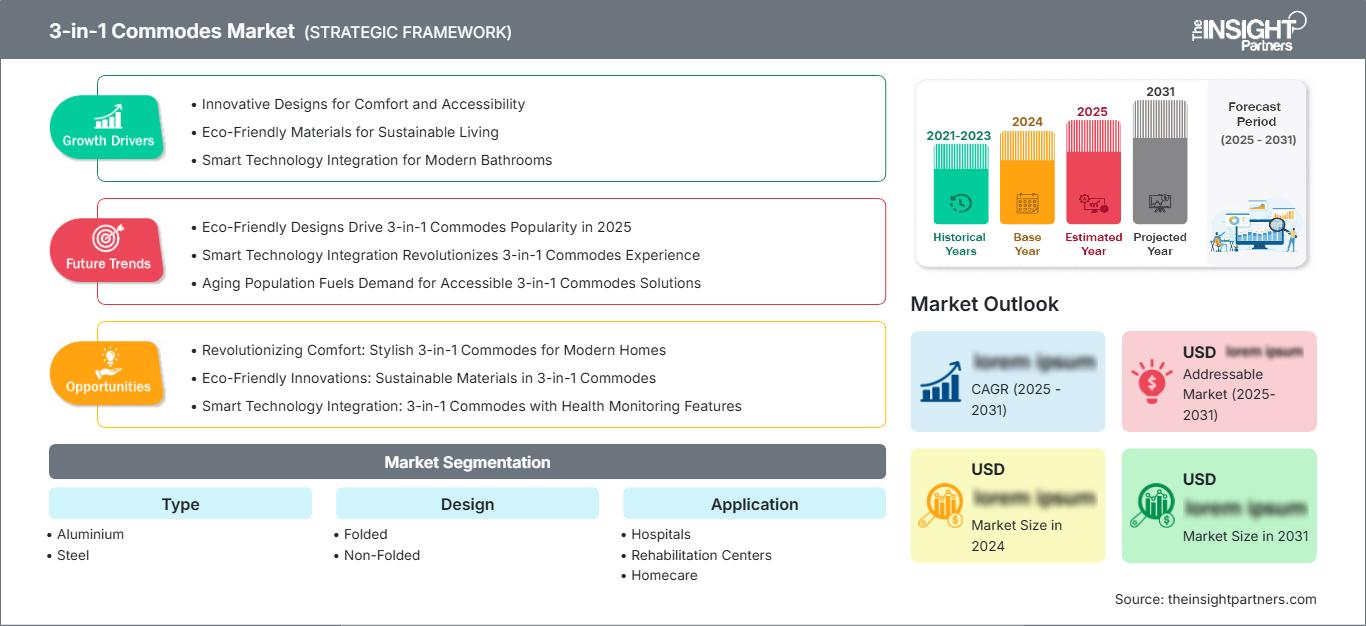
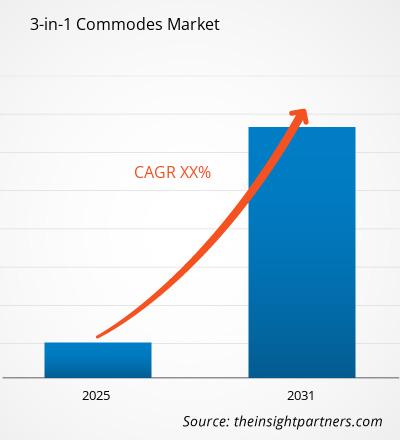
The 3-in-1 commodes market size was valued at US$ 588.00 Million in 2025 and is projected to reach US$ 961.00 Million by 2034; it is expected to record a CAGR of 5.61% from 2026 to 2034. The market reflects durable demand for multifunctional toileting aids used across hospitals, rehabilitation centers, and homecare settings where mobility support, safe transfers, and hygienic patient handling remain core purchase criteria.
North America is expected to expand at a 5.2–5.6% CAGR during 2026–2034, supported by high home healthcare penetration and structured reimbursement pathways for durable medical equipment. The region benefits from aging demographics, post-acute care discharge planning, and a mature distributor network that enables rapid replacement cycles for steel and aluminium commodes in institutional and residential environments.
3-in-1 Commodes Market Assessment and Insights
- North America: The region accounted for 34–37% share in 2025 and is projected to grow at a 5.2–5.6% CAGR between 2026–2034, led by homecare procurement and hospital discharge support.
- US: The country represented 78–82% of North America 3-in-1 commodes market share in 2025 and is forecast to grow at a 5.1–5.5% CAGR between 2026–2034, supported by strong DME channels.
- Europe: Europe held 24–27% share in 2025 and is expected to expand at a 4.9–5.3% CAGR between 2026–2034, with Germany, the UK, and France leading institutional demand.
- Asia Pacific: APAC captured 22–25% share in 2025 and is projected to grow at a 6.2–6.7% CAGR between 2026–2034, driven by China, Japan, India, and Australia.
- Largest Segment: Steel held 61–65% 3-in-1 commodes market share in 2025 and is expected to grow at a 5.0–5.4% CAGR between 2026–2034 due to durability and lower acquisition cost.
- High Growth Segment: Homecare held 31–34% market share in 2025 and is projected to grow at a 6.4–6.9% CAGR between 2026–2034 as care shifts to residences.
- Key companies analyzed in detail: TFI Healthcare LLC, Herdegen SAS, NOVA Medical Products, Medline Industries, LP, Roscoe Medical, Inc., GF Health Products, Inc., Sunrise Medical LLC, Cardinal Health, Inc., North Coast Medical, Inc., Alex Orthopedic Inc.
Source: The Insight Partners' analysis based on proprietary research, government publications, company annual reports, investor presentations, industry databases, and expert interviews.
Product evolution in the 3-in-1 commodes Market is moving from basic bedside frames toward lighter, adjustable, foldable, and easier-to-sanitize designs. The steel commode continues to be the economical option for institutional usage, whereas aluminium variants become more popular among those that value portability and corrosion resistance. The manufacturing process is impacted by the tube production, powder coating, plastic molding, and private labeling through distributors, thus making the product price competitive and quickening the replenishment process for healthcare facilities.
The future growth will most probably focus on developing homecare networks, rehabilitating centers, and medical supply stores in the Asia Pacific region and some Middle Eastern countries. The policies regarding disability inclusion, aging in place, and hospital management will expand the usage area for 3-in-1 commodes, especially among non-folding institutional and folding residential ones.
3-in-1 Commodes Market Report Scope
| Report Attribute | Details |
|---|---|
| Market size in 2025 | US$ 588.00 Million |
| Market Size by 2034 | US$ 961.00 Million |
| Global CAGR (2026 - 2034) | 5.61% |
| Historical Data | 2021-2024 |
| Forecast period | 2026-2034 |
3-in-1 Commodes Market Analysis
The 3-in-1 commodes Market Report is tied to mobility impairment, post-operative recovery, geriatric care, and caregiver safety. WHO estimates that the population aged 60 years and above will reach 2 billion by 2050, strengthening long-term need for assistive products. Within the value chain, metal tubing suppliers, injection molders, contract assemblers, distributors, pharmacies, and e-commerce platforms influence availability and margin structure.
Fragmentation in the supply continues as there is some standardization of products, but differentiation occurs on the basis of weight capacity, foldability, drop arms, antimicrobial surface, and easy cleaning. Thus, the 3-in-1 commodes business potential is not dependent upon premium technology but rather on dependability, procurement diversity, need for replacement, and accessibility of durable medical equipment channels in the region.
Competitors include general medical distributors and specialized suppliers of mobility aids. Competing among themselves are Medline Industries, LP and Cardinal Health, Inc. due to their scale, hospital connections, and logistics for at-home delivery whereas GF Health Products, Inc., NOVA Medical Products, and Roscoe Medical, Inc. serve the retail and home care market needs. Additional competitors are Sunrise Medical LLC and Herdegen SAS serving different channels in Europe.
In investments, the priorities include supply chain automation, delivery directly to homes, product diversification, and ergonomic design rather than product innovation. Strategic position of companies should be focused on the combination of regulatory compliance, consistent supply availability, and various frame designs. In summary, from the analysis of 3-in-1 commodes it is evident that the importance of private label products persists.
● REPORT CUSTOMIZATION
Tailor This Report To Align With Your Specific Business Requirements
This report can be customized to align precisely with your business objectives, scope, and target markets. Customization options include tailored segmentation, geography, competitive analysis, and strategic insights to support informed decision-making.
Customize This Report →WHAT YOU CAN ADJUST
- ● Segmentations
- ● Geography
- ● Competitive Analysis
- ● Language Preferences
3-in-1 Commodes Market: Strategic Insights
Regional Insights
North America 3-in-1 commodes
North America accounted for 34–37% 3-in-1 commodes market share in 2025 and is forecast to expand at a 5.2–5.6% CAGR during 2026–2034. Demand is supported by mature home healthcare infrastructure, hospital discharge protocols, and high use of durable medical equipment for older adults recovering after orthopedic, neurological, and cardiovascular procedures.
The structure of the area is such that quick replenishment through medical distributors, pharmacy chains, and online sources is favored. According to Cardinal Health, Inc., in 2025, there was an expansion in at-home delivery capabilities. Steel models account for most facility purchases, but aluminum models that fold are gaining favor among caregivers in tight spaces.
U.S. 3-in-1 commodes Market
The US represented 78–82% of North America 3-in-1 commodes market share in 2025 and is expected to grow at a 5.1–5.5% CAGR from 2026 to 2034. Demand is concentrated around homecare agencies, post-acute providers, rehabilitation clinics, and retail DME outlets serving patients discharged earlier from hospitals.
Presence of companies is significant, with Medline Industries, LP, Cardinal Health, Inc., NOVA Medical Products, GF Health Products, Inc., North Coast Medical, Inc., and Alex Orthopedic Inc. catering to both institutional and home care segments. Trends in application point towards increased use in home care due to aging in place, whereas hospitals continue to buy non-foldable steel versions for re-use.
Europe 3-in-1 commodes Market
Europe held 24–27% 3-in-1 commodes market share in 2025 and is projected to record a 4.9–5.3% CAGR from 2026 to 2034. The UK remains a leading adopter through community care, occupational therapy assessments, and equipment loan schemes that prioritize safe toileting support after hospital discharge.
Germany ranks topmost with regards to revenue generation owing to its high investment in rehabilitation services, aging demographics, and organized insurance plans covering assistive products. Manufacturers enjoy benefits in form of demand from hospitals, nursing homes, and outpatient rehabilitation centers where there is preference for sturdy and unfolded equipment.
France, Italy, and Spain rank in terms of their consistent purchasing through public hospitals, private eldercare providers, and home adaptation programs. Herdegen SAS has its importance in France, whereas imported steel and aluminum units provide competition based on price. Southern Europe enjoys higher replacement demand due to family-centered treatment.
APAC 3-in-1 commodes Market
APAC accounted for 22–25% 3-in-1 commodes market share in 2025 and is forecast to grow at a 6.2–6.7% CAGR during 2026–2034. China is the leading country, reflecting expanding eldercare infrastructure, domestic manufacturing strength, and rising household spending on mobility aids.
Mature demand can be seen in Japan and South Korea, due to super aged demographics and the implementation of policies on long-term care. India is moving up from a relatively low base because of the development of private hospitals, rehabilitation centers, and medical supply sites online that offer affordable steel commodes.
Australia is also a player in this market through home modification initiatives and procurement of rehabilitation facilities. Some other factors include regional metal fabrication capabilities, reduced assembly costs, and increased e-commerce capability.
Middle East & Africa 3-in-1 commodes Market
The Middle East & Africa market is expected to grow at a 5.4–5.9% CAGR from 2026 to 2034, with Saudi Arabia leading regional demand. Hospital expansion, rehabilitation investment, and eldercare services are supporting institutional procurement.
Private healthcare growth, presence of medical tourism infrastructure, and high-end homecare services which require foldable and resistant units are strengths of the UAE market. In South Africa, demand remains steady in private hospitals, rehabilitation facilities, and medical equipment stores catering to patients with mobility issues.
Adoption in the rest of MEA region is sporadic due to poor healthcare infrastructure and budget constraints. The energy driven fiscal strength of Gulf countries leads to modern hospitals, while overall infrastructure developments increase access to durable medical equipment.
Segmentation Analysis
Type
The Type segment in the 3-in-1 commodes market report is projected to grow at a 5.3–5.8% CAGR from 2026 to 2034. Material choice influences weight, price, cleaning durability, and suitability for repeated use. Steel remains preferred in hospitals and rehabilitation centers because of strength and cost efficiency, while aluminium supports homecare mobility where caregivers need lighter handling and corrosion resistance.
- Aluminium commodes serve users and caregivers prioritizing portability, rust resistance, and easier repositioning. Demand is stronger in homecare, travel use, and humid environments where lighter frames improve daily handling.
- Steel commodes retain the strongest market position because they offer higher perceived stability, familiar procurement specifications, and competitive pricing. Institutional buyers favor steel for repeat use and predictable durability.
Design
The Design segment in the 3-in-1 commodes market forecast is expected to grow at a 5.4–5.9% CAGR from 2026 to 2034. Folded formats address storage limitations in homes and smaller clinics, while non-folded designs support frequent institutional use. Product differentiation increasingly depends on fast assembly, secure locking, seat comfort, and cleaning convenience.
- Folded commodes are strategically important in homecare because they reduce storage burden and support temporary recovery needs. Their portability also helps retailers position them for short-term and post-surgical users.
- Non-folded commodes remain central to hospitals and rehabilitation centers where stability, quick availability, and repeated daily use matter more than compact storage. Procurement decisions emphasize frame strength and cleanability.
Application
The Application segment is forecast to grow at a 5.8–6.3% CAGR from 2026 to 2034. Hospitals continue to purchase standardized bedside commodes for patient safety and nursing efficiency, rehabilitation centers require transfer-friendly designs, and homecare is expanding fastest as older adults and post-surgical patients recover outside institutions.
- Hospitals generate recurring demand for sturdy commodes that support fall prevention, bedside toileting, and infection control routines. Standardization across wards helps simplify cleaning, training, and inventory management.
- Rehabilitation centers value adjustable and transfer-friendly commodes because patients often rebuild mobility after surgery, stroke, or injury. Drop-arm access and stable frames improve therapy workflow and caregiver safety.
- Homecare is strategically significant as families seek compact, affordable, and easy-to-clean products for aging-in-place. Folded designs and direct-to-home distribution strengthen adoption among temporary and long-term users.
Opportunity Snapshot
| Application | Revenue Contribution | Trend Tag | Adoption Stage |
| Hospitals | High | Ward Safety | Mature |
| Rehabilitation Centers | Medium | Transfer Care | Scaling |
| Homecare | High | Aging Home | Scaling |
3-in-1 Commodes Market Growth Drivers and Impact Analysis
Aging-in-place demand reshaping homecare equipment purchasing
The growing interest of older patients in recovery and continued care at home increases the demand for toileting solutions for beds significantly. It changes the buyer from healthcare institutions to people who have elderly parents or relatives, home-care facilities, pharmacies, and online providers of DME products. It is evident in the increasing popularity of folding frames, non-tool assembly, removable buckets, and convenient to clean seats. With the growing popularity of homecare, it is important to strike a balance between affordable prices and additional options which make life easier for caregivers.
Hospital discharge efficiency increasing need for basic DME kits
Hospital stays and post-acute care coordinators are being challenged to keep down length of stay but still provide a safe environment for recovery. The three-in-one commode is usually incorporated into the plan of home readiness since it can serve as a toileting aid, seat elevating device, and bed siderail protector without changing the bathroom. This generates a predictable demand from discharge planners, rehabilitation organizations, and suppliers of medical devices. The greatest effect is generated in North America and Europe, where there is a structured system for post-acute pathway and equipment recommendation.
Caregiver safety and fall prevention strengthening institutional demand
Falls and unsafe transfers remain major risks in hospitals, rehabilitation centers, and homes. 3-in-1 commodes reduce walking distance to bathrooms and provide stable arm support during sitting or standing. Institutions therefore view them as low-cost tools that support nursing efficiency, patient dignity, and risk management. Demand is strongest for non-folded steel units where repeated daily use requires strength and stability. The market impact includes steady replacement cycles, higher preference for weight-rated products, and growing interest in drop-arm variants that support lateral transfers from wheelchairs.
3-in-1 Commodes Market Future Trends
Lightweight materials moving from premium feature to standard expectation
A key in the 3-in-1 commodes market trend is that Aluminium and hybrid frame designs are likely to gain wider acceptance as caregivers place greater value on portability, corrosion resistance, and easier cleaning. This does not eliminate steel demand, but it changes the product mix in homecare and travel-oriented use cases. Suppliers that can offer lighter frames without compromising weight capacity may improve margins and retail differentiation. Over the forecast period, lightweight design will likely become less of a premium niche and more of a standard expectation in urban households, outpatient rehabilitation, and private homecare services.
Direct-to-home distribution becoming a competitive differentiator
Distribution speed is becoming as important as product design because many purchases are triggered by discharge, injury, or sudden mobility decline. Companies with automated warehouses, strong parcel networks, and clear online product content will be better positioned to capture urgent demand. Cardinal Health, Inc.’s at-home distribution expansion illustrates how healthcare logistics are moving closer to residential users. This trend will encourage packaging improvements, simplified assembly, and clearer sizing information, reducing returns and improving user confidence in online medical equipment purchases.
3-in-1 Commodes Market Opportunities
Bundled post-acute recovery kits for hospitals and homecare agencies
Manufacturers and distributors can create higher-value opportunities by bundling commodes with raised toilet accessories, liners, gait belts, and basic bathroom safety products. Hospitals and homecare agencies benefit because bundled kits simplify discharge planning and reduce delays caused by separate procurement. This approach is especially relevant for orthopedic, stroke, and elderly care pathways where toileting support is one of several immediate home needs. The opportunity favors companies with broad catalogs, reliable fulfillment, and education materials that help caregivers select correct sizes and configurations.
Localized manufacturing and sourcing for emerging Asian markets
Emerging Asian markets offer scope for localized production that lowers freight cost, improves availability, and supports price-sensitive buyers. Steel tube fabrication and plastic molding are well suited to regional manufacturing clusters, enabling suppliers to tailor dimensions, packaging, and distribution formats to local homes and hospitals. India, China, and Southeast Asian economies can support both domestic demand and export-oriented assembly. The opportunity is strongest for companies that combine quality control, regulatory documentation, and partnerships with hospital suppliers, rehabilitation chains, and online medical retailers.
Recent Developments
- April 2026: Cardinal Health, Inc. released findings highlighting the movement of advanced care closer to community and home settings, reinforcing the company’s strategic focus on distributed healthcare access and provider partnerships. The development supports broader at-home medical supply relevance, including durable equipment logistics and patient-centered delivery models
- July 2025: Sunrise Medical LLC — announced the acquisition of Made for Movement, a neurorehabilitation specialist serving children and adults with complex mobility needs. The transaction expanded Sunrise Medical’s therapeutic portfolio and strengthened relationships across clinicians, hospitals, rehabilitation centers, and distribution partners in Europe and global mobility markets
- September 2025: Cardinal Health, Inc. — opened a 340,000-square-foot Fort Worth distribution center dedicated to at-Home Solutions and announced plans for a Sacramento facility. The site is designed to ship about 10,000 packages daily, strengthening direct-to-home medical supply capacity for chronic care and home-based patient needs
Frequently Asked Questions

- Comprehensive Market Sizing and Forecast Analysis
- Detailed Segmentation Analysis
- In-Depth Market Dynamics Assessment
- Regional and Country-Level Insights
- Competitive Landscape and Company Benchmarking
- Strategic Business Intelligence
Recent Reports
Testimonials

The Insight Partners provided valuable market intelligence that supported our global go-to-market strategy. Their team was professional, responsive, and attentive to our feedback, providing thoughtful analysis and helpful methodological clarifications throughout the project.
Junmo Kim Chief Financial Officer (CFO), Enertech Co., Ltd.
The Insight Partners' SCADA System Market report is comprehensive, with valuable insights on current trends and future forecasts. The team was highly professional, responsive, and supportive throughout. We are very satisfied and highly recommend their services.
RAN KEDEM Partner, Reali Technologies LTDs
I requested a report on a very specific software market and the team produced the report in a few days. The information was very relevant and well presented. I then requested some changes and additions to the report. The team was again very responsive and I got the final report in less than a week.
JEAN-HERVE JENN Chairman, Future Analytica
We worked with The Insight Partners for an important market study and forecast. They gave us clear insights into opportunities and risks, which helped shape our plans. Their research was easy to use and based on solid data. It helped us make smart, confident decisions. We highly recommend them.
PIYUSH NAGPAL Sr. Vice President, High Beam Global
The Insight Partners delivered insightful, well-structured market research with strong domain expertise. Their team was professional and responsive throughout. The user-friendly website made accessing industry reports seamless. We highly recommend them for reliable, high-quality research services
YUKIHIKO ADACHI CEO, Deep Blue, LLC.
This is the first time I have purchased a market report from The Insight Partners.While I was unsure at first, I visited their web site and felt more comfortable to take the risk and purchase a market report.I am completely satisfied with the quality of the report and customer service. I had several questions and comments with the initial report, but after a couple of dialogs over email with their analyst I believe I have a report that I can use as input to our strategic planning process.Thank you so much for taking the extra time and making this a positive experience.I will definitely recommend your service to others and you will be my first call when we need further market data.
JOHN SUZUKI President and Chief Executive Officer, Board Director, BK Technologies
I wish to appreciate your support and the professionalism you displayed in the course of attending to my request for information regarding to infectious disease IVD market in Nigeria. I appreciate your patience, your guidance, and the fact that you were willing to offer a discount, which eventually made it possible for us to close a deal. I look forward to engaging The Insight Partners in the future, all thanks to the impression you have created in me as a result of this first encounter.
DR CHIJIOKE ONYIA MANAGING DIRECTOR, PineCrest Healthcare Ltd.Reason to Buy
- Informed Decision-Making
- Understanding Market Dynamics
- Competitive Analysis
- Identifying Emerging Markets
- Customer Insights
- Market Forecasts
- Risk Mitigation
- Boosting Operational Efficiency
- Strategic Planning
- Investment Justification
- Tracking Industry Innovations
- Aligning with Regulatory Trends





 Get Free Sample for