
3D Dental Scanners Market Share, Growth & Forecast by 2034
Coverage: By Product (Desktop or Laboratory 3D Dental Scanners, Intraoral 3D Dental Scanners, Hand-held 3D Dental Scanners, Cone Beam Computerized Tomography (CBCT)); Type (3D Dental Light Scanner, 3D Dental Laser Scanner); End User (Hospitals, Dental Clinics), and Geography (North America, Europe, Asia Pacific, and South and Central America)
- Status : Data Released
- Report Code : TIPRE00021552
- Category : Life Sciences
- No. of Pages : 150
- Available Report Formats :


- Last update date : July 29, 2026


2025 Market Size
US$ 2.21 Bn
Base year value
2034 Forecast
US$ 4.43 Bn
Projected by 2034
CAGR 2026-2034
8.03 %
Growth rate
Addressable Market
US$ 29.85 Bn
(2026-2034)
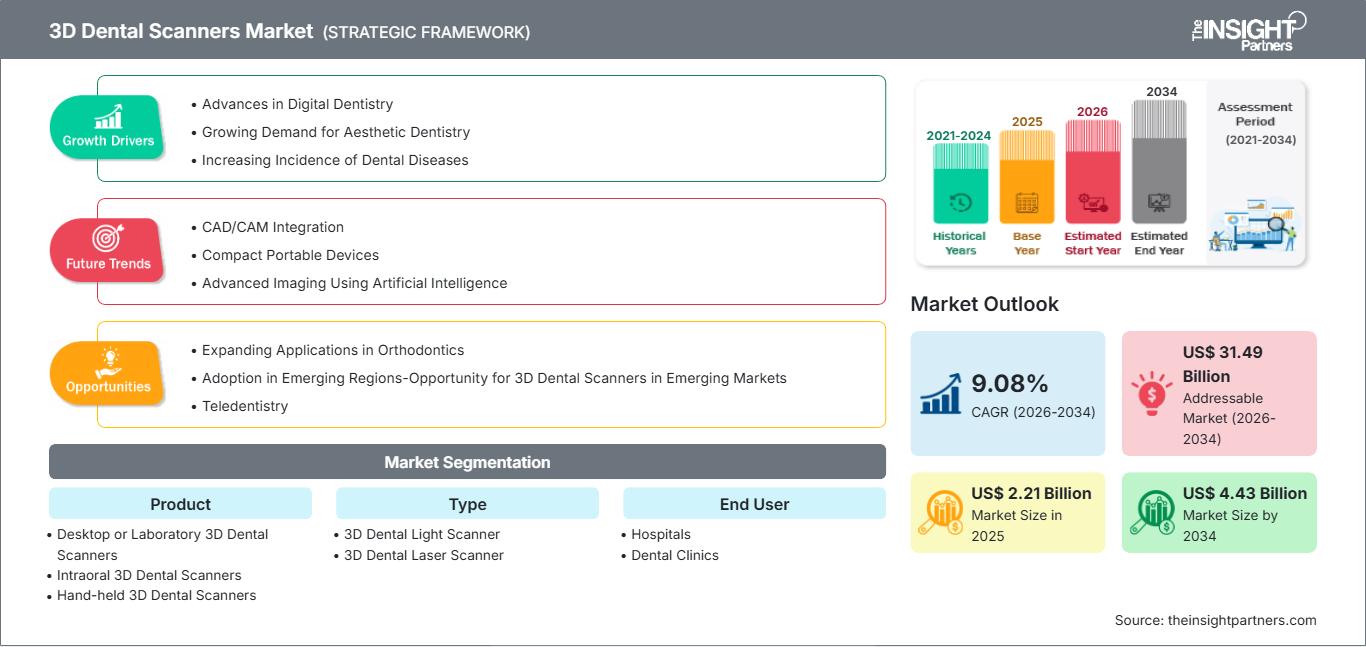
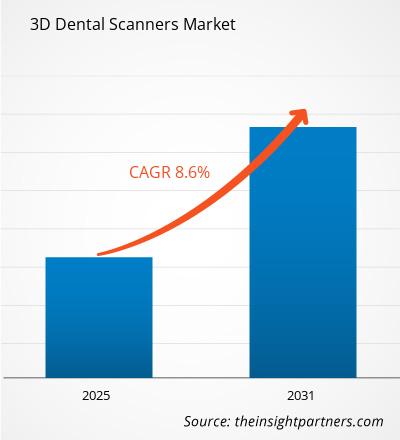
The 3D Dental Scanners market was valued at US$ 2.21 billion in 2025 and is expected to reach US$ 4.43 billion by 2034; it is estimated to record a CAGR of 8.03% during 2026-2034.
3D Dental Scanners Market Assessment and Insights
- North America held 37–40% share in 2025 and is projected to grow at a CAGR between 2026–2034 of 8.5–9.3%, supported by digital impression uptake, DSO purchasing, and restorative workflow automation.
- US represented 85–88% of North America in 2025 and is expected to grow at a CAGR between 2026–2034 of 8.4–9.2%, led by aligner workflows and implant planning.
- Europe accounted for 28–31% share in 2025 and is forecast to expand at a CAGR between 2026–2034 of 8.0–8.8%, with Germany, France, Italy, Spain, and the UK leading adoption.
- Asia Pacific captured 22–25% share in 2025 and is projected to grow at a CAGR between 2026–2034 of 10.1–10.9%, driven by China, Japan, South Korea, India, and Australia.
- Largest Segment Intraoral 3D Dental Scanners held 48–52% market share in 2025 and is expected to grow at a CAGR range of 9.3–10.1% during 2026–2034 due to chairside adoption.
- High Growth Segment Hand-held 3D Dental Scanners represented 18–22% share in 2025 and is forecast to grow at a CAGR range of 10.8–11.7% during 2026–2034 as usability improves.
- Key companies analyzed in detail: 3M Company, 3Shape A/S, Age Solutions S.r.l., Align Technology, Inc., Carestream Dental LLC, Condor Technologies NV, Asahi Roentgen Ind. Co., Ltd., Danaher Corporation, Densys3D Ltd., and Straumann Holding AG.
Source: The Insight Partners' analysis based on proprietary research, government publications, company annual reports, investor presentations, industry databases, and expert interviews.
This market is transitioning from laboratory-based to cloud-connected chair-side scanning solutions that enable dentists to scan, diagnose, communicate, design, and transmit their cases digitally. Trends include light wands, bigger fields of views, calibration-free scanning, AI-driven diagnostic capabilities, and better scans of edentulous and complicated restorations. The 3d dental scanners market is also driven by increased interoperability between intraoral scanners, CBCT images, implant planning tools, and 3D printing devices.
Future trends in this market will be driven by emerging countries, dental chains, and multidisciplinary clinics, which will drive the adoption of scanners through lower costs of digital processes. Accuracy and data protection requirements from regulatory bodies along with artificial intelligence will have an impact on products. Capital investment will shift from pure hardware selling to cloud management of cases, communication software, design modules, and scanning to lab ecosystem solutions.
3D Dental Scanners Market Report Scope
| Report Attribute | Details |
|---|---|
| Market size in 2025 | US$ 2.21 Billion |
| Market Size by 2034 | US$ 4.43 Billion |
| Global CAGR (2026 - 2034) | 8.03% |
| Historical Data | 2021-2024 |
| Forecast period | 2026-2034 |
3D Dental Scanners Market Analysis
Factors fueling demand include reducing the number of retaken impressions, improving turnaround times for restoration procedures, aligner submission support, helping with implant planning, and enhancing communications between dentists and patients. The market growth of 3d dental scanners is bolstered by WHO statistics on oral health which reveal that 2.5 billion people have untreated dental caries, while 1 billion people suffer from severe periodontal diseases.
Components along the supply chain include optics, sensor assemblies, scanner devices, imaging software, design tools, dental labs, milling facilities, 3D printers, distributors, and services. Those businesses that combine precision in scanning images with training, warranty services, workflow integration, and CAD/CAM processes and aligners integration will benefit from the dynamics of supply.
Competition is innovative and growing to be more dependent on software. 3d dental scanners market analysis indicates that 3Shape A/S, Align Technology, Inc., Carestream Dental LLC, Straumann Holding AG, and Densys3D Ltd. compete on intraoral scanning precision, integration into treatment procedures, and platforms’ ecosystems.
3M Company, Age Solutions S.r.l., Condor Technologies NV, Asahi Roentgen Ind. Co., Ltd., and Danaher Corporation contribute to the breadth of the market through relationships with materials, imaging, manufacturing, and dental technology. Positioning depends on scanning precision, user friendliness, openness of data exchange, cloud-based workflows, diagnostic capabilities with artificial intelligence, and access to dental clinics and laboratories.
● REPORT CUSTOMIZATION
Tailor This Report To Align With Your Specific Business Requirements
This report can be customized to align precisely with your business objectives, scope, and target markets. Customization options include tailored segmentation, geography, competitive analysis, and strategic insights to support informed decision-making.
Customize This Report →WHAT YOU CAN ADJUST
- ● Segmentations
- ● Geography
- ● Competitive Analysis
- ● Language Preferences
3D Dental Scanners Market: Strategic Insights
Regional Insights
North America 3d dental scanners Market
North America accounted for 37-40% market share in 2025 and is forecasted to grow at CAGR of 8.5-9.3% during 2026-2034. Factors driving its adoption include dental service organizations, workflow for orthodontic aligners, implant dentistry, and replacement of traditional impressions. Practices are viewing scanners more as productivity tools and not as optional digital devices anymore.
The factors that support the 3d dental scanners market share in North America include the large volume of procedures and the adoption of software. Factors influencing scanner adoption include the need for accurate restorations, chair side visualization, laboratory connectivity, and patient acceptance. iTero Lumina features from Align Technology include faster scanning, small size wand, and intraoral camera function.
U.S. 3d dental scanners Market
The United States made up 85%-88% of North America in 2025 and is anticipated to grow with a CAGR of 8.4-9.2% from 2026-2034. The region holds significance because of high investments in dental treatment, use of aligners, multisite practice purchases, and the need for same-day restoration process.
There is presence of companies in the region through sales directly, dental dealerships, and via platforms. Companies such as Align Technology, Inc., 3Shape A/S, Carestream Dental LLC, Straumann Holding AG, 3M Company, and Densys3D Ltd. cater to clinics that require scan-to-design, scan-to-aligner, scan-to-CBCT, and scan-to-lab integration.
Europe 3d dental scanners Market
Europe accounted for 28–31% share in 2025 and is forecast to expand at a CAGR of 8.0–8.8% during 2026–2034. Germany is the leading country, supported by dental technology adoption, laboratory networks, and implantology. France, Italy, Spain, and the UK also show strong digital dentistry replacement demand.
The German market is driven by an integrated practice-laboratory workflow process, high-quality equipment, and restorative quality requirements. Productivity in the private dentistry and aligner workflows are emphasized in the UK, while France supports adoption through implants and prosthodontics processes. Purchase considerations take into account scanner accuracy, software costs, and open systems.
Italy and Spain are growing with aesthetic dentistry, dental tourism, and clinic development. High adoption of cloud-based case collaboration is observed in the Nordic and Benelux regions. European market growth continues to be robust since digital dentistry is already well-established, but artificial intelligence, faster scanning, and subscription workflows continue driving upgrades.
APAC 3d dental scanners Market
APAC held 22–25% share in 2025 and is projected to grow at a CAGR of 10.1–10.9% during 2026–2034. China leads regional volume through clinic expansion and domestic digital dentistry investment, while Japan, South Korea, India, and Australia contribute through premium dentistry and orthodontic demand.
Industrial and policy drivers include local device manufacturing, digital dental laboratories, and expanding private care networks. South Korea and Japan support high-end imaging and CAD/CAM workflows, while India offers growth through urban clinics and aligner adoption. Financing, training, and service coverage remain key adoption factors.
Middle East & Africa 3d dental scanners Market
Middle East & Africa is projected to grow at a CAGR of 7.0–7.8% during 2026–2034. Saudi Arabia leads demand through dental infrastructure investment, specialist clinics, and healthcare modernization. The UAE follows through premium aesthetic dentistry, medical tourism, and private dental groups.
South Africa anchors African demand through private clinics and dental laboratories. Rest of MEA remains concentrated in urban practices because scanners require trained operators, software support, and sufficient case volume. Gulf healthcare investment supports adoption of digital impression and implant planning systems, although affordability limits wider penetration.
Segmentation Analysis
Product
The Product segment is expected to grow at a CAGR of 9.0–9.8% during 2026–2034. 3d dental scanners market scope across product categories is defined by where the scanner is used, how data are captured, and how directly files support clinical or laboratory outputs. Intraoral scanners lead chairside adoption, while desktop systems remain important for labs managing high-volume restorative design.
- Desktop or Laboratory 3D Dental Scanners remain important for dental laboratories because they support high-precision model scanning, prosthetic design, implant cases, and batch processing for crowns, bridges, and dentures.
- Intraoral 3D Dental Scanners dominate demand because clinicians use them chairside for digital impressions, aligners, crowns, implants, monitoring, and patient communication without conventional impression materials.
- Hand-held 3D Dental Scanners are gaining adoption due to lighter designs, improved ergonomics, faster capture, and usability in complex areas such as palates, edentulous spaces, and full arches.
- Cone Beam Computerized Tomography supports broader treatment planning where 3D skeletal and dental anatomy are required for implants, orthodontics, oral surgery, and integration with intraoral scans.
Type
The Type segment is projected to grow at a CAGR of 8.7–9.5% during 2026–2034. Technology selection depends on scan speed, surface capture, accuracy, powder-free workflow, color reproduction, device cost, and software compatibility. Light-based scanners are widely used in intraoral workflows, while laser scanners retain relevance in laboratory and specialized measurement environments.
- 3D Dental Light Scanner products hold the leading position because structured light and optical technologies support fast, powder-free intraoral capture, photorealistic models, and comfortable scanning workflows.
- 3D Dental Laser Scanner products remain relevant for precise surface measurement, laboratory work, and specific applications where point-based capture, model scanning, or controlled environments support accuracy.
End User
The End User segment is forecast to grow at a CAGR of 8.9–9.7% during 2026–2034. Dental clinics dominate purchases because scanners directly influence chairside workflow, case acceptance, and lab communication. Hospitals use scanners selectively in dental departments, maxillofacial units, and multidisciplinary care where digital records support treatment planning.
- Hospitals generate demand where dental departments, oral surgery units, orthodontic programs, and maxillofacial services require digital impressions and integrated imaging for complex patient management.
- Dental Clinics represent the strongest end-user base because scanners reduce impression materials, improve restorative workflows, support aligner cases, and enhance visual communication with patients.
Opportunity Snapshot
| Segment Name | Revenue Contribution | Trend Tag | Adoption Stage |
| Hospitals | Medium | Digital Records | Scaling |
| Dental Clinics | High | Chairside Scanning | Mature |
3D Dental Scanners Market Growth Drivers and Impact Analysis
Shift from Conventional Impressions to Digital Workflows
Dental practices are replacing physical impressions because digital scans reduce material handling, improve patient comfort, and accelerate laboratory communication. The 3d dental scanners market benefits as scanners become central to crowns, bridges, aligners, dentures, implants, and orthodontic monitoring. Digital capture also supports file reuse, remote consultations, and design automation, reducing the need for repeated chairside appointments. Real-world impact is strongest in high-volume clinics and dental service organizations where workflow standardization matters. WHO’s large oral disease burden reinforces sustained need for efficient diagnosis and restoration pathways, particularly as dental systems manage caries, periodontal disease, and tooth loss at scale.
Expansion of Aligner, Implant, and Restorative Dentistry
Aligner therapy, implant planning, and chairside restorations are accelerating scanner adoption because each workflow depends on accurate digital records. Align Technology announced restorative capabilities for iTero Lumina systems, including single-pass scanning for crowns to full-arch preparations and Near Infra-Red Imaging support in the Pro system. Carestream Dental’s IDS 2025 updates emphasized AI-assisted implant planning and integration of CBCT volumes with digital impressions, illustrating how scanner data now supports end-to-end treatment planning. Market impact is visible in higher scanner utilization per clinic and stronger demand for open ecosystem connectivity.
AI-Enabled Diagnostics and Patient Communication
AI-assisted features are changing scanner value propositions from image capture to clinical decision support. 3Shape introduced TRIOS 6 with hyperspectral technology and TRIOS Dx Plus software designed to help detect surface and proximal caries, plaque, tooth wear, and gingival recession. These capabilities support patient education by turning scans into visual evidence that can improve treatment discussions. The market impact is important because clinics increasingly justify scanner investment through case acceptance, monitoring, and multi-condition assessment rather than impression replacement alone. Vendors with software subscriptions and patient-facing apps can create recurring revenue while improving clinical workflow stickiness.
3D Dental Scanners Market Future Trends
Diagnostics-Integrated Intraoral Scanning
Diagnostics-integrated scanning will define 3d dental scanners market trends as intraoral devices combine surface capture, color imaging, near-infrared data, fluorescence, and AI-assisted visualization. 3Shape’s TRIOS 6 uses hyperspectral technology to capture white, fluorescent, and near-infrared light sources simultaneously, while Align’s iTero Lumina Pro includes NIRI support for interproximal caries detection. Future scanners will increasingly support monitoring of enamel changes, gingival recession, tooth wear, plaque, and restorative fit. Commercial advantage will depend on regulatory clearance, diagnostic reliability, user interface simplicity, and the ability to convert findings into treatment acceptance.
Cloud-Based Collaboration Across Clinics and Labs
Cloud-enabled workflows are expected to become central as clinics, laboratories, aligner providers, and implant planning services work from shared digital records. Straumann launched Straumann AXS as a cloud-based platform integrating digital solutions, services, and products, while its collaboration with Carestream Dental connects CBCT scanning into the Straumann digital ecosystem. Future scanner purchasing will increasingly depend on whether files move smoothly between chairside capture, case planning, guide design, prosthetic production, and patient communication. This trend favors open platforms that reduce rework and make multisite dental groups easier to manage
3D Dental Scanners Market Opportunities
Subscription Software and AI Modules
3d dental scanners market Forecasts point to strong opportunity in software subscriptions that extend scanner value after hardware purchase. Companies can monetize AI diagnostics, treatment simulation, patient apps, restorative design tools, cloud storage, and lab collaboration modules. 3Shape’s DentalHealth app and TRIOS Dx Plus demonstrate how patient communication and diagnostic visualization can become part of scanner ecosystems. The opportunity is strongest among dental service organizations and high-volume clinics seeking consistent workflows. Success will depend on transparent pricing, regulatory compliance, cybersecurity, integration with practice systems, and measurable clinical productivity gains.
Emerging Market Clinic Digitization
Emerging markets offer major opportunity as clinics in India, China, Southeast Asia, the Middle East, and Latin America move from analog impressions to digital dentistry. Scanner suppliers can improve penetration with lower-cost models, financing, local-language training, and service teams. IDS 2025 reporting showed intraoral scanners becoming more powerful and affordable, while AI and digital workflows are increasingly embedded across dentistry. The strongest demand will come from urban clinics offering aligners, implants, cosmetic restorations, and same-day dentistry. Vendors that bundle scanners with design software, lab access, and support can accelerate adoption.
Recent Developments
- September 2025: Align Technology, Inc. announced availability of restorative capabilities on its next-generation iTero Lumina intraoral scanner and new iTero Lumina Pro Dental Imaging System, supporting diagnostic, restorative, and multidisciplinary ortho-restorative workflows with single-pass scanning, larger field of view, and NIRI-enabled interproximal caries detection support.
- March 2025: 3Shape A/S introduced TRIOS 6, TRIOS Dx Plus diagnostic software, and the DentalHealth patient app at IDS 2025. The wireless scanner incorporates hyperspectral technology and AI-assisted diagnostic support for surface and proximal caries, plaque, tooth wear, and gingival recession, while offering higher scan resolution than previous 3Shape scanners.
- March 2025: Carestream Dental LLC showcased CS 8200 3D Advance Edition and AI-assisted implant planning software at IDS 2025, while previewing collaboration with Straumann to connect Carestream imaging with the Straumann digital ecosystem, supporting CBCT and intraoral scan integration for implant planning and laboratory workflows.
Frequently Asked Questions

- Comprehensive Market Sizing and Forecast Analysis
- Detailed Segmentation Analysis
- In-Depth Market Dynamics Assessment
- Regional and Country-Level Insights
- Competitive Landscape and Company Benchmarking
- Strategic Business Intelligence
Recent Reports
Testimonials

The Insight Partners' SCADA System Market report is comprehensive, with valuable insights on current trends and future forecasts. The team was highly professional, responsive, and supportive throughout. We are very satisfied and highly recommend their services.
RAN KEDEM Partner, Reali Technologies LTDs
I requested a report on a very specific software market and the team produced the report in a few days. The information was very relevant and well presented. I then requested some changes and additions to the report. The team was again very responsive and I got the final report in less than a week.
JEAN-HERVE JENN Chairman, Future Analytica
We worked with The Insight Partners for an important market study and forecast. They gave us clear insights into opportunities and risks, which helped shape our plans. Their research was easy to use and based on solid data. It helped us make smart, confident decisions. We highly recommend them.
PIYUSH NAGPAL Sr. Vice President, High Beam Global
The Insight Partners delivered insightful, well-structured market research with strong domain expertise. Their team was professional and responsive throughout. The user-friendly website made accessing industry reports seamless. We highly recommend them for reliable, high-quality research services
YUKIHIKO ADACHI CEO, Deep Blue, LLC.
This is the first time I have purchased a market report from The Insight Partners.While I was unsure at first, I visited their web site and felt more comfortable to take the risk and purchase a market report.I am completely satisfied with the quality of the report and customer service. I had several questions and comments with the initial report, but after a couple of dialogs over email with their analyst I believe I have a report that I can use as input to our strategic planning process.Thank you so much for taking the extra time and making this a positive experience.I will definitely recommend your service to others and you will be my first call when we need further market data.
JOHN SUZUKI President and Chief Executive Officer, Board Director, BK Technologies
I wish to appreciate your support and the professionalism you displayed in the course of attending to my request for information regarding to infectious disease IVD market in Nigeria. I appreciate your patience, your guidance, and the fact that you were willing to offer a discount, which eventually made it possible for us to close a deal. I look forward to engaging The Insight Partners in the future, all thanks to the impression you have created in me as a result of this first encounter.
DR CHIJIOKE ONYIA MANAGING DIRECTOR, PineCrest Healthcare Ltd.Reason to Buy
- Informed Decision-Making
- Understanding Market Dynamics
- Competitive Analysis
- Identifying Emerging Markets
- Customer Insights
- Market Forecasts
- Risk Mitigation
- Boosting Operational Efficiency
- Strategic Planning
- Investment Justification
- Tracking Industry Innovations
- Aligning with Regulatory Trends





 Get Free Sample for