
3D Reconstruction Solutions Market Size, Share & Forecast by 2034
Coverage: By Construction Method (Active, Passive); Type (3D Reconstruction Software, Based on 3D Scanning, Based on Images and Video); Application (Culture Heritage and Museum, Films and Games, 3D Printing, Drones and Robots), and Geography (North America, Europe, Asia Pacific, and South and Central America)
- Status : Data Released
- Report Code : TIPRE00003701
- Category : Manufacturing and Construction
- No. of Pages : 150
- Available Report Formats :


- Last update date : July 15, 2026


2025 Market Size
US$ 1.38 Bn
Base year value
2034 Forecast
US$ 1.89 Bn
Projected by 2034
CAGR 2026-2034
3.56 %
Growth rate
Addressable Market
US$ 14.85 Bn
(2026-2034)
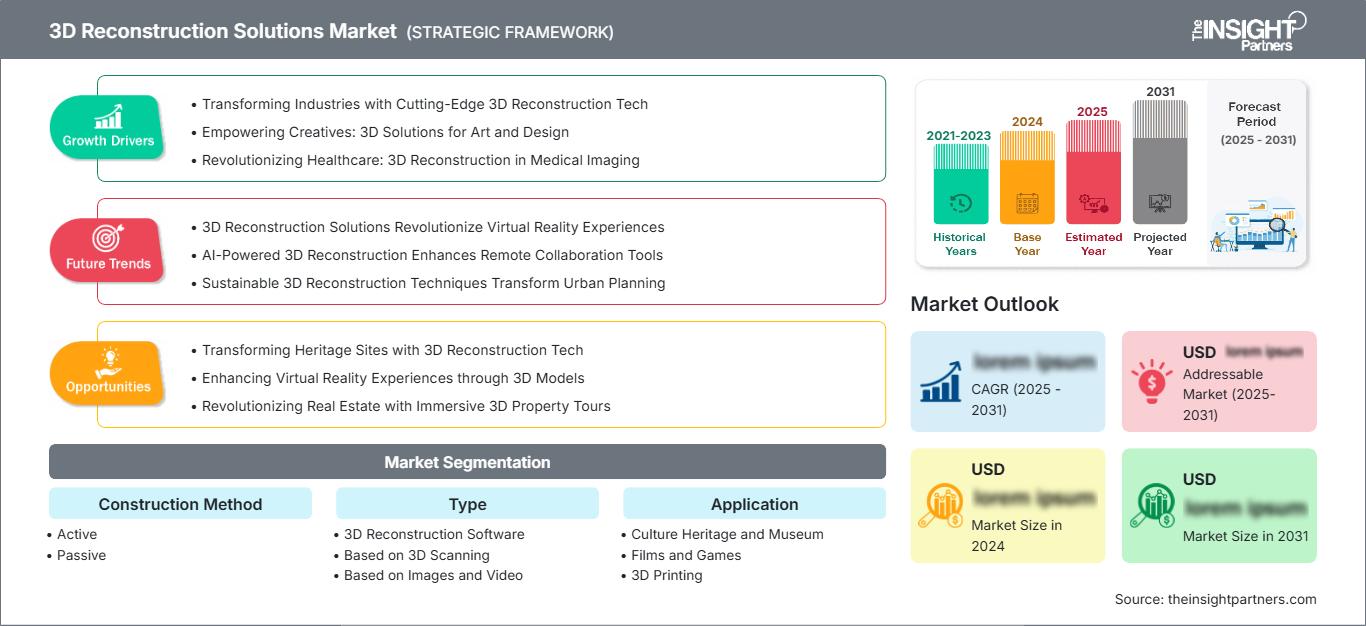
The global 3D Reconstruction Solutions market was valued at US$ 1.38 billion in 2025 and is expected to reach US$ 1.89 billion by 2034; it is estimated to record a CAGR of 3.56% during 2026-2034.
3D Reconstruction Solutions Market Assessment and Insights
- North America: The region accounted for 38–42% share in 2025 and is projected to grow at 3.8–4.4% CAGR between 2026–2034, supported by digital twins, BIM, defense visualization, and media production workflows.
- US: The US represented 78–82% of North America in 2025 and is forecast to grow at 3.7–4.3% CAGR between 2026–2034, reflecting strong enterprise software adoption.
- Europe: Europe held 25–29% share in 2025 and may expand at 3.5–4.1% CAGR, led by the UK, Germany, France, Italy, and Spain through cultural preservation, manufacturing, and infrastructure modernization.
- Asia Pacific: Asia Pacific captured 22–26% 3d reconstruction solutions market share in 2025 and is expected to record 4.5–5.2% CAGR, led by China, Japan, South Korea, India, and Australia through industrial automation and smart-city programs.
- Largest Segment: 3D Reconstruction Software held 48–52% market share in 2025 and is estimated to grow at 3.9–4.5% CAGR as users prioritize scalable cloud processing and workflow integration.
- High Growth Segment: Drones and Robots represented 14–18% 3d reconstruction solutions market share in 2025 and is projected to grow at 5.0–5.8% CAGR due to automated inspection and remote mapping demand.
- Key companies analyzed in detail: Agisoft LLC, Autodesk, Inc., Bentley Systems, Incorporated, Epic Games, Inc., Hexagon AB, Matterport, Inc., PhotoModeler Technologies, Pix4D SA, Trimble Inc., 3Dflow SRL.
Source: The Insight Partners' analysis based on proprietary research, government publications, company annual reports, investor presentations, industry databases, and expert interviews.
The 3d reconstruction solutions Market has evolved from specialist photogrammetry and laser scanning workflows into integrated platforms that combine imagery, point clouds, AI-assisted registration, and cloud-based collaboration. Production dynamics are moving towards subscription software, automatic meshing, and integration capabilities with CAD, BIM, GIS, game engines, and digital twin models that will reduce project time and expand use to non-expert surveying teams.
Over the forecast period, new geographic regions will fuel usage with their needs for accurate recording of space due to transportation arteries, renewable energy infrastructure, smart cities projects, and digitalizing historic heritage. Focus on safe inspection of infrastructure and resilient public assets will drive investment into the market steadily, while decreasing costs of sensors and pipeline for converting images to model will expand market coverage for medium-sized companies.
3D Reconstruction Solutions Market Report Scope
| Report Attribute | Details |
|---|---|
| Market size in 2025 | US$ 1.38 Billion |
| Market Size by 2034 | US$ 1.89 Billion |
| Global CAGR (2026 - 2034) | 3.56% |
| Historical Data | 2021-2024 |
| Forecast period | 2026-2034 |
3D Reconstruction Solutions Market Analysis
The market demand for 3d reconstruction services is fueled by organizations that require exact digital representations of buildings, objects, film sets, manufacturing parts, and outdoor landscapes. The supply chain includes image acquisition, LiDAR/structured light scanning, software processing, cloud computing, 3d reconstruction, and further visualization within CAD, BIM, AR/VR, simulation, and 3D printing applications.
The competitive forces within the supply market will be biased towards vendors that can facilitate efficient data acquisition as well as quick data processing without loss of geometry. Software subscription model is the source of repeatable revenues, while platform agnostic software processing helps to eliminate buyers' lock-in. As the company's growth curve is getting more mature, the procurement decisions will rely on the levels of automation, data compatibility, enterprise security, and total cost of processing.
Fragmentation in the competitive environment persists among photogrammetry providers, engineering software vendors, geospatial companies, and immersive property scanning tools. The companies enjoying advantages because of existing engineering ecosystems include Autodesk, Inc., Bentley Systems, Incorporated, Trimble Inc., and Hexagon AB, whereas Agisoft LLC, Pix4D SA, PhotoModeler Technologies, 3Dflow SRL, Matterport, Inc., and Epic Games, Inc. compete due to automation capabilities, visualizations, and verticalization.
Current investment dynamics are oriented toward AI-based reconstructions, cloud-based collaboration, drone-based mapping, and digital twin integrations. Positioning is defined through collaboration with organizations in construction, gaming, geospatial services, and cultural heritage preservation. The buyers of 3d reconstruction solutions analysis pay more attention to proven accuracy, enterprise scalability, and handling large amounts of data from sensor suites.
● REPORT CUSTOMIZATION
Tailor This Report To Align With Your Specific Business Requirements
This report can be customized to align precisely with your business objectives, scope, and target markets. Customization options include tailored segmentation, geography, competitive analysis, and strategic insights to support informed decision-making.
Customize This Report →WHAT YOU CAN ADJUST
- ● Segmentations
- ● Geography
- ● Competitive Analysis
- ● Language Preferences
3D Reconstruction Solutions Market: Strategic Insights
Regional Insights
North America 3d reconstruction solutions
North America held 38–42% 3d reconstruction solutions market share in 2025 and is expected to grow at 3.8–4.4% CAGR. Demand is driven by engineering design, infrastructure revitalization, visualization of real estate, media creation, safety mapping, and simulations for defense purposes. Businesses in the area usually have a higher level of preparedness to implement cloud computing and link reconstruction data with CAD, BIM, GIS, and digital twins platforms.
Drone services network, highly developed cameras and LiDAR sensors, as well as a substantial number of trained specialists in surveying, design, and visualization, also add value to the regional context. Trends of 3d reconstruction services in North America are now shifting toward the automation of inspection process in order to collect condition records without any field work repetition.
U.S. 3d reconstruction solutions Market
The US accounted for 78–82% of North America 3d reconstruction solutions market in 2025 and is forecast to expand at 3.7–4.3% CAGR. Demand is concentrated in architecture, engineering, construction, film and games, unmanned systems, and immersive property documentation. Local presence from Autodesk, Inc., Bentley Systems, Incorporated, Matterport, Inc., Trimble Inc., and PhotoModeler Technologies strengthens enterprise adoption and support coverage.
The application trends indicate a growing reliance on the image-based modeling technique to capture locations, create visual effects, document facilities, and analyze inspections. North American investments in public infrastructure, private construction digitization, and advanced manufacturing workflows facilitate 3d reconstruction solutions adoption. US customers tend to prioritize cybersecurity, data sovereignty, interoperability, and verified precision before deploying reconstruction at a multi-site level.
Europe 3d reconstruction solutions Market
Europe held 25–29% 3d reconstruction solutions market share in 2025 and is projected to grow at 3.5–4.1% CAGR, with the UK and Germany leading adoption. The UK market benefits from heritage documentation, film production, infrastructure surveys, and digital construction mandates that encourage model-based workflows across public and private projects.
This is backed up by manufacturing automation, automotive engineering, industrial metrology, and infrastructure upgrading. The buyers in engineering place emphasis on reconstruction precision, versioning, and simulation system compatibility, thus enterprise-class software and scanning solutions become key to manufacturing, railways, utilities, and construction sites.
Additional demand comes from France, Italy, and Spain with their applications in museums, archaeology, urban development, tourism-related assets, and public infrastructure. The cultural heritage and museum applications still carry strategic weight due to the ability of digital artifacts to facilitate conservation plans, remote examination, and restoration procedures. Growth in European 3d reconstruction solutions Market is solid and predictable.
APAC 3d reconstruction solutions Market
APAC represented 22–26% 3d reconstruction solutions market share in 2025 and is expected to grow at 4.5–5.2% CAGR, the fastest regional range. China leads regional demand through infrastructure digitization, manufacturing automation, urban mapping, and robotics.
Precision manufacturing, autonomous technologies, cultural digitization, and media content pipeline are some of the areas of focus in Japan and South Korea. In India and Australia, momentum is gained through smart cities initiatives, mining, construction, and geospatial mapping projects. Infrastructure investments due to policy backing and adoption of drones increase the potential market, while cloud-based service delivery reduces entry barriers for medium-size survey and visualization companies.
Middle East & Africa 3d reconstruction solutions Market
The Middle East and Africa 3d reconstruction solutions market is forecast to grow at a 3.9–4.6% CAGR, with Saudi Arabia leading through megaprojects, tourism assets, and infrastructure digitalization. Energy facilities, airports, and industrial sites use reconstruction for inspection and documentation.
Adoption in the UAE is aided by real estate visualisation, smart city initiatives, cultural districts, and e-government applications. Demand in South Africa is created by mining, utilities, construction, and heritage conservation where remote data capture will lower field risks.
MEA (excluding UAE & SA) adoption is still selective and growing through more drone mapping projects, renewable energy transition infrastructure, and resiliency programs creating demand. End users favor a service-led deployment model before enterprise software subscriptions.
Segmentation Analysis
Construction Method
Construction Method in the 3d reconstruction solutions market forecast is expected to grow at 3.8–4.5% CAGR between 2026–2034 as buyers balance active capture precision with passive image-based flexibility. Selection depends on project scale, accuracy thresholds, lighting conditions, asset accessibility, and required integration with design or inspection systems.
- Active methods remain important where LiDAR, structured light, or depth sensors are required for measurable geometry, repeatable inspections, and complex indoor or industrial environments.
- Passive methods are favored for lower-cost image capture, drone photogrammetry, film assets, and cultural sites where flexible acquisition and broad scene coverage matter.
Type
Type in the 3d reconstruction solutions market is projected to expand at 3.9–4.6% CAGR as software, scanning-based workflows, and image or video reconstruction converge. The 3d reconstruction solutions size by type is influenced by enterprise preference for automated processing, sensor compatibility, and output formats that support CAD, BIM, visualization, and additive manufacturing.
- 3D Reconstruction Software leads adoption because it centralizes processing, editing, collaboration, and export functions while supporting recurring enterprise deployment across many use cases.
- Based on 3D Scanning is selected for metrology-grade capture, industrial assets, heritage artifacts, and environments requiring reliable depth data and measurable surfaces.
- Based on Images and Video supports scalable capture using cameras, drones, and mobile devices, making it valuable for visual effects, surveys, tourism, and asset documentation.
Application
Application in the 3d reconstruction solutions market report is expected to grow at 4.0–4.8% CAGR as demand expands from visualization into operational decision-making. Culture heritage and museum users emphasize preservation, films and games require immersive assets, 3D printing needs manufacturable geometry, and drones and robots create automated capture channels for difficult sites.
- Culture Heritage and Museum applications use reconstruction for conservation records, virtual exhibits, restoration planning, and education, especially where fragile assets need non-contact documentation.
- Films and Games rely on reconstructed environments, props, and characters to reduce manual modeling time and improve realism across visual effects and immersive production.
- 3D Printing applications convert scans or image-derived models into manufacturable files, supporting prototyping, replacement parts, customized products, and artifact replicas.
- Drones and Robots are strategically important for automated mapping, hazardous inspection, construction progress tracking, and repetitive capture over large or inaccessible sites.
Opportunity Snapshot
| Application | Revenue Contribution | Trend Tag | Adoption Stage |
| Culture Heritage and Museum | Medium | Digital Archives | Scaling |
| Films and Games | High | Virtual Sets | Mature |
| 3D Printing | Medium | Scan-to-Print | Scaling |
| Drones and Robots | High | Autonomous Mapping | Emerging |
3D Reconstruction Solutions Market Growth Drivers and Impact Analysis
Enterprise Digital Twin Integration
Companies are integrating the reconstructed 3D models with their digital twin systems for monitoring assets, testing the scenarios and managing the maintenance activities better. Why is this driver important? Because the reconstruction offers the basis for accurate spatial context through its geometry and IoT/analytics provide operational data. The organizations that own infrastructure, manufacturing facilities or real estate properties could save time on visiting sites, check the actual state of the property against designs and schedule maintenance tasks. This driver works best in cases when the assets are complicated, dispersed and costly to check by humans.
Drone-Based Capture for Large Sites
Drone-enabled photogrammetry is expanding the market by reducing the time, labor, and risk associated with surveying large or difficult terrain. Construction sites, mines, energy corridors, ports, and heritage locations benefit from repeatable aerial capture that can be converted into dense point clouds and textured meshes. The market impact is practical rather than speculative: faster capture cycles improve progress verification, stockpile measurement, route planning, and inspection documentation. As aviation rules mature and enterprise drone fleets become easier to manage, demand should rise for software that processes high image volumes reliably and converts outputs into engineering-ready formats.
AI-Assisted Model Processing
AI-assisted processing improves reconstruction economics by automating image alignment, feature matching, segmentation, mesh cleanup, and texture optimization. This reduces dependence on specialist operators and makes reconstruction more accessible for enterprises with frequent capture needs. The impact is visible in shorter project cycles, better consistency, and lower rework when datasets are large or imperfect. AI also helps classify objects and detect changes between captures, turning static models into decision-support tools. Vendors that embed automation without sacrificing auditability are better positioned for enterprise procurement, especially in regulated sectors that require traceable measurements and repeatable workflows.
3D Reconstruction Solutions Market Future Trends
Real-Time Reconstruction at the Edge
Future deployments will increasingly process reconstruction data near the capture device rather than waiting for centralized cloud workflows. Edge computing can support faster field decisions for robots, drones, emergency responders, and construction teams that need immediate spatial awareness. Real-time reconstruction is especially relevant where connectivity is limited or safety decisions cannot wait for overnight processing. The trend may shift software requirements toward lighter algorithms, sensor fusion, and incremental model updates. Over time, this could create new subscription tiers for field-ready processing and strengthen demand for devices that combine cameras, depth sensors, and onboard AI acceleration.
Reconstruction for Immersive Commerce
A key in the 3d reconstruction solutions market trend is that immersive commerce will broaden reconstruction demand as retailers, real estate platforms, museums, and tourism operators use accurate 3D spaces to improve buyer confidence and remote engagement. Unlike basic visualization, reconstructed environments can support measurement, navigation, product placement, and interactive storytelling. The trend will favor solutions that balance visual quality with web performance, privacy controls, and easy publishing. As consumers become more comfortable with spatial interfaces, enterprises may treat reconstruction as a content infrastructure layer rather than a one-off marketing project, creating recurring needs for model refresh, hosting, and experience optimization.
3D Reconstruction Solutions Market Opportunities
Managed Reconstruction Services for Mid-Market Buyers
Mid-market construction firms, museums, manufacturers, and inspection providers often need 3D outputs but lack dedicated reconstruction specialists. This creates an opportunity for managed services that bundle capture planning, data processing, quality checks, hosting, and integration support. Providers can differentiate through standardized turnaround times, accuracy documentation, and application-specific templates for progress tracking, digital exhibits, or scan-to-print workflows. The opportunity is attractive because it converts technical complexity into an outcome-based service. Vendors and channel partners that build repeatable delivery models can expand adoption among customers that are not ready for full in-house software and hardware investment.
Vertical Workflows for Heritage and Infrastructure
Specialized workflows for heritage and infrastructure can unlock higher-value opportunities than generic reconstruction tools. Heritage users need non-contact capture, metadata, conservation records, and public-facing access, while infrastructure owners require repeatable measurements, change detection, and integration with asset management systems. Vendors can create tailored packages combining photogrammetry, scanning, documentation templates, and secure repositories. This opportunity is actionable because both sectors face aging assets, limited expert capacity, and pressure to preserve or inspect more efficiently. Solutions that provide defensible accuracy and simple reporting can command stronger buyer trust and improve procurement success.
Recent Developments
- February 2026: Autodesk, Inc. — announced AI and cloud enhancements across design and make workflows, reinforcing the role of automated model generation and connected data environments for AEC and manufacturing users adopting reconstruction-adjacent workflows
- October 2025: Pix4D SA — expanded drone and terrestrial mapping workflow capabilities for professional photogrammetry users, supporting faster processing, improved field-to-office collaboration, and broader use in surveying, construction, and inspection projects
- June 2025: Matterport, Inc. — continued platform development for digital twins and spatial data services, strengthening capture, hosting, and analytics capabilities used by real estate, facilities, retail, and insurance customers
Frequently Asked Questions

- Comprehensive Market Sizing and Forecast Analysis
- Detailed Segmentation Analysis
- In-Depth Market Dynamics Assessment
- Regional and Country-Level Insights
- Competitive Landscape and Company Benchmarking
- Strategic Business Intelligence
Recent Reports
Testimonials

The Insight Partners' SCADA System Market report is comprehensive, with valuable insights on current trends and future forecasts. The team was highly professional, responsive, and supportive throughout. We are very satisfied and highly recommend their services.
RAN KEDEM Partner, Reali Technologies LTDs
I requested a report on a very specific software market and the team produced the report in a few days. The information was very relevant and well presented. I then requested some changes and additions to the report. The team was again very responsive and I got the final report in less than a week.
JEAN-HERVE JENN Chairman, Future Analytica
We worked with The Insight Partners for an important market study and forecast. They gave us clear insights into opportunities and risks, which helped shape our plans. Their research was easy to use and based on solid data. It helped us make smart, confident decisions. We highly recommend them.
PIYUSH NAGPAL Sr. Vice President, High Beam Global
The Insight Partners delivered insightful, well-structured market research with strong domain expertise. Their team was professional and responsive throughout. The user-friendly website made accessing industry reports seamless. We highly recommend them for reliable, high-quality research services
YUKIHIKO ADACHI CEO, Deep Blue, LLC.
This is the first time I have purchased a market report from The Insight Partners.While I was unsure at first, I visited their web site and felt more comfortable to take the risk and purchase a market report.I am completely satisfied with the quality of the report and customer service. I had several questions and comments with the initial report, but after a couple of dialogs over email with their analyst I believe I have a report that I can use as input to our strategic planning process.Thank you so much for taking the extra time and making this a positive experience.I will definitely recommend your service to others and you will be my first call when we need further market data.
JOHN SUZUKI President and Chief Executive Officer, Board Director, BK Technologies
I wish to appreciate your support and the professionalism you displayed in the course of attending to my request for information regarding to infectious disease IVD market in Nigeria. I appreciate your patience, your guidance, and the fact that you were willing to offer a discount, which eventually made it possible for us to close a deal. I look forward to engaging The Insight Partners in the future, all thanks to the impression you have created in me as a result of this first encounter.
DR CHIJIOKE ONYIA MANAGING DIRECTOR, PineCrest Healthcare Ltd.Reason to Buy
- Informed Decision-Making
- Understanding Market Dynamics
- Competitive Analysis
- Identifying Emerging Markets
- Customer Insights
- Market Forecasts
- Risk Mitigation
- Boosting Operational Efficiency
- Strategic Planning
- Investment Justification
- Tracking Industry Innovations
- Aligning with Regulatory Trends





 Get Free Sample for