
4K Camera Market Size, Growth & Demand by 2034
Coverage: by Types (Professional camcorders, DSLR, Mirrorless, Video, and PTZ); and Application (Consumer Electronics, Retail, Advertisement, Defense & Aerospace, and Entertainment), and Geography (North America, Europe, Asia Pacific, and South and Central America)
- Status : Data Released
- Report Code : TIPTE100001006
- Category : Electronics and Semiconductor
- No. of Pages : 150
- Available Report Formats :


- Last update date : July 10, 2026


2025 Market Size
US$ 18.57 Bn
Base year value
2034 Forecast
US$ 31.23 Bn
Projected by 2034
CAGR 2026-2034
5.95 %
Growth rate
Addressable Market
US$ 225.62 Bn
(2026-2034)
The 4k camera market is valued at US$ 18.57 Billion in 2025 and is projected to reach US$ 31.23 Billion by 2034; it is expected to register a CAGR of 5.95% during 2026–2034. The market reflects rising adoption of high-resolution imaging across professional production, consumer electronics, retail monitoring, advertising, defense and aerospace, and entertainment workflows where 4K capture is increasingly treated as a baseline capability.
North America is anticipated to experience a CAGR of 5.6%-6.3%, backed by streaming studios, sports broadcasts, business video, retail analytics, and the defense sector. North America will benefit from a well-developed ecosystem of creators, high replacement spending, and early adoption of IP-based PTZ cameras. The 4 K camera market is positively influenced by the development of professional services channels and the availability of lenses and accessories.
4K Camera Market Assessment and Insights
- North America: The region held 28%–33% share in 2025 and is forecast to grow at a CAGR of 5.6%–6.3% between 2026–2034, driven by streaming, sports production, enterprise video, and defense imaging modernization.
- US: The US accounted for 78%–84% of North American share in 2025 and is projected to grow at a CAGR of 5.7%–6.4% between 2026–2034, supported by studios, universities, retail chains, and defense programs.
- Europe: Europe represented 24%–29% share in 2025 and is expected to expand at a CAGR of 5.1%–5.8% between 2026–2034, led by Germany, the UK, France, Italy, and Spain.
- Asia Pacific: Asia Pacific captured 31%–36% share in 2025 and is likely to grow at a CAGR of 6.4%–7.2% between 2026–2034, with China, Japan, South Korea, India, and Australia leading adoption.
- Largest Segment: Mirrorless cameras held 34%–39% market share in 2025 and are expected to grow at a CAGR of 6.1%–6.8% between 2026–2034, supported by hybrid creator and professional workflows.
- High Growth Segment: PTZ cameras held 12%–17% of the 4K Camera market share in 2025 and are forecast to grow at a CAGR of 7.0%–7.8% between 2026–2034, driven by remote production and institutional deployments.
- Key companies analyzed in detail: Canon Inc., Panasonic Holdings Corporation, Sony Group Corporation, Nikon Corporation, FUJIFILM Holdings Corporation, Samsung Electronics Co., Ltd., Axis Communications AB, RED Digital Cinema, LLC, Blackmagic Design Pty Ltd., and Sharp Corporation.
Source: The Insight Partners' analysis based on proprietary research, government publications, company annual reports, investor presentations, industry databases, and expert interviews.
The 4k camera market has transitioned from an elite category to a standard for professionals and enthusiasts alike. The initial use was limited to the film industry, broadcasters, and photographers who use DSLRs or camcorders, but today it extends to surveillance applications, corporate studios, sports stadia, defense, virtual production, and independent media production. This product category has evolved to focus more on workflow integration than on resolution alone.
Market outlook remains positive as 4K becomes embedded across across capture, editing, transmission, and display, which provides the basis for the long-term 4K Camera Market Forecast. The mirrorless cameras are becoming more dominant owing to their hybrid nature, and PTZ cameras are becoming more relevant in churches, educational institutions, retail, events, and even remote production applications. Professional camcorders remain essential in scenarios that require long-duration recordings, optical zoom, XLR audio, SDI out, and ruggedness.
4K Camera Market Report Scope
| Report Attribute | Details |
|---|---|
| Market size in 2025 | US$ 18.57 Billion |
| Market Size by 2034 | US$ 31.23 Billion |
| Global CAGR (2026 - 2034) | 5.95% |
| Historical Data | 2021-2024 |
| Forecast period | 2026-2034 |
4K Camera Market Analysis
The 4k camera market is being fueled by the demand for high production values in professional and commercial settings. The entertainment industry needs cameras that provide high-definition images, dynamic range, and color options, while retailers and companies require 4 K cameras for analytics, surveillance, demonstrations, and consumer engagement. In defense and aerospace, a 4 K camera system enhances situational awareness, documentation, and remote viewing capabilities. The value chain consists of image sensors, lenses, processors, displays, storage media, firmware, accessories, distribution networks, and post-production systems.
The demand in the market also reflects a shift towards buying entire imaging workflow systems rather than devices. Canon Inc., Panasonic Corporation, Sony Corporation, Nikon Corporation, Fujifilm Holdings Corporation, Samsung Electronics Co., Ltd., Axis Communications AB, Red Digital Cinema Camera Company, Blackmagic Design, and Sharp Corporation participate across different layers of this ecosystem, from consumer imaging to broadcast, cinema, surveillance, and display-linked capture solutions.
The competitive landscape is shaped by product specialization. Sony Corporation and Canon Inc. compete strongly in mirrorless, cinema, and broadcast workflows; Panasonic Corporation maintains relevance in professional camcorders, PTZ, and live production; Nikon Corporation develops its image credibility through cinema-friendly systems; Fujifilm Holdings Corporation focuses on hybrid shooters and premium imaging; Axis Communications AB on networked surveillance; Blackmagic Design on production value and post-production; and RED Digital Cinema Camera Company on high-end cinema cameras.
The investment patterns indicate that the future is with intelligent recognition, small full frame video bodies, IP video production, PTZ control, low latency live streaming and flexible codecs that ease up the editing process. The positioning strategies would also have an application specific angle, impacting 4K Camera Market Share, where artists prefer portability and autofocus, broadcasters like dependability and connectivity, the defense sector is looking for ruggedness and clarity and the retailers are interested in image capture ready for analytics.
● REPORT CUSTOMIZATION
Tailor This Report To Align With Your Specific Business Requirements
This report can be customized to align precisely with your business objectives, scope, and target markets. Customization options include tailored segmentation, geography, competitive analysis, and strategic insights to support informed decision-making.
Customize This Report →WHAT YOU CAN ADJUST
- ● Segmentations
- ● Geography
- ● Competitive Analysis
- ● Language Preferences
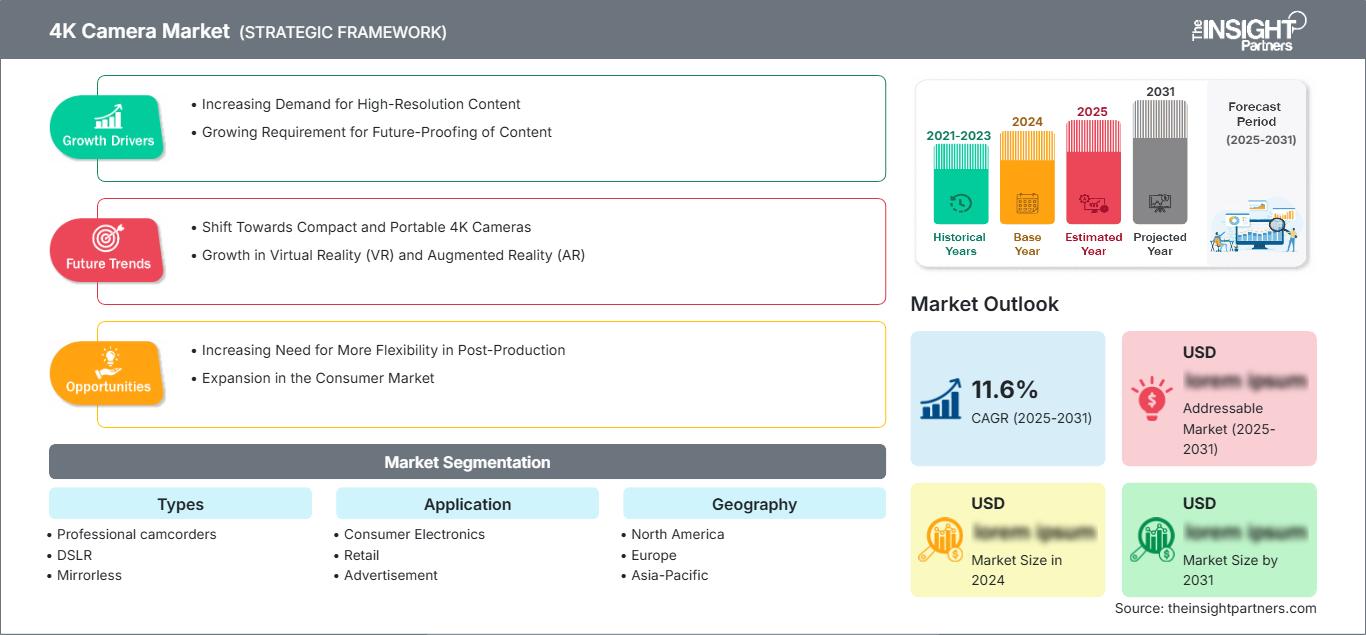
4K Camera Market: Strategic Insights
Regional Insights
North America 4k camera
North America is expected to grow at a CAGR of 5.6%–6.3% in the 4k camera market. The region benefits from mature entertainment production, sports broadcasting, corporate video, retail surveillance, defense procurement, and creator monetization. Demand is especially strong for mirrorless cameras, compact cinema bodies, IP-based PTZ systems, and professional camcorders used in live events, education, worship venues, and remote production.
The structural factors include high broadband usage, post-production facilities, cloud-based processes, and a large number of professionals willing to buy the product because of its autofocus capability, stabilization, flexibility in recording, and low-light sensitivity. The other factors driving the market include the presence of key firms such as Canon Inc., Sony Corporation, Panasonic Corporation, Nikon Corporation, Blackmagic Design, Axis Communications AB, and RED Digital Cinema Camera Company.
U.S. 4k camera Market
The U.S. accounts for approximately 78%–84% of North American demand and is estimated to advance at a CAGR of 5.7%–6.4%. Growth is linked to entertainment studios, sports leagues, defense programs, retail chains, universities, and creator-led production businesses. Mirrorless and cinema cameras dominate high-value creative use, while PTZ cameras are increasingly deployed in lecture halls, churches, conference rooms, and live-streamed events.
Company reach is widespread with Canon Inc., Sony Corporation, Panasonic Corporation, Nikon Corporation, Blackmagic Design, Axis Communications AB, and RED Digital Cinema Camera Company targeting various buying groups. Application areas include using 4K to shoot commercials, stream TV shows, showcase products, perform surveillance analysis, conduct tactical reconnaissance, and provide coverage of event venues. American buyers tend to value ecosystem stability, lens depth, support services, and compatibility with editing/broadcast/cloud production solutions.
Europe 4k camera Market
Europe represents an estimated 24%–29% share of the global 4k camera market and is projected to expand at a CAGR of 5.1%–5.8%. Germany is the leading country because of professional broadcast infrastructure, industrial imaging, retail modernization, and strong demand from event production and engineering-led applications. European customers often emphasize image consistency, durability, privacy-aware deployment, and long-term equipment support, a trend reflected in recent 4K Camera Market Analysis.
Film, television, advertising, streaming production, and individual creator works bring value to the UK market. Demand is focused around mirrorless cameras, compact cinema cameras, professional camcorders, and PTZ devices used for educational, religious, business, and live events purposes. In Germany, adoption is higher for industrial, media, automotive, and technical training applications, where the quality of optics and the level of service play their role in the decision-making process.
France, Italy, and Spain can participate through entertainment creation, tourism-related media, fashion, retail spaces, sports events, and cultural broadcasting. France has demands in film and government video applications; Italy enjoys fashion, design, and commercial content, and Spain participates in event broadcasting and tourism-related productions. Throughout Europe, there is an expectation and a need for regulations that drive competition among providers in reliability, efficiency, and network integration.
APAC 4k camera Market
Asia Pacific is the fastest-growing region, with an estimated share of 31%–36% and a projected CAGR of 6.4%–7.2%. China is the leading country due to manufacturing scale, retail surveillance deployment, electronics supply chains, streaming platforms, smart city projects, and growing demand for professional content tools. Japan and South Korea remain important innovation centers for sensors, optics, mirrorless systems, and broadcast-grade imaging technologies.
The factors behind demand creation in Japan are strong camera brands, professional photography, broadcasting, and the adoption of advanced consumer electronics. The areas that help South Korea in creating the demand include entertainment content production, competitive games, retail technology, and the digital creators ecosystem. India is witnessing growth in demand creation due to advertising, wedding videos, social video, military modernization, education, and retail security.
Drivers for the industry and policy include smart city investments, local electronics manufacturing, public security modernization, broadband connectivity, and the development of the content economy. The growth within the APAC region is not equally distributed; whereas the developed regions concentrate more on image quality and workflow efficiency, the developing regions focus on cost, robustness, and access to channels.
Middle East & Africa 4k camera Market
The Middle East & Africa 4k camera market is projected to grow at a CAGR of 5.3%–6.1%. The UAE is the leading country because of media production hubs, tourism promotion, retail modernization, smart infrastructure, and event-driven demand. Saudi Arabia is gaining importance as entertainment, sports, tourism, and infrastructure projects increase the need for high-quality video capture, broadcast systems, and security imaging.
In particular, energy and infrastructure settings are highly applicable. Petroleum and natural gas plants, ports, airports, transit routes, and heavy construction sites all require more detailed surveillance to ensure safety, documentation, and remote monitoring. PTZ and ruggedized 4K cameras are desirable in situations that require a wider field of view, zoom capability, and remote control. Other examples of sectors that can help drive demand include defense and aviation.
The opportunity in South Africa and other countries within MEA is selective and lies in broadcasting, education, retail security, live events, and infrastructure projects. Limitations of adoption include budget considerations and lack of after sales support. However, there is increased demand where there are products that provide durability, serviceability and easy usability. Suppliers who combine professional imaging and trustworthy channels create durable presence in urban locations and high investment sectors.
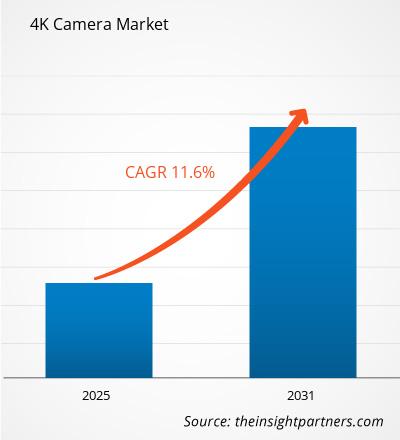
Segmentation Analysis
Types
Types are projected to grow at a CAGR of 5.8%–6.5% during 2026–2034 as buyers shift toward workflow-ready cameras that combine resolution, portability, codecs, autofocus, and integration. The segment reflects varied usage requirements: camcorders support long-form coverage, mirrorless systems serve hybrid creators, video cameras support productions, and PTZ models enable remote operation.
- Professional camcorders: Professional camcorders remain essential where long recording times, optical zoom, XLR audio, SDI output, heat control, and dependable field operation are required for broadcast, education, events, and documentary production.
- DSLR: DSLR demand is gradually narrowing as mirrorless systems gain momentum, but existing users continue to value optical viewfinders, lens investments, battery life, and familiar ergonomics for photography-led workflows with 4K capability.
- Mirrorless: Mirrorless cameras lead because they combine compact bodies, strong autofocus, interchangeable lenses, high-quality 4K video, stabilization, and hybrid shooting flexibility for creators, advertisers, journalists, and professional studios.
- Video: Dedicated video cameras serve production users that need advanced codecs, dynamic range, color control, modular rigs, external monitoring, and professional audio integration for films, commercials, web series, and branded content.
- PTZ: PTZ cameras are scaling rapidly in remote production, education, worship, retail, conference rooms, and events because they reduce operator requirements while enabling flexible camera angles and centralized control.
Application
Application is expected to record a CAGR of 5.7%–6.4% during 2026–2034 as 4K capture becomes embedded in entertainment, retail, consumer electronics, advertising, defense, and aerospace workflows. The 4k camera scope is widening from content creation to operational monitoring, analytics, documentation, and institutional communication, making image quality and system integration equally important.
- Consumer Electronics: Consumer electronics adoption is driven by creators, vloggers, travelers, and hobbyists seeking sharper video, better autofocus, compact form factors, and seamless sharing across social platforms and home entertainment displays.
- Retail: Retail uses 4K cameras for loss prevention, store analytics, queue monitoring, product demonstrations, customer behavior analysis, and higher-quality surveillance where image detail improves operational awareness.
- Advertisement: Advertisement production relies on 4K cameras for product clarity, social campaigns, commercial shoots, branded videos, and flexible editing, where high-resolution capture supports cropping, grading, and multi-platform delivery.
- Defense & Aerospace: Defense and aerospace users adopt 4K cameras for surveillance, testing, mission documentation, training, perimeter monitoring, and situational awareness where higher detail improves interpretation and evidence quality.
- Entertainment: Entertainment remains a high-value application as films, streaming content, sports, concerts, esports, and live events require professional image quality, color control, multicamera operation, and reliable production workflows.
Opportunity Snapshot
| Application | Revenue Contribution | Trend Tag | Adoption Stage |
| Consumer Electronics | High | Creator Video | Mature |
| Retail | Medium | Store Analytics | Scaling |
| Advertisement | Medium | Brand Content | Mature |
| Defense & Aerospace | Medium | Situational Awareness | Scaling |
| Entertainment | High | Live Production | Mature |
4K Camera Market Growth Drivers and Impact Analysis
Creator economy and streaming workflows lift 4K adoption
The expansion of creator-led media is a central driver for the 4k camera market because independent professionals, small studios, educators, and brands now compete on visual quality across social platforms, streaming services, and corporate channels. 4K capture provides sharper detail, better cropping flexibility, cleaner downsampling, and more professional output even when final content is delivered in lower resolution. This matters for advertisements, product videos, tutorials, livestreams, and hybrid events where production value influences audience retention.
The real-world impact is a wider addressable base for mirrorless cameras, video cameras, professional camcorders, and compact PTZ systems. Canon Inc., Sony Corporation, Panasonic Corporation, Nikon Corporation, Fujifilm Holdings Corporation, Blackmagic Design, and RED Digital Cinema Camera Company benefit when buyers upgrade from smartphones or older HD systems into workflow-ready cameras. Accessories, lenses, microphones, gimbals, monitors, and editing software also gain from this demand, turning camera upgrades into broader ecosystem spending.
Remote production and PTZ automation reduce operating costs
Remote production is reshaping buying decisions because organizations want high-quality video without large crews or complex setup. PTZ cameras, IP control, cloud transfer, and centralized switching allow venues to capture multiple angles from classrooms, churches, retail spaces, corporate studios, and event halls with fewer operators. 4K resolution improves digital zoom and reframing, which is valuable when a single camera must cover wide and close perspectives during live or recorded sessions.
The market impact is stronger demand for PTZ systems and networked professional cameras. Panasonic Corporation, Sony Corporation, Canon Inc., Axis Communications AB, and Sharp Corporation are positioned around different parts of this shift, including remote control, surveillance, display-linked workflows, and live production. The cost-saving argument is especially powerful for education, worship, municipal broadcasting, and corporate communications, where organizations must deliver professional-looking video while managing staff and production budgets.
Security, retail, and defense demand sharper visual intelligence
Security-oriented applications are increasing the importance of 4K imaging because higher resolution improves identification, scene analysis, and post-event review. Retailers use 4K cameras for loss prevention, shelf visibility, customer flow analysis, and operational monitoring. Defense and aerospace users value clearer observation for perimeter security, testing, training, and mission documentation. These applications often require reliable optics, low-light performance, rugged design, compression efficiency, and secure network integration rather than consumer-style features.
The real-world impact is a more diversified revenue base beyond entertainment and consumer electronics. Axis Communications AB is particularly relevant in networked surveillance, while Panasonic Corporation, Sony Corporation, Canon Inc., and Sharp Corporation contribute through professional imaging, PTZ, and integrated visual systems. As analytics software improves, camera buyers will increasingly view 4K systems as data collection assets. This supports recurring service opportunities around storage, video management, firmware updates, and system integration.
4K Camera Market Future Trends
AI-assisted imaging will become a core product differentiator
AI-assisted imaging will increasingly define competition in the market. Autofocus systems are moving beyond face detection toward eye, body, animal, vehicle, posture, and subject-intent recognition. In PTZ and broadcast settings, auto-framing and subject tracking can reduce operator workload and improve consistency during live production. In retail and security, edge intelligence can support alerts, counting, movement analysis, and more efficient video review when paired with appropriate software and privacy controls.
Forward-looking product strategy will focus on making professional results easier to achieve, reflecting evolving 4K Camera Market Trends across professional and commercial imaging. Cameras that combine strong sensors with reliable AI processing can serve solo creators, small production teams, retail operators, and enterprise users who lack specialist camera crews. However, differentiation will depend on trust: users need predictable focus behavior, controllable automation, secure data handling, and firmware support. Vendors that treat AI as a workflow tool rather than a feature label will command stronger loyalty.
IP, cloud, and codec flexibility will reshape production workflows
The next phase of the 4k camera market will be shaped by cameras that fit directly into networked and cloud-based production. Users increasingly expect file transfer, livestreaming, remote camera control, proxy creation, metadata, and compatibility with editing systems. Codecs matter because they determine storage cost, editing speed, image quality, and delivery flexibility. Professional buyers are likely to favor cameras that support efficient compression without limiting color grading, multicamera work, or archival needs.
Forward-looking demand will therefore reward vendors that connect hardware with software ecosystems. PTZ cameras will become more common in IP studios, while mirrorless and cinema cameras will add faster wireless and cloud handoff. Professional camcorders will continue to serve news, sports, and events where reliability and rapid turnaround matter. The strongest products will reduce friction from capture to delivery, helping organizations produce more content without proportionally expanding crews or infrastructure, reflecting evolving 4K Camera Market Trends.
4K Camera Market Opportunities
Integrated PTZ systems for education, worship, and enterprises
A major opportunity lies in integrated PTZ systems designed for institutions that need professional video without traditional production teams. Universities, schools, houses of worship, conference centers, healthcare training facilities, and corporate communication teams are expanding video output for livestreaming, hybrid learning, internal broadcasts, and events. These buyers need cameras, controllers, mounts, microphones, switchers, and service packages that work together with minimal technical burden.
The investment path is to package 4K PTZ cameras around complete use cases rather than standalone hardware. Panasonic Corporation, Sony Corporation, Canon Inc., Axis Communications AB, and Sharp Corporation can strengthen adoption by offering simplified control interfaces, training, secure network setup, and integration partnerships. Vendors that make installation and operation predictable will capture customers that value dependable output more than highly technical specifications. This opportunity is especially attractive because institutions often expand deployments once the first room proves successful.
Premium hybrid cameras for advertisers and creator studios
Premium hybrid cameras offer a strong opportunity as advertisers, product teams, influencers, and small studios require one system that can handle stills, 4K video, live output, and social formats. These users often operate lean teams and need cameras that deliver reliable autofocus, strong stabilization, fast lens changes, clean audio integration, and editing-friendly files. High-resolution capture enables repurposing of one shoot across vertical video, widescreen ads, thumbnails, product pages, and presentations.
Strategies oriented towards action should target product bundles comprising camera bodies with lenses, mics, cages, lighting, cloud workflows, and education. Canon Inc., Sony Corporation, Nikon Corporation, Fujifilm Holdings Corporation, Blackmagic Design, and Panasonic Corporation may utilize this opportunity through kits and ecosystems geared towards creators. The attractive economics stem from creators' repeated purchases of lenses, accessories, and upgrades as they professionalize their workflows and transition from basic to production gear, thereby contributing to the steady growth of the 4K Camera Market Size forecast for the period ahead.
Recent Developments
- July, 2025: Sony Electronics Inc. launched the PXW-Z300 flagship handheld XDCAM camcorder with 1/2-inch 4K 3-CMOS Exmor R sensors, BIONZ XR processing, AI-powered subject recognition, 4K 60p recording, advanced networking, and video authentication support through embedded digital signatures.
- January, 2025: Panasonic Entertainment & Communication announced four 4K60p 10-bit professional camcorders, including AG-CX20, HC-X2100, HC-X1600, and HC-X1200, with wide-angle 25mm lenses, 24x optical zoom, USB-C power support, improved viewfinders, Wi-Fi enhancements, and professional streaming features.
- September, 2025: Nikon Corporation released the ZR, a compact full-frame camera in the Z CINEMA series developed through synergy with RED Digital Cinema, supporting internal recording up to 6K/59.94p, RED-inspired color science, R3D NE recording, and advanced audio capabilities.
Frequently Asked Questions

- Comprehensive Market Sizing and Forecast Analysis
- Detailed Segmentation Analysis
- In-Depth Market Dynamics Assessment
- Regional and Country-Level Insights
- Competitive Landscape and Company Benchmarking
- Strategic Business Intelligence
Recent Reports
Testimonials

The Insight Partners' SCADA System Market report is comprehensive, with valuable insights on current trends and future forecasts. The team was highly professional, responsive, and supportive throughout. We are very satisfied and highly recommend their services.
RAN KEDEM Partner, Reali Technologies LTDs
I requested a report on a very specific software market and the team produced the report in a few days. The information was very relevant and well presented. I then requested some changes and additions to the report. The team was again very responsive and I got the final report in less than a week.
JEAN-HERVE JENN Chairman, Future Analytica
We worked with The Insight Partners for an important market study and forecast. They gave us clear insights into opportunities and risks, which helped shape our plans. Their research was easy to use and based on solid data. It helped us make smart, confident decisions. We highly recommend them.
PIYUSH NAGPAL Sr. Vice President, High Beam Global
The Insight Partners delivered insightful, well-structured market research with strong domain expertise. Their team was professional and responsive throughout. The user-friendly website made accessing industry reports seamless. We highly recommend them for reliable, high-quality research services
YUKIHIKO ADACHI CEO, Deep Blue, LLC.
This is the first time I have purchased a market report from The Insight Partners.While I was unsure at first, I visited their web site and felt more comfortable to take the risk and purchase a market report.I am completely satisfied with the quality of the report and customer service. I had several questions and comments with the initial report, but after a couple of dialogs over email with their analyst I believe I have a report that I can use as input to our strategic planning process.Thank you so much for taking the extra time and making this a positive experience.I will definitely recommend your service to others and you will be my first call when we need further market data.
JOHN SUZUKI President and Chief Executive Officer, Board Director, BK Technologies
I wish to appreciate your support and the professionalism you displayed in the course of attending to my request for information regarding to infectious disease IVD market in Nigeria. I appreciate your patience, your guidance, and the fact that you were willing to offer a discount, which eventually made it possible for us to close a deal. I look forward to engaging The Insight Partners in the future, all thanks to the impression you have created in me as a result of this first encounter.
DR CHIJIOKE ONYIA MANAGING DIRECTOR, PineCrest Healthcare Ltd.Reason to Buy
- Informed Decision-Making
- Understanding Market Dynamics
- Competitive Analysis
- Identifying Emerging Markets
- Customer Insights
- Market Forecasts
- Risk Mitigation
- Boosting Operational Efficiency
- Strategic Planning
- Investment Justification
- Tracking Industry Innovations
- Aligning with Regulatory Trends





 Get Free Sample for