
Acquired Hemophilia Treatment Market Size, Growth & Demand by 2034
Coverage: by Type (Traditional Therapy,, Advanced Therapy); End-User (Hospitals, Clinics, Others), and Geography (North America, Europe, Asia Pacific, and South and Central America)
- Status : Data Released
- Report Code : TIPRE00008530
- Category : Life Sciences
- No. of Pages : 150
- Available Report Formats :


- Last update date : July 15, 2026


2025 Market Size
US$ 1.17 Bn
Base year value
2034 Forecast
US$ 1.84 Bn
Projected by 2034
CAGR 2026-2034
5.14 %
Growth rate
Addressable Market
US$ 13.64 Bn
(2026-2034)
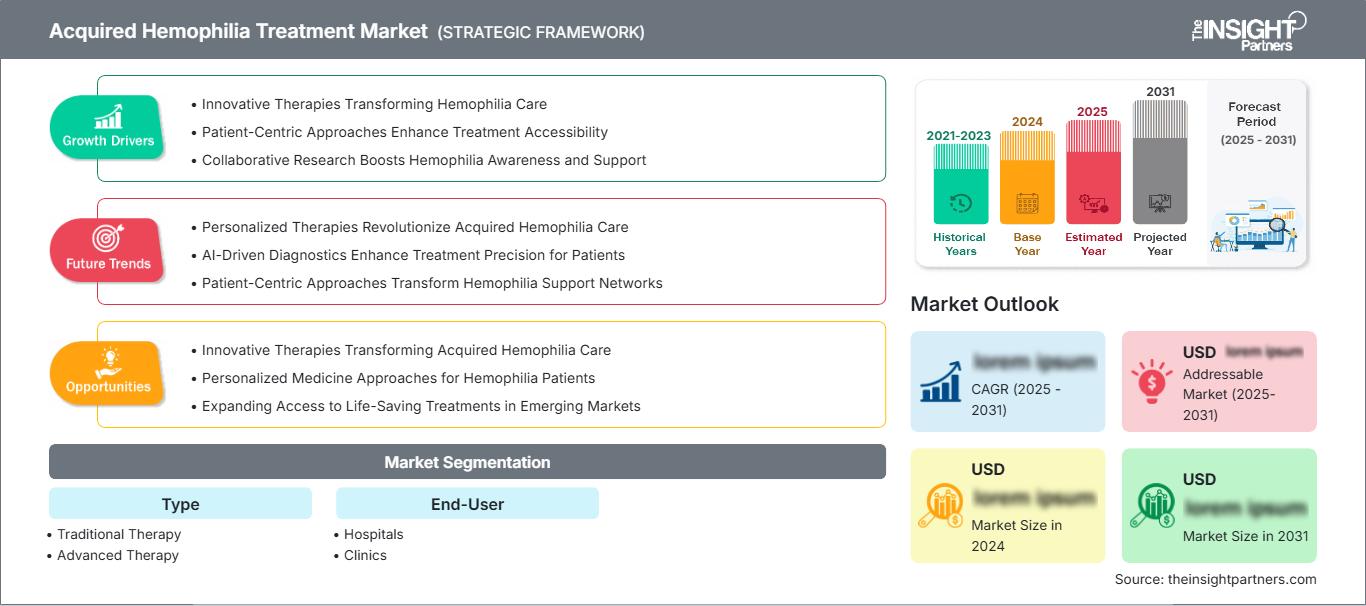
The Acquired Hemophilia Treatment Market was valued at US$ 1.17 Billion in 2025 and is projected to reach US$ 1.84 Billion by 2034, expanding at a CAGR of 5.14% during 2026–2034. The market captures increasing emphasis on rare autoimmune bleeding disorders, fast hemostasis, inhibitor removal, and approaches through bypassing agents, immunosuppression, and specialized hematology services.
For North America, the acquired hemophilia treatment market size has been backed by its high rare disease diagnostic ability, well-established network of hemophilia treatment centers, and easy availability of advanced treatment options. It is forecasted to grow at a rate of 5.5–5.9% CAGR between 2026 and 2034.
Acquired Hemophilia Treatment Market Assessment and Insights
- North America: Share in 2025 is estimated at 39–41%, with CAGR between 2026–2034 at 5.5–5.9%, supported by hemophilia treatment centers, rapid laboratory testing, advanced biologics access, and structured specialty pharmacy networks.
- US: Share in 2025 is estimated at 84–88% of North America, with CAGR between 2026–2034 at 5.4–5.8%, reflecting strong hematology referral systems and hospital reimbursement.
- Europe: Share in 2025 is estimated at 28–30%, with CAGR between 2026–2034 at 5.8–6.2%; Germany, the UK, France, Italy, and Spain lead through rare-disease frameworks and specialized coagulation centers.
- Asia Pacific: Share in 2025 is estimated at 19–21%, with CAGR between 2026–2034 at 7.1–7.5%; Japan, China, India, South Korea, and Australia benefit from improving diagnosis and tertiary hospital expansion.
- Largest Segment: Traditional Therapy held a market share range of 58–62% in 2025, with CAGR between 2026–2034 at 6.8–7.2%, due to established use of bypassing agents and immunosuppression.
- High Growth Segment: Advanced Therapy held a market share range of 38–42% in 2025, with CAGR between 2026–2034 at 7.1–7.5%, supported by biologics, lower treatment burden, and inhibitor-focused innovation.
- Key companies analyzed in detail: Baxter International Inc., Bristol Myers Squibb Company, Viatris Inc., Genentech, Inc., Novo Nordisk A/S, Ferring Pharmaceuticals A/S, Sanofi S.A., Biogen Inc., Pfizer Inc., F. Hoffmann-La Roche Ltd.
Source: The Insight Partners' analysis based on proprietary research, government publications, company annual reports, investor presentations, industry databases, and expert interviews.
The development of the market has gone through stages like reactive bleed management to pre-breached diagnosis, co-agulation counseling, and personalized selection of treatment. Market trends depend on production of biologicals, availability of plasma- and recombinant-derived products, immunosuppressants and hospital inventory requirements. The rare incidence of acquired hemophilia signifies the need for treatment consolidation in spite of fewer patients requiring high-end treatments and fast diagnoses.
Emerging areas for future R&D include tertiary hospitals, special distribution, and registration that will help improve efficiency in diagnosis. Regulatory tailwinds encompass policies related to orphan drugs, pharmacovigilance efforts, and broadening of indications for the currently available drugs used in hemophilia therapy, with respect to inhibitors. Investments will be made in biologics, subcutaneous drugs, companion diagnostics, and hospital procedures that reduce time from diagnosis to therapy start-up.
Acquired Hemophilia Treatment Market Report Scope
| Report Attribute | Details |
|---|---|
| Market size in 2025 | US$ 1.17 Billion |
| Market Size by 2034 | US$ 1.84 Billion |
| Global CAGR (2026 - 2034) | 5.14% |
| Historical Data | 2021-2024 |
| Forecast period | 2026-2034 |
Acquired Hemophilia Treatment Market Analysis
Incidence rarity is associated with the development of a niche, albeit a very intense demand scenario since acquired hemophilia A is observed at the incidence rate of 1–1.5 cases per million people per year and is limited to the population of older patients. This drives the acquired hemophilia treatment market forward due to the fact that every detected case needs immediate hemostatic management, inhibitors elimination, inpatient care, blood transfusions, and testing. The stakeholders include emergency rooms, coagulation labs, hematologists, hospital pharmacies, specialty distributors, and payer committees.
The supply characteristics rely on prompt product availability rather than extensive distribution channels. Hemostatics, corticosteroids, immunosuppressives, and biologicals need to be available for the use at tertiary care centers since the delay in bleeding stabilization increases morbidity risks. The management strategy involves the factor VIII assay, inhibitors titration, and activated partial thromboplastin time assessment.
Hemophilia treatment market report for acquired hemophilia reveals a market structure that depends on rare bleeding disorder know-how and hematology portfolio breadth. Novo Nordisk A/S, Sanofi S.A., Pfizer Inc., F. Hoffmann-La Roche Ltd, and Genentech, Inc. help shape the future of advanced therapies whereas Baxter International Inc., Viatris Inc., Bristol Myers Squibb Company, Biogen Inc., and Ferring Pharmaceuticals A/S stay relevant with their hospital medicines, immunology, specialty care, and supportive treatment offerings.
Positioning of players increasingly relies on clinical education, payer evidence, and quick hospital access. The companies that have field-based hematology sales teams can assist with protocol implementation whereas biologicals suppliers fight over convenience of dosing, relevance to inhibitors, and safety data from the real world. Investment priorities include development of long-acting drugs, targeted immune modulation, and specialty distribution models.
● REPORT CUSTOMIZATION
Tailor This Report To Align With Your Specific Business Requirements
This report can be customized to align precisely with your business objectives, scope, and target markets. Customization options include tailored segmentation, geography, competitive analysis, and strategic insights to support informed decision-making.
Customize This Report →WHAT YOU CAN ADJUST
- ● Segmentations
- ● Geography
- ● Competitive Analysis
- ● Language Preferences
Acquired Hemophilia Treatment Market: Strategic Insights
Regional Insights
North America Acquired hemophilia treatment market
North America accounted for an estimated 39–41% share in 2025 and is projected to grow at a 7.5–7.9% CAGR during 2026–2034. The region benefits from specialized hemophilia treatment centers, advanced coagulation laboratories, and strong adoption of bypassing agents, recombinant therapies, and immunosuppressive regimens. A larger elderly population also increases diagnostic probability because acquired hemophilia is more common later in life.
The market share for acquired hemophilia drugs in North America is buoyed by high levels of awareness among hematologists, along with the quick referral of patients from the emergency room in case of unexplained bleeding and isolated prolongation of the activated partial thromboplastin time test. Specialty pharmacies and hospital formularies provide access to expensive medications, and in Canada, there is rare disease care.
U.S. Acquired hemophilia treatment market
The U.S. represented 84–88% of North America in 2025 and is expected to expand at a 7.4–7.8% CAGR through 2034. The demand base is built around national availability of hemophilia treatment centers, high usage of biologicals, and repeated admissions of severe hemorrhage patients. Autoimmune hemophilia readmissions reinforce the importance of long-term inhibitor elimination and proper follow-up.
Company involvement is widespread in different therapy areas. Hemophilia A development is supported by Genentech, Inc. and F. Hoffmann-La Roche Ltd, while Novo Nordisk A/S and Sanofi S.A. bring non-factor and inhibitor-related treatments. Pfizer Inc., Viatris Inc., Baxter International Inc., and Bristol Myers Squibb Company continue to play a role through hospital drugs, immunosuppressants, and specialty care alliances.
Europe Acquired hemophilia treatment market
Europe held an estimated 28–30% share in 2025 and is forecast to grow at a 6.8–7.2% CAGR during 2026–2034. The UK has national networks for hemophilia, centralized treatment advice, and referral processes for rare bleeding disorders. Germany leads in terms of dense specialists, superior coagulation diagnostic tools, and availability of hemostatic products at hospitals.
France, Italy, and Spain help in terms of public funding, specialist hematology clinics, and registries for management of rare diseases. The buyers from Europe pay more attention to safety data, usage restrictions, and adherence to protocols due to high treatment expenses per small number of patients. Growth is slow, but quick testing of inhibitors and standardization of emergency procedures drive therapy demand.
APAC Acquired hemophilia treatment market
APAC accounted for an estimated 19–21% share in 2025 and is projected to expand at an 8.1–8.5% CAGR during 2026–2034. Japan excels in special diagnostic tests and biologics availability, while China and India have growing tertiary hospital demand.
South Korea and Australia contribute excellent specialist networks and payment systems. The industrial factors involve localization of biologics, cold chain improvements, and hospital pharmacies’ development. Rare disease policies, insurance and clinical training are anticipated to help recognize acquired factor inhibitors in cities.
Middle East & Africa Acquired hemophilia treatment market
Middle East & Africa is expected to grow at a 6.5–6.9% CAGR during 2026–2034, led by Saudi Arabia. The UAE, South Africa, and Rest of MEA contribute through tertiary hospital investment, imported biologics, and gradual expansion of coagulation testing.
Energy-driven reforms towards healthcare systems modernization within the Gulf States ensure availability of hematologists and high-end hospital pharmacies. South Africa is still a vital referral point for the subregion. Nonetheless, inadequate laboratory facilities, importation issues, and lack of knowledge on rare diseases continue to affect the diagnostic process, making education and sourcing key factors for development.
Segmentation Analysis
Type
The Type segment is expected to grow at a 7.2–7.6% CAGR during 2026–2034, reflecting the continued role of established hemostatic and immunosuppressive regimens alongside rising interest in biologic innovation. The acquired hemophilia treatment market forecast is shaped by bleeding severity, inhibitor titer, comorbidities, age, treatment availability, and physician experience in balancing hemostasis with thrombotic and infection risks.
- Traditional Therapy: This sub-segment remains the main treatment foundation because bypassing agents, corticosteroids, cyclophosphamide, and rituximab-based approaches are embedded in hospital protocols for acute bleeding and inhibitor eradication.
- Advanced Therapy: This sub-segment is strategically important as biologics, non-factor mechanisms, and more convenient administration models address treatment burden, inhibitor complexity, and care continuity beyond acute hospitalization.
End-User
The End-User segment is projected to grow at a 7.0–7.4% CAGR during 2026–2034. Demand is concentrated in hospitals because life-threatening bleeding, laboratory confirmation, transfusion support, and hemostatic therapy initiation require specialist infrastructure. Clinics remain important for post-discharge monitoring, inhibitor eradication assessment, tapering of immunosuppression, and early identification of relapse or treatment-related complications.
- Hospitals: This sub-segment dominates because acute bleeding control, intensive monitoring, coagulation testing, and biologic administration are generally managed in tertiary or specialist hematology hospital settings.
- Clinics: This sub-segment supports follow-up care, immune suppression monitoring, laboratory review, patient counseling, and referral coordination after stabilization, especially in regions with established hematology outpatient networks.
Opportunity Snapshot
| Segment Name | Revenue Contribution | Trend Tag | Adoption Stage |
| Hospitals | High | Emergency Hemostasis | Mature |
| Clinics | Medium | Relapse Monitoring | Scaling |
Acquired Hemophilia Treatment Market Growth Drivers and Impact Analysis
Older Patient Demographics and Higher Diagnostic Suspicion
Acquired hemophilia is linked to patients who are elderly, autoimmune disease, malignancies, post-partum and idiopathic immune dysregulation, which creates complicated patients in clinical practice. With growing aging population, there will be many instances where there will be unexplained bleeding with prolonged activated partial thromboplastin time, and hence, chances of testing for inhibitors will increase. Market implications in such a case would be increased need for coagulation testing, hematologist consultation and hemostatic management immediately. Earlier diagnosis also prevents unnecessary procedures and delay in transfusion. From an industry perspective, this driver creates value through education programs for emergency medicine specialists, internists, obstetricians, oncologists and geriatric care professionals.
Adoption of Advanced Hemostatic and Non-Factor Therapies
Advanced treatments are becoming strategically important as acquired hemophilia creates an immediate need for effective bleeding management in patients who frequently have comorbidities. Inhibitor-independent strategies and methods are helpful to diminish the reliance on classical replacement therapy in case of neutralization of factor VIII. The commercial consequence is a move towards the use of expensive biological products, targeted prescribing, and evidence-driven reimbursement negotiations. Hospitals will consider safety, thrombosis risk, ease of administration, and monitoring issues prior to adding to formularies. Companies that have robust hematology data and programs for physicians may increase their adoption.
Hospital Protocol Standardization for Rare Bleeding Emergencies
Hospital protocols are becoming increasingly necessary due to the increased possibility of increased bleed severity, blood needs, hospital stays, and mortality rates caused by late diagnoses. Hospital protocols which link the following procedures will ensure consistency in treatments: emergency assessment, coagulation lab testing, hematology consultations, pharmacy preparations, and inhibitor removal planning. The business implication is greater use of authorized hemostatics, better inventory management, and the necessity of clinician training. Hospitals which deal with cases involving oncology, autoimmune diseases, and post-partum problems need such protocols more urgently. Protocol standardization provides vendors with a chance to help hospitals review their formularies, dose, monitor side effects, and track outcomes.
Acquired Hemophilia Treatment Market Future Trends
Personalized Inhibitor Eradication and Safer Immune Control
The acquired hemophilia treatment market trends would be focused more on personalizing the level of immunosuppression based on the burden of inhibitors, bleeding risk, infection susceptibility, and frailty of patients. The older population may not be able to tolerate intensive regimes, and therefore, there is a need to find an option which results in remission with low risk of infections, cytopenias, and hospitalization. Biomarkers-guided treatment, more frequent monitoring of inhibitors, and experience gathered in registries would help in the optimization of treatment sequences. Pharmaceutical companies could gain from drugs that deliver tailored immune modulation with reliable safety profiles.
Integration of Rare-Disease Registries With Treatment Access
It is anticipated that registries for rare diseases would become commercially and clinically more valuable as payers demand outcomes data to justify expensive treatments. Registries would be able to track the time until diagnosis, severity of bleeding, product usage, remission, relapse, infections, thrombosis, and mortality. Such data would allow conducting reimbursement discussions and would help in developing hospital protocols. Registries would also be useful in quantifying the need for therapy in the regions where low rates of diagnoses exist. Companies that work with clinicians in a responsible manner can enhance the generation of evidence without overpromotional activities.
Acquired Hemophilia Treatment Market Opportunities
Rapid-Access Hospital Therapy Programs
The hospital and manufacturing firms can collaborate to design access therapy plans that would shorten the period from diagnosis of suspected acquired inhibitors to start of treatment. Market forecast for acquired hemophilia therapy suggests that value would be created in those settings where the clinical pathway includes lab confirmation, pharmacy supply, hematology expertise, and reimbursement assistance. Suppliers can assist the hospitals by providing educational material, emergency dosing guidelines, and product supply. The best potential lies within tertiary care centers that manage elderly, oncology, autoimmune, and postpartum cases. The commercial success here relies on reliability not volume.
Specialist Clinic Models for Remission and Relapse Management
There is an investment opportunity in post-discharge management due to the fact that inhibitor removal needs to be monitored beyond the first time of bleeding. Specialized clinics will be able to oversee the process of steroid dose reduction, rituximab dosing, infection monitoring, recurrence testing, and patient education. In this way, there is better continuity of care, which will help in avoiding re-hospitalization caused by bleeding, infections, or medication-related toxicity issues. There is an opportunity for pharmaceutical companies to join through patient support programs, adherence programs, and educational programs on laboratory monitoring. Such a health system exists already in North America, Europe, and APAC countries.
Recent Developments
- June 2026: Novo Nordisk A/S announced that new hemophilia portfolio data, including phase 3 FRONTIER4 analyses for investigational denecimig and explorer10 data for concizumab in pediatric patients with inhibitors, would be presented at the ISTH Congress 2026, reinforcing its rare bleeding disorder development focus.
- November 2025: F. Hoffmann-La Roche Ltd announced 46 hematology abstracts for ASH 2025, including Hemlibra post-marketing evidence and NXT007 phase I/II results in hemophilia A with and without inhibitors, supporting continued development of next-generation bispecific antibody approaches in complex coagulation disorders.
- March 2025: Sanofi S.A. received U.S. FDA approval for Qfitlia, fitusiran, for routine prophylaxis in hemophilia A or B with or without inhibitors in patients aged 12 years or older, adding an antithrombin-lowering siRNA therapy with infrequent subcutaneous dosing to the bleeding disorders landscape.
Frequently Asked Questions

- Comprehensive Market Sizing and Forecast Analysis
- Detailed Segmentation Analysis
- In-Depth Market Dynamics Assessment
- Regional and Country-Level Insights
- Competitive Landscape and Company Benchmarking
- Strategic Business Intelligence
Recent Reports
Testimonials

The Insight Partners provided valuable market intelligence that supported our global go-to-market strategy. Their team was professional, responsive, and attentive to our feedback, providing thoughtful analysis and helpful methodological clarifications throughout the project.
Junmo Kim Chief Financial Officer (CFO), Enertech Co., Ltd.
The Insight Partners' SCADA System Market report is comprehensive, with valuable insights on current trends and future forecasts. The team was highly professional, responsive, and supportive throughout. We are very satisfied and highly recommend their services.
RAN KEDEM Partner, Reali Technologies LTDs
I requested a report on a very specific software market and the team produced the report in a few days. The information was very relevant and well presented. I then requested some changes and additions to the report. The team was again very responsive and I got the final report in less than a week.
JEAN-HERVE JENN Chairman, Future Analytica
We worked with The Insight Partners for an important market study and forecast. They gave us clear insights into opportunities and risks, which helped shape our plans. Their research was easy to use and based on solid data. It helped us make smart, confident decisions. We highly recommend them.
PIYUSH NAGPAL Sr. Vice President, High Beam Global
The Insight Partners delivered insightful, well-structured market research with strong domain expertise. Their team was professional and responsive throughout. The user-friendly website made accessing industry reports seamless. We highly recommend them for reliable, high-quality research services
YUKIHIKO ADACHI CEO, Deep Blue, LLC.
This is the first time I have purchased a market report from The Insight Partners.While I was unsure at first, I visited their web site and felt more comfortable to take the risk and purchase a market report.I am completely satisfied with the quality of the report and customer service. I had several questions and comments with the initial report, but after a couple of dialogs over email with their analyst I believe I have a report that I can use as input to our strategic planning process.Thank you so much for taking the extra time and making this a positive experience.I will definitely recommend your service to others and you will be my first call when we need further market data.
JOHN SUZUKI President and Chief Executive Officer, Board Director, BK Technologies
I wish to appreciate your support and the professionalism you displayed in the course of attending to my request for information regarding to infectious disease IVD market in Nigeria. I appreciate your patience, your guidance, and the fact that you were willing to offer a discount, which eventually made it possible for us to close a deal. I look forward to engaging The Insight Partners in the future, all thanks to the impression you have created in me as a result of this first encounter.
DR CHIJIOKE ONYIA MANAGING DIRECTOR, PineCrest Healthcare Ltd.Reason to Buy
- Informed Decision-Making
- Understanding Market Dynamics
- Competitive Analysis
- Identifying Emerging Markets
- Customer Insights
- Market Forecasts
- Risk Mitigation
- Boosting Operational Efficiency
- Strategic Planning
- Investment Justification
- Tracking Industry Innovations
- Aligning with Regulatory Trends





 Get Free Sample for