
Air-Dried Vegetables Market Demand, Size & Forecast by 2034
Coverage: By Type (Carrot, Beans, Peas, Corn, Potatoes, Broccoli, Mushrooms, Others); Category (Organic, Conventional); End User (Food Processing, Food Retail, Foodservice) , and Geography (North America, Europe, Asia Pacific, and South and Central America)
- Status : Data Released
- Report Code : TIPRE00022255
- Category : Food and Beverages
- No. of Pages : 150
- Available Report Formats :


- Last update date : August 12, 2026


2025 Market Size
US$ 15.51 Bn
Base year value
2034 Forecast
US$ 27.98 Bn
Projected by 2034
CAGR 2026-2034
6.78 %
Growth rate
Addressable Market
US$ 196.57 Bn
(2026-2034)
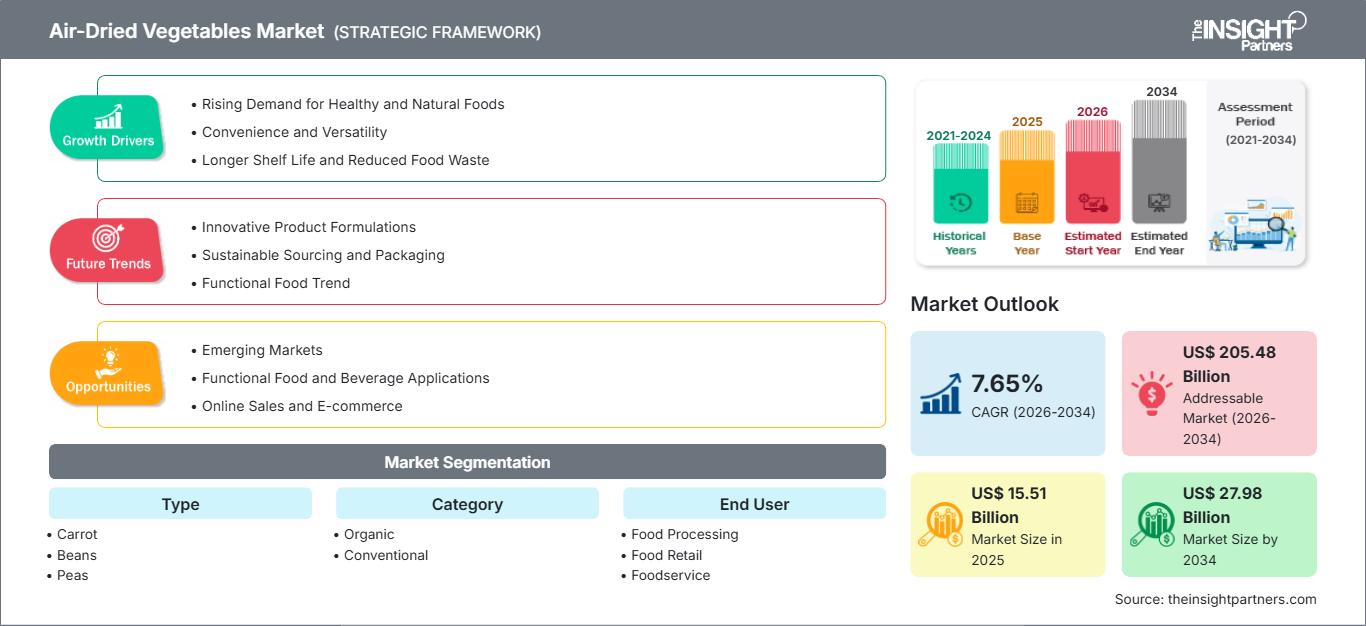
The Air-Dried Vegetables market was valued at US$ 15.51 billion in 2025 and is expected to reach US$ 27.98 billion by 2034; it is estimated to record a CAGR of 6.78% during 2026-2034.
Air-Dried Vegetables Market Assessment and Insights
- North America: The region accounts for 32%–35% share in 2025 and is expected to grow at a CAGR of 6.8%–7.4% during 2026–2034, supported by strong processed food demand, advanced dehydration technologies, and established distribution networks.
- US: The country represents 68%–72% of North American demand in 2025 and is projected to record a CAGR of 6.9%–7.5%, driven by packaged food innovation and growing adoption of shelf-stable vegetable ingredients.
- Europe: Holding 27%–30% share in 2025, Europe is forecast to expand at a CAGR of 6.7%–7.3%. Germany, France, the UK, Italy, and Spain remain major consumers owing to strong food processing industries.
- Asia Pacific: Accounting for 24%–28% share in 2025, the region is expected to achieve a CAGR of 8.4%–9.0%. China, India, Japan, South Korea, and Australia continue to support volume growth and processing investments.
- Largest Segment: Conventional products lead the market with a 68%–72% market share in 2025 and are estimated to grow at a CAGR of 7.1%–7.7% due to broad availability and cost competitiveness.
- High Growth Segment: Organic products hold 28%–32% market share in 2025 and are projected to expand at a CAGR of 8.8%–9.4%, supported by premium food applications and clean-label preferences.
- Key companies analyzed in detail: North Bay Trading Company, Harmony House Foods Inc., Silva International, Olam Group Limited, Jaworski Sp. z o.o., R. Steinicke GmbH, Garon Dehydrates Private Limited, Trokost Gemüsetrocknungs GmbH, Georg Fles GmbH, EUROCEBOLLAS S.A., Mercer Foods LLC, Sensient Technologies Corporation.
Source: The Insight Partners' analysis based on proprietary research, government publications, company annual reports, investor presentations, industry databases, and expert interviews.
Manufacturing procedures have changed significantly over time in terms of ensuring that flavor, colors, and nutrients are maintained and costs are minimized. Controlled temperature dehydration technologies and automation, along with advanced monitoring tools, are key drivers behind product consistency. Air-drying of vegetables in soups, ready-to-eat meals, sauces, snacks, and convenience food products is likely to boost demand from the food industry in developed and developing nations alike.
Going forward, growth will be driven by new capacities in Asia, the use of organic vegetables, and a rising focus on food waste management on the part of regulators. Manufacturers are adopting traceable sources along with sustainable manufacturing operations. Foodservice providers, as well as food processors, are generating demand for added-value vegetable products that offer longevity along with functional benefits.
Air-Dried Vegetables Market Report Scope
| Report Attribute | Details |
|---|---|
| Market size in 2025 | US$ 15.51 Billion |
| Market Size by 2034 | US$ 27.98 Billion |
| Global CAGR (2026 - 2034) | 6.78% |
| Historical Data | 2021-2024 |
| Forecast period | 2026-2034 |
Air-Dried Vegetables Market Analysis
Growing consumption of convenience foods remains a major force behind the air-dried vegetables market growth worldwide. Air-dried ingredients offer reduced transportation costs, longer shelf life, and easier storage compared with fresh alternatives. This combination makes these products very appealing to food producers who need efficient processing without compromising on quality. The trend of growing urbanization and hectic lifestyles will keep driving up demand for packed soups, fast meals, snacks, and seasonings that use dried vegetable components.
The value chain consists of farming of vegetables, procurement, sorting, cleaning, cutting, dehydration, packaging, and food manufacturing. Supply trends are influenced by agricultural cycles and the availability of raw vegetables. Manufacturers are now diversifying their sourcing to mitigate the risk of procurement challenges arising from climatic changes. Advancements in drying technologies are also helping improve product quality and manufacturing efficiency.
The air-dried vegetables market analysis highlights increasing competition focused on product differentiation, sustainable sourcing, and geographic expansion. Manufacturers are building up business ties with food processors and retailers to enter into long-term agreements. The premium range of products, such as organic vegetables, is promoting investments in certifications and tracking systems.
Silva International, Olam Group Limited, Harmony House Foods Inc., EUROCEBOLLAS S.A., and R. Steinicke GmbH are still stressing the importance of portfolio diversification and efficiency. North Bay Trading Company and Garon Dehydrates Private Limited are paying attention to expanding their product lines, whereas Jaworski Sp. z o.o., Trokost Gemüsetrocknungs GmbH, Georg Fles GmbH, Mercer Foods LLC, and Sensient Technologies Corporation occupy strategic positions through specialization and customer-oriented solutions.
● REPORT CUSTOMIZATION
Tailor This Report To Align With Your Specific Business Requirements
This report can be customized to align precisely with your business objectives, scope, and target markets. Customization options include tailored segmentation, geography, competitive analysis, and strategic insights to support informed decision-making.
Customize This Report →WHAT YOU CAN ADJUST
- ● Segmentations
- ● Geography
- ● Competitive Analysis
- ● Language Preferences
Air-Dried Vegetables Market: Strategic Insights
Regional Insights
North America Air-Dried Vegetables Market
North America accounted for 32%–35% air-dried vegetables market share in 2025 and is projected to grow at a CAGR of 6.8%–7.4% through 2034. Strong demand from processed food manufacturers, coupled with rising adoption of convenient and shelf-stable ingredients, continues to drive regional growth. Investment in automated dehydration facilities and food ingredient innovation supports market competitiveness.
This region is favored by the presence of agricultural production systems and efficient food processing facilities. Growing preference for natural food ingredients, higher consumption levels of packaged foods, and growth in the quick-service restaurants sector are contributing to the development of this sector. Both Canada and Mexico are increasingly using dehydrated vegetable ingredients in packaged foods.
U.S. Air-Dried Vegetables Market
The United States represents 68%–72% of North American demand in 2025 and is expected to expand at a CAGR of 6.9%–7.5%. The presence of an expansive processed food industry and robust retail base ensures the constant use of dehydrated vegetable products. The food producers are consistently utilizing the ingredients in ready meals, soups, snacks, and seasonings.
The local demand will also get a boost due to the increasing preference for shelf-stable foods as well as quick meal preparation. The leading ingredient producers have established production facilities in the nation. Investment in food innovations is expected to bolster the market performance during the forecast period.
Europe Air-Dried Vegetables Market
Europe accounted for 27%–30% share in 2025 and is anticipated to expand at a CAGR of 6.7%–7.3%. Germany remains the leading national market due to its large food manufacturing base and strong export orientation. Producers continue investing in quality-focused processing technologies and sustainable sourcing practices.
In the UK, the stable demand is a result of the use of convenience foods and the development of private label products. In Germany, it leads due to the capacity to process ingredients extensively. The countries of France, Italy, and Spain all contribute to the demand because of the increasing use of dehydration ingredients in various food preparations.
APAC Air-Dried Vegetables Market
Asia Pacific held 24%–28% share in 2025 and is projected to register a CAGR of 8.4%–9.0%, the highest among major regions. China remains the largest contributor due to extensive vegetable production and processing capacities.
India, Japan, South Korea, and Australia continue supporting regional expansion through increasing consumption of processed foods and growing investment in food manufacturing infrastructure. Policy initiatives that encourage food preservation and agricultural value addition are expected to strengthen long-term industry growth.
Middle East & Africa Air-Dried Vegetables Market
The Middle East and Africa market is forecast to expand at a CAGR of 6.3%–6.9% during the assessment period. Saudi Arabia and the UAE are experiencing growing demand for imported food ingredients and shelf-stable products suited to distribution efficiency.
South Africa remains a key market supported by food manufacturing development. Infrastructure investment, expanding retail networks, and increasing focus on food security are encouraging wider adoption of dehydrated vegetable products across the region.
Segmentation Analysis
Type
Type segment is expected to grow at a CAGR of 7.4%–8.0%. Product innovation and application diversity continue to support demand across different vegetable categories. Manufacturers focus on maintaining flavor retention, appearance, and nutrient preservation to meet food processing requirements. The air-dried vegetables market scope continues to broaden as ingredient usage expands across snacks, soups, seasonings, and ready meals.
- Carrot: Widely utilized in soups, seasoning blends, and ready meals. Strong availability and processing compatibility support its position within commercial food manufacturing applications.
- Beans: Demand is supported by convenience foods and nutritional positioning. Processors value dried beans for storage efficiency and reduced waste during ingredient handling.
- Peas: Frequently incorporated into packaged meals and snack formulations. Producers benefit from a stable agricultural supply and broad application versatility.
- Corn: Popular across seasoning mixes and processed food products. Consistent flavor and color characteristics support repeat purchasing by ingredient manufacturers.
- Potatoes: Important for soups, instant products, and snack categories. High utilization rates support ongoing commercial demand across multiple end-use sectors.
- Broccoli: Adoption continues increasing within health-oriented food formulations. Nutritional positioning contributes to growing interest among premium ingredient buyers.
- Mushrooms: Valued for flavor enhancement and specialty applications. Food processors utilize dehydrated mushrooms across sauces, ready meals, and seasoning systems.
Category
The category segment is projected to grow at a CAGR of 7.3%–7.9%. Consumer preferences regarding ingredient transparency and sustainability influence purchasing decisions. Organic products are gaining visibility, while conventional offerings retain strong volume leadership because of broader affordability and supply consistency.
- Organic: Premium positioning, certification standards, and growing clean-label demand support adoption across retail and specialty food manufacturing applications.
- Conventional: Maintains dominant market presence through scalable production, extensive availability, and cost-effective procurement for large-volume processing operations.
End User
The end-user segment is expected to advance at a CAGR of 7.6%–8.2%. Demand is driven by food manufacturers seeking ingredients that improve storage stability and processing efficiency. Expanding applications across retail products and foodservice menus continue to create growth opportunities.
- Food Processing: Represents the most significant demand center owing to widespread utilization in packaged foods, flavor systems, ready meals, soups, and snack production.
- Food Retail: Retail channels benefit from growing consumer preference for pantry-stable ingredients, meal preparation convenience, and reduced spoilage concerns.
- Foodservice: Restaurants and institutional kitchens increasingly adopt dehydrated vegetables to improve inventory management and operational consistency.
Opportunity Snapshot
| End User | Revenue Contribution | Trend Tag | Adoption Stage |
| Food Processing | High | Ready Meals | Mature |
| Food Retail | Medium | Pantry Foods | Scaling |
| Foodservice | Medium | Menu Efficiency | Scaling |
Air-Dried Vegetables Market Growth Drivers and Impact Analysis
Expansion of Convenience Food Consumption
Population increase in cities and their busy lives go on increasing the need for packaged foods that last long and ingredients that behave well in the process. The air-dried vegetables give the manufacturers the ability to handle the goods easily in storage and transport, as well as during the manufacturing process. The products minimize the risk of spoilage while allowing effective inventory control. The food companies are increasingly using dehydrated vegetables in the preparation of instant soups, ready meals, seasonings, and snacks. The demand is especially high in those places where consumers are looking for easy meals and the availability of food items.
Advancements in Dehydration Technologies
Advancements in technology have been improving the quality of the products while at the same time ensuring that there is more efficiency in the manufacturing process. The new dehydration machines have been made in such a way that they can retain the flavor, color, and nutrition of the foods much better than the old methods used previously. Technology has also improved production processes since it helps minimize variability and costs. These developments allow more widespread use of the technology in high-quality food categories where consistency in ingredients is very important.
Increasing Focus on Reducing Food Waste
The reduction of food wastage is emerging as a significant concern for governmental bodies, food producers, and consumers alike. Air drying increases the shelf life of products to a much greater extent than fresh vegetables, hence reducing losses during storage and distribution. There have been many instances where companies have integrated preservative techniques within their sustainability programs, which are concerned with increasing agricultural yield. This creates a need for an increased shelf life in order to create effective and optimized inventory management. As a result, the growth potential of the industry will increase.
Air-Dried Vegetables Market Future Trends
Premiumization of Organic Ingredient Portfolios
The air-dried vegetables market trends increasingly reflect demand for premium ingredients that combine convenience, sustainability, and traceability. Consumers are showing stronger interest in certified organic products and minimally processed food components. Manufacturers are responding by expanding organic sourcing programs and developing differentiated products targeting premium retail and foodservice categories. Enhanced transparency in sourcing and production practices is expected to strengthen customer confidence and support increased adoption of high-value ingredient offerings across global markets.
Integration of Smart Manufacturing Systems
It is anticipated that digitalization and automation will change production methods over the next decade. There is an increasing use of advanced monitoring systems, predictive maintenance technologies, and data-driven quality control mechanisms by manufacturers. While improving efficiency, they increase consistency among batches of products produced. With the increased implementation of smart manufacturing, the food producers are expected to be able to increase scalability and profitability without compromising on quality standards.
Air-Dried Vegetables Market Opportunities
Expansion in Emerging Asia Processing Clusters
The growing food manufacturing sectors of India, Southeast Asia, and China present significant investment potential. Increasing disposable incomes, urbanization, and packaged food consumption are supporting demand for preserved vegetable ingredients. Air-dried vegetables market Forecasts indicate attractive opportunities for suppliers capable of establishing local sourcing and processing networks. Strategic investments in regional manufacturing facilities can improve supply security, lower transportation costs, and strengthen long-term competitiveness. Companies that develop strong procurement partnerships and localized distribution capabilities may benefit from accelerating demand across high-growth consumer markets.
Development of Customized Ingredient Solutions
Food product makers are increasingly looking for customized ingredients that suit specific formulations and applications. The possibilities exist in customized particle sizes, combinations of vegetables, and dehydration properties, among others. The companies that have the ability to offer customized solutions can form stronger customer ties and better realize value in the process. Increased demand for unique flavors, gourmet meals, and clean labels will drive innovation in customized ingredients going forward.
Frequently Asked Questions

- Comprehensive Market Sizing and Forecast Analysis
- Detailed Segmentation Analysis
- In-Depth Market Dynamics Assessment
- Regional and Country-Level Insights
- Competitive Landscape and Company Benchmarking
- Strategic Business Intelligence
Recent Reports
Testimonials

The Insight Partners' SCADA System Market report is comprehensive, with valuable insights on current trends and future forecasts. The team was highly professional, responsive, and supportive throughout. We are very satisfied and highly recommend their services.
RAN KEDEM Partner, Reali Technologies LTDs
I requested a report on a very specific software market and the team produced the report in a few days. The information was very relevant and well presented. I then requested some changes and additions to the report. The team was again very responsive and I got the final report in less than a week.
JEAN-HERVE JENN Chairman, Future Analytica
We worked with The Insight Partners for an important market study and forecast. They gave us clear insights into opportunities and risks, which helped shape our plans. Their research was easy to use and based on solid data. It helped us make smart, confident decisions. We highly recommend them.
PIYUSH NAGPAL Sr. Vice President, High Beam Global
The Insight Partners delivered insightful, well-structured market research with strong domain expertise. Their team was professional and responsive throughout. The user-friendly website made accessing industry reports seamless. We highly recommend them for reliable, high-quality research services
YUKIHIKO ADACHI CEO, Deep Blue, LLC.
This is the first time I have purchased a market report from The Insight Partners.While I was unsure at first, I visited their web site and felt more comfortable to take the risk and purchase a market report.I am completely satisfied with the quality of the report and customer service. I had several questions and comments with the initial report, but after a couple of dialogs over email with their analyst I believe I have a report that I can use as input to our strategic planning process.Thank you so much for taking the extra time and making this a positive experience.I will definitely recommend your service to others and you will be my first call when we need further market data.
JOHN SUZUKI President and Chief Executive Officer, Board Director, BK Technologies
I wish to appreciate your support and the professionalism you displayed in the course of attending to my request for information regarding to infectious disease IVD market in Nigeria. I appreciate your patience, your guidance, and the fact that you were willing to offer a discount, which eventually made it possible for us to close a deal. I look forward to engaging The Insight Partners in the future, all thanks to the impression you have created in me as a result of this first encounter.
DR CHIJIOKE ONYIA MANAGING DIRECTOR, PineCrest Healthcare Ltd.Reason to Buy
- Informed Decision-Making
- Understanding Market Dynamics
- Competitive Analysis
- Identifying Emerging Markets
- Customer Insights
- Market Forecasts
- Risk Mitigation
- Boosting Operational Efficiency
- Strategic Planning
- Investment Justification
- Tracking Industry Innovations
- Aligning with Regulatory Trends





 Get Free Sample for