
Airport Notification Systems Market Size, Share & Growth by 2034
Coverage: By Type (Digital Display, LED Screen, Broadcast, Others); Application (Airports, Terminals, Others) , and Geography (North America, Europe, Asia Pacific, and South and Central America)
- Status : Data Released
- Report Code : TIPRE00021500
- Category : Aerospace and Defense
- No. of Pages : 150
- Available Report Formats :


- Last update date : November 02, 2026


2025 Market Size
US$ 1.95 Bn
Base year value
2034 Forecast
US$ 3.15 Bn
Projected by 2034
CAGR 2026-2034
5.47 %
Growth rate
Addressable Market
US$ 23.12 Bn
(2026-2034)
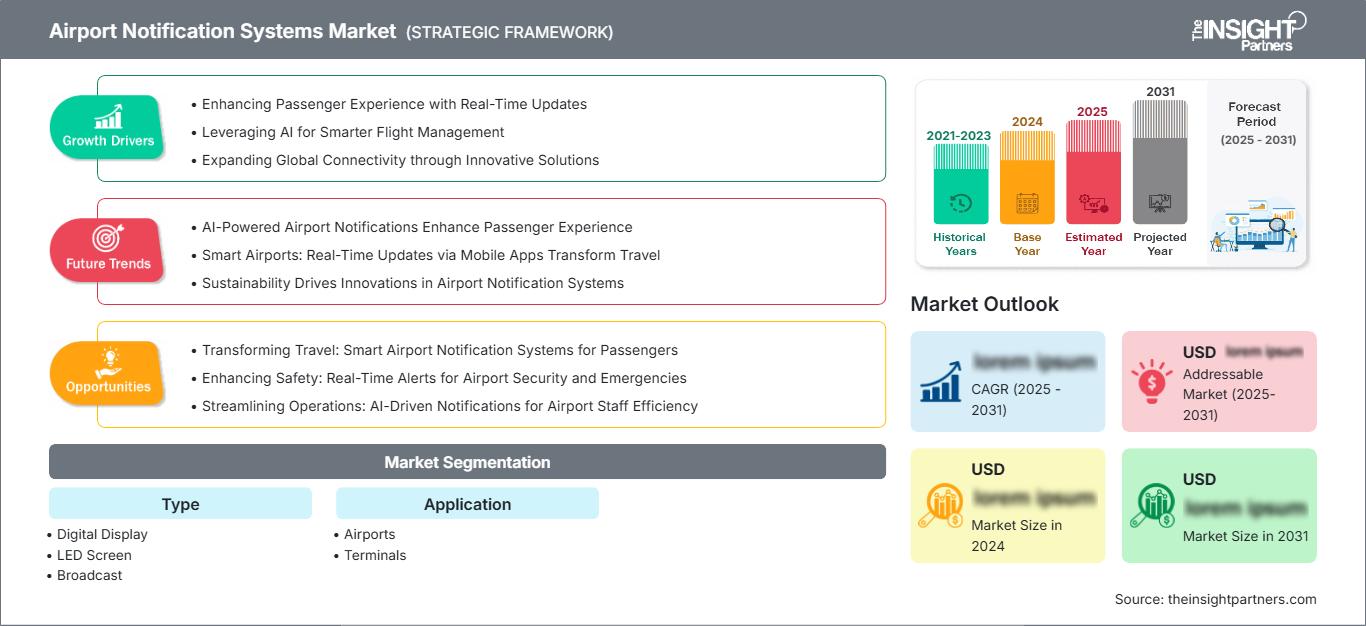
The airport notification systems market was valued at US$ 1.95 Billion in 2025 and is projected to reach US$ 3.15 Billion by 2034, registering a CAGR of 5.47% from 2026 to 2034. Growth is supported by rising passenger volumes, airport terminal modernization, demand for real-time operational communication, and increasing integration of digital passenger services. Airports are also prioritizing coordinated information delivery across display, audio, and connected digital channels to manage disruptions, improve passenger flow, and support increasingly technology-enabled terminal environments.
North America is expected to maintain a mature position in the airport notification systems market size, supported by extensive airport infrastructure, established passenger information networks, and continued investment in terminal technology. The region is projected to record a ~5% CAGR through 2034, with replacement of legacy systems, expansion of digital displays, and integration with airport operational databases supporting demand. Increasing emphasis on passenger experience and operational resilience is also encouraging airports to modernize notification infrastructure alongside broader digital transformation programs.
Airport Notification Systems Market Assessment and Insights
Regional Outlook
- North America: ~31% of the global market in 2025 | ~5% CAGR through 2034. Market position: North America represents a mature market supported by large airport networks, established information infrastructure, and replacement demand. Modernization of terminal systems and integration with operational data platforms reinforce its substantial global position.
- US: ~82% of North American market revenue in 2025 | ~5% CAGR through 2034. Market position: The US accounts for most North American demand because of its extensive commercial airport network and high passenger throughput. Investments increasingly emphasize interoperable passenger communications, digital displays, and operational resilience.
- Europe: ~27% of the global market in 2025 | ~5% CAGR through 2034. Market position: Europe has a mature airport technology ecosystem, with the UK, Germany, France, Italy, and Spain supporting substantial demand. Large hubs and modernization programs sustain replacement and digitalization requirements.
- Asia Pacific: ~30% of the global market in 2025 | ~7% CAGR through 2034. Market position: Asia Pacific is the fastest-growing major region, supported by expanding passenger traffic, new terminal capacity, smart-airport programs, and modernization in China, Japan, South Korea, India, and Australia.
Segment Outlook
- Digital Display: ~46% Share in 2025 | ~5% CAGR through 2034. Market position: Digital Display leads because visual information remains a central passenger communication mechanism. Large terminal deployments, centralized content management, multilingual requirements, and integration with live flight data sustain demand across airport environments.
- Broadcast: ~24% Share in 2025 | ~7% CAGR through 2034. Market position: Broadcast represents a high-growth segment as airports seek coordinated audio communication during boarding, gate changes, disruptions, emergencies, and operational events. Integration with automated systems increases the value of synchronized announcements.
Competitive Coverage
Amadeus IT Group SA, Collins Aerospace, IDS PIDS, INFORM Software, NEC Corporation, RESA Airport Data Systems, Siemens, SITA, Simpleway Europe a.s., Verdict Media Limited
Methodology
The Insight Partners follows Data Collection & Secondary Research, Primary Research, Data Analysis, and Data Triangulation & Final Review to validate market estimates and insights.
Source: The Insight Partners' analysis based on proprietary research, government publications, company annual reports, investor presentations, industry databases, and expert interviews.
This evolution of airport notification systems involves moving from traditional flight display boards and public address systems towards networked, centrally managed communication platforms. The new systems tend to get operational information from airport databases and relay the information through many points of contact used by passengers. This makes changes in flight schedule, gate, baggage handling, or airport operational conditions more consistent. According to SITA, the percentage of airport IT investments to airport revenue in 2025 will be 7.3%, which was 6.4% in 2024.
In the future, airport notification systems development is expected to move beyond stand-alone information display devices towards a broader architecture of passenger communication systems. New airport capacity that is being developed in the Asia Pacific and Middle Eastern regions presents an opportunity for new implementations of notification systems, whereas existing airports in North America and Europe present a need for upgrading and lifecycle replacement. Digital identity, artificial intelligence, passenger flow management, and real-time data exchange could make airport notification systems more prominent parts of the overall airport technology ecosystem.
Airport Notification Systems Market Report Scope
| Report Attribute | Details |
|---|---|
| Market size in 2025 | US$ 1.95 Billion |
| Market Size by 2034 | US$ 3.15 Billion |
| Global CAGR (2026 - 2034) | 5.47% |
| Historical Data | 2021-2024 |
| Forecast period | 2026-2034 |
Airport Notification Systems Market Analysis
The need for airport notification systems will be driven by passenger throughput, terminal complexity, operational variation, and the need to disseminate passenger information promptly and accurately. Passenger demand through international air travel has shown robust growth in 2025, but capacity has been limited. According to IATA, global passenger demand in 2025 has grown by 5.3% while international demand has grown by 7.1%. Such conditions enhance the need to provide real-time passenger information about gate changes, delays, boarding, and irregular operation.
It is an interconnected ecosystem made up of airport operators, technology providers, screen manufacturers, system integrators, software companies, communication service providers, and maintainers. It connects flight and operational data with screens and communication services. According to Amadeus, the company’s flight information display solution provides flight, gate, and baggage data from airport operational databases to the airport screens. The system helps in generating recurrent demand in software, integration, maintenance, and hardware replacements.
The competitive landscape of the airport notification systems market report revolves around the capabilities of integrating reliable information distribution together with scalability, cybersecurity, integration, multi-language support, and continuity. Amadeus, SITA, NEC Corporation, Siemens, Collins Aerospace, as well as specific vendors like RESA Airport Data Systems, and Simpleway Europe a.s. solve particular combinations of passenger information, airport operations, digital signage, and communications needs. For instance, SITA presents the concept of passenger information in terms of an integration of audio, visual, and digital communications, demonstrating how the industry evolves into the realm of integrated communications instead of just the digital signage.
Cloud-based systems, automated content management systems, intelligent displays, and systems capable of integrating real-time data are becoming an area for investment. In particular, NEC Corporation provides the solutions of airport display that cover the range of flight information, wayfinding, retail signage, control, monitoring, and passenger displays. Vendors with airport integrations can leverage replacement cycles and digital transformation programs, while specific vendors can rely on configuration interfaces, display management, announcements automation, and localization.
● REPORT CUSTOMIZATION
Tailor This Report To Align With Your Specific Business Requirements
This report can be customized to align precisely with your business objectives, scope, and target markets. Customization options include tailored segmentation, geography, competitive analysis, and strategic insights to support informed decision-making.
Customize This Report →WHAT YOU CAN ADJUST
- ● Segmentations
- ● Geography
- ● Competitive Analysis
- ● Language Preferences
Airport Notification Systems Market: Strategic Insights
Regional Insights
North America airport notification systems market
North America held approximately ~31% airport notification systems market share in 2025 and is anticipated to grow at a ~5% CAGR during 2034. There exists a large installed base of airport information systems along with ongoing activity levels among commercial airports in this region. US airports constitute most of the demand in North America, while Canada drives demand through investments in passenger processing and terminal communications infrastructure. There exists a greater demand for modernizing existing solutions from mature airport operators.
Demand from North America is further driven by complexities arising in large hub airports, where there exist fast changes in gate assignment information, delays, baggage information, and passenger flow information. Digital display networks and automated broadcasting services help operators in disseminating information to many terminal zones. Hence, modernization efforts may include not just screen replacements but also content management, networking infrastructure, software integration, and monitoring services. Such efforts favor those vendors who can offer solutions that meet long lifecycle needs along with cybersecurity, interoperability, and continuity of service.
U.S. airport notification systems market
The US accounted for ~82% of North American airport notification systems market revenue in 2025 and is expected to record a ~5% CAGR through 2034. The country's large airport network, high passenger volumes, and extensive terminal infrastructure create recurring demand for passenger information technologies. Large hubs require synchronized information across departure halls, security areas, gates, baggage zones, and other passenger-facing locations, supporting continued deployment of centralized notification platforms.
US airport operators are also moving toward more connected technology environments in which passenger information systems receive operational data from multiple airport systems. This creates opportunities for solutions that support real-time updates, remote monitoring, accessibility, multilingual communication, and targeted passenger messaging. Large technology providers and specialized airport systems companies participate in this ecosystem, while airports increasingly evaluate notification infrastructure as part of broader terminal modernization rather than as a standalone equipment purchase.
Europe airport notification systems market
Europe accounted for ~27% of the global airport notification systems market in 2025 and is projected to grow at a ~5% CAGR through 2034. The region combines mature airport infrastructure with continued passenger traffic expansion and terminal modernization. ACI EUROPE reported that European airport passenger traffic reached a record 2.6 billion passengers in 2025, an increase of 4.4% from 2024. The UK, Germany, France, Italy, and Spain therefore remain important markets for information and communication infrastructure.
The UK benefits from major international hubs, with London Heathrow handling 84.48 million passengers in 2025. Germany and France maintain significant technology demand through large hub airports and complex terminal operations, while Italy and Spain continue to benefit from strong tourism and international passenger flows. ACI EUROPE reported particularly strong 2025 growth at several major European airports, including Munich, Rome, Milan, Copenhagen, and Athens.
The UK is the leading country in Europe by airport passenger scale within this market context, supported by Heathrow and other high-throughput airports. Replacement of legacy displays, integration with airport operational databases, accessibility requirements, and expansion of digital passenger services create opportunities for both hardware and software suppliers. European airports also increasingly require coordinated information across multiple channels as passenger journeys become more digitally connected.
APAC airport notification systems market
Asia Pacific accounted for ~30% of the global airport notification systems market in 2025 and is projected to expand at a ~7% CAGR through 2034, making it the fastest-growing major region. IATA reported that Asia Pacific airlines recorded a 10.9% increase in international traffic in 2025, the strongest regional growth rate. This traffic momentum supports investment in passenger-facing airport technologies.
China is the leading country in Asia Pacific by passenger market scale, followed by significant technology demand from Japan, South Korea, India, and Australia. China and India are expanding airport capacity, while Japan and South Korea continue to modernize sophisticated airport environments. Australia is also investing in digital border and passenger technologies. These developments create demand for large-scale displays, automated broadcast systems, multilingual messaging, and integrated passenger information platforms.
Middle East & Africa airport notification systems market
The Middle East & Africa market is projected to expand at a ~6% CAGR through 2034. Gulf aviation investment, airport expansion, tourism development, and infrastructure modernization support demand in the Middle East, while improving airport capacity and passenger connectivity create opportunities across Africa. The UAE and Saudi Arabia are particularly important because of major hub development, international passenger traffic, and long-term aviation infrastructure programs.
The UAE is the leading country in the Middle East & Africa for advanced airport technology deployment within the market context. Saudi Arabia is also increasing airport investment as aviation capacity becomes part of broader economic diversification programs. South Africa remains an important African market, while Rest of MEA includes airports pursuing phased modernization. Notification systems are relevant to these projects because new terminals require integrated visual and audio communication from initial commissioning rather than retrofit-only deployment.
Segmentation Analysis
Type
Type represents a core technology dimension of the airport notification systems market because airports require dependable mechanisms for communicating flight, gate, operational, safety, and passenger-service information. Digital communication infrastructure is increasingly integrated with centralized airport systems, allowing operators to update information consistently across passenger areas. Broadcast is expected to record a ~7% CAGR through 2034, supported by demand for synchronized audio messaging during boarding, disruption management, emergency communication, and operational changes.
- Digital Display: Digital Display systems provide highly visible passenger information across terminals and remain central to flight-status communication. Their value increases when screens can receive live operational data, support multiple languages, and allow centralized control over content and layout.
- LED Screen: LED Screen solutions are suited to large-format and high-visibility environments where passengers must recognize information from greater distances. Their flexibility supports prominent flight information, wayfinding, advertising, and event-driven communication across high-traffic terminal areas.
- Broadcast: Broadcast systems provide audible communication for passengers who may not be within direct viewing distance of displays. Automated and synchronized announcements are particularly relevant during boarding, gate changes, disruptions, emergency situations, and multilingual passenger communication.
Application
Application segment in the airport notification systems market determines where notification infrastructure creates operational value and how systems are integrated into passenger journeys. Airports deploy notification technologies across environments with different passenger densities, operational requirements, and information priorities. Terminals are expected to record a ~6% CAGR through 2034, supported by renovation programs, capacity expansion, and growing requirements for coordinated passenger communication across increasingly complex terminal layouts.
- Airports: Airport-level deployment connects passenger communication with broader operational requirements, enabling consistent information management across facilities. Operators use integrated notification infrastructure to coordinate passenger messaging with flight operations, security conditions, baggage processes, and service information.
- Terminals: Terminal deployments focus on high-density passenger environments where timely information can reduce confusion and support orderly movement. Modern terminal projects increasingly incorporate digital communication infrastructure into the initial technology architecture, creating demand for scalable and centrally managed solutions.
Opportunity Snapshot
| Application | Revenue Contribution | Trend Tag | Adoption Stage |
| Airports | High | System Integration | Mature |
| Terminals | High | Smart Terminals | Scaling |
Airport Notification Systems Market Growth Drivers and Impact Analysis
Rising Passenger Volumes Increase the Need for Real-Time Communication
Passenger growth directly increases the operational value of accurate and timely airport notifications. IATA reported that global passenger demand increased 5.3% in 2025, while international demand grew 7.1%. As passenger numbers rise, airports must communicate gate assignments, boarding instructions, delays, baggage information, and operational changes across larger and more crowded facilities. Notification infrastructure helps distribute the same operational message through multiple passenger touchpoints, reducing dependence on manual communication. The impact extends beyond passenger convenience because inaccurate or delayed information can contribute to congestion around gates and service counters. Consequently, passenger growth encourages airports to increase display coverage, automate announcements, improve centralized content control, and connect notification platforms more closely with airport operational databases.
Airport Digital Transformation Is Expanding Connected Notification Infrastructure
Airport technology investment is moving toward integrated systems that combine passenger processing, operational data, automation, and digital communication. SITA reports that 63% of airports planned to increase IT spending for 2026, while 48% planned to implement cross-silo data streaming, sharing, or synchronization by 2027. These developments strengthen demand for notification platforms capable of receiving trusted data from multiple operational sources. The impact is particularly significant for large airports because a centralized architecture can coordinate information across numerous displays and communication zones. Cloud deployment, remote monitoring, automated content distribution, and data integration can also reduce the operational burden associated with maintaining fragmented notification infrastructure.
Terminal Modernization Supports Replacement and New-System Deployment
Airport terminal redevelopment creates a direct channel for notification-system investment because new or renovated passenger areas require modern communication infrastructure. The modernization cycle can involve displays, controllers, software, networks, audio systems, monitoring tools, and integration interfaces. ACI EUROPE reported 2.6 billion passengers across European airports in 2025, while several major airports recorded meaningful passenger growth during the year. Similar expansion across Asia Pacific and the Middle East creates additional deployment opportunities. Modern terminal projects increasingly emphasize passenger flow, self-service, digital identity, and automated operations, allowing notification systems to be specified as part of a connected technology architecture rather than added after construction.
Airport Notification Systems Market Future Trends
Context-Aware and Personalized Passenger Notifications
The next stage of airport notification systems market trends is likely to involve greater contextualization of information according to passenger location, journey stage, operational conditions, and communication preferences. SITA reports that 45% of airports planned to use airline- or airport-issued digital identity credentials, up from 27% in 2024. As digital identity and passenger-flow technologies mature, notification platforms can increasingly support targeted communication while retaining centralized operational control. Future deployments may combine flight information with wayfinding, disruption alerts, accessibility options, retail information, and localized instructions. The commercial implication is a shift from static broadcasting toward responsive passenger communication, increasing the software and integration component of airport notification infrastructure.
AI-Enabled Notification Orchestration and Predictive Messaging
Artificial intelligence is expected to influence how airport information is prioritized, generated, and distributed. SITA reports that 60% of airports already use AI in passenger-flow management and that 73% of airports are investing in AI-related applications across areas such as cybersecurity, passenger flow, and turnaround operations. Notification platforms can use these data streams to identify emerging congestion, operational disruption, or changing passenger requirements and then recommend or automate appropriate messages. Over time, this could reduce manual intervention and improve consistency across screens, audio channels, and digital touchpoints. Vendors able to combine reliable airport data with controlled AI workflows may gain relevance in next-generation notification architectures.
Airport Notification Systems Market Opportunities
Cloud-Based Notification Platforms for Multi-Terminal Airports
Cloud-based notification platforms present an opportunity for airports operating multiple terminals, geographically distributed facilities, or mixed legacy and modern infrastructure. Centralized platforms can provide common control, remote monitoring, software updates, content governance, and integration across multiple communication endpoints. This approach can be particularly valuable for airports undertaking phased modernization because new systems can be introduced without requiring every legacy component to be replaced simultaneously. Vendors can develop modular migration strategies that combine existing displays with modern software and integration layers. The commercial opportunity in the airport notification systems market forecast therefore extends beyond new-build airports to lifecycle modernization, managed services, cybersecurity, maintenance, and recurring software capabilities.
Integrated Passenger Communication for Emerging Airport Hubs
Rapid airport development in Asia Pacific and the Middle East creates opportunities for integrated notification solutions designed into terminal infrastructure from the planning stage. New hubs can deploy centralized flight information, digital signage, broadcast, wayfinding, and operational messaging as interconnected components rather than separate systems. This creates scope for vendors to participate in architecture design, systems integration, commissioning, and long-term service contracts. The opportunity is also relevant to secondary airports that are expanding international connectivity and passenger capacity. Solutions supporting multilingual communication, centralized management, high availability, and interoperability can address the operational complexity associated with expanding passenger volumes and increasingly digital travel processes.
Frequently Asked Questions

- Comprehensive Market Sizing and Forecast Analysis
- Detailed Segmentation Analysis
- In-Depth Market Dynamics Assessment
- Regional and Country-Level Insights
- Competitive Landscape and Company Benchmarking
- Strategic Business Intelligence
Recent Reports
Testimonials

The Insight Partners provided valuable market intelligence that supported our global go-to-market strategy. Their team was professional, responsive, and attentive to our feedback, providing thoughtful analysis and helpful methodological clarifications throughout the project.
Junmo Kim Chief Financial Officer (CFO), Enertech Co., Ltd.
The Insight Partners' SCADA System Market report is comprehensive, with valuable insights on current trends and future forecasts. The team was highly professional, responsive, and supportive throughout. We are very satisfied and highly recommend their services.
RAN KEDEM Partner, Reali Technologies LTDs
I requested a report on a very specific software market and the team produced the report in a few days. The information was very relevant and well presented. I then requested some changes and additions to the report. The team was again very responsive and I got the final report in less than a week.
JEAN-HERVE JENN Chairman, Future Analytica
We worked with The Insight Partners for an important market study and forecast. They gave us clear insights into opportunities and risks, which helped shape our plans. Their research was easy to use and based on solid data. It helped us make smart, confident decisions. We highly recommend them.
PIYUSH NAGPAL Sr. Vice President, High Beam Global
The Insight Partners delivered insightful, well-structured market research with strong domain expertise. Their team was professional and responsive throughout. The user-friendly website made accessing industry reports seamless. We highly recommend them for reliable, high-quality research services
YUKIHIKO ADACHI CEO, Deep Blue, LLC.
This is the first time I have purchased a market report from The Insight Partners.While I was unsure at first, I visited their web site and felt more comfortable to take the risk and purchase a market report.I am completely satisfied with the quality of the report and customer service. I had several questions and comments with the initial report, but after a couple of dialogs over email with their analyst I believe I have a report that I can use as input to our strategic planning process.Thank you so much for taking the extra time and making this a positive experience.I will definitely recommend your service to others and you will be my first call when we need further market data.
JOHN SUZUKI President and Chief Executive Officer, Board Director, BK Technologies
I wish to appreciate your support and the professionalism you displayed in the course of attending to my request for information regarding to infectious disease IVD market in Nigeria. I appreciate your patience, your guidance, and the fact that you were willing to offer a discount, which eventually made it possible for us to close a deal. I look forward to engaging The Insight Partners in the future, all thanks to the impression you have created in me as a result of this first encounter.
DR CHIJIOKE ONYIA MANAGING DIRECTOR, PineCrest Healthcare Ltd.Reason to Buy
- Informed Decision-Making
- Understanding Market Dynamics
- Competitive Analysis
- Identifying Emerging Markets
- Customer Insights
- Market Forecasts
- Risk Mitigation
- Boosting Operational Efficiency
- Strategic Planning
- Investment Justification
- Tracking Industry Innovations
- Aligning with Regulatory Trends





 Get Free Sample for