
Dental Biomaterials Market Demand, Size & Forecast by 2034
Coverage: By Type (Metallic Biomaterials, Ceramic Biomaterials, Polymeric Biomaterials, Metal-Ceramic Biomaterials, Natural Biomaterials); Application (Implantology, Prosthodontics, Orthodontics, Others); End User (Dental Product Manufacturers, Dental Laboratories, Dental Hospitals and Clinics, Dental Academies and Research Institutes), and Geography (North America, Europe, Asia Pacific, and South and Central America)
- Status : Data Released
- Report Code : TIPRE00004714
- Category : Life Sciences
- No. of Pages : 150
- Available Report Formats :


- Last update date : August 24, 2026


2025 Market Size
US$ 9.46 Bn
Base year value
2034 Forecast
US$ 18.68 Bn
Projected by 2034
CAGR 2026-2034
7.85 %
Growth rate
Addressable Market
US$ 126.61 Bn
(2026-2034)
The Dental Biomaterials Market was valued at US$ 9.46 Billion in 2025 and is projected to reach US$ 18.68 Billion by 2034, registering a CAGR of 7.85% during 2026–2034. Growth is being facilitated through rising applications of implant materials, restorative processes, digital dentistry, regenerative solutions, and ceramics and polymers that help enhance their durability, biocompatibility, appearance, and efficacy in current-day dental practices.
The North American region continues to be a structurally significant market, due to the high rate of use of dental implants, well-developed laboratory systems, advanced restorative processes, and relatively high expenditure on healthcare. Key factors that determine the Dental Biomaterials Market Size in the region include replacement dentistry, aging population, rising applications of CAD/CAM materials, and the need for biologically compatible products.
Dental Biomaterials Market Assessment and Insights
- North America: North America held a 2025 share of 38–41% and is projected to grow at a CAGR of 8.1–8.6% between 2026–2034, supported by implant procedures, restorative dentistry, digital laboratories, and established biomaterial distribution networks.
- US: The US represented 83–87% of North America's 2025 share and is expected to grow at a CAGR of 8.0–8.5% during 2026–2034, supported by implantology and advanced prosthodontics.
- Europe: Europe accounted for a 2025 share of 27–30%, with a CAGR of 7.1–7.6% between 2026–2034. Germany, the UK, France, Italy, and Spain remain important markets, supported by mature laboratories and restorative care.
- Asia Pacific: Asia Pacific represented a 2025 share of 23–26% and is forecast to expand at a CAGR of 9.0–9.6% during 2026–2034, led by China, Japan, South Korea, India, and Australia.
- Largest Segment: Metallic Biomaterials held a 2025 market share of 34–38% and is projected to grow at a CAGR of 7.2–7.7% during 2026–2034, reflecting implant and structural applications.
- High Growth Segment: Implantology represented a 2025 market share of 31–35% and is expected to register a CAGR of 8.6–9.1% during 2026–2034, supported by implant adoption and regenerative procedures.
- Key companies analyzed in detail: Carpenter Technology Corporation; Danaher Corporation; DENTSPLY SIRONA Inc.; Geistlich Pharma AG; Kuraray Co., Ltd.; Medtronic plc; DSM-Firmenich AG; Straumann Holding AG; Zimmer Biomet Holdings, Inc.; Ivoclar Vivadent AG.
Source: The Insight Partners' analysis based on proprietary research, government publications, company annual reports, investor presentations, industry databases, and expert interviews.
The development of material technologies has shifted from traditional metals and acrylic polymer towards ceramics, high performance polymers, surface engineering of alloys, collagen derived products, and digital processing of restorative materials. The manufacture is also taking into account better control over the particle size, porosity, material surface and more stringent quality standards. Changes in the Dental Biomaterials Market will be influenced by the advances in CAD/CAM and additive manufacturing technologies, which will allow laboratories to produce increasingly customized and highly repeatable restorations and prosthetic parts using advanced materials.
Prospects for market growth will be aided by the rising availability of implants, increasing levels of digitization in dental laboratories, and interest in regenerative dentistry. Asia Pacific can be expected to receive investment in production and distribution as dental infrastructure becomes developed, while North America and Europe will continue to play a key role in providing premium materials and clinical research.
Dental Biomaterials Market Report Scope
| Report Attribute | Details |
|---|---|
| Market size in 2025 | US$ 9.46 Billion |
| Market Size by 2034 | US$ 18.68 Billion |
| Global CAGR (2026 - 2034) | 7.85% |
| Historical Data | 2021-2024 |
| Forecast period | 2026-2034 |
Dental Biomaterials Market Analysis
Dental Biomaterials Market growth will be strongly dependent on volume of procedures done for implantology, prosthodontics and orthodontics where choice of materials is essential for performance characteristics, aesthetics, osseointegration and durability. Ecosystem includes specialized material manufacturers, implants producers, dental laboratories, distribution channels, practitioners and R&D institutions. Raw materials comprise titanium alloys, ceramics, polymers, collagen, bone graft material and composite materials.
Supply chain increasingly becomes dependent on accurate manufacturing and material processing. Metallurgy and surface modification are necessary for titanium alloys, while ceramics need controlled sintering and dimensions. Polymers need formulation and reliable curing properties. For regenerative products there is biological sourcing, processing, sterilization and traceability issues. This situation creates entry barriers and makes it advantageous for suppliers combining material expertise with clinical evidence, manufacturing and regulation expertise.
The Dental Biomaterials Market Report shows a competitive structure combining diversified dental manufacturers, implant specialists, advanced-material suppliers, and healthcare technology companies. Straumann Holding AG, Geistlich Pharma AG, DENTSPLY SIRONA Inc., Zimmer Biomet Holdings, Inc., and Kuraray Co., Ltd. participate through different combinations of implants, regenerative products, restorative materials, and specialty dental technologies.
The strategic investments have started to shift towards digital manufacturing, regenerative technologies, advanced ceramics, surface engineering, and lab process integration. The role of Carpenter Technology Corporation comes in specialized metallurgy technology, whereas Medtronic plc remains relevant due to its bone grafting technology. The roles played by Danaher Corporation and DSM-Firmenich AG include materials and life sciences technology. Ivoclar Vivadent AG provides specialized restorative and laboratory materials.
● REPORT CUSTOMIZATION
Tailor This Report To Align With Your Specific Business Requirements
This report can be customized to align precisely with your business objectives, scope, and target markets. Customization options include tailored segmentation, geography, competitive analysis, and strategic insights to support informed decision-making.
Customize This Report →WHAT YOU CAN ADJUST
- ● Segmentations
- ● Geography
- ● Competitive Analysis
- ● Language Preferences
Dental Biomaterials Market: Strategic Insights
Regional Insights
North America Dental Biomaterials Market
North America represented a 38–41% of the Dental Biomaterials Market share in 2025 and expected to register a CAGR of 8.1–8.6% in 2026–2034. The advantages for North America include the high rate of implants, well-established dental laboratories, the high rate of digital workflows adoption, and well-developed specialists ecosystem. The demand in the region comes primarily from the US, while Canada also helps due to existing dental infrastructure and accessibility of restorative and implant solutions.
The market potential is strengthened by replacement dentistry needs, aging population, and preference of dental practitioners to materials that are strong but also aesthetic. Digital planning of procedures sees more and more zirconia, titanium, polymeric restorative materials, and regenerative solutions used. Established distributors and dental services providers help manufacturers increase the pace of adoption of materials through standardization of materials portfolio in different regions. Additionally, familiarity with regulations and well-developed clinical research environment are advantageous for product validation and commercialization.
U.S. Dental Biomaterials Market
The US represented 83–87% of North America's 2025 share and is forecast to grow at a CAGR of 8.0–8.5% during 2026–2034. Demand is supported by implantology, prosthodontics, cosmetic restoration, orthodontics, and digitally fabricated laboratory products. Straumann Holding AG, Zimmer Biomet Holdings, Inc., DENTSPLY SIRONA Inc., Danaher Corporation, and other suppliers maintain significant commercial exposure through implants, materials, technologies, or related clinical workflows.
Applications call for material types that are durable, attractive, and digital friendly. Laboratories in dentistry are now employing CAD/CAM milling, while implants require predictability in terms of surface properties and regeneration. Group practices and larger laboratory networks can speed up the process of material standardization. Innovation is still taking place in the US because there are many clinical networks that make it easy to introduce biomaterial systems.
Europe Dental Biomaterials Market
Europe held a 27–30% share in 2025 and is expected to expand at a CAGR of 7.1–7.6% during 2026–2034. Germany is the leading country, supported by a strong dental manufacturing base, laboratory ecosystem, specialist practices, and established restorative and implant markets. The UK, France, Italy, and Spain provide additional demand through mature dental services and growing use of digital restorative technologies.
The United Kingdom has a demand for materials used in restoration and prosthetics both in private dentistry and in laboratories. Germany is a combination of good implantology and dental production in addition to excellent laboratory services. Prosthodontics, implants, orthodontics, and digital restorations have a contribution from France, Italy, and Spain. Documentation, biocompatibility, production, and clinical evidence are important factors in the commercialization process of biomaterials in Europe due to stringent regulations. Germany is the major hub for biomaterials and dental technologies.
APAC Dental Biomaterials Market
APAC Dental Biomaterials Market represented a 23–26% share in 2025 and is expected to grow at a CAGR of 9.0–9.6% during 2026–2034, making it the fastest-expanding major region. China is the leading market, followed by Japan, South Korea, India, and Australia. Increasing dental infrastructure and treatment accessibility are widening the addressable patient base.
Industrial development, urbanization, dental tourism, and health care investment by the government fuel demand. China and India give significant volumes of opportunity, whereas Japan and South Korea provide technologically sophisticated dental environments. Australia gives a well-established clinical demand along with laboratory usage. Policies aimed at increasing health care access and local manufacturing will improve supply availability, and increased laboratory digitalization will fuel demand for ceramics, polymers, and implants material.
Middle East & Africa Dental Biomaterials Market
Middle East and Africa region is expected to grow at a CAGR of 7.0-7.6% in 2026-2034, with Saudi Arabia as one of the key countries along with UAE and South Africa. Rising capacities and investments in dedicated dental clinics will increase access to implantology and restorative procedures.
The advantage of Saudi Arabia and UAE lies in their programs for development of healthcare infrastructure and significant capital investments, while that of South Africa – in the availability of well-developed dental and laboratory infrastructure. As for the Rest of MEA, its growth is likely to be driven by affordability, development of infrastructure, and availability of advanced clinical services. In Gulf countries, revenues from energy sector finance investments in the healthcare sector, whereas development of infrastructure will help to gain access to advanced dental procedures.
Segmentation Analysis
Type
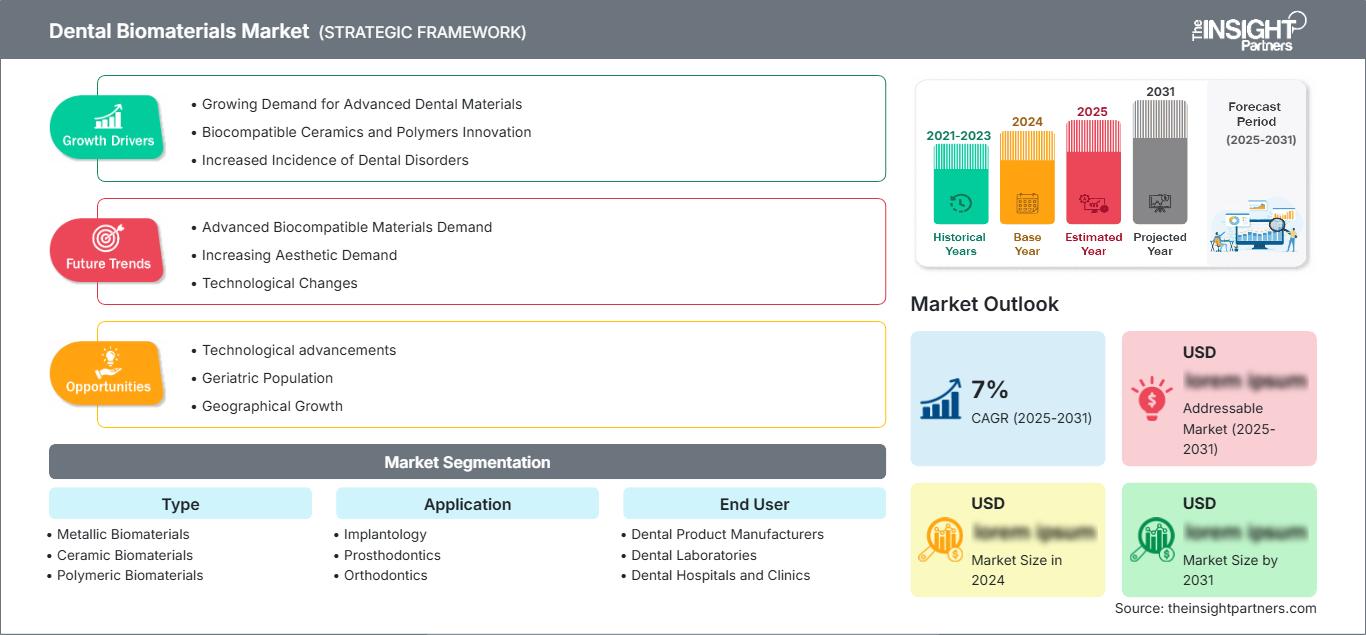
Type comprises Metallic Biomaterials, Ceramic Biomaterials, Polymeric Biomaterials, Metal-Ceramic Biomaterials, Natural Biomaterials and is expected to grow at a CAGR of 7.3–7.8% during 2026–2034. Metallic materials retain a major role in implant structures, while ceramics and polymers gain importance through aesthetics, digital fabrication, and restorative applications. Natural materials remain strategically relevant for regenerative dentistry.
- Metallic Biomaterials: Maintain a leading position in load-bearing applications, particularly implants and structural components, because titanium-based systems combine strength, established clinical evidence, and favorable tissue interaction.
- Ceramic Biomaterials: Gain demand through zirconia and other high-performance ceramics used where aesthetics, strength, biocompatibility, and metal-free restoration requirements influence material selection.
- Polymeric Biomaterials: Support restorative, prosthetic, and digitally fabricated applications where lightweight construction, processability, aesthetic customization, and compatibility with additive manufacturing provide practical advantages.
- Metal-Ceramic Biomaterials: Remain important for restorations requiring a combination of structural metal support and ceramic aesthetics, particularly within established prosthodontic workflows and replacement applications.
- Natural Biomaterials: Provide strategic relevance in regenerative procedures through collagen, tissue-derived materials, and biologically active matrices designed to support healing and tissue reconstruction.
Application
Application segment in the Dental Biomaterials Market includes Implantology, Prosthodontics, Orthodontics and is forecast to expand at a CAGR of 8.3–8.8% during 2026–2034. Implantology represents the principal opportunity because biomaterials directly determine implant integration and regenerative support. Prosthodontics benefits from advanced ceramics and polymers, while orthodontics increasingly incorporates specialized polymeric and composite materials.
- Implantology: Represents the principal application base, supported by implant placement, bone regeneration, surface engineering, and increasing clinical preference for durable materials with predictable integration.
- Prosthodontics: Sustains demand for ceramics, polymers, and metal-ceramic systems used in crowns, bridges, dentures, and implant-supported restorations requiring strength and aesthetic performance.
- Orthodontics: Uses specialized polymers, ceramics, and metals across brackets, aligners, retainers, and related appliances, with material selection increasingly influenced by aesthetics, comfort, and digital manufacturing.
End User
End User segment in the Dental Biomaterials Market covers Dental Product Manufacturers, Dental Laboratories, Dental Hospitals and Clinics, Dental Academies and Research Institutes and is projected to grow at a CAGR of 7.7–8.2% during 2026–2034. Manufacturers remain central purchasers, while laboratories and clinics increasingly influence material specifications through digital workflows and patient-driven aesthetic requirements.
- Dental Product Manufacturers: Represent a strategically important customer group because they integrate biomaterials into implants, restorations, orthodontic products, regenerative systems, and other finished dental solutions.
- Dental Laboratories: Drive recurring material consumption through crowns, bridges, dentures, implant restorations, CAD/CAM milling, and additive manufacturing, making workflow compatibility a major purchasing consideration.
- Dental Hospitals and Clinics: Generate direct procedural demand across implantology, prosthodontics, and orthodontics, with material selection influenced by clinical evidence, handling properties, patient requirements, and treatment outcomes.
- Dental Academies and Research Institutes: Support product development and validation by evaluating material performance, biocompatibility, tissue response, surface characteristics, and emerging regenerative or digitally manufactured biomaterial technologies.
Opportunity Snapshot
| End User | Revenue Contribution (High/Medium/Low) | Trend Tag (MAX 2 words) | Adoption Stage (Emerging/Scaling/Mature) |
|---|---|---|---|
| Dental Product Manufacturers | High | Material Integration | Mature |
| Dental Laboratories | High | Digital Fabrication | Scaling |
| Dental Hospitals and Clinics | High | Implant Workflows | Mature |
| Dental Academies and Research Institutes | Low | Biomaterial R&D | Emerging |
Dental Biomaterials Market Growth Drivers and Impact Analysis
Rising Implant Adoption and Tooth Replacement Requirements
There will be increased demand for biomaterials that ensure the mechanical stability of tooth replacement by implants, osseointegration, and the performance of the restorations. These include titanium and zirconia, which satisfy various mixes of mechanical strength, tissue tolerance, and aesthetics of the teeth and implants. The surgery creates the demand for membranes, bone grafting materials, scaffolds, and restoration materials. The impact will affect the entire value chain, since the implant manufacturing firms have to have reliable biomaterials, while dentists begin to assess the surfaces of the materials and the regenerative capability in the planning process of the treatments. More treatments mean more demand for existing biomaterials, as well as for specialized ones, that will increase the predictability of the surgery.
Expansion of Digital Dentistry and Additive Manufacturing
Digital dentistry is changing how dental materials are selected, processed, and consumed. CAD/CAM systems require materials with predictable milling, sintering, curing, or printing behavior, while additive manufacturing introduces additional requirements for viscosity, photopolymerization, dimensional stability, and post-processing. The commercial impact is significant because digitally integrated laboratories can shift from labor-intensive fabrication toward standardized material workflows. Manufacturers can consequently compete through validated combinations of materials, software parameters, printing systems, and finishing protocols. Digital workflows also improve reproducibility, allowing laboratories to maintain more consistent restoration quality across cases. As adoption expands, suppliers with broad compatibility and documented processing parameters should have an advantage in laboratory accounts. Material companies may increasingly form partnerships with equipment manufacturers to accelerate validation and reduce barriers to adoption.
Growing Demand for Biocompatible and Regenerative Materials
Clinical attention is increasingly moving beyond structural replacement toward materials capable of supporting tissue healing, regeneration, and improved biological integration. Natural biomaterials, collagen membranes, bone grafts, bioactive ceramics, and surface-engineered implant materials can address requirements that conventional structural materials cannot fully satisfy. This creates opportunities for companies with expertise in biological evaluation and translational research. The impact is particularly relevant to implantology, where insufficient bone volume can complicate treatment planning and increase the need for regenerative procedures. Regulatory expectations also raise the importance of systematic biological safety assessment. As the ISO 10993 framework continues to guide biological evaluation, suppliers must increasingly connect material development with risk management, testing, manufacturing controls, and evidence supporting intended clinical use.
Dental Biomaterials Market Future Trends
Digital Materials Designed for End-to-End Workflows
Dental materials are likely to become increasingly optimized for complete digital workflows rather than individual fabrication stages. Future products in the Dental Biomaterials Market Trends may be engineered specifically for validated combinations of scanning, computer-aided design, milling or printing, post-processing, and clinical placement. This approach can reduce variability between laboratories and improve manufacturing predictability. Materials with optimized printability, shrinkage control, surface finish, and curing characteristics should become more important as additive manufacturing expands. Manufacturers may also provide software-linked processing profiles that automatically define recommended parameters for specific equipment and applications. The resulting ecosystem could shift competition toward integrated material platforms, where performance depends on compatibility across the entire production chain. Such integration should be particularly relevant for laboratories seeking standardized, repeatable production of prosthetic and restorative products.
Bioactive and Patient-Specific Material Platforms
Future innovation is expected to emphasize biomaterials that respond more effectively to patient-specific biological and mechanical requirements. Bioactive ceramics, collagen-based matrices, resorbable scaffolds, and surface treatments that encourage favorable cellular responses may gain wider clinical attention as regenerative dentistry advances. Material development could increasingly incorporate patient anatomy, defect characteristics, implant location, and healing requirements into product design. Three-dimensional printing may support this transition by enabling customized structures with controlled geometry and porosity. Greater use of computational modeling and laboratory characterization could accelerate optimization before clinical validation. Commercially, differentiated biological performance may allow suppliers to move beyond commodity material competition and establish higher-value applications. However, successful adoption will depend on reproducible manufacturing, clinical evidence, regulatory clarity, and demonstrated improvements in treatment outcomes.
Dental Biomaterials Market Opportunities
Localized Manufacturing and Regional Supply Platforms
Dental Biomaterials Market Forecasts indicate an opportunity to establish localized production and distribution capabilities in high-growth Asian economies. China and India offer substantial demand potential, but regulatory requirements, logistics, pricing sensitivity, and clinical preferences differ materially from mature Western markets. Companies can reduce market-entry risk by partnering with established laboratories, distributors, implant manufacturers, and clinical networks before committing to large-scale manufacturing. Localized production of selected polymers, ceramics, and regenerative materials could shorten lead times and reduce exposure to international logistics disruptions. Strategic investment should prioritize products with established clinical demand before expanding into advanced biologically active platforms. Regional technical centers can further support clinician education, product validation, and troubleshooting, strengthening adoption while generating market intelligence for subsequent portfolio localization.
Integrated Regenerative and Implant Solutions
A second opportunity is the development of integrated portfolios combining implants, bone grafts, membranes, surface technologies, and restorative materials. Buyers increasingly value solutions that reduce procedural complexity and provide predictable compatibility between components. Companies with expertise in only one product category can pursue partnerships or licensing arrangements to create broader treatment platforms without building every capability internally. The opportunity is particularly attractive in implantology because a single case may require several biomaterial categories. Integration can also improve clinical education by allowing suppliers to provide standardized protocols for material selection and handling. Companies pursuing this strategy should prioritize evidence generation, surgeon training, regulatory compliance, and transparent product indications. Strong clinical support can differentiate integrated portfolios from commodity suppliers while creating recurring demand across the treatment pathway.
Recent Developments
- May 2026: DENTSPLY SIRONA Inc. reported first-quarter 2026 results and highlighted the launch of Smart View-Detect, an FDA-cleared AI-enabled diagnostic aid, alongside continued investment under its Return-to-Growth strategy. The company also expanded its US distribution footprint through an enhanced agreement with Atlanta Dental Supply, strengthening access to its broader dental technology and consumables portfolio.
- February 2026: Geistlich Pharma AG marked the start of its 175th anniversary year and reported continued portfolio expansion and entry into new markets. The company had also introduced Geistlich Bio-Gide Forte in October 2025, a collagen membrane designed to provide advanced handling while extending its established regenerative biomaterials portfolio for dental and oral applications.
- March 2025: Ivoclar Vivadent AG introduced Ivotion Base Print, its first 3D-printing material for permanent applications, designed for digitally fabricated denture bases. The PMMA-based material integrates with the PrograPrint workflow, while validation with SprintRay Pro 2 expanded compatibility in North America. The launch demonstrates continuing convergence between advanced dental materials and additive manufacturing.
Frequently Asked Questions

- Comprehensive Market Sizing and Forecast Analysis
- Detailed Segmentation Analysis
- In-Depth Market Dynamics Assessment
- Regional and Country-Level Insights
- Competitive Landscape and Company Benchmarking
- Strategic Business Intelligence
Recent Reports
Testimonials

The Insight Partners provided valuable market intelligence that supported our global go-to-market strategy. Their team was professional, responsive, and attentive to our feedback, providing thoughtful analysis and helpful methodological clarifications throughout the project.
Junmo Kim Chief Financial Officer (CFO), Enertech Co., Ltd.
The Insight Partners' SCADA System Market report is comprehensive, with valuable insights on current trends and future forecasts. The team was highly professional, responsive, and supportive throughout. We are very satisfied and highly recommend their services.
RAN KEDEM Partner, Reali Technologies LTDs
I requested a report on a very specific software market and the team produced the report in a few days. The information was very relevant and well presented. I then requested some changes and additions to the report. The team was again very responsive and I got the final report in less than a week.
JEAN-HERVE JENN Chairman, Future Analytica
We worked with The Insight Partners for an important market study and forecast. They gave us clear insights into opportunities and risks, which helped shape our plans. Their research was easy to use and based on solid data. It helped us make smart, confident decisions. We highly recommend them.
PIYUSH NAGPAL Sr. Vice President, High Beam Global
The Insight Partners delivered insightful, well-structured market research with strong domain expertise. Their team was professional and responsive throughout. The user-friendly website made accessing industry reports seamless. We highly recommend them for reliable, high-quality research services
YUKIHIKO ADACHI CEO, Deep Blue, LLC.
This is the first time I have purchased a market report from The Insight Partners.While I was unsure at first, I visited their web site and felt more comfortable to take the risk and purchase a market report.I am completely satisfied with the quality of the report and customer service. I had several questions and comments with the initial report, but after a couple of dialogs over email with their analyst I believe I have a report that I can use as input to our strategic planning process.Thank you so much for taking the extra time and making this a positive experience.I will definitely recommend your service to others and you will be my first call when we need further market data.
JOHN SUZUKI President and Chief Executive Officer, Board Director, BK Technologies
I wish to appreciate your support and the professionalism you displayed in the course of attending to my request for information regarding to infectious disease IVD market in Nigeria. I appreciate your patience, your guidance, and the fact that you were willing to offer a discount, which eventually made it possible for us to close a deal. I look forward to engaging The Insight Partners in the future, all thanks to the impression you have created in me as a result of this first encounter.
DR CHIJIOKE ONYIA MANAGING DIRECTOR, PineCrest Healthcare Ltd.Reason to Buy
- Informed Decision-Making
- Understanding Market Dynamics
- Competitive Analysis
- Identifying Emerging Markets
- Customer Insights
- Market Forecasts
- Risk Mitigation
- Boosting Operational Efficiency
- Strategic Planning
- Investment Justification
- Tracking Industry Innovations
- Aligning with Regulatory Trends





 Get Free Sample for