
Downhole Fishing Equipment Market Trends, Demand & Growth by 2034
Coverage: By Offering (Solution, Service); Type (Catch Tools, Junk Tools, Milling Tools, Others), and Geography (North America, Europe, Asia Pacific, and South and Central America)
- Status : Data Released
- Report Code : TIPRE00014382
- Category : Manufacturing and Construction
- No. of Pages : 150
- Available Report Formats :


- Last update date : October 26, 2026


2025 Market Size
US$ 6.63 Bn
Base year value
2034 Forecast
US$ 11.06 Bn
Projected by 2034
CAGR 2026-2034
5.84 %
Growth rate
Addressable Market
US$ 80.10 Bn
(2026-2034)
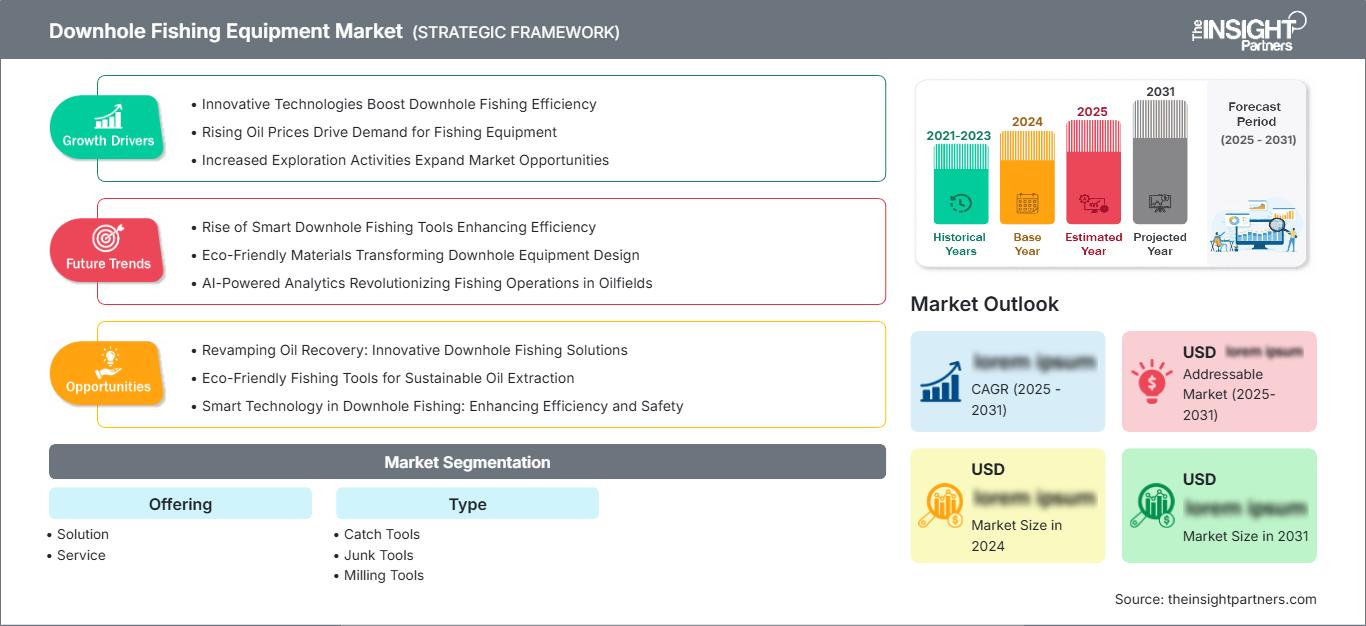
The Downhole Fishing Equipment Market was valued at US$ 6.63 Billion in 2025 and is projected to reach US$ 11.06 Billion by 2034, registering a CAGR of 5.84% during 2026–2034. The market covers specialized tools and field services used to recover stuck pipe, lost assemblies, metallic debris, and other obstructions from oil and gas wells, thereby restoring access and limiting nonproductive time.
Across North America, the market is projected to expand at a ~5% CAGR through 2034. The Downhole Fishing Equipment Market size is supported by a large producing-well base, recurring workover activity in mature basins, and complex horizontal wells that increase retrieval difficulty. Deepwater intervention, plugging and abandonment programs, and operator preference for digitally informed, lower-run remediation also sustain demand for premium tools and experienced service crews.
Downhole Fishing Equipment Market Assessment and Insights
Regional Outlook
- North America: ~38% of the global Downhole Fishing Equipment Market share in 2025 | ~5% CAGR through 2034. Market position: Largest regional market, supported by a dense well inventory, high intervention intensity, mature shale basins, Gulf of Mexico complexity, and broad availability of fishing specialists and rental fleets.
- US: ~84% of North American market revenue in 2025 | ~5% CAGR through 2034. Market position: Leading country in North America, with demand concentrated in shale workovers, deepwater recovery, mature-well remediation, and technology-led service execution.
- Europe: ~14% of the global market in 2025 | ~4% CAGR through 2034. Market position: Mature regional market shaped by North Sea intervention and abandonment activity, with the UK and Norway as principal demand centers and Germany, France, Italy, and Spain supporting smaller requirements.
- Asia Pacific: ~20% of the global market in 2025 | ~7% CAGR through 2034. Market position: Fastest-growing regional market, driven by offshore development, expanding national oil company programs, aging fields, and service localization in China, India, Australia, Indonesia, and Malaysia.
Segment Outlook
- Service: ~58% Share in 2025 | ~6% CAGR through 2034. Market position: Service leads because successful recovery depends on job design, tool selection, experienced crews, well-specific contingencies, and rapid mobilization rather than hardware availability alone.
- Type: ~46% Share in 2025 | ~6% CAGR through 2034. Market position: Type is the high-growth main segment as increasingly complex fish profiles require application-specific catch, junk, and milling tools with improved metallurgy and cutting structures.
Competitive Coverage
Baker Hughes Company, Equity Petroleum Services Nigeria Limited, Falcon Downhole Services, LLC, GasGroup International TechPairer Limited, NOV Inc., Rubicon Oilfield Products Limited, Tecon Oil Services Limited, Tobitem Downhole Solutions Company Limited, Wellbore Integrity Solutions, Wenzel Industries
Methodology
The Insight Partners follows Data Collection & Secondary Research, Primary Research, Data Analysis, and Data Triangulation & Final Review to validate market estimates and insights.
Source: The Insight Partners' analysis based on proprietary research, government publications, company annual reports, investor presentations, industry databases, and expert interviews.
Fishing operations have advanced from largely mechanical and experience-based retrieval operations to engineered intervention programs with simulation, downhole real-time information, specialized conveyance and high-performance cutting structures. Extended reach wells, multistage completions, high angle wells, and deepwater equipment stacks lead to diversified failure scenarios and increased cost of retrieval. Hence, suppliers are enhancing overshots, spears, jars, magnets, mills, and casing cutters while including job modeling and diagnostics services. Manufacturing operations are still metallurgy-driven but field success depends on application engineering, fleet preparedness, and the ability to adjust the bottom-hole assembly on a run-by-run basis.
Between now and 2034, capital investments are expected to be in offshore projects pipelines, mature fields' intervention, and increasing plugging and abandonment needs. Asia-Pacific and the Middle East region present localization possibilities for suppliers since national oil companies are expanding their domestic capabilities and need quick access to qualified inventories. Growth in North America and Europe will depend more on challenging workover, slot recovery, and decommissioning operations rather than on the simple increase of rig counts. Standards in procurement that include traceability, pressure integrity, and tool maintenance documentation will reward suppliers with local service bases and sound engineering systems.
Downhole Fishing Equipment Market Report Scope
| Report Attribute | Details |
|---|---|
| Market size in 2025 | US$ 6.63 Billion |
| Market Size by 2034 | US$ 11.06 Billion |
| Global CAGR (2026 - 2034) | 5.84% |
| Historical Data | 2021-2024 |
| Forecast period | 2026-2034 |
Downhole Fishing Equipment Market Analysis
Downhole Fishing Equipment Market growth depends on the economic value of recovering a plugged wellbore before sidetracking and plugging it. The demand for the products occurs during the drilling process, completion process, production phase, workover operations, and abandonment phase, thus providing the category with exposure to both new wells and existing wells. Increased depth and increased complexity increase friction, access, and difficulty in recovery, hence increasing the value of having correct tool selection and contingencies.
The ecosystem includes specialty steel, cutting materials, precision machining, manufacturers of tools, rental fleet operators, intervention service companies, conveyance equipment providers, and operators. Supply conditions favor inventory capacity and availability of local repair services since loss of production and rig time is crucial. Digital records of well information, torque and drag models, and downhole imaging assist the teams in deciding on catching, jarring, milling, and removal of debris.
Competitive Positioning of Downhole Fishing Equipment Market Analysis differs on different scales and geographies. While Baker Hughes Company and NOV Inc. have comprehensive range of offerings and worldwide coverage, Wellbore Integrity Solutions and Wenzel Industries focus on intervention systems, impact tools, machining and robust field experience. Equity Petroleum Services Nigeria Limited, Tecon Oil Services Limited, Tobitem Downhole Solutions Company Limited and GasGroup International TechPairer Limited improve Nigerian service delivery. Falcon Downhole Services, LLC and Rubicon Oilfield Products Limited deliver expertise and products.
The trend in capital is focused on durable rental fleet, regional service hubs, innovative milling designs and intervention backed up by data. Acquisitions will help to gain access to trained personnel, client base and inventory faster than building greenfield facilities. Strategic benefit will be achieved through minimizing trips, casing protection and predictable performance rather than just extensive product range.
● REPORT CUSTOMIZATION
Tailor This Report To Align With Your Specific Business Requirements
This report can be customized to align precisely with your business objectives, scope, and target markets. Customization options include tailored segmentation, geography, competitive analysis, and strategic insights to support informed decision-making.
Customize This Report →WHAT YOU CAN ADJUST
- ● Segmentations
- ● Geography
- ● Competitive Analysis
- ● Language Preferences
Downhole Fishing Equipment Market: Strategic Insights
Regional Insights
North America Downhole Fishing Equipment Market
North America accounted for ~38% of global revenue in 2025 and is projected to register a ~5% CAGR through 2034. The Downhole Fishing Equipment Market shares owe to the vast well inventory, robust intervention market, developed rental base, and technically challenging operations in shale and offshore fields. Horizontal wells may make the conveyance of fishing equipment difficult and complicate fish engagement, while offshore high day rate makes it economically valuable to cut down on unsuccessful operations.
In U.S., shale formations create a need for drilling, completion cleanout, workover, and fracturing preparation. The Gulf of Mexico is responsible for deep water fishing, slot recovery, and abandonment operations. Canada is represented by Western Canada drilling operations, heavy oil operations, and mature well servicing operations. More and more regional buyers prefer vendors with the ability to mobilize their inventory, perform milling or jarring program modeling, and have traceable inspection history.
U.S. Downhole Fishing Equipment Market
The U.S. represented ~84% of North American revenue in 2025 and is projected to expand at a ~5% CAGR through 2034, making it the leading country in North America. Demand is segmented into Permian, Eagle Ford, Bakken, Mid-Continent, Appalachian, and Gulf of Mexico workflow segments. Longer laterals increase the complexity of torque and drag and increase difficulties with debris removal, while older offshore and onshore assets demand workover and abandonment services.
Products from Baker Hughes Company, NOV Inc., Wellbore Integrity Solutions, Falcon Downhole Services, LLC, and Wenzel Industries fit well to the market demands. Pre-job planning, downhole diagnostics, and custom mills are becoming increasingly important for operators to decrease uncertainty. The market thus consists of high-volume rental demand on land basins and low-volume but high-value engineered recovery demand in offshore wells.
Europe Downhole Fishing Equipment Market
Europe held ~14% of the global market in 2025 and is projected to record a ~4% CAGR through 2034. The market is mature, but North Sea workovers, integrity remediation, end-of-field lifetime operations, and decommissioning ensure continuing specialist need. The UK is the leading country in Europe in terms of this market, due to its offshore assets, intervention services chain, and increasing need for re-accessing before plugging or slot reuse.
Germany and France contribute to the market through equipment engineering, machining, energy services capacity, and well interventions in their own countries. Italy contributes to Mediterranean production and storage-based intervention, whereas Spain's contributions are more specific in nature, relating to storage facilities, industrial capacity, and international service capacity. Norway continues to be important for the larger European market through offshore engineering standards and well intervention programs, although the required country set includes EU and UK markets only.
Procurement considerations focus on certifications, metallurgy, pressure integrity, and life cycle documentation. With operators trying to reduce days offshore, the vendors capable of performing fishing, section milling, casing cutting, and abandonment engineering can maximize value on every job. Growth in the market is limited due to selective drilling, however the installed base ensures lasting remediation opportunities.
APAC Downhole Fishing Equipment Market
Asia Pacific represented ~20% of global revenue in 2025 and is projected to register a ~7% CAGR through 2034, making it the fastest-growing region. China is the leading country in Asia Pacific, supported by a large drilling program, mature producing assets, domestic tool manufacturing, and expanding unconventional operations.
India’s exploration and offshore investment, Australia’s LNG and mature-field interventions, and activity in Southeast Asian offshore basins broaden the opportunity. Japan and South Korea contribute advanced steel, machining, and offshore engineering capabilities despite limited domestic drilling. Localization policies, supplier qualification, and national oil company procurement encourage regional inventories and service bases.
Middle East & Africa Downhole Fishing Equipment Market
The Middle East & Africa market is projected to expand at a ~6% CAGR through 2034. Saudi Arabia is the leading country in the Middle East & Africa, supported by extensive field development, workover programs, and local-content investment. The UAE adds complex onshore and offshore intervention demand, while regional operators prioritize reliable tools for high-temperature and extended-reach wells.
South Africa contributes selective offshore, gas, and industrial-service demand. Across Rest of MEA, Nigeria, Angola, Egypt, and emerging producers require fishing capacity for mature fields and offshore assets. Local repair, personnel competence, and inventory availability remain decisive because import delays can prolong nonproductive time.
Segmentation Analysis
Offering
Offering is projected to record a ~6% CAGR during 2026–2034. The Downhole Fishing Equipment Market scope includes engineered solutions and field services used to identify, engage, cut, mill, retrieve, or bypass downhole obstructions. Buyers assess fleet readiness, engineering competence, response time, tool condition, and the provider’s ability to revise the recovery sequence as well conditions become clearer.
- Solution: Solutions include catch tools, jars, mills, cutters, magnets, junk baskets, and associated assemblies. Demand favors modular, field-redressable equipment designed for high loads, abrasive debris, casing protection, and compatibility with varied conveyance methods.
- Service: Services represent the larger offering because execution depends on diagnosis, job design, experienced personnel, tool preparation, onsite decisions, and post-run interpretation. Service integration is especially valuable in deep, deviated, or offshore wells.
Type
Type is projected to register a ~6% CAGR during 2026–2034. Product demand is shaped by fish geometry, material, depth, accessibility, casing condition, and whether retrieval or destruction is the preferred path. Tool portfolios increasingly combine proven mechanical designs with improved carbide structures, stronger connections, and better pre-job modeling.
- Catch Tools: Overshots, spears, taps, and related devices support direct engagement and retrieval when the fish presents an accessible internal or external profile. Their strategic value lies in recovering equipment while minimizing additional wellbore damage.
- Junk Tools: Magnets, baskets, boot baskets, and debris-recovery assemblies remove loose metallic fragments and cuttings that can obstruct completion or intervention equipment. Demand is recurring across drilling, cleanout, and post-milling operations.
- Milling Tools: Mills and cutting structures address fish that cannot be pulled intact or require profile preparation. Growth is supported by harder materials, complex completions, casing-removal work, and pressure to improve penetration while controlling debris.
Opportunity Snapshot
| Type | Revenue Contribution | Trend Tag | Adoption Stage |
| Catch Tools | High | Precision Retrieval | Mature |
| Junk Tools | Medium | Debris Control | Mature |
| Milling Tools | High | Advanced Cutting | Scaling |
Downhole Fishing Equipment Market Growth Drivers and Impact Analysis
Rising Complexity of Extended-Reach and Offshore Wells
Longer laterals, higher-angle trajectories, deeper targets, and crowded completion assemblies increase the number of mechanical interfaces and make a stuck tool harder to reach. Friction can reduce the impact delivered by jars, while restricted annuli complicate circulation and debris transport. Offshore wells magnify the financial impact because rig, vessel, and production downtime are costly. These conditions increase demand for engineered fishing programs that combine torque-and-drag analysis, jar placement, specialized catch profiles, and high-performance mills. Suppliers that can evaluate load paths, provide contingency assemblies, and mobilize replacement components quickly help operators avoid sidetracks and preserve well value.
Mature-Well Workovers and Plugging Programs
Aging well populations require interventions to restore production, repair integrity, change completions, or prepare for permanent abandonment. Corrosion, scale, deformed tubulars, legacy hardware, and incomplete well records can make retrieval more difficult than in newly drilled wells. Fishing tools are often needed before plugs can be placed at the correct depth or before casing sections can be milled. This creates demand that is less dependent on the new-well cycle. Providers with combined fishing, cutting, milling, and abandonment capabilities can support multi-stage campaigns, reduce handoffs, and improve schedule control across fields with many similar but not identical wells.
Operator Focus on Reducing Nonproductive Time
Nonproductive time affects rig cost, production schedules, and well economics, making recovery speed a direct purchasing criterion. Operators increasingly assess the probability of success per run rather than the day rate of an individual tool. Real-time downhole information, disciplined tool inspection, hydraulic and mechanical modeling, and experienced onsite judgment can reduce repeated attempts. The Downhole Fishing Equipment Market benefits as customers shift from ad hoc rentals toward packaged services with defined engineering and response standards. Suppliers that document tool condition, maintain regional inventory, and use post-job learning to refine procedures can build recurring relationships and defend value-based pricing.
Downhole Fishing Equipment Market Future Trends
Data-Enabled Fishing and Real-Time Downhole Confirmation
Downhole Fishing Equipment Market trends increasingly favor workflows that reduce uncertainty before full pulling or milling force is applied. Cameras, telemetry, distributed measurements, and digital job models can clarify fish position, engagement, circulation, and tool response. Through 2034, integration with coiled tubing and wired conveyance could make selected complex jobs more observable, allowing crews to adapt weight, rotation, and fluid programs while the assembly remains downhole. Adoption will initially concentrate in high-cost wells where avoided runs justify premium systems. Over time, reusable digital templates and lower-cost sensors can extend the approach to mature-field workovers and abandonment.
Integrated Retrieval, Milling, and Abandonment Toolchains
Future intervention programs are likely to be planned as connected toolchains rather than isolated fishing runs. A recovery sequence may progress from diagnosis to catching, controlled impact, milling, debris removal, casing cutting, and barrier preparation. Vendors that engineer these steps together can reduce interface risk and select tools that produce manageable debris for the next operation. The shift also supports standardized bottom-hole assemblies, modular redress kits, and field data capture. Commercially, integrated delivery can expand revenue per well while giving operators clearer accountability for schedule and well-access outcomes.
Downhole Fishing Equipment Market Opportunities
Regional Service Hubs in Fast-Expanding Producing Markets
One of the strongest Downhole Fishing Equipment Market Forecasts opportunities lies in placing qualified rental fleets, machining, inspection, and engineering close to national oil company programs in Asia Pacific, the Middle East, and Africa. Local hubs shorten mobilization time and help suppliers comply with local-content requirements. Investment priorities include common catch sizes, redress components, mills suited to regional metallurgy, pressure-test capability, and technician training. Partnerships with established domestic service companies can accelerate customer qualification and provide access to field knowledge. The commercial model should balance locally stocked high-use tools with rapid transfer of specialized assemblies across a wider network.
Premium Solutions for Offshore Decommissioning and Slot Recovery
Offshore abandonment creates an opportunity for providers that can restore access through damaged or obstructed well sections before barriers are installed. Complex legacy completions may require sequential retrieval, casing cutting, section milling, and debris management under strict environmental and operational controls. Suppliers can invest in integrated engineering, verified cutting structures, robust contingency inventories, and digital documentation that supports regulatory assurance. Framework agreements across multi-well campaigns improve utilization and enable lessons from one well to reduce execution risk on the next. The opportunity is particularly attractive where rig-time savings outweigh the incremental price of specialized equipment and experienced crews.
Recent Developments
- August 2026: SLB announced an electrically controlled coiled-tubing intervention platform that combines downhole measurements, telemetry and tool actuation. It supports intervention activities such as cleanout, isolation and shifting operations.
- February 2026: KINGWELL reported dispatching 55 units of fishing equipment to an oilfield in Central Asia. The shipment included fishing taper taps, pin taps, magnetic fishing mills and bottom-hole mills.
- November 2024: Archer Limited Archer closed its acquisition of Wellbore Fishing & Rental Tools, LLC for US$ 51.5 million. The transaction added U.S. fishing operations focused on removal of stuck pipe, completions, tools, casing, and liners, strengthening Archer’s Gulf of Mexico intervention and abandonment position.
Frequently Asked Questions

- Comprehensive Market Sizing and Forecast Analysis
- Detailed Segmentation Analysis
- In-Depth Market Dynamics Assessment
- Regional and Country-Level Insights
- Competitive Landscape and Company Benchmarking
- Strategic Business Intelligence
Recent Reports
Testimonials

The Insight Partners provided valuable market intelligence that supported our global go-to-market strategy. Their team was professional, responsive, and attentive to our feedback, providing thoughtful analysis and helpful methodological clarifications throughout the project.
Junmo Kim Chief Financial Officer (CFO), Enertech Co., Ltd.
The Insight Partners' SCADA System Market report is comprehensive, with valuable insights on current trends and future forecasts. The team was highly professional, responsive, and supportive throughout. We are very satisfied and highly recommend their services.
RAN KEDEM Partner, Reali Technologies LTDs
I requested a report on a very specific software market and the team produced the report in a few days. The information was very relevant and well presented. I then requested some changes and additions to the report. The team was again very responsive and I got the final report in less than a week.
JEAN-HERVE JENN Chairman, Future Analytica
We worked with The Insight Partners for an important market study and forecast. They gave us clear insights into opportunities and risks, which helped shape our plans. Their research was easy to use and based on solid data. It helped us make smart, confident decisions. We highly recommend them.
PIYUSH NAGPAL Sr. Vice President, High Beam Global
The Insight Partners delivered insightful, well-structured market research with strong domain expertise. Their team was professional and responsive throughout. The user-friendly website made accessing industry reports seamless. We highly recommend them for reliable, high-quality research services
YUKIHIKO ADACHI CEO, Deep Blue, LLC.
This is the first time I have purchased a market report from The Insight Partners.While I was unsure at first, I visited their web site and felt more comfortable to take the risk and purchase a market report.I am completely satisfied with the quality of the report and customer service. I had several questions and comments with the initial report, but after a couple of dialogs over email with their analyst I believe I have a report that I can use as input to our strategic planning process.Thank you so much for taking the extra time and making this a positive experience.I will definitely recommend your service to others and you will be my first call when we need further market data.
JOHN SUZUKI President and Chief Executive Officer, Board Director, BK Technologies
I wish to appreciate your support and the professionalism you displayed in the course of attending to my request for information regarding to infectious disease IVD market in Nigeria. I appreciate your patience, your guidance, and the fact that you were willing to offer a discount, which eventually made it possible for us to close a deal. I look forward to engaging The Insight Partners in the future, all thanks to the impression you have created in me as a result of this first encounter.
DR CHIJIOKE ONYIA MANAGING DIRECTOR, PineCrest Healthcare Ltd.Reason to Buy
- Informed Decision-Making
- Understanding Market Dynamics
- Competitive Analysis
- Identifying Emerging Markets
- Customer Insights
- Market Forecasts
- Risk Mitigation
- Boosting Operational Efficiency
- Strategic Planning
- Investment Justification
- Tracking Industry Innovations
- Aligning with Regulatory Trends





 Get Free Sample for