
Lifting Hooks Market Growth, Demand & Size by 2034
Coverage: By Type (Eye Hooks, Clevis Hooks, Swivel Hooks, Grab Hooks, Foundry Hooks); Capacity (Below 5 ton, 5-15 ton, 15-25 ton, Over 25 ton); Industry (Construction, Logistics and Transportation, Industrial, Automotive, Others) , and Geography (North America, Europe, Asia Pacific, and South and Central America)
- Status : Data Released
- Report Code : TIPRE00019805
- Category : Manufacturing and Construction
- No. of Pages : 150
- Available Report Formats :


- Last update date : July 13, 2026


2025 Market Size
US$ 1.3 Bn
Base year value
2034 Forecast
US$ 2.03 Bn
Projected by 2034
CAGR 2026-2034
5.09 %
Growth rate
Addressable Market
US$ 15.12 Bn
(2026-2034)
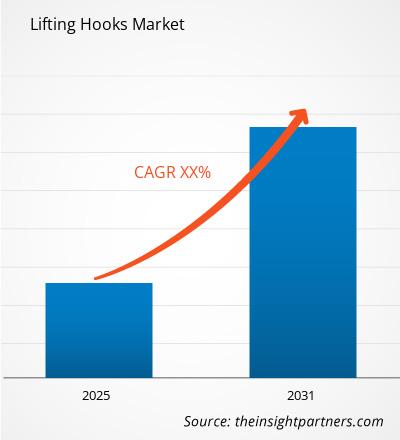
The lifting hooks market size was valued at US$ 1.3 Billion in 2025 and is projected to reach US$ 2.03 Billion by 2034, growing at a CAGR of 5.09% during 2026–2034. Lifting hooks serve as crucial connection devices employed alongside cranes, hoists, slings, and rigging in constructions, logistics, manufacturing industries, and automobile manufacturing processes that involve controlled lifting, attachment, and following the load-bearing safety norms.
North America is projected to grow in a 4.7–5.2% compound annual growth rate over the forecast period 2026–2034 due to rising reshoring-driven factory improvements, increased automation in warehouses, replacement of old rigging equipment due to regulatory push, and crane upgradation in utility, metal fabrication, and oil & gas maintenance sectors favoring certified hooks with latches and predictable fatigue behavior.
Lifting Hooks Market Assessment and Insights
- North America: The region accounted for 28–31% share in 2025 and is growing at a CAGR range of 4.7–5.2% during 2026–2034, driven by industrial safety compliance and warehouse automation.
- US: The country represented 78–82% of the North America lifting hooks market in 2025 and is growing at a CAGR range of 4.8–5.3% during 2026–2034, led by manufacturing and logistics upgrades.
- Europe: The region held 23–26% share in 2025 and is growing at a CAGR range of 4.4–4.9% during 2026–2034, with Germany, the UK, France, Italy, and Spain leading demand.
- Asia Pacific: The region captured 32–35% share in 2025 and is growing at a CAGR range of 5.6–6.2% during 2026–2034, led by China, India, Japan, South Korea, and Australia.
- Largest Segment: Clevis Hooks held 31–34% lifting hooks market share in 2025 and is growing at a CAGR range of 4.8–5.3% during 2026–2034 due to broad sling compatibility.
- High Growth Segment: Swivel Hooks held 16–19% market share in 2025 and is growing at a CAGR range of 5.8–6.4% during 2026–2034 as rotation control improves handling safety.
- Key companies analyzed in detail: Columbus McKinnon Corporation, Kito Crosby Limited, Irizar Forge S.L., Ketten Wälder GmbH, Pewag Group, Stamperia Carcano Giuseppe S.p.A., TOHO-Rongkee Electronic and Machinery Co., Ltd., Van Beest B.V., YOKE Industrial Corp., RUD Ketten Rieger & Dietz GmbH u. Co. KG.
Source: The Insight Partners' analysis based on proprietary research, government publications, company annual reports, investor presentations, industry databases, and expert interviews.
Development in the Lifting Hooks Market forecast is progressing from simple forgings to specialized, traceable, and higher-grade hardware products. This has been done by using alloy steels, controlled heat-treatment, proof testing, and batch marking in order to cater to stricter procurement policies. Moreover, production networks are becoming closer to big distributors of cranes, hoists, and rigging in order to avoid volatility in prices due to steel and at the same time facilitate aftermarket replacement cycles in developed industrial markets and new equipment needs in the Asia Pacific region.
Moving forward, manufacturing hubs, port development, renewable energy projects, and automated distribution centers are going to widen the application range of the Lifting Hooks Market. The regulations similar to those of OSHA, ASME, EN, and ISO for lifting operations will keep replacement demand up; and infrastructure programs in India, Southeast Asia, Gulf Region, and North America will contribute to high capacity hooks, swivel assemblies, and certified rigging kits.
Lifting Hooks Market Report Scope
| Report Attribute | Details |
|---|---|
| Market size in 2025 | US$ 1.3 Billion |
| Market Size by 2034 | US$ 2.03 Billion |
| Global CAGR (2026 - 2034) | 5.09% |
| Historical Data | 2021-2024 |
| Forecast period | 2026-2034 |
Lifting Hooks Market Analysis
The Lifting Hooks Market report takes its foundation from installed lifting equipment, construction cranes, port machinery, fabrication facilities, and heavy vehicles assembly plants. Being wear critical parts of lifting equipment, the demand for replacements does not depend on capital expenditure as much as other lifting equipment. Factors affecting the market include the intensity of usage, the frequency of inspection, and the transition from manual handling to mechanized movement in industrial facilities.
The market ecosystem consists of steel companies, forging facilities, heat treating facilities, testing facilities, distributors, crane OEMs and end users. Alloy steel dominates in production of rated hooks since fatigue resistance and dimensions are essential for safe handling. The supply factors include price of steel, capabilities for machining, availability of non-destructive testing, and distributor policies.
The industry structure is somewhat consolidated on the high end for certification and fragmented for the regional forging companies. The purchase of Kito Crosby Limited by Columbus McKinnon Corporation provides a scale advantage in lifting hardware, while Pewag Group, Van Beest B.V., YOKE Industrial Corp., and RUD Ketten Rieger & Dietz GmbH u. Co. KG compete with grade certified products, distributors, and application engineering.
The capital expenditure focus areas are automated forging lines, robotics for finishing, traceability systems, and stocking facilities close to industrial concentrations. Irizar Forge S.L., Ketten Wälder GmbH, Stamperia Carcano Giuseppe S.p.A., and TOHO-Rongkee Electronic and Machinery Co., Ltd. are focused in specialist hooks, chains, and distribution. Lifting Hooks market analysis suggest that buyers look at product longevity, certifications, and availability over cost per unit basis.
● REPORT CUSTOMIZATION
Tailor This Report To Align With Your Specific Business Requirements
This report can be customized to align precisely with your business objectives, scope, and target markets. Customization options include tailored segmentation, geography, competitive analysis, and strategic insights to support informed decision-making.
Customize This Report →WHAT YOU CAN ADJUST
- ● Segmentations
- ● Geography
- ● Competitive Analysis
- ● Language Preferences
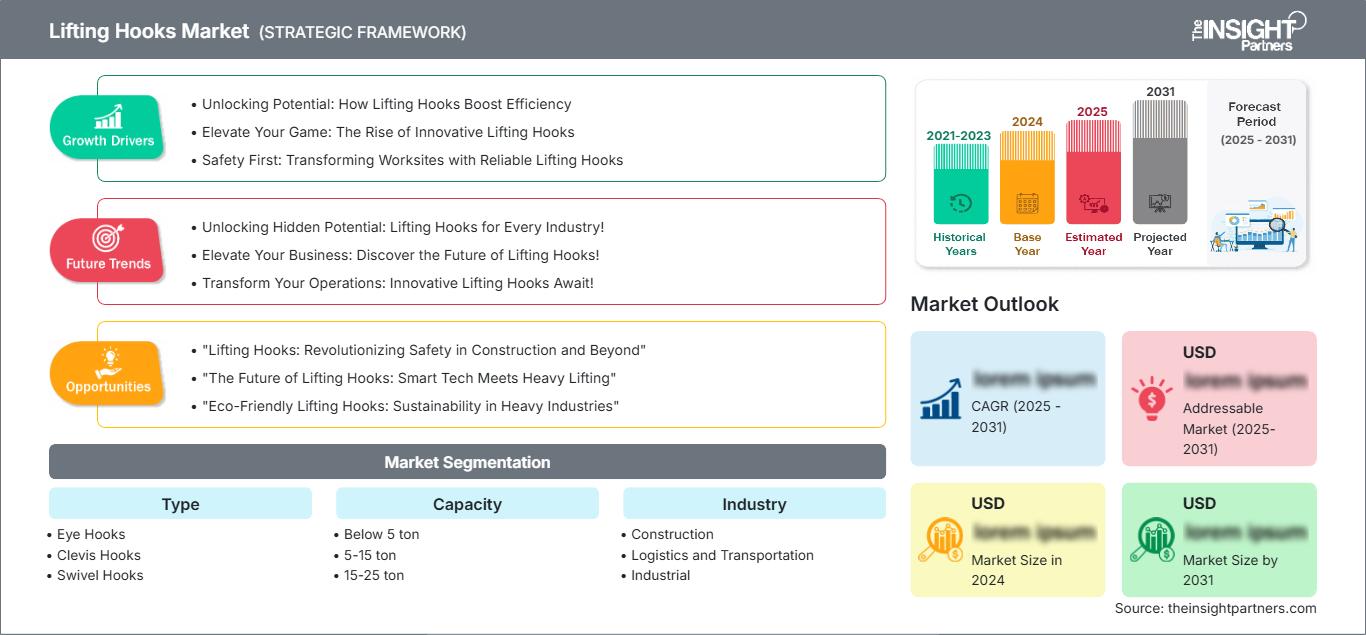
Lifting Hooks Market: Strategic Insights
Regional Insights
North America Lifting Hooks
North America held a 28–31% share in 2025 and is forecast to grow at a CAGR range of 4.7–5.2% during 2026–2034. Demand is supported by crane modernization, reshoring in durable goods manufacturing, and high inspection intensity in construction, utilities, energy maintenance, and logistics facilities.
Regional buyers prioritize certified hooks with proof-load documentation, safety latches, and quick replacement availability. The Lifting Hooks market share in North America is also supported by distributors serving rental fleets, fabrication yards, and warehousing operators. IATA cargo recovery and sustained e-commerce fulfillment needs reinforce handling-equipment utilization across transport nodes.
U.S. Lifting Hooks Market
The US accounted for 78-82% of the total North American market share in 2025 and is projected to witness a growth rate at CAGR of 4.8-5.3% between 2026 and 2034. The demand is highest in warehouse applications, machinery manufacturing, bridge construction, maintenance at the shipyard, and oil field equipment handling due to regular inspections.
There is a substantial presence of companies with Columbus McKinnon Corporation, Kito Crosby Limited, and YOKE Industrial Corp. providing distribution and OEMs. The clevis and swivel hooks have an application in below 25-ton lifting applications while above 25 ton applications include infrastructure, energy, and heavy fabrication projects.
Europe Lifting Hooks Market
Europe held 23–26% share in 2025 and will expand at a CAGR rate of 4.4–4.9% during 2026–2034. UK relies on port development, utility maintenance, and commercial building construction, with customers demanding certification that follows EN, presence of distributors, and lifecycle information.
Germany will maintain its position because of the country’s machinery industry, automotive industry, steel processing industry, and engineering manufacturing industry. There will be a need for alloy hook, grab hooks for chains assembly, and swivel hooks due to the compliance culture and ability of the supplier to test and provide traceability.
France, Italy, and Spain are contributing by means of rehabilitating infrastructure, industrial fabrication, ship repairing, and logistics modernization. Some of the companies that benefit include Pewag Group, Ketten Wälder GmbH, Irizar Forge S.L., and Stamperia Carcano Giuseppe S.p.A.
APAC Lifting Hooks Market
APAC held 32–35% share in 2025 and is advancing at a CAGR range of 5.6–6.2% during 2026–2034. China leads regional demand through construction equipment, ports, shipbuilding, and steel handling, while Japan and South Korea sustain precision lifting applications.
India is gaining share through rail, metro, warehousing, and manufacturing investments, while Australia supports demand in mining and energy maintenance. Policy-led infrastructure pipelines and factory automation programs are increasing Lifting Hooks market growth for certified medium-capacity and high-capacity products.
Middle East & Africa Lifting Hooks Market
The Middle East & Africa region is forecasted to have a CAGR of 4.9–5.5% from 2026 to 2034. The leading demand generator from the Middle East region is Saudi Arabia in the form of energy, construction, and giga-project lifting requirements. Meanwhile, UAE provides demand due to port logistics, industrial parks, and commercial developments.
The demand from South Africa comes from mining, metals, utilities, and rail maintenance applications. The RoMEA demand will be projects-driven, and the purchase of cranes is usually connected to imported cranes, contractor cranes, and oil and gas servicing companies needing traceable hooks.
Segmentation Analysis
Type
The Type segment is expected to grow at a CAGR range of 5.0–5.5% during 2026–2034 as buyers shift toward application-matched designs rather than generic hooks. Selection is influenced by sling interface, load rotation, shortening needs, working environment, and inspection protocol. Certified clevis and swivel designs are gaining preference where downtime and safety exposure carry high operational costs.
- Eye Hooks remain widely used where permanent attachment to slings, wire ropes, or connectors is required, offering stable load engagement and predictable performance in construction and workshop lifting tasks.
- Clevis Hooks dominate general-purpose lifting because the clevis pin allows rapid connection to chain assemblies, making them strategically important for rental fleets, maintenance crews, and industrial rigging kits.
- Swivel Hooks support safer positioning when loads rotate during lifting, helping users reduce sling twisting, improve handling control, and manage complex warehouse, fabrication, and assembly-line movements.
- Grab Hooks are important in chain-shortening and load restraint applications, especially for transport, fabrication, and maintenance teams requiring fast adjustment without additional rigging accessories.
- Foundry Hooks serve high-temperature and rugged industrial environments where oversized openings, heat exposure, and heavy castings demand robust geometry, durable materials, and inspection discipline.
Capacity
The Capacity segment is forecast to grow at a CAGR range of 4.9–5.4% during 2026–2034, reflecting varied replacement cycles across light, medium, and heavy lifting tasks. Lower-capacity hooks benefit from high-volume warehouse and construction use, while higher-capacity categories are tied to infrastructure, energy, shipbuilding, and heavy equipment manufacturing where certification and fatigue performance are decisive.
- Below 5 ton hooks are used in maintenance, small workshops, warehousing, and light construction, where frequent handling tasks create consistent replacement demand and broad distributor stock requirements.
- 5-15 ton hooks represent a high-utility range for factories, logistics yards, and construction contractors, balancing manageable size with enough capacity for common equipment and material loads.
- 15-25 ton hooks serve heavier industrial and infrastructure uses, including steel handling, machinery installation, and transport equipment assembly, where documentation and proof testing influence supplier selection.
- Over 25 ton hooks address specialized heavy lifting in energy, shipbuilding, mining, and large infrastructure projects, where procurement is lower volume but technically demanding and safety-critical.
Industry
The Industry segment is projected to expand at a CAGR range of 5.1–5.7% during 2026–2034 as end users increase mechanized lifting to improve safety and throughput. Construction leads high-frequency use, logistics adds automated handling demand, industrial facilities drive replacement discipline, and automotive plants require reliable hooks for tooling, components, engines, and equipment movement.
- Construction demand is linked to cranes, hoists, scaffolding support, prefabricated elements, and site equipment handling, making certified hooks essential for contractor safety programs and rental fleets.
- Logistics and Transportation applications are expanding with warehouses, ports, and intermodal terminals, where hooks support maintenance, load movement, container-handling accessories, and distribution equipment uptime.
- Industrial users include steel, machinery, energy, and fabrication plants that require durable hooks for repetitive lifting, maintenance shutdowns, and movement of heavy components within controlled facilities.
- Automotive applications involve assembly plants, tooling shops, and component suppliers, where hooks support engine handling, die movement, line maintenance, and safe transfer of production equipment.
Opportunity Snapshot
| Industry | Revenue Contribution | Trend Tag | Adoption Stage |
| Construction | High | Prefab Lifting | Mature |
| Logistics and Transportation | Medium | Warehouse Automation | Scaling |
| Industrial | High | Plant Modernization | Mature |
| Automotive | Medium | Tooling Transfer | Scaling |
Lifting Hooks Market Growth Drivers and Impact Analysis
Rising Infrastructure and Industrial Lifting Intensity
Infrastructural pipelines are driving the use of cranes, hoists, and rigging kits on construction sites, bridge works, harbors, renewable energy projects, and utility projects. Growth through infrastructure-led priorities by the IMF and capital expenditure policies by governments are resulting in consistent use of such equipment, which causes wear on the hooks and subsequent replacement due to inspection requirements. The trend directly affects the market since the hook is not an optional accessory but a certified load path part.
Warehouse Automation and Faster Material Flow
Increasing mechanization in distribution facilities, intermodal facilities, and manufacturing warehouse operations is leading to the movement of heavier loads with a reduced number of manual operations. Such trends are increasing the need for hooks which will be suitable for electric hoists, below-the-hook lifting accessories, chain slings, and maintenance equipment. Increased material handling is enhancing the importance of hooks which are easily testable, exchangeable, and suitable for rigging kits. The effects are being felt more in the logistics corridors.
Safety Compliance and Certified Replacement Cycles
Hook traceability, proof-load testing, safety latch durability, and visibility are becoming more important procurement criteria through regulatory requirements and customer audits. The need for periodic inspection and removal of defective hooks is supported by OSHA, ASME, EN, and ISO standards. This provides a constant replacement requirement that will help buffer demand during leaner capital expenditure times. Distributors and suppliers of lifting equipment who have documentation of production control, certificates, and distributor education have an improved market position since end users now view their purchases as an investment in risk management.
Lifting Hooks Market Future Trends
Digitally Traceable and Sensor-Ready Hook Designs
Future Lifting Hooks market trends will increasingly include QR-coded certificates, batch-level records, and sensor-ready geometries for high-value lifting applications. While hooks remain mechanical components, digital traceability can simplify audits, support predictive maintenance systems, and reduce disputes about inspection history. Adoption will begin in ports, aerospace maintenance, heavy manufacturing, and energy projects where downtime costs are high. Suppliers that connect documentation to distributor inventory systems can improve aftermarket loyalty and reduce substitution risk.
Shift Toward Lightweight High-Strength Alloy Hardware
Hook materials in the future will evolve into lightweight, stronger alloyed hooks that will retain their work load limits but will provide better ergonomics and transport benefits. This trend is particularly applicable to workers who have to put together and relocate the rigging equipment on a frequent basis. It will include advanced heat treatment, closer dimensional tolerances, and fatigue testing among other things. In the long run, high-end hooks will start gaining a premium.
Lifting Hooks Market Opportunities
Aftermarket Programs for Certified Replacement Kits
Suppliers can capture attractive margins by offering certified replacement kits aligned with common hoist capacities, chain grades, and industry inspection intervals. Bundled hooks, latches, pins, certificates, and inspection guidance reduce purchasing complexity for contractors, warehouses, and plant maintenance teams. This opportunity is especially relevant where users operate mixed fleets and need fast replenishment from distributors. A structured aftermarket model can also improve brand visibility at the point of replacement and convert safety compliance into recurring revenue.
Localized Forging Capacity Near Growth Corridors
Regional forging and finishing capacity near high-growth construction, port, mining, and manufacturing corridors can reduce lead times and tariff exposure. Localized production also helps suppliers adapt hook geometries, markings, and certificates to country-specific lifting standards. The opportunity is strongest in India, Southeast Asia, the Gulf, and selected North American industrial clusters where infrastructure and logistics investments are accelerating. Partnerships with distributors and crane service firms can improve demand visibility and inventory turns.
Recent Developments
- February 2026: Columbus McKinnon Corporation announced that it has completed its acquisition (the “Acquisition”) of Kito Crosby Limited (“Kito Crosby”) from funds managed by leading global investment firm, KKR. The Company expects that the Acquisition will scale the business of the combined Company, deliver improved Adjusted EBITDA Margin and enhance shareholder value through the delivery of US$70 million of expected net annual run rate cost synergies with upside from potential revenue synergies.
- August 2025: American National Standard has released ASME B30 standard for hook lifting devices. ASME B30 standard has offered provisions for the construction, installation, operation, and maintenance of cranes and related lifting equipment.
- June 2023: The IMO Maritime Safety Committee (MSC) adopted Resolution MSC.532(107), which amends the SOLAS Convention by introducing new regulations II-1/2 and II-1/3-13. These regulations focus on onboard lifting appliances and anchor handling winches.
Frequently Asked Questions

- Comprehensive Market Sizing and Forecast Analysis
- Detailed Segmentation Analysis
- In-Depth Market Dynamics Assessment
- Regional and Country-Level Insights
- Competitive Landscape and Company Benchmarking
- Strategic Business Intelligence
Recent Reports
Testimonials

The Insight Partners provided valuable market intelligence that supported our global go-to-market strategy. Their team was professional, responsive, and attentive to our feedback, providing thoughtful analysis and helpful methodological clarifications throughout the project.
Junmo Kim Chief Financial Officer (CFO), Enertech Co., Ltd.
The Insight Partners' SCADA System Market report is comprehensive, with valuable insights on current trends and future forecasts. The team was highly professional, responsive, and supportive throughout. We are very satisfied and highly recommend their services.
RAN KEDEM Partner, Reali Technologies LTDs
I requested a report on a very specific software market and the team produced the report in a few days. The information was very relevant and well presented. I then requested some changes and additions to the report. The team was again very responsive and I got the final report in less than a week.
JEAN-HERVE JENN Chairman, Future Analytica
We worked with The Insight Partners for an important market study and forecast. They gave us clear insights into opportunities and risks, which helped shape our plans. Their research was easy to use and based on solid data. It helped us make smart, confident decisions. We highly recommend them.
PIYUSH NAGPAL Sr. Vice President, High Beam Global
The Insight Partners delivered insightful, well-structured market research with strong domain expertise. Their team was professional and responsive throughout. The user-friendly website made accessing industry reports seamless. We highly recommend them for reliable, high-quality research services
YUKIHIKO ADACHI CEO, Deep Blue, LLC.
This is the first time I have purchased a market report from The Insight Partners.While I was unsure at first, I visited their web site and felt more comfortable to take the risk and purchase a market report.I am completely satisfied with the quality of the report and customer service. I had several questions and comments with the initial report, but after a couple of dialogs over email with their analyst I believe I have a report that I can use as input to our strategic planning process.Thank you so much for taking the extra time and making this a positive experience.I will definitely recommend your service to others and you will be my first call when we need further market data.
JOHN SUZUKI President and Chief Executive Officer, Board Director, BK Technologies
I wish to appreciate your support and the professionalism you displayed in the course of attending to my request for information regarding to infectious disease IVD market in Nigeria. I appreciate your patience, your guidance, and the fact that you were willing to offer a discount, which eventually made it possible for us to close a deal. I look forward to engaging The Insight Partners in the future, all thanks to the impression you have created in me as a result of this first encounter.
DR CHIJIOKE ONYIA MANAGING DIRECTOR, PineCrest Healthcare Ltd.Reason to Buy
- Informed Decision-Making
- Understanding Market Dynamics
- Competitive Analysis
- Identifying Emerging Markets
- Customer Insights
- Market Forecasts
- Risk Mitigation
- Boosting Operational Efficiency
- Strategic Planning
- Investment Justification
- Tracking Industry Innovations
- Aligning with Regulatory Trends





 Get Free Sample for