
Military Vehicle Market Trends, Size & Growth by 2034
Coverage: By Type (Military Tanks, Military Trucks, Military Amphibious Vehicles, Armored Vehicles, Military Special Vehicles, and Others), Application (Ground Support Handling, Tactical Warfare, ISR, Military Transportation, and Others), Technology (Autonomous Vehicles and Manual Driven Vehicles), and Geography
- Status : Published
- Report Code : TIPRE00025477
- Category : Aerospace and Defense
- No. of Pages : 260
- Available Report Formats :


- Last update date : May 28, 2026


2025 Market Size
US$ 35.36 Bn
Base year value
2034 Forecast
US$ 68.79 Bn
Projected by 2034
CAGR 2026-2034
7.7 %
Growth rate
Addressable Market
US$ 469.64 Bn
(2026-2034)
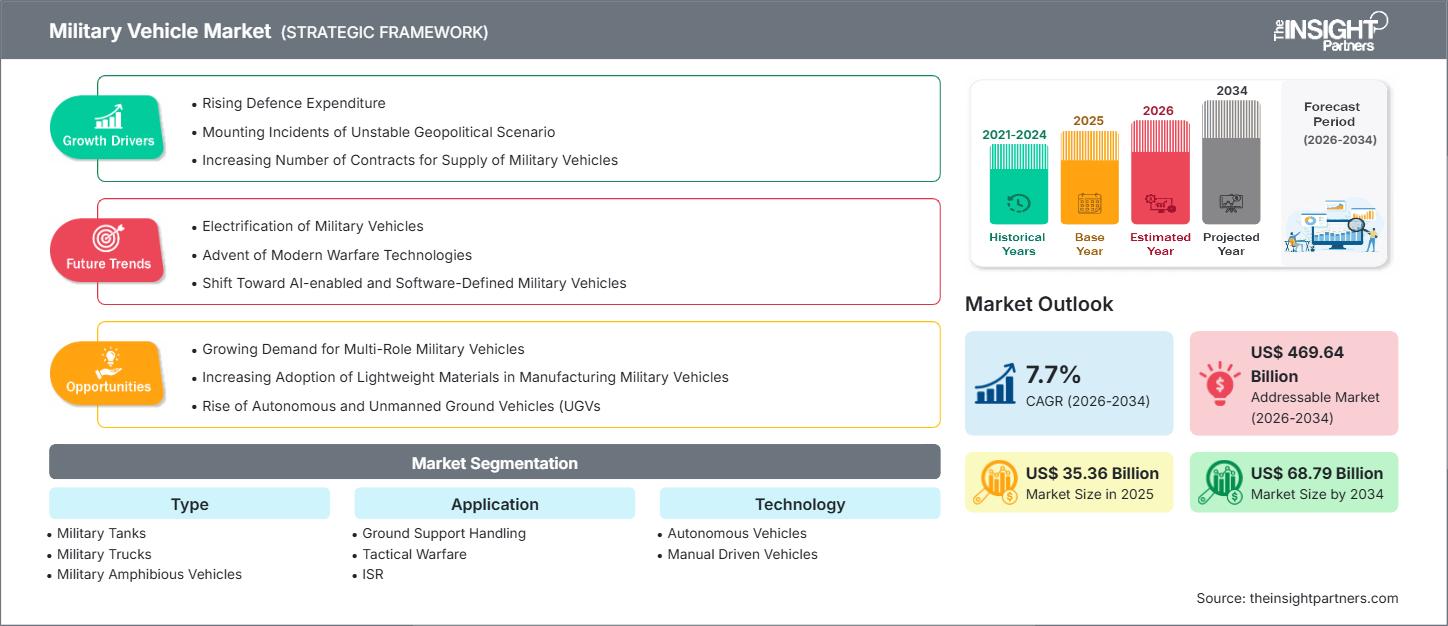
The military vehicle market size is projected to reach US$ 68.79 billion by 2034, from US$ 35.36 billion in 2025. The market is expected to register a CAGR of 7.7% during 2026–2034.
Military Vehicle Market Analysis
Autonomously operated military vehicles improve operational efficiency by enabling missions in hazardous environments without risking personnel, making them suitable for surveillance, reconnaissance, and logistical roles. Unmanned ground vehicles (UGVs) can be used for tasks such as troop resupply and explosive ordnance disposal, delivering cost savings and improved mission outcomes. Growing demand for multirole vehicles capable of reconnaissance, troop transport, and combat support is increasing interest in military vehicle procurement. In addition, the U.S. Department of Defense is placing greater emphasis on vehicle versatility to support adaptable platforms for a wide range of military operations.
Military Vehicle Market Overview
Military vehicles play an integral role in modern warfare by supporting logistics, transportation, reconnaissance, and combat operations. Their deployment is influenced by volatile geopolitical conditions and increased defense investment in advanced technologies, which are driving higher demand. As the nature of modern warfare continues to evolve, the military vehicle market is expected to grow accordingly.
The military vehicle market is expected to continue growing, with increased emphasis on efficiency and sustainability. Countries are seeking to meet operational requirements while managing defense budgets by prioritizing vehicles with lower lifecycle costs and reduced environmental impact. As multinational cooperation in military operations increases, demand for innovative vehicle designs and procurement approaches is also rising, creating opportunities for companies offering advanced technologies.
Market Assessment and Insights
- North America dominated the market with 41.5% share in 2025.
- Asia Pacific is poised to grow at a CAGR of 8.6% over the forecast period.
- United States market is projected to grow at a CAGR of 8.1% over the forecast period.
- By Type, the Armored Vehicles segment accounted for the largest market share of 38.2% in 2025.
- By Application, the Tactical Warfare segment is anticipated to witness the fastest growth, registering a CAGR of 9.5% over the forecast period
- By Technology, the Manual Driven Vehicles segment accounted for the largest market share of 95.8% in 2025.
- The report profiles key industry players such as BAE Systems Plc, General Dynamics Corp, Thales SA, Lockheed Martin Corp, Rheinmetall AG, Tata Motors Ltd, Ashok Leyland Ltd, Oshkosh Corp, KMW+NEXTER Defense Systems NV, Patria Oyj, while also analyzing key developments in novel ideas, disruptive products, and innovative services that could reshape the future market and reveal emerging themes across the industry.
Source: The Insight Partners' analysis based on proprietary research, government publications, company annual reports, investor presentations, industry databases, and expert interviews.
● REPORT CUSTOMIZATION
Tailor This Report To Align With Your Specific Business Requirements
This report can be customized to align precisely with your business objectives, scope, and target markets. Customization options include tailored segmentation, geography, competitive analysis, and strategic insights to support informed decision-making.
Customize This Report →WHAT YOU CAN ADJUST
- ● Segmentations
- ● Geography
- ● Competitive Analysis
- ● Language Preferences
Military Vehicle Market: Strategic Insights
-
Get Top Key Market Trends of this report.This FREE sample will include data analysis, ranging from market trends to estimates and forecasts.
Military Vehicle Market Drivers and Opportunities
Market Drivers:
- Rising Defense Expenditure: Globally, various governments allocate substantial funds and financial aid toward their respective defense and military forces. The defense budget allocation supports the army and military forces to acquire enhanced technologies and equipment from native or international developers.
- Mounting Incidents of an Unstable Geopolitical Scenario: The unstable geopolitical scenario worldwide involving India-Pakistan, China-Taiwan, China-India, Russia-Ukraine war, Russia-US, and the Israel-Palestine war is boosting the demand for advanced military vehicles equipped with high-end surveillance, communication, and navigation systems.
- Increasing Number of Contracts for Supply of Military Vehicles: The military forces of various countries are granting numerous contracts to military vehicle manufacturers to procure advanced military vehicles equipped with high-end communication, surveillance, and navigation systems.
- Growing Investments in Electric Battlefield Vehicles: Electric and hybrid military vehicles are emerging as a key trend due to their reduced fuel dependency, lower heat signatures, and quieter operation.
- Military Modernization Programs: Many countries are replacing aging vehicle fleets with modern tactical and combat vehicles to improve operational efficiency and battlefield survivability.
Market Opportunities:
- Demand for Multirole Military Vehicles: A demand for multirole military vehicles is generated from the requirement for efficient, flexible, cost-effective solutions that address varied operational requisites. Multirole vehicles are designed to accomplish troop transportation, reconnaissance, combat support, and medical evacuation.
- Increased Adoption of Lightweight Materials in Manufacturing Military Vehicles: Lightweight materials are significant for vehicles designed for multipurpose or amphibious operations, where weight limits are fundamental.
- Rise of Autonomous and Unmanned Ground Vehicles (UGVs): As geopolitical tensions and asymmetric warfare threats continue to increase, militaries are investing heavily in autonomous platforms that can operate in contested and hostile environments where traditional manned vehicles face significant limitations.
- Integration of Advanced Communication Systems: Opportunities are increasing for vehicles equipped with real-time data sharing, battlefield management systems, and secure communication technologies.
- Adoption of Hybrid and Electric Propulsion: Demand for fuel-efficient and low-signature military vehicles is creating opportunities for hybrid-electric and alternative energy technologies.
Military Vehicle Market Report Segmentation Analysis
The military vehicle market is segmented into distinct categories to provide a detailed understanding of its type, application, and technology:
By Type:
- Military Tanks: Military tanks are a vital part of defense budgets as countries invest in enhancing their armored capabilities to address changing battlefield needs.
- Military Trucks: Military trucks are vital for transporting supplies, personnel, and equipment across distinct terrains, making them a significant investment for contemporary defense forces.
- Military Amphibious Vehicles: Amphibious vehicles, competent for operating on both land and water, are essential for a wide range of military applications, such as reconnaissance, beach assaults, troop transport, and humanitarian missions.
- Armored Vehicles: The demand for armored vehicles has been experiencing significant growth, driven by the rising global security concerns, geopolitical hostilities, and the demand for enhanced defense capabilities.
- Military Special Vehicles: Rising investments in defense infrastructure development contribute to the demand for specialized vehicles designed for special tasks.
- Others: Other vehicle types include infantry fighting vehicles and robotic combat vehicles. The military vehicle market is witnessing sustained growth, driven by security needs and technological advancements in the defense sector.
By Application:
- Ground Support Handling
- Tactical Warfare
- ISR
- Military Transportation
- Others
By Technology:
- Autonomous Vehicles
- Manual Driven Vehicles
By Geography:
- North America
- Europe
- Asia Pacific
- Latin America
- Middle East & Africa
Military Vehicle Market Report Scope
| Report Attribute | Details |
|---|---|
| Market size in 2025 | US$ 35.36 Billion |
| Market Size by 2034 | US$ 68.79 Billion |
| Global CAGR (2026 - 2034) | 7.7% |
| Historical Data | 2021-2024 |
| Forecast period | 2026-2034 |
| Segments Covered |
By Type
|
| Regions and Countries Covered |
North America
|
| Market leaders and key company profiles |
|
Military Vehicle Market Players Density: Understanding Its Impact on Business Dynamics
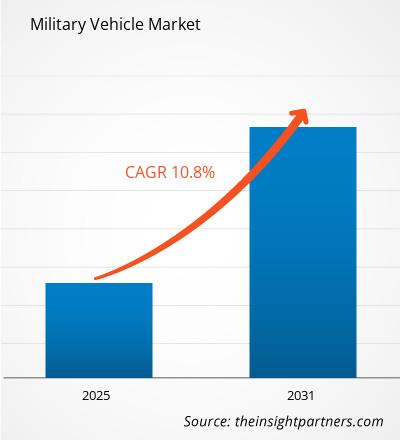
The Military Vehicle Market is growing rapidly, driven by increasing end-user demand due to factors such as evolving consumer preferences, technological advancements, and greater awareness of the product's benefits. As demand rises, businesses are expanding their offerings, innovating to meet consumer needs, and capitalizing on emerging trends, which further fuels market growth.
Military Vehicle Market Share Analysis by Geography
Asia Pacific is witnessing the fastest growth, driven by its expanding military expenditure and demand for autonomous vehicles. Emerging markets in Latin America and the MEA offer untapped opportunities for military vehicle providers.
The military vehicle market experiences varying growth rates across different regions. Below is a summary of market share and trends by region:
1. North America
- Rising U.S. defense budgets and ongoing fleet modernization programs are accelerating procurement of advanced armored, tactical, and autonomous military vehicles integrated with next-generation battlefield communication and protection systems.
- Adoption of AI-enabled situational awareness, hybrid propulsion systems, unmanned ground vehicles, and digitally connected combat platforms is reshaping military vehicle procurement priorities across the US and Canada.
2. Europe
- Increasing NATO commitments, geopolitical tensions, and collaborative defense initiatives are driving European nations to upgrade armored fleets and invest heavily in interoperable military land vehicle platforms.
- Joint procurement programs, indigenous manufacturing expansion, and demand for highly mobile, sustainable, and digitally integrated armored combat vehicles are becoming dominant trends across European defense markets.
3. Asia Pacific
- Escalating border disputes, regional security tensions, and rapidly expanding defense budgets in China, India, Japan, and South Korea are fueling military vehicle modernization and procurement activities.
- Governments are prioritizing indigenous defense manufacturing, autonomous combat technologies, lightweight armored systems, and smart mobility solutions to strengthen regional military self-reliance and operational readiness.
4. South and Central America
- Rising organized crime, border security challenges, and internal unrest are increasing the demand for armored patrol, tactical response, and homeland security vehicles across several South American countries.
- Procurement is gradually shifting toward cost-effective, multipurpose wheeled armored vehicles designed for urban security operations, rapid deployment, and counterinsurgency missions throughout the region.
5. Middle East and Africa
- Persistent regional conflicts, counterterrorism operations, and increasing defense investments are driving strong demand for rugged armored vehicles capable of operating in harsh desert and combat environments.
- Defense forces are increasingly procuring mine-resistant vehicles, integrated drone-defense systems, and locally assembled armored platforms to enhance operational flexibility and regional manufacturing capabilities.
High Market Density and Competition
Competition is strong due to the presence of established players such as BAE Systems Plc (UK), Thales SA (France), and Lockheed Martin Corp (US). Regional and niche providers such as Rheinmetall AG (Germany) and General Dynamics Corp (US) add to the competitive landscape across different regions.
A highly competitive environment drives companies to offer unique products and services, including:
- Vertical integration and scale
- Technological partnerships
- Geographic footprint
Opportunities and Strategic Moves
- Consolidation through mergers and acquisitions
- Investment in automation
- Diversifying into high-growth verticals
- Sustainability and eco-friendly solutions
Major Companies operating in the Military Vehicle Market are:
- Ashok Leyland Ltd (India)
- BAE Systems Plc (UK)
- General Dynamics Corp (US)
- Rheinmetall AG (Germany)
- Tata Motors Ltd (India)
- Thales SA (France)
- Lockheed Martin Corp (US)
- Oshkosh Corp (US)
- Patria Oyj (Finland)
- KMW+NEXTER Defense Systems NV (Netherlands)
Other companies analyzed during the course of research:
- Arquus SAS
- Otokar Otomotiv ve Savunma Sanayi A.Ş.
- IVECO Defence Vehicles S.p.A.
- Singapore Technologies Engineering Ltd
- Navistar Defense LLC
- Mahindra Defence Systems Ltd
- NIMR Automotive LLC
- Paramount Group Ltd
- SC Group Global Ltd (Supacat brand)
- Force Protection Industries Inc.
- EXCALIBUR ARMY spol. s r.o.
- Denel Land Systems SOC Ltd
- Hyundai Rotem Company
- Hanwha Aerospace Co., Ltd.
- China North Industries Group Corporation Limited
- FNSS Savunma Sistemleri A.Ş.
- BMC Otomotiv Sanayi ve Ticaret A.Ş.
- Armoured Vehicles Nigam Limited (AVNL)
- Tatra Defence Vehicle a.s.
- John Cockerill Defense SA
- JSC Research and Production Corporation UralVagonZavod
- GAZ Group LLC
- Dongfeng Motor Corporation
- JCBL Limited
- INKAS Armored Vehicle Manufacturing Ltd.
Disclaimer: The companies listed above are not ranked in any particular order.
Military Vehicle Market News and Recent Developments
- Düsseldorf-based Rheinmetall AG and the Spanish Technology Group Indra sign an MoU for the Production of Military Vehicle Systems: In March 2026, Düsseldorf-based Rheinmetall AG and the Spanish technology Group Indra signed a memorandum of understanding to deepen their strategic cooperation, particularly in the production of military vehicle systems for European and Latin American Armed Forces. The next step is to establish a joint venture later this year in order to bid on a Spanish Army contract for the procurement of up to 3,000 military trucks.
- Oshkosh Defense LLC Introduced Multi-Mission Autonomous Vehicles: In October 2025, Oshkosh Defense introduced its Family of Multi-Mission Autonomous Vehicles (FMAV) at the Association of the United States Army Annual Meeting and Exposition. As the U.S. Army accelerated its transformation, Oshkosh demonstrated how the FMAV platforms supported modernization priorities for long-range precision fires, resilient formations, and scalable autonomy, delivering production-based solutions aimed at reducing risk and enhancing capabilities for soldiers in contested environments.
Military Vehicle Market Report Coverage and Deliverables
The "Military Vehicle Market Size and Forecast (2021–2034)" report provides a detailed analysis of the market covering below areas:
- Military vehicle market size and forecast at global, regional, and country levels for all the segments covered under the scope
- Military vehicle market trends, as well as dynamics such as drivers, restraints, and key opportunities
- Detailed PEST and SWOT analysis
- Military vehicle market analysis covering key trends, global and regional framework, major players, regulations, and recent market developments
- Industry landscape and competition analysis covering market concentration, heat map analysis, prominent players, and recent developments for the military vehicle market
- Detailed company profiles
Frequently Asked Questions
1. Ground Support Handling
2. Tactical Warfare
3. ISR
4. Military Transportation
5. Others
1. Autonomous Vehicles
2. Manual Driven Vehicles
2. A limited number of military vehicle manufacturing facilities in developing countries
3. High acquisition and lifecycle costs
1. Demand for Multirole Military Vehicles
2. Increased Adoption of Lightweight Materials in Manufacturing Military Vehicles
3. Rise of Autonomous and Unmanned Ground Vehicles (UGVs)

- Comprehensive Market Sizing and Forecast Analysis
- Detailed Segmentation Analysis
- In-Depth Market Dynamics Assessment
- Regional and Country-Level Insights
- Competitive Landscape and Company Benchmarking
- Strategic Business Intelligence
Recent Reports
Testimonials

The Insight Partners provided valuable market intelligence that supported our global go-to-market strategy. Their team was professional, responsive, and attentive to our feedback, providing thoughtful analysis and helpful methodological clarifications throughout the project.
Junmo Kim Chief Financial Officer (CFO), Enertech Co., Ltd.
The Insight Partners' SCADA System Market report is comprehensive, with valuable insights on current trends and future forecasts. The team was highly professional, responsive, and supportive throughout. We are very satisfied and highly recommend their services.
RAN KEDEM Partner, Reali Technologies LTDs
I requested a report on a very specific software market and the team produced the report in a few days. The information was very relevant and well presented. I then requested some changes and additions to the report. The team was again very responsive and I got the final report in less than a week.
JEAN-HERVE JENN Chairman, Future Analytica
We worked with The Insight Partners for an important market study and forecast. They gave us clear insights into opportunities and risks, which helped shape our plans. Their research was easy to use and based on solid data. It helped us make smart, confident decisions. We highly recommend them.
PIYUSH NAGPAL Sr. Vice President, High Beam Global
The Insight Partners delivered insightful, well-structured market research with strong domain expertise. Their team was professional and responsive throughout. The user-friendly website made accessing industry reports seamless. We highly recommend them for reliable, high-quality research services
YUKIHIKO ADACHI CEO, Deep Blue, LLC.
This is the first time I have purchased a market report from The Insight Partners.While I was unsure at first, I visited their web site and felt more comfortable to take the risk and purchase a market report.I am completely satisfied with the quality of the report and customer service. I had several questions and comments with the initial report, but after a couple of dialogs over email with their analyst I believe I have a report that I can use as input to our strategic planning process.Thank you so much for taking the extra time and making this a positive experience.I will definitely recommend your service to others and you will be my first call when we need further market data.
JOHN SUZUKI President and Chief Executive Officer, Board Director, BK Technologies
I wish to appreciate your support and the professionalism you displayed in the course of attending to my request for information regarding to infectious disease IVD market in Nigeria. I appreciate your patience, your guidance, and the fact that you were willing to offer a discount, which eventually made it possible for us to close a deal. I look forward to engaging The Insight Partners in the future, all thanks to the impression you have created in me as a result of this first encounter.
DR CHIJIOKE ONYIA MANAGING DIRECTOR, PineCrest Healthcare Ltd.Reason to Buy
- Informed Decision-Making
- Understanding Market Dynamics
- Competitive Analysis
- Identifying Emerging Markets
- Customer Insights
- Market Forecasts
- Risk Mitigation
- Boosting Operational Efficiency
- Strategic Planning
- Investment Justification
- Tracking Industry Innovations
- Aligning with Regulatory Trends





 Get Free Sample for