
Monoblock Filling Machine Market Share, Demand & Growth by 2034
Coverage: By Type (Auto, Semi Auto); Application (Food and Beverages, Household Cleaning Products, Cosmetics, Pharmaceutical, Electronics, Others) , and Geography (North America, Europe, Asia Pacific, and South and Central America)
- Status : Data Released
- Report Code : TIPRE00022038
- Category : Manufacturing and Construction
- No. of Pages : 150
- Available Report Formats :


- Last update date : July 28, 2026


2025 Market Size
US$ 1.24 Bn
Base year value
2034 Forecast
US$ 1.93 Bn
Projected by 2034
CAGR 2026-2034
5.07 %
Growth rate
Addressable Market
US$ 14.41 Bn
(2026-2034)
The Monoblock Filling Machine Market size had a valuation of US$ 1.24 Billion in 2025 and is expected to grow to US$ 1.93 Billion in 2034, exhibiting a CAGR of 5.07% from 2026 to 2034. The growth of the market can be attributed to the presence of platforms for filling, capping, and sealing which help the manufacturers cut down on processing time and achieve consistency in production lines for the food, cosmetics, pharmaceutical, electronics, and household cleaning products segments.
North America continues to be a focus investment area as the Monoblock Filling Machine Market size is driven by a regional share of around 31–34% and a CAGR of 4.7–5.2% till 2034. The factors behind the growth of the market include beverage line upgrades, pharmaceutical fill-finish operations, and replacement of manual filler machines with compact automation.
Monoblock Filling Machine Market Assessment and Insights
- North America accounted for 31–34% share in 2025 and is growing at a 4.7–5.2% CAGR during 2026–2034, supported by pharmaceutical compliance investment, premium beverages, and automated packaging replacement cycles.
- US represented 76–79% of North America in 2025 and is growing at a 4.8–5.3% CAGR, led by cleanroom filling and beverage automation.
- Europe held 26–29% share in 2025 and is growing at a 4.3–4.8% CAGR, with Germany, Italy, France, and the UK leading demand for sanitary and flexible machinery.
- Asia Pacific captured 28–31% share in 2025 and is growing at a 5.8–6.4% CAGR, with China, India, Japan, and South Korea driving upgrades in beverage, cosmetics, and pharmaceutical production.
- Largest Segment Auto held 63–67% Monoblock Filling Machine Market Share in 2025 and is growing at a 5.3–5.8% CAGR due to higher throughput, accuracy, and labor optimization.
- High Growth Segment Pharmaceutical held 18–21% market share in 2025 and is growing at a 6.0–6.6% CAGR as sterile filling and validation needs intensify.
- Key companies analyzed in detail: Albertina-Machinery, Capmatic Ltd., Cozzoli Machine Company, Egberts Food Machinery Import/Export B.V., Filamatic, Frain Industries, Harsiddh Sterilepack (India) Pvt. Ltd., IC Filling Systems Ltd., Inline Filling Systems, LLC, and Rejves Machinery S.r.l.
Source: The Insight Partners' analysis based on proprietary research, government publications, company annual reports, investor presentations, industry databases, and expert interviews.
Integrated monoblocks have evolved from simple volumetric fillers to advanced programmable and servo-controlled machinery with coordinated operations of filling, plugging, capping, inspection, and data collection. Increasing complexities in the dynamics of production due to increasing numbers of stock-keeping units, smaller batches, and various container sizes make it necessary to have machines with compact construction allowing fast changeovers, validation of cleaning, and reduction of transfer points. Thus, the Monoblock Filling Machine Market is driven by operational robustness alongside production capacity.
Within the forecast period, investments are anticipated to grow in Southeast Asia, India, the Gulf region, and Eastern Europe due to the growing production of packaged food, personal care, and generics pharmaceuticals. Growing regulatory requirement for filling machine in terms of GMP, food safety, and traceability systems contribute to growing demand for filling performance documentation. Modular construction, remote monitoring, and hygienic construction in stainless steel will continue to be crucial purchasing factors for mid-sized manufacturers.
Monoblock Filling Machine Market Report Scope
| Report Attribute | Details |
|---|---|
| Market size in 2025 | US$ 1.24 Billion |
| Market Size by 2034 | US$ 1.93 Billion |
| Global CAGR (2026 - 2034) | 5.07% |
| Historical Data | 2021-2024 |
| Forecast period | 2026-2034 |
Monoblock Filling Machine Market Analysis
Market growth for Monoblock Filling Machines stems from the intention of the manufacturers to integrate various packaging processes into a single machine. Monoblock filling machines are used by beverage companies to reduce losses and maintain uniformity of closures, while pharmaceutical and cosmetic manufacturers have high requirements for dosing accuracy and contamination prevention. These machines are backed up by a number of auxiliary devices such as filling valves, pumps, conveyor systems, capping devices, sterilizing equipment, and controls.
Supply considerations involve the level of stainless steel fabrication, precision parts availability, and integration know-how for controls. Lead times are highly dependent on servo motors, PLCs, and specialized pumps; however, there is an increasing ability to perform regional assembly and upgrades. Equipment customers are now interested not only in the price tag of the unit but in total cost of ownership that includes parts, preventative maintenance, operator training, and downtime.
The focus areas in the Competitive Positioning in the Monoblock Filling Machine Market Report section include customization, compliance, and aftermarket service. The names of firms related to precise liquid filling include Cozzoli Machine Company and Filamatic, whereas firms such as Capmatic Ltd., IC Filling Systems Ltd., and Inline Filling Systems, LLC specialize in customized filling machines for producing beverages, foods, and personal care items.
The other firms, which have a geographic presence in addition to being a part of the market are Albertina-Machinery, Rejves Machinery S.r.l., Egberts Food Machinery Import/Export B.V., Frain Industries, and Harsiddh Sterilepack (India) Pvt. Ltd. The investment areas have shifted towards servo-based filling solutions, recipe handling systems, and compact monoblocks.
● REPORT CUSTOMIZATION
Tailor This Report To Align With Your Specific Business Requirements
This report can be customized to align precisely with your business objectives, scope, and target markets. Customization options include tailored segmentation, geography, competitive analysis, and strategic insights to support informed decision-making.
Customize This Report →WHAT YOU CAN ADJUST
- ● Segmentations
- ● Geography
- ● Competitive Analysis
- ● Language Preferences
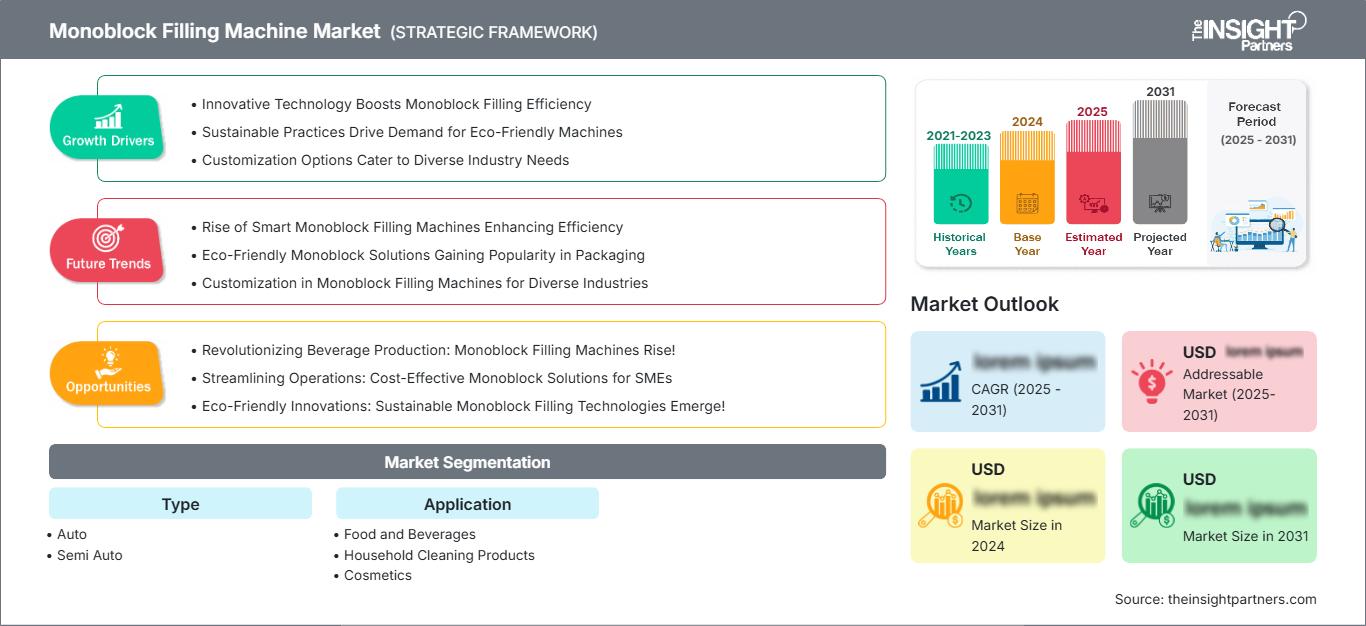
Monoblock Filling Machine Market: Strategic Insights
Regional Insights
North America Monoblock Filling Machine Market
North America held 31–34% share in 2025, making it one of the largest regional bases for the share. The region is expected to grow at a 4.7–5.2% CAGR during 2026–2034, supported by beverage diversification, pharmaceutical fill-finish investment, and replacement of aging fillers with validated automated systems. Demand is strongest in facilities that require compact, cleanable equipment for multiple package formats. Food safety compliance, FDA-aligned documentation, and high labor costs support automation decisions. Canada and Mexico contribute through beverage, nutraceutical, and contract manufacturing capacity, while US machinery suppliers strengthen service availability, spare parts support, and retrofit adoption across installed production lines.
U.S. Monoblock Filling Machine Market
The USA had 76-79% share of the North America market in 2025 and is expected to grow at a 4.8-5.3% CAGR up to 2034. Applications for the machines include pharma fluids, specialty beverages, cosmetics, and consumer goods filling in which consistent dosage, ease of changeovers, and closure control are required. Company presence matters since potential customers typically have application testing prior to capital expenditure approval. Some domestic companies such as Cozzoli Machine Company, Filamatic, Inline Filling Systems, LLC, and Frain Industries assist with the needs for engineering, machinery, and after-sales services. The best applications are found in sterile or sanitary fluid lines, premium beverages, and contract packagers that change formats frequently.
Europe Monoblock Filling Machine Market
Share in Europe is accounted for 26–29% in 2025, with CAGR at a 4.3–4.8% between 2026 and 2034. Germany accounts for the highest regional penetration in engineering excellence, pharmaceuticals, and hygienic packaging standards. Italy continues to be significant in machinery design, while the United Kingdom and France contribute to demand through beverages, cosmetics, and healthcare packaging. United Kingdom is a preferred market for craft beverages, personal care, and pharmaceutical contract manufacturing companies that need monoblocks to save on space and labor cost. Germany requires machines due to automation quality, validation and export production plants that require machinery which is durable and has reliable filling accuracy and control. France, Italy, and Spain have varied requirements for cosmetics, food condiments, wines, spirits, and household goods. Machines clusters of Italy cater for regional demands, while flexible filling machines used by cosmetics manufacturers in France are needed to accommodate different packaging needs. Food and beverage industry in Spain offers demands for semi-automatic and automatic machines.
APAC Monoblock Filling Machine Market
APAC region had a market share of 28–31% in 2025 and is expected to grow at a compound annual growth rate of 5.8–6.4%. China leads the regional market, followed by Japan, South Korea, India, and Australia as players develop packaging solutions for drinks, personal care products, generics, and electronics-based liquids. Industrial policies, exports, and increasing quality requirements have sped up the replacement process. The pharmaceuticals and cosmetic production industry of India fuels high demand growth, while Japan and South Korea focus on accuracy, space-saving designs, and cleanliness. Australia’s contribution is made through food and beverage and nutraceutical production requiring medium-speed automation.
Middle East & Africa Monoblock Filling Machine Market
MEA & Africa region is projected to have CAGR growth of 4.6-5.1% between 2026 and 2034, with Saudi Arabia as the main investor. The demand from UAE, South Africa, and Rest of MEA markets is associated with the beverage bottle filling, home care products, cosmetics, and pharmaceuticals packaging industries. Diversification of energy-related industries, food security initiatives, and infrastructure developments are driving the packaged goods industry. While customers from Saudi Arabia and UAE seek to have efficient imported machines with local services, the South African market for food and personal care products is driving demand for semi-automatic and automatic machines.
Segmentation Analysis
Type
Type segmentation defines the Monoblock Filling Machine Market scope by automation level, capital intensity, and production environment. The segment is expected to grow at a 5.0–5.5% CAGR during 2026–2034. Automatic systems dominate high-volume and regulated plants, while semi auto systems remain relevant for smaller batches, seasonal production, and manufacturers that need flexibility before full automation.
- Auto machines hold the strongest position because they integrate filling, capping, and control functions for high throughput, consistent dosing, lower labor dependency, and stronger validation across sanitary applications.
- Semi Auto machines serve emerging producers, pilot lines, and specialty batches where lower capital cost, manual flexibility, and easier maintenance outweigh the need for continuous high-speed production.
Application
Application segmentation is projected to grow at a 5.2–5.7% CAGR during 2026–2034, reflecting diverse filling needs across consumables, regulated products, and industrial fluids. Food and beverages generate broad installed demand, pharmaceuticals show the strongest quality-driven momentum, and cosmetics, household cleaning products, and electronics require accuracy, hygiene, and packaging flexibility.
- Food and Beverages remains the largest application base as producers fill juices, sauces, dairy alternatives, condiments, and functional drinks while seeking consistent closure integrity and reduced product giveaway.
- Household Cleaning Products demand is supported by detergents, disinfectants, sprays, and concentrated cleaners that require corrosion-resistant contact parts, safe handling, and reliable filling of foaming or viscous liquids.
- Cosmetics adoption is shaped by premium packaging, smaller batch runs, and varied viscosities across lotions, serums, gels, and oils, making flexible changeover and clean filling essential.
- Pharmaceutical applications prioritize validated dosing, sterile or cleanroom-compatible designs, and documentation, making monoblock systems valuable for liquid medicines, vials, suspensions, and specialty healthcare products.
- Electronics uses are narrower but strategically important for solvents, adhesives, conductive fluids, and specialty chemicals where precision filling and contamination control influence product reliability.
Opportunity Snapshot
| Application | Revenue Contribution | Trend Tag | Adoption Stage |
| Food and Beverages | High | Functional Drinks | Mature |
| Household Cleaning Products | Medium | Concentrate Packs | Scaling |
| Cosmetics | Medium | Premium Serums | Scaling |
| Pharmaceutical | High | Sterile Dosing | Scaling |
| Electronics | Low | Precision Fluids | Emerging |
Monoblock Filling Machine Market Growth Drivers and Impact Analysis
Automation Pressure in High-Mix Packaging Lines
Flavor, formulation, and pack size variations from brands are contributing to increased risk of downtime on conventional separate filling and capping machines. This is where monoblocks come in handy because they place all synchronized operations on one platform. It will be easier to see this effect in medium-sized food, beverages, cosmetic, and consumer products factories, where changeovers are common and can result in reduced profitability. Automatic systems, with recipes stored in the system memory, servo adjustments, and quick-change parts without tools, will allow for stabilization of throughput and less reliance on specialized manpower.
Regulated Filling Requirements Across Healthcare and Food
The demands for documentation, cleanability, and process control are growing among drug, nutritional, and food companies. Monoblocks address such needs through their design that provides dose, cap application, and ready for control points within one small and validated system. In pharmaceutical applications, the significance of monoblocks resides in precise fill volumes, minimized contact with contaminants, and suitability for clean room/barrier systems. In food and beverage manufacturing plants, stainless steel construction and controlled flow of the product eliminate potential product recalls. From a business perspective, there is a greater need to justify investment in equipment with audit compliance features.
Floor-Space Optimization and Total Cost Focus
Many manufacturers operate within constrained production buildings where adding separate machines can require costly layout changes. Monoblock filling platforms reduce equipment footprint by combining several operations, which can lower conveyor length, utility requirements, and operator stations. The effect is particularly important for contract packagers, urban plants, and smaller pharmaceutical or cosmetics facilities. Buyers increasingly compare lifecycle economics, including downtime, cleaning time, spare parts, and training. A compact system that improves line balance and reduces manual handling can provide measurable savings even when upfront capital cost exceeds a basic standalone filler.
Monoblock Filling Machine Market Future Trends
Connected Monoblocks with Predictive Service
Monoblock Filling Machine Market trends are moving toward connected platforms that monitor fill accuracy, torque, stoppages, pump health, and changeover conditions in real time. Future systems will increasingly use secure dashboards, predictive maintenance alerts, and machine-learning-assisted fault detection to reduce unplanned downtime. This is especially relevant for contract manufacturers that run multiple formulations and need evidence-based service planning. Suppliers that combine mechanical reliability with digital diagnostics will gain advantage because customers will expect performance transparency, remote support, and documented production data as standard purchasing criteria rather than optional upgrades.
Flexible Aseptic and Low-Volume Production
Future demand will increasingly come from biologics, specialty pharmaceuticals, premium cosmetics, and niche beverages that require smaller batches with high quality assurance. This will shift equipment design toward modular filling paths, disposable contact components, isolator compatibility, and faster format conversion. Rather than maximizing speed alone, customers will value systems that support safe product introduction, clinical-scale production, and commercial ramp-up on the same platform. The trend favors suppliers able to engineer compact aseptic or ultra-clean configurations with validation support and scalable automation architecture.
Monoblock Filling Machine Market Opportunities
Localized Pharmaceutical Fill-Finish Capacity
Governments and private manufacturers are expanding regional pharmaceutical supply resilience, creating a clear opportunity for monoblock suppliers with sterile and cleanroom-compatible platforms. Investment is strongest where generic medicines, vaccines, ophthalmics, and liquid formulations are being localized. Equipment providers can capture this opportunity by offering validation packages, documentation support, and flexible machines suitable for multiple container formats. Service networks will matter as much as machine capability because pharmaceutical buyers need qualification support, rapid spare parts access, and lifecycle maintenance. Suppliers that combine compliance expertise with regional execution can win capital projects tied to health-system security.
Specialty Liquids for Premium Consumer Products
Premium beverages, cosmetics, and household concentrates create an opportunity for systems that handle viscosity, foaming, particulates, fragrance sensitivity, and smaller package formats. These applications often carry higher product value, making fill accuracy and giveaway reduction commercially important. Equipment suppliers can differentiate through application testing, customized nozzles, gentle product handling, and fast cleaning. The opportunity is strongest among brands moving from semi-manual production to repeatable automation without installing very large lines. Partnerships with packaging converters and contract manufacturers can also accelerate adoption by matching container design with filling performance early in product development.
Recent Developments
- July 2025: Rejves Machinery S.r.l. showcase a monoblock dedicated to packaging liquid products such as nail polish, perfume, detergent, or cream at Fachpack 2025. This machine is characterized by its high flexibility, guaranteed in both the filling and capping sections, as well as the ability to dose both viscous and foamy products, using various technologies such as syringes, mass dosers, flow meters, or peristaltic pumps.
- May 2025: Shanghai Npack announced its participation in ProPak China 2025—Asia’s premier processing and packaging exhibition. At the National Exhibition and Convention Center (Shanghai), the company showcased its cutting-edge technology such as Liquid Filling Machine, Monoblock Filling Machine, Powder Filling Machine, and other machines at Booth 61A05 designed to revolutionize production line.
- October 2024: Rejves Machinery S.r.l. showcasing the new indexing Monobloc denominated JAM42 at the forthcoming Pack Expo 2024 in Chicago (USA). The machine takes advantage of the wide flexibility that can be provided on both the filling and the capping sections.
Frequently Asked Questions

- Comprehensive Market Sizing and Forecast Analysis
- Detailed Segmentation Analysis
- In-Depth Market Dynamics Assessment
- Regional and Country-Level Insights
- Competitive Landscape and Company Benchmarking
- Strategic Business Intelligence
Recent Reports
Testimonials

The Insight Partners provided valuable market intelligence that supported our global go-to-market strategy. Their team was professional, responsive, and attentive to our feedback, providing thoughtful analysis and helpful methodological clarifications throughout the project.
Junmo Kim Chief Financial Officer (CFO), Enertech Co., Ltd.
The Insight Partners' SCADA System Market report is comprehensive, with valuable insights on current trends and future forecasts. The team was highly professional, responsive, and supportive throughout. We are very satisfied and highly recommend their services.
RAN KEDEM Partner, Reali Technologies LTDs
I requested a report on a very specific software market and the team produced the report in a few days. The information was very relevant and well presented. I then requested some changes and additions to the report. The team was again very responsive and I got the final report in less than a week.
JEAN-HERVE JENN Chairman, Future Analytica
We worked with The Insight Partners for an important market study and forecast. They gave us clear insights into opportunities and risks, which helped shape our plans. Their research was easy to use and based on solid data. It helped us make smart, confident decisions. We highly recommend them.
PIYUSH NAGPAL Sr. Vice President, High Beam Global
The Insight Partners delivered insightful, well-structured market research with strong domain expertise. Their team was professional and responsive throughout. The user-friendly website made accessing industry reports seamless. We highly recommend them for reliable, high-quality research services
YUKIHIKO ADACHI CEO, Deep Blue, LLC.
This is the first time I have purchased a market report from The Insight Partners.While I was unsure at first, I visited their web site and felt more comfortable to take the risk and purchase a market report.I am completely satisfied with the quality of the report and customer service. I had several questions and comments with the initial report, but after a couple of dialogs over email with their analyst I believe I have a report that I can use as input to our strategic planning process.Thank you so much for taking the extra time and making this a positive experience.I will definitely recommend your service to others and you will be my first call when we need further market data.
JOHN SUZUKI President and Chief Executive Officer, Board Director, BK Technologies
I wish to appreciate your support and the professionalism you displayed in the course of attending to my request for information regarding to infectious disease IVD market in Nigeria. I appreciate your patience, your guidance, and the fact that you were willing to offer a discount, which eventually made it possible for us to close a deal. I look forward to engaging The Insight Partners in the future, all thanks to the impression you have created in me as a result of this first encounter.
DR CHIJIOKE ONYIA MANAGING DIRECTOR, PineCrest Healthcare Ltd.Reason to Buy
- Informed Decision-Making
- Understanding Market Dynamics
- Competitive Analysis
- Identifying Emerging Markets
- Customer Insights
- Market Forecasts
- Risk Mitigation
- Boosting Operational Efficiency
- Strategic Planning
- Investment Justification
- Tracking Industry Innovations
- Aligning with Regulatory Trends





 Get Free Sample for