
Offshore Mooring Systems Market Trends, Share & Demand by 2034
Coverage: by Mooring Type (Catenary, Taut, Semi-taut, Spread, Single Point, Dynamic Positioning); Anchorage (Drag Embedment Anchors, Suction Anchors, Vertical Load Anchors); Application (Floating Production, Storage and Offloading Vessels, Floating Drilling, Production, Storage and Offloading Vessels, Floating Liquefied Natural Gas Vessels, Tension Leg Platform, Semi-Submersibles, Spar Platforms); and Geography (North America, Europe, Asia Pacific, and South and Central America)
- Status : Data Released
- Report Code : TIPTE100000105
- Category : Manufacturing and Construction
- No. of Pages : 150
- Available Report Formats :


- Last update date : July 30, 2026


2025 Market Size
US$ 2.76 Bn
Base year value
2034 Forecast
US$ 5.73 Bn
Projected by 2034
CAGR 2026-2034
8.44 %
Growth rate
Addressable Market
US$ 38.07 Bn
(2026-2034)
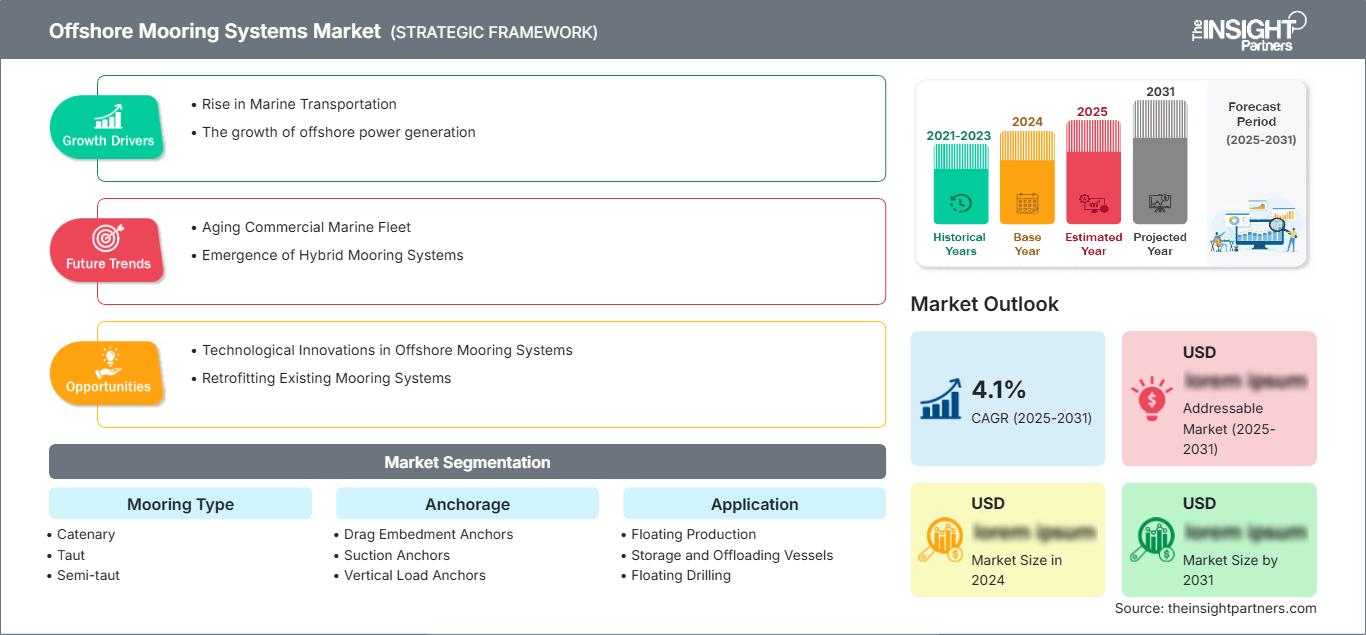
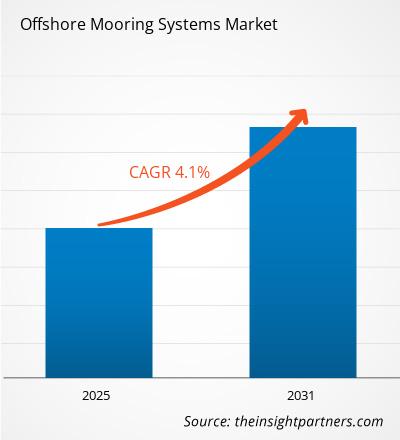
The Offshore Mooring Systems Market was worth US$ 2.76 Billion in 2025 and will be around US$ 5.73 Billion in 2034, growing at a CAGR of 8.44% between 2026 and 2034. The market is driven by deep-water oil & gas production, floating infrastructure for natural gas, and the increasing need for station-keeping of assets operating in harsh environment locations. The market is expected to continue to be technically intense, with each mooring system having to consider seabed conditions, vessel dynamics, loads, installation risks, and integrity management needs.
North America continues to be a technically mature demand center with growth in the region estimated to be between 7.6% and 8.1% till 2034. Regional Offshore Mooring Systems Market size growth drivers include subsea tie-back projects, deep water activities in the Gulf of Mexico, and life extension projects for floating production systems.
Offshore Mooring Systems Market Assessment and Insights
- North America accounted for 25%–28% share in 2025 and is growing at a CAGR of 7.6%–8.1% between 2026–2034, supported by Gulf of Mexico redevelopments, subsea tiebacks, and brownfield floating production upgrades.
- US represented 78%–82% of North America in 2025 and is expanding at 7.7%–8.2% CAGR, led by deepwater project sanctioning and offshore service capacity.
- Europe held 21%–24% share in 2025 and is advancing at 7.9%–8.4% CAGR, with the UK, Norway, Germany, and France driving offshore wind-linked mooring innovation.
- Asia Pacific captured 31%–35% share in 2025 and is growing at 8.8%–9.4% CAGR, led by China, South Korea, Japan, India, and Australia across FPSO and floating energy projects.
- Largest Segment Floating Production, Storage and Offloading Vessels held 34%–38% market share in 2025 and is growing at 8.1%–8.6% CAGR, reflecting long-cycle deepwater production demand.
- High Growth Segment Floating Liquefied Natural Gas Vessels held 10%–13% market share in 2025 and is growing at 9.2%–9.8% CAGR as gas monetization projects accelerate.
- Key companies analyzed in detail: Offspring International Limited, Mampaey Offshore Industries B.V., Lamprell Energy Limited, Advanced Production and Loading AS, Balltec Limited, HR Services & Equipment Inc., Scana Industrier ASA, MODEC, Inc., De Haan Musselkanaal B.V., Rigzone Mooring Systems, Delmar Systems, Inc., Balmoral Group Holdings Ltd, BW Offshore Limited, Single Point Mooring Systems, Blue Water Energy Services B.V.
Source: The Insight Partners' analysis based on proprietary research, government publications, company annual reports, investor presentations, industry databases, and expert interviews.
The technology trend has shifted from the traditional heavy chain design towards hybrid designs featuring polyester ropes, suction anchors, load monitoring, among others. Floating production facilities continue to provide the bulk of revenues, but the specification of projects will increasingly take into consideration fatigue life, seabed impact, disconnect capability during storms, and inspection. This means that future procurement in this industry will shift from parts procurement to more holistic engineering, installation, and integrity agreements.
In the long-term, offshore activity will extend into new basins such as Guyana, Mozambique, Brazil, India, and certain areas of Asia involving floating wind farms. The focus on safety and environmental protection of assets has increased the need for qualified anchors, traceable loads, and predictive monitoring. This means that the market can look forward to sustained oil and gas activity and the commercialization of renewable floating infrastructure.
Offshore Mooring Systems Market Report Scope
| Report Attribute | Details |
|---|---|
| Market size in 2025 | US$ 2.76 Billion |
| Market Size by 2034 | US$ 5.73 Billion |
| Global CAGR (2026 - 2034) | 8.44% |
| Historical Data | 2021-2024 |
| Forecast period | 2026-2034 |
Offshore Mooring Systems Market Analysis
Growth in Offshore Mooring Systems is spurred on by deep reservoirs, complex floating production facilities, and the increased use of lease-floaters, which have the need for reliable station keeping during their lifetimes. The growing number of FLNG and FPSO projects in which downtime, heading stability, and offloading opportunities determine the economics of the project.
Value chain participants include naval architecture firms, anchor manufacturers, chain and wire suppliers, installers, class societies, and asset integrity experts. Pricing continues to be affected by the cost of steel, offshore ship availability, manufacturing capabilities, and engineering cycles unique to each project. Customers are increasingly focusing on lifecycle cost.
Engineering credibility, installed base, and multi-region execution capabilities define competitive positioning within the Offshore Mooring Systems Market report. Competitive advantage is possessed by MODEC, Inc. and BW Offshore Limited owing to their competence in integrated floating production systems. However, Delmar Systems, Inc., Mampaey Offshore Industries B.V., Balltec Limited, and Advanced Production and Loading AS provide specialist expertise in mooring and loading.
Financial investments will flow to systems with high digital condition monitoring, anti-corrosion materials, synthetic mooring lines, and rapid hook-up. Lamprell Energy Limited, Balmoral Group Holdings Ltd and Offspring International Limited offer advantages related to fabrication, buoyancy, and engineering services. Small companies have competitive advantage in providing reliability statistics, field services, and qualified product lines.
● REPORT CUSTOMIZATION
Tailor This Report To Align With Your Specific Business Requirements
This report can be customized to align precisely with your business objectives, scope, and target markets. Customization options include tailored segmentation, geography, competitive analysis, and strategic insights to support informed decision-making.
Customize This Report →WHAT YOU CAN ADJUST
- ● Segmentations
- ● Geography
- ● Competitive Analysis
- ● Language Preferences
Offshore Mooring Systems Market: Strategic Insights
Regional Insights
North America Offshore Mooring Systems Market
North America’s market share is expected to hold a percentage of 25%–28% of the global market in 2025 and the Offshore Mooring Systems Market share has been dominated by the Gulf of Mexico deep water production, installation of mooring systems on floating facilities and advanced hurricane resistant mooring system design.
The regional market share growth rate is projected to grow at a CAGR of 7.6%–8.1% between 2026 and 2034. The major drivers for this include the requirement for permanent mooring systems for FPSOs, semi-submersible and drilling floating facilities; however, there are also emerging applications in replacement and inspection.
U.S. Offshore Mooring Systems Market
The U.S. accounts for 78%-82% of North America in 2025 and is estimated to witness growth at CAGR 7.7%-8.2% up to 2034. Major demand includes Gulf of Mexico installations that need reliability in anchoring systems, turret mating, riser mating, and storm protection.
The market presence of the companies is high in the areas of engineering, installation, and services with leading companies such as Delmar Systems, Inc. and HR Services & Equipment Inc. providing critical services for offshore operations. The application preferences include Floating Production, Drilling Support, and Mooring Replacement services.
Europe Offshore Mooring Systems Market
The Europe region accounted for 21%-24% share in 2025 and is anticipated to grow at 7.9%-8.4% CAGR, driven by the UK and Norway. The North Sea brownfield developments, floating wind demonstrator projects, and rigorous marine safety regulations are driving the requirement for engineered mooring solutions.
In the UK, there is focus on floating wind demonstrators, FPSO integrity, and harsh environment engineering, while in Germany, it is from offshore equipment manufacturers and engineering driven by certification. In France, Italy, and Spain, there is demand support through shipbuilding, marine equipment, and Mediterranean energy infrastructure.
APAC Offshore Mooring Systems Market
APAC holds a market share of 31%–35% in 2025 and is expected to register CAGR of 8.8%–9.4%. China drives regional demand by way of offshore energy production and fabrication capabilities, whereas South Korea and Japan drive floater construction and engineering activities of high specification.
India and Australia are becoming significant demand regions owing to offshore gas, subsea development, and energy security considerations. Growing policy support for shipbuilding capabilities within the region and offshore renewable energy is leading to rising demand for fatigue-resistant installations.
Middle East & Africa Offshore Mooring Systems Market
Middle East & Africa is forecast to grow at 8.4%–9.0% CAGR, led by Saudi Arabia, the UAE, Mozambique, and South Africa. Gas monetization, FLNG development, and offshore loading infrastructure are central to regional demand formation.
Mozambique is particularly important for FLNG-linked turret mooring, while the Gulf states emphasize export infrastructure resilience and terminal reliability. South Africa and the Rest of MEA contribute through offshore exploration, port infrastructure, and selective floating production opportunities.
Segmentation Analysis
Mooring Type
Mooring Type is expected to grow at 8.0%–8.6% CAGR during 2026–2034. The Offshore Mooring Systems Market scope across this segment is shaped by water depth, vessel motion, riser configuration, seabed profile, and disconnect requirements. Operators increasingly combine proven catenary systems with taut or semi-taut designs where weight reduction, footprint control, and fatigue performance are critical.
- Catenary systems remain widely used in conventional floating production because they offer operational familiarity, robust holding performance, and suitability for shallow to medium water depths.
- Taut systems are gaining adoption in deepwater projects where reduced seabed footprint, lower line weight, and improved positional control support complex subsea layouts.
- Semi-taut configurations balance flexibility and stiffness, making them attractive for mixed-depth developments requiring better motion control without fully rigid mooring behavior.
- Spread mooring supports FPSOs and semi-submersibles where directional stability, multiple anchor points, and predictable load sharing are required for long-term operations.
- Single Point mooring enables weathervaning and efficient offloading, particularly for FPSOs and FLNG assets operating in changing current, wind, and wave conditions.
- Dynamic Positioning supports station-keeping for drilling and installation vessels, often complementing mooring systems when temporary positioning, mobility, and operational flexibility are priorities.
Anchorage
Anchorage is projected to expand at 8.2%–8.8% CAGR during 2026–2034 as offshore assets move into deeper and more variable seabed environments. Selection depends on geotechnical data, uplift loads, installation vessel availability, and retrieval strategy. The segment is increasingly influenced by suction anchor adoption in deepwater projects and vertical load anchor use where high holding capacity is required.
- Drag Embedment Anchors remain cost-effective for suitable soils and conventional spreads, offering proven holding capacity where installation tolerances and seabed conditions are well understood.
- Suction Anchors are preferred in deepwater and ultra-deepwater applications because they provide high vertical and lateral resistance with controlled installation and lower seabed disturbance.
- Vertical Load Anchors address projects with high uplift forces, compact footprints, and demanding load paths, especially where taut mooring or polyester rope systems are specified.
Application
Application is forecast to grow at 8.4%–9.0% CAGR during 2026–2034, with floating production assets generating the largest revenue contribution. Demand is linked to field development economics, gas monetization, and platform motion limits. The market continues to see application-specific engineering, especially for FPSOs, FLNG units, semi-submersibles, and spar platforms operating under severe metocean conditions.
- Floating Production, Storage and Offloading Vessels dominate demand because deepwater oil developments rely on long-life station-keeping, safe offloading, and integrated turret or spread mooring architectures.
- Floating Drilling, Production, Storage and Offloading Vessels require flexible mooring packages that support drilling, production, and storage functions while maintaining operational safety under variable offshore conditions.
- Floating Liquefied Natural Gas Vessels are strategically important as offshore gas projects require weathervaning, high uptime, and resilient turret systems for liquefaction and export operations.
- Tension Leg Platform applications depend on high-tension mooring elements that limit vertical motion, supporting production in deeper waters where fixed platforms are uneconomical.
- Semi-Submersibles use mooring systems to maintain stable drilling or production positions, especially in harsh environments where motion response and fatigue performance influence availability.
- Spar Platforms require deep-draft stability and specialized mooring layouts, making them relevant for ultra-deepwater developments with long service lives and complex riser systems.
Opportunity Snapshot
| Application | Revenue Contribution | Trend Tag | Adoption Stage |
| Floating Production, Storage and Offloading Vessels | High | Deepwater FPSO | Mature |
| Floating Drilling, Production, Storage and Offloading Vessels | Medium | Rig Flexibility | Scaling |
| Floating Liquefied Natural Gas Vessels | High | Gas Monetization | Scaling |
| Tension Leg Platform | Medium | Motion Control | Mature |
| Semi-Submersibles | Medium | Harshwater Stability | Mature |
| Spar Platforms | Low | Ultra-deepwater | Scaling |
Offshore Mooring Systems Market Growth Drivers and Impact Analysis
Deepwater production expansion increases station-keeping complexity
Deep-water oil & gas developments need mooring solutions that have the capacity to withstand high cyclical stresses, high offsets, and varied seabed types. With the discovery of reservoirs where a fixed structure is no longer economic, floating structures emerge as the choice for development. This drives the need for engineering-based mooring solutions and not commodity products. Its effect is felt through the rise in usage of suction anchors, polyester cables, fatigue studies, and integrated installation plans. In Offshore Mooring Systems Market, deep-water developments mean higher project values due to the incorporation of design assurance, testing, classification, and long-term inspections in procurement processes.
Floating gas infrastructure creates higher specification demand
FLNG plants and floating storage need secure weathervaning capabilities, uninterrupted production capability, and robust fluid transfer interfaces. Failure of mooring in such assets may lead to interruption in processes such as liquefaction, storage, and export, which makes reliability of utmost importance in project economics. Gas exploration in Africa, Asia, and Eastern Mediterranean is leading to increased demand for turret systems, high capacity anchors, and integrity management systems in real-time. This trend adds to the addressable market value as equipment choice depends on operation integrity and risk management. Increased engineering intensity favors Offshore Mooring Systems Market due to distant location of gas export projects.
Lifecycle integrity requirements reshape procurement decisions
Operators are extending the operating lives of FPSOs, semi-submersibles, and offshore loading assets, which increases the importance of inspection, replacement planning, and condition-based maintenance. Mooring systems are no longer assessed only at installation; they are evaluated across fatigue accumulation, corrosion, chain wear, line tension, and environmental exposure. This creates demand for sensors, inspection services, and engineered replacement scopes. The Offshore Mooring Systems Market gains from recurring service revenue as asset owners prioritize availability and regulatory compliance. Suppliers able to connect equipment, data, and offshore intervention capability are better positioned for long-term contracts.
Offshore Mooring Systems Market Future Trends
Digital mooring integrity becomes a standard specification
Offshore Mooring Systems Market trends point toward embedded monitoring as a standard feature rather than an optional upgrade. Future projects will increasingly specify line tension sensors, corrosion monitoring, digital twins, and analytics that connect metocean data with fatigue models. This shift will reduce uncertainty in inspection planning and improve decision-making during storms, offloading, and life-extension reviews. The commercial effect will be a higher share of service-led revenue, with suppliers offering data interpretation, alerts, and maintenance planning. As insurers and regulators demand stronger evidence of integrity, monitored mooring systems will become a competitive requirement for critical floating assets.
Hybrid materials support lighter and deeper systems
Hybrid mooring designs combining chain, wire, polyester, and advanced connectors will gain relevance as operators move into deeper water and floating renewable pilots. Weight reduction improves installation efficiency and reduces load on floating structures, while corrosion-resistant materials can lower long-term intervention needs. The trend will encourage closer collaboration between rope manufacturers, anchor specialists, and installation contractors during front-end engineering. Adoption will be strongest where water depth, seabed footprint, and fatigue exposure make conventional chain-heavy systems less attractive. Over time, validated field performance will determine which hybrid configurations become bankable for commercial-scale offshore projects.
Offshore Mooring Systems Market Opportunities
FLNG project pipelines open specialist turret opportunities
Offshore Mooring Systems Market Forecasts indicate that FLNG-linked mooring packages will offer attractive opportunities for suppliers with proven turret, swivel, and fluid transfer experience. Investors should prioritize projects where gas resources are stranded, pipeline economics are weak, and floating liquefaction offers faster monetization. These projects require early engineering engagement because mooring design affects hull integration, operability, and export reliability. Companies that can provide modular turret engineering, risk simulation, and local execution support can capture higher-value scopes. The opportunity is strongest in Mozambique, Asia Pacific, and selected Middle East gas developments where offshore gas infrastructure is being scaled.
Integrity services create recurring aftermarket revenue
Aftermarket services represent a practical expansion path because many floating assets are operating beyond initial design assumptions or entering life-extension programs. Providers can build recurring revenue through inspection, chain replacement, line tension verification, anchor assessment, and digital monitoring upgrades. The opportunity is commercially attractive because intervention decisions are tied to asset uptime, insurance acceptance, and regulatory approval rather than discretionary spending. Service providers that combine offshore crews, engineering analysis, and replacement hardware can reduce downtime for operators. This creates a defensible business model in mature basins such as North America, the North Sea, Brazil, and parts of Asia.
Recent Developments
- June 2026: MODEC, Inc. announced it would supply a SOFEC internal turret mooring system for the Coral Norte FLNG project offshore Mozambique, supporting a 3.6 MTPA liquefaction development with first LNG targeted for 2028.
- February 2026: Intermoor, an Acteon company received a Petrobras contract for stack-up mooring system services in Brazil, supporting light-workover interventions and abandonment operations on installed offshore wells.
- November 2025: MODEC, Inc. announced the formal integration of SOFEC into a dedicated Mooring Solutions Business Unit, strengthening delivery of permanent mooring systems and fluid transfer technologies for FPSO and FSO projects.
Frequently Asked Questions

- Comprehensive Market Sizing and Forecast Analysis
- Detailed Segmentation Analysis
- In-Depth Market Dynamics Assessment
- Regional and Country-Level Insights
- Competitive Landscape and Company Benchmarking
- Strategic Business Intelligence
Recent Reports
Testimonials

The Insight Partners' SCADA System Market report is comprehensive, with valuable insights on current trends and future forecasts. The team was highly professional, responsive, and supportive throughout. We are very satisfied and highly recommend their services.
RAN KEDEM Partner, Reali Technologies LTDs
I requested a report on a very specific software market and the team produced the report in a few days. The information was very relevant and well presented. I then requested some changes and additions to the report. The team was again very responsive and I got the final report in less than a week.
JEAN-HERVE JENN Chairman, Future Analytica
We worked with The Insight Partners for an important market study and forecast. They gave us clear insights into opportunities and risks, which helped shape our plans. Their research was easy to use and based on solid data. It helped us make smart, confident decisions. We highly recommend them.
PIYUSH NAGPAL Sr. Vice President, High Beam Global
The Insight Partners delivered insightful, well-structured market research with strong domain expertise. Their team was professional and responsive throughout. The user-friendly website made accessing industry reports seamless. We highly recommend them for reliable, high-quality research services
YUKIHIKO ADACHI CEO, Deep Blue, LLC.
This is the first time I have purchased a market report from The Insight Partners.While I was unsure at first, I visited their web site and felt more comfortable to take the risk and purchase a market report.I am completely satisfied with the quality of the report and customer service. I had several questions and comments with the initial report, but after a couple of dialogs over email with their analyst I believe I have a report that I can use as input to our strategic planning process.Thank you so much for taking the extra time and making this a positive experience.I will definitely recommend your service to others and you will be my first call when we need further market data.
JOHN SUZUKI President and Chief Executive Officer, Board Director, BK Technologies
I wish to appreciate your support and the professionalism you displayed in the course of attending to my request for information regarding to infectious disease IVD market in Nigeria. I appreciate your patience, your guidance, and the fact that you were willing to offer a discount, which eventually made it possible for us to close a deal. I look forward to engaging The Insight Partners in the future, all thanks to the impression you have created in me as a result of this first encounter.
DR CHIJIOKE ONYIA MANAGING DIRECTOR, PineCrest Healthcare Ltd.Reason to Buy
- Informed Decision-Making
- Understanding Market Dynamics
- Competitive Analysis
- Identifying Emerging Markets
- Customer Insights
- Market Forecasts
- Risk Mitigation
- Boosting Operational Efficiency
- Strategic Planning
- Investment Justification
- Tracking Industry Innovations
- Aligning with Regulatory Trends





 Get Free Sample for