
Pulp Molding Machine Market Trends, Size & Growth by 2034
Coverage: By Type (Automatic, Semi-Automatic, Manual); Product Type (Rotary, Reciprocating); Application (Trays, End Caps, Bowls and Cups, Clamshells, Plates, Others); End-user (Food and Beverage, Consumer Goods, Cosmetic and Personal Care, Healthcare, Others) , and Geography (North America, Europe, Asia Pacific, and South and Central America)
- Status : Data Released
- Report Code : TIPRE00013829
- Category : Manufacturing and Construction
- No. of Pages : 150
- Available Report Formats :


- Last update date : September 07, 2026


2025 Market Size
US$ 933.67 Mn
Base year value
2034 Forecast
US$ 1,372.39 Mn
Projected by 2034
CAGR 2026-2034
4.37 %
Growth rate
Addressable Market
US$ 10,470.31 Mn
(2026-2034)
The pulp molding machine market stood at US$ 933.67 Million in 2025 and is projected to reach US$ 1372.39 Million by 2034, registering a CAGR of 4.37% during 2026–2034. Expansion is supported by rising demand for fiber-based packaging, automation of forming and drying processes, and broader substitution of plastic formats. Equipment suppliers are increasingly integrating energy controls, faster mold changes, and precision handling into production lines.
North American adoption is expected to advance at an estimated 4.6–5.1% CAGR between 2026 and 2034. The pulp molding machine market size opportunity is supported by food-service packaging conversion, retailer pressure on plastic use, and investments in domestic converting capacity. Demand is also influenced by food-contact requirements and growing interest in fiber formats designed for established recycling systems.
Pulp Molding Machine Market Assessment and Insights
- North America: North America is estimated to represent a 29–33% share in 2025 and is expected to grow at a 4.6–5.1% CAGR between 2026–2034, supported by food-service conversion, domestic packaging capacity, and fiber-based protective formats.
- US: The US is estimated to account for 78–82% of North America's 2025 value and is projected to grow at a 4.7–5.2% CAGR between 2026–2034, led by food packaging and retail applications.
- Europe: Europe is estimated at a 25–29% share in 2025, with a 4.4–4.9% CAGR between 2026–2034. Germany, the UK, France, Italy, and Spain are important markets as packaging recyclability and material-efficiency requirements strengthen.
- Asia Pacific: Asia Pacific is estimated to hold a 31–35% share in 2025 and expand at a 5.1–5.7% CAGR between 2026–2034. China, India, Japan, South Korea, and Australia provide diverse equipment demand across foodservice, consumer goods, and industrial packaging.
- Largest Segment: Automatic machines are estimated to hold a 55–60% market share in 2025 and are expected to grow at a 4.8–5.4% CAGR between 2026–2034 as producers prioritize throughput and consistency.
- High Growth Segment: Healthcare applications are estimated at a 10–14% market share in 2025 and are projected to expand at a 5.6–6.3% CAGR between 2026–2034, supported by sterile and protective fiber formats.
- Key companies analyzed in detail: Beston (Henan) Machinery Co., Ltd.; Parason Machinery; SODALTECH; Guangzhou Nanya Pulp Molding Equipment Co., Ltd.; HGHY Pulp Molding Pack Co., Ltd.; Inmaco Solutions B.V.; Pulp Moulding Dies Inc.; Southern Pulp Machinery (Pty) Ltd; Taiwan Pulp Molding Co., Ltd.; ZH Moulded Pulp Co., Ltd.
Source: The Insight Partners' analysis based on proprietary research, government publications, company annual reports, investor presentations, industry databases, and expert interviews.
The development of equipment is moving away from basic forming machines towards full lines that incorporate pulping, vacuum forming, hot pressing, drying, trimming, and automatic conveyance. The rotary type is becoming more common in dealing with high volume, while reciprocating machines are still useful in flexible and moderate volume production. Machine manufacturers are developing mold-changing systems, PLC controls, robots, and energy management to minimize variation, dependency on labor, and production loss in packaging.
In the future, the areas for capital expenditure will be the automated lines with the capability of handling different raw fibers as well as forming complex shapes. There will also be a new manufacturing base in South and Southeast Asia, which will be favored by packaging localization and modern equipment. The coming into effect of the Packaging and Packaging Waste Regulation in Europe from August 2026 is also a factor.
Pulp Molding Machine Market Report Scope
| Report Attribute | Details |
|---|---|
| Market size in 2025 | US$ 933.67 Million |
| Market Size by 2034 | US$ 1,372.39 Million |
| Global CAGR (2026 - 2034) | 4.37% |
| Historical Data | 2021-2024 |
| Forecast period | 2026-2034 |
Pulp Molding Machine Market Analysis
The pulp molding machine market growth is linked to the conversion of recycled paper, agricultural fibers, and virgin pulp into protective or food-contact formats. The value chain spans fiber preparation, stock conditioning, forming, dewatering, drying, hot pressing, trimming, mold production, and packaging. Equipment suppliers, therefore, compete not only on forming speed but also on line integration, fiber consistency, energy consumption, and after-sales engineering support.
Material availability continues to be an influential operational factor. Waste paper and used boards could help reduce the feedstock cost; bagasse, wheat straw, bamboo, and wood pulp could increase the range of product offerings. The manufacturer should be able to consider such factors as fiber length, moisture content, drainage properties, and surface finishing when choosing the equipment to fit the manufacturing process. An automatic system would involve a higher initial cost but might decrease labor-intensive actions.
The competitive environment comprises specialized equipment producers and comprehensive pulp and paper equipment engineering companies. Among the first group of companies, we may mention Beston (Henan) Machinery Co., Ltd., SODALTECH, and Guangzhou Nanya Pulp Molding Equipment Co., Ltd., which is notable for its intelligent equipment and custom-made lines. Parason Machinery enlarged the molded fiber line with the help of automation and forming, and Inmaco Solutions B.V. deals with integrated molded-fiber equipment.
Strategic positioning increasingly depends on automation, retrofit capability, mold engineering, and regional service. HGHY Pulp Molding Pack Co., Ltd., Taiwan Pulp Molding Co., Ltd., ZH Molded Pulp Co., Ltd., Pulp Molding Dies Inc., and Southern Pulp Machinery (Pty) Ltd. provide specialist capabilities across machinery, tooling, and regional manufacturing requirements. Competitive differentiation is moving toward lifecycle efficiency, shorter commissioning periods, digital controls, and support for multiple product formats.
● REPORT CUSTOMIZATION
Tailor This Report To Align With Your Specific Business Requirements
This report can be customized to align precisely with your business objectives, scope, and target markets. Customization options include tailored segmentation, geography, competitive analysis, and strategic insights to support informed decision-making.
Customize This Report →WHAT YOU CAN ADJUST
- ● Segmentations
- ● Geography
- ● Competitive Analysis
- ● Language Preferences
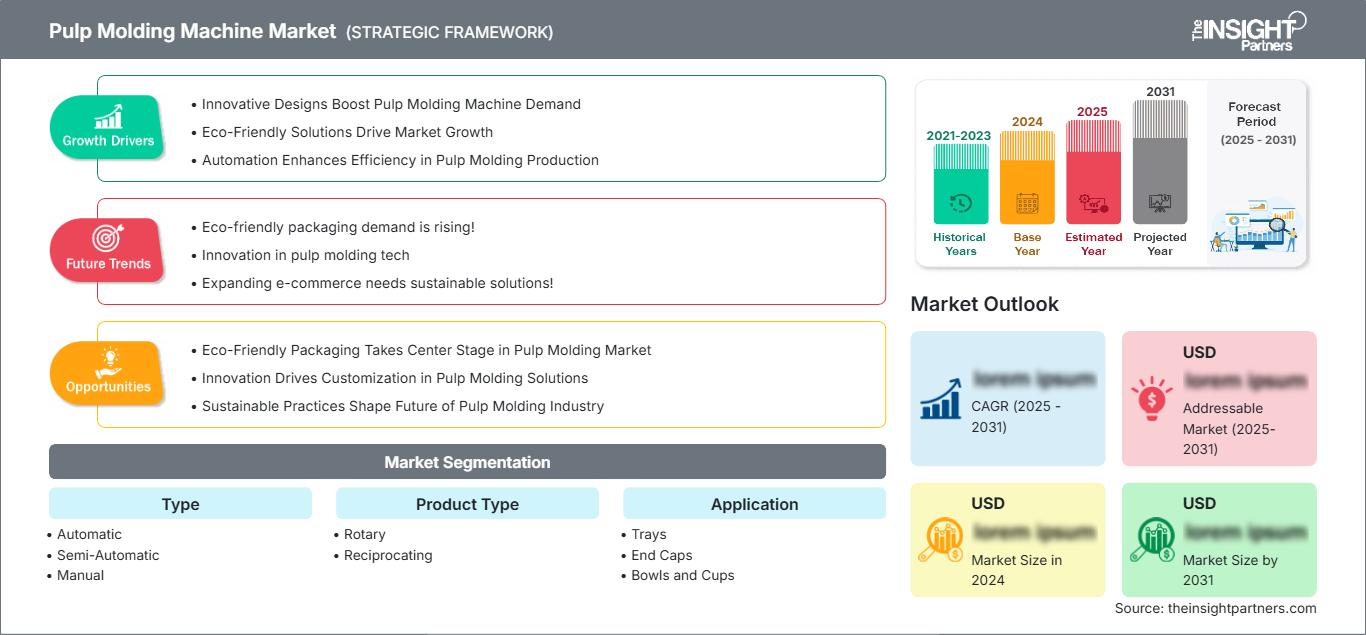
Pulp Molding Machine Market: Strategic Insights
Regional Insights
North America Pulp molding machine market
North America is estimated to account for a 29–33% of the Pulp molding machine market share in 2025 and is projected to grow at a 4.6–5.1% CAGR through 2034. The United States constitutes the leading national market, aided by food-service packaging, protective packaging for electronic items, and increased use of expanded plastics. The contribution from Canada involves food packaging, agriculture, and sustainable packaging programs.
In addition, regional demand will be driven by food contact regulations and the reduction of fluorinated substances in paper-based packaging. More and more manufacturers are looking at machinery that can provide precision forming, drying, and consistent surface quality. Local packaging converters are exploring automation when high labor costs become economic constraints. Mexico offers another manufacturing base due to its proximity to the US supply chain network.
U.S. Pulp molding machine Market
The US is estimated to represent 78–82% of North America's 2025 Pulp molding machine market value and is expected to grow at a 4.7–5.2% CAGR through 2034. The demand is focused on foodservice, consumer-product protection, electronics packaging, and specific healthcare applications. The equipment choice tends to lean towards automation with regard to forming, hot pressing, trimming, and quality control.
The existence of machinery suppliers and specialist tool makers ensures that technology is accessible in the existing converting facilities. Food-contact packaging becomes especially important since US regulators have sped up the process of eliminating some of the food-contact uses of PFAS substances. Thus, forming equipment that would be able to work with fiber constructions and coatings has to comply with product performance needs while not compromising recyclability.
Europe Pulp molding machine Market
Europe is estimated to hold a 25–29% share of the Pulp molding machine market in 2025 and is projected to grow at a 4.4–4.9% CAGR through 2034. Germany is the top market, with the UK, France, Italy, and Spain following in that order. The focus on reducing packaging waste, its recyclability, and material efficiency ensures investment in fiber-based packaging and machinery for its production.
The UK requires fiber packaging in food service, retail, and consumer segments, and it requires an automatic system that can produce fiber packaging reliably. The availability of an industrial packaging base and a good machinery environment in Germany makes it a good market for fiber packaging machinery. The markets of France, Italy, and Spain present potential in food and beverage, hospitality, and consumer packaging.
APAC Pulp molding machine Market
APAC is estimated to represent a 31–35% share of the Pulp molding machine market in 2025 and is expected to grow at a 5.1–5.7% CAGR through 2034. China leads regional demand, while India, Japan, South Korea, and Australia contribute through foodservice, electronics, consumer goods, and industrial packaging.
Industrial expansion, export-oriented manufacturing, and packaging localization support equipment investment. China benefits from a broad machinery ecosystem, while India combines growing domestic packaging consumption with agricultural-fiber availability. Japan and South Korea emphasize precision and quality, whereas Australia supports sustainable packaging conversion. Policy measures encouraging alternatives to conventional plastics further strengthen regional demand for automated and energy-efficient forming systems.
Middle East & Africa Pulp molding machine Market
The Middle East and Africa Pulp molding machine market demand is developing from a smaller base, with a modeled CAGR of 4.0–4.6% through 2034. Saudi Arabia and the UAE offer the best opportunities in the Gulf, with South Africa being a good sub-Saharan manufacturing country. Food service, logistics, agriculture, and consumer packaging facilitate the use of equipment.
Saudi Arabia and the UAE have the benefit of infrastructure and diversification in the food sector, whereas South Africa has the ability to manufacture paper and packaging products. The rest of MEA is open for selected projects that depend on waste paper collection locally, agriculture residuals, and substituting imports. The supplier of the equipment should have modular production with easy maintenance and technical support.
Segmentation Analysis
Type
The Type segment is expected to expand at a 4.6–5.2% CAGR from 2026–2034. As highlighted in the pulp molding machine market report, automation is increasingly preferred where throughput, labor efficiency, repeatability, and multi-stage processing determine project economics. Semi-automatic and manual systems remain relevant for smaller converters, customized products, and markets where capital availability limits full-line automation. The pulp molding machine scope therefore, extends from entry-level production to integrated industrial facilities.
- Automatic: Automatic equipment serves high-volume producers requiring synchronized forming, transfer, drying, pressing, trimming, and stacking. Its strategic value lies in repeatability, lower manual handling, higher utilization, and compatibility with digital production monitoring.
- Semi-Automatic: Semi-automatic machines provide a balance between investment and productivity, making them suitable for medium-scale manufacturers producing trays, tableware, and protective packaging across several product formats.
- Manual: Manual systems remain relevant for small enterprises, pilot projects, customized products, and regions where low initial capital expenditure is prioritized over maximum throughput.
Product Type
The Product Type segment is estimated to grow at a 4.2–4.9% CAGR during 2026–2034. As indicated in the pulp molding machine market forecast, product architecture determines throughput, floor-space requirements, mold exchange, and suitability for different packaging geometries. Rotary systems are favored for continuous high-volume production, while reciprocating systems provide flexibility and comparatively straightforward configuration for medium-output projects and varied product specifications.
- Rotary: Rotary systems support continuous forming and transfer cycles, making them strategically important for high-volume packaging where consistent output, automated handling, and reduced idle time are central operating priorities.
- Reciprocating: Reciprocating machines offer flexible forming cycles and are well-suited to medium-scale projects, product experimentation, and applications requiring frequent mold or format changes.
Application
The Application segment is projected to grow at a 4.4–5.0% CAGR during 2026–2034. As reflected in the pulp molding machine market trends, product requirements vary significantly by geometry, stiffness, moisture resistance, stacking behavior, and food-contact performance. Equipment manufacturers increasingly design lines around interchangeable molds and controlled drying so converters can address multiple packaging categories without extensive production redesign.
- Trays: Trays represent a broad application base across food, agriculture, electronics, and consumer packaging, with demand supported by protective geometry, stacking efficiency, and compatibility with recycled fiber.
- End Caps: End caps are used for cushioning and dimensional protection, particularly in industrial and consumer-product packaging, where molded fiber can replace selected foam components.
- Bowls and Cups: Bowls and cups require controlled forming and surface quality, supporting investment in precise hot pressing and automated handling for foodservice and takeaway applications.
- Clamshells: Clamshell production requires dimensional accuracy and reliable closure geometry, making mold precision and forming consistency important for food, retail, and consumer packaging.
- Plates: Plates benefit from automated forming and hot pressing, where uniform thickness, smooth surfaces, and high throughput are necessary for foodservice applications.
End-user
The pulp molding machine market End-user segment is expected to expand at a 4.5–5.3% CAGR during 2026–2034. Food and beverage remains the principal demand center, while healthcare offers comparatively faster growth as molded-fiber formats gain relevance for protective and disposable applications. Consumer goods and personal care provide additional opportunities through premium packaging, inserts, and product-protection formats.
- Food and Beverage: Food and beverage users require high-volume, food-contact-compatible packaging and tableware, making automation, hygiene, surface quality, and consistent drying important equipment-selection criteria.
- Consumer Goods: Consumer-goods manufacturers use molded fiber for protective inserts, trays, and presentation packaging, with demand shaped by product geometry, cushioning requirements, and retail sustainability objectives.
- Cosmetic and Personal Care: Cosmetic and personal-care applications favor customized inserts and premium presentation formats, encouraging tooling flexibility and precise surface finishing for differentiated packaging designs.
- Healthcare: Healthcare applications prioritize cleanliness, dimensional consistency, protective performance, and controlled manufacturing, creating opportunities for specialized molded-fiber products and higher-specification automated machinery.
Opportunity Snapshot
| Segment Name | Revenue Contribution (High/Medium/Low) | Trend Tag | Adoption Stage |
| Food and Beverage | High | Foodservice Fiber | Mature |
| Consumer Goods | Medium | Protective Inserts | Scaling |
| Cosmetic and Personal Care | Medium | Premium Fiber | Scaling |
| Healthcare | Low | Medical Protection | Emerging |
Pulp Molding Machine Market Growth Drivers and Impact Analysis
Plastic substitution is expanding fiber packaging investment
Pressure to limit the types of hard-to-recycle plastics is opening up opportunities for molded fiber applications in trays, tableware, protective pads, and packaging. The EU's Packaging and Packaging Waste Directive entered into force in February 2025 and will generally apply from August 2026, establishing a more defined structure around packaging design and disposal. In the US, the FDA stated that 35 food contact notifications for PFAS in paper and paperboard packaging were no longer effective as of January 2025. Such trends further solidify the need for machines able to produce food-grade fiber constructions. The implications for machine suppliers are an increased need for precision molds, proper drying, surface quality, and flexible lines that can handle replacement packaging programs.
Automation is improving production economics and quality control
Labor considerations, product uniformity, and manufacturing utilization are increasingly becoming influential factors when making decisions regarding machine selection. Automatic lines have the ability to integrate operations such as forming, handling, hot press, trimming and stacking to eliminate labor between various process stages. It is especially significant for big players in the foodservice and protective packaging industries since small changes in moisture or forming pressure can result in defective products. With robotics and PLC-controlled data gathering systems, the manufacturer has the ability to obtain operational data and detect deviations from the established process. The consequence is the changing investment strategy from acquiring individual farmers to manufacturing systems. Retrofit solutions offered by suppliers make it possible to work with existing equipment without rebuilding the whole factory.
Fiber diversification is widening the equipment addressable base
In molded-fiber manufacturing, an increasing number of companies are considering waste paper along with bagasse, bamboo, wheat straw, wood pulp, and other fiber feedstocks. This broadening of the feedstocks not only opens up more customers, but it also requires the use of adaptable machinery owing to varying properties in fiber morphology, water retention, dewatering, and refining. The difference can be seen in the machinery specification that demands fiber adaptability, pulping control, mold compatibility, and drying efficiency. Agricultural residues are particularly significant in those geographical areas where there is much processing of crops since they can add value to the waste streams and do away with the need for transportation costs. Molded-fiber companies can thus bid for projects if other recycled-paper feedstocks are out of the question.
Pulp Molding Machine Market Future Trends
Digital process control will become embedded in new production lines
The future machines will incorporate sensor-enabled architecture, which will continually measure consistency of pulp, vacuum pressure, moisture, temperature, cycle timings, and forming parameters. The machine learning and rules will be used to detect deviations early enough before they translate into defects of the final products. Remote diagnostics will ensure that the downtime is minimized since it will enable the support team to analyze the condition of the machine before coming to the plant. Digital recipe management will also become useful because the converters will be changing trays, plates, inserts, and clamshells within the same production platform. Eventually, connectivity will change equipment buying from just mechanical efficiency to operational efficiency. The manufacturers who manage to set up common data structures for pulping, forming, drying, pressing, and trimming will enhance their process traceability and predictive maintenance.
Dryer efficiency and low-carbon processing will reshape machine design
Energy-intensive drying remains a major consideration in wet molded-fiber production, encouraging manufacturers to redesign heat transfer, airflow, insulation, and moisture-removal systems. Future equipment is likely to combine improved thermal recovery with variable-speed drives, optimized airflow, and more precise moisture sensing. Hybrid energy architectures could also connect electric heating, heat recovery, and renewable power where local economics permit. These changes may reduce the operating-cost penalty associated with high-moisture forming while improving production stability. Equipment suppliers are also likely to emphasize compact drying layouts because a reduced footprint can lower factory infrastructure requirements. As packaging buyers increasingly evaluate lifecycle performance, machine-level energy efficiency will become an important procurement criterion alongside output capacity, mold flexibility, labor requirements, and finished-product quality.
Pulp Molding Machine Market Opportunities
Localized equipment manufacturing in emerging packaging hubs
Emerging packaging centers in India, Southeast Asia, Latin America, and selected African markets provide opportunities for machinery suppliers that can localize engineering, spare parts, installation, and operator training. Customers in these regions often need scalable equipment that can begin with one product family and expand as packaging demand develops. Modular forming and drying systems can reduce initial project risk while allowing later capacity additions. Suppliers can also strengthen competitiveness through locally manufactured molds and service partnerships. The opportunity is particularly relevant where agricultural residues or recovered paper are readily available, but advanced molded-fiber machinery remains imported. Developing regional technical teams can shorten commissioning periods, improve machine uptime, and create recurring revenue from tooling, maintenance, upgrades, and replacement components.
Multi-format production platforms for premium packaging
Packaging converters can capture higher-value applications by using flexible machinery capable of producing several geometries without extensive downtime. Cosmetic inserts, consumer-electronics protection, food containers, specialty trays, and healthcare packaging often require different molds and surface specifications. A platform supporting rapid mold exchange, programmable forming conditions, automated quality checks, and controlled hot pressing can improve asset utilization across these categories. The investment case becomes stronger when the same production line can serve multiple customers or packaging contracts. Suppliers can therefore differentiate through tooling libraries, digital recipes, quick-change mechanisms, and application engineering rather than machine capacity alone. The pulp molding machine forecasts indicate that equipment capable of supporting product diversification should be particularly relevant as converters seek to reduce dependence on a single packaging application.
Frequently Asked Questions

- Comprehensive Market Sizing and Forecast Analysis
- Detailed Segmentation Analysis
- In-Depth Market Dynamics Assessment
- Regional and Country-Level Insights
- Competitive Landscape and Company Benchmarking
- Strategic Business Intelligence
Recent Reports
Testimonials

The Insight Partners' SCADA System Market report is comprehensive, with valuable insights on current trends and future forecasts. The team was highly professional, responsive, and supportive throughout. We are very satisfied and highly recommend their services.
RAN KEDEM Partner, Reali Technologies LTDs
I requested a report on a very specific software market and the team produced the report in a few days. The information was very relevant and well presented. I then requested some changes and additions to the report. The team was again very responsive and I got the final report in less than a week.
JEAN-HERVE JENN Chairman, Future Analytica
We worked with The Insight Partners for an important market study and forecast. They gave us clear insights into opportunities and risks, which helped shape our plans. Their research was easy to use and based on solid data. It helped us make smart, confident decisions. We highly recommend them.
PIYUSH NAGPAL Sr. Vice President, High Beam Global
The Insight Partners delivered insightful, well-structured market research with strong domain expertise. Their team was professional and responsive throughout. The user-friendly website made accessing industry reports seamless. We highly recommend them for reliable, high-quality research services
YUKIHIKO ADACHI CEO, Deep Blue, LLC.
This is the first time I have purchased a market report from The Insight Partners.While I was unsure at first, I visited their web site and felt more comfortable to take the risk and purchase a market report.I am completely satisfied with the quality of the report and customer service. I had several questions and comments with the initial report, but after a couple of dialogs over email with their analyst I believe I have a report that I can use as input to our strategic planning process.Thank you so much for taking the extra time and making this a positive experience.I will definitely recommend your service to others and you will be my first call when we need further market data.
JOHN SUZUKI President and Chief Executive Officer, Board Director, BK Technologies
I wish to appreciate your support and the professionalism you displayed in the course of attending to my request for information regarding to infectious disease IVD market in Nigeria. I appreciate your patience, your guidance, and the fact that you were willing to offer a discount, which eventually made it possible for us to close a deal. I look forward to engaging The Insight Partners in the future, all thanks to the impression you have created in me as a result of this first encounter.
DR CHIJIOKE ONYIA MANAGING DIRECTOR, PineCrest Healthcare Ltd.Reason to Buy
- Informed Decision-Making
- Understanding Market Dynamics
- Competitive Analysis
- Identifying Emerging Markets
- Customer Insights
- Market Forecasts
- Risk Mitigation
- Boosting Operational Efficiency
- Strategic Planning
- Investment Justification
- Tracking Industry Innovations
- Aligning with Regulatory Trends





 Get Free Sample for