
Rack and Pinion Jack Market Size, Share & Trends by 2034
Coverage: by Type (Manual, Electric, Hydraulic); Application (Automotive, Industrial, Construction, Aerospace, Others); Load Capacity (Up to 5 Tons, 5-1 Tons, Above 1 Tons); Distribution Channel (Online, Offline), and Geography (North America, Europe, Asia Pacific, and South and Central America)
- Status : Data Released
- Report Code : TIPRE00007268
- Category : Manufacturing and Construction
- No. of Pages : 150
- Available Report Formats :


- Last update date : September 02, 2026


2025 Market Size
US$ 1.3 Bn
Base year value
2034 Forecast
US$ 2.07 Bn
Projected by 2034
CAGR 2026-2034
5.31 %
Growth rate
Addressable Market
US$ 15.29 Bn
(2026-2034)
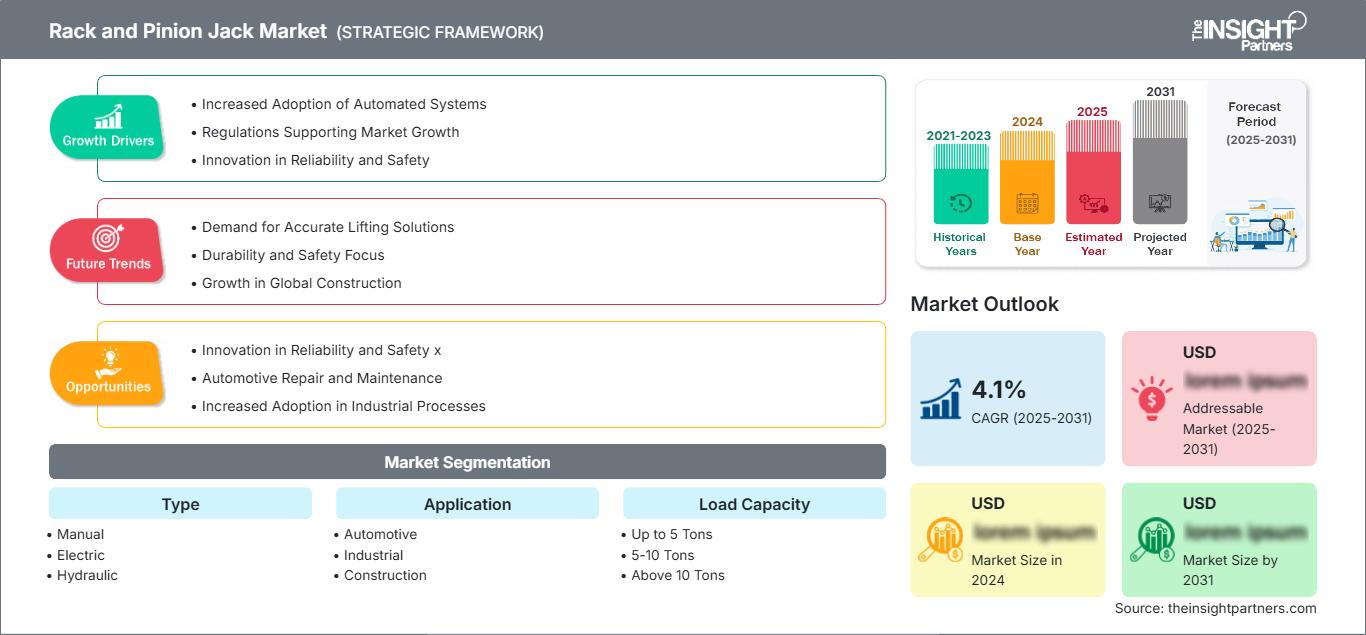
The rack and pinion jack market was valued at US$ 1.3 Billion in 2025 and is projected to reach US$ 2.07 Billion by 2034, expanding at a CAGR of 5.31% during 2026–2034. The market encompasses manually, electrically, and hydraulically operated lifting solutions serving automotive, industrial, construction, and aerospace applications, with purchasing decisions increasingly influenced by load precision, portability, safety requirements, maintenance cycles, and operating environments.
North American demand is positioned for a CAGR of approximately 4.8–5.6% through 2034, contributing significantly to the Rack and Pinion Jack Market Size, supported by sustained vehicle maintenance activity and investment in industrial facilities. Modernization of workshops, stricter workplace safety practices, and demand for dependable mechanical lifting systems are strengthening replacement requirements, while rental channels broaden access among smaller contractors and maintenance operators.
Rack and Pinion Jack Market Assessment and Insights
- North America: North America is estimated to account for 25–29% share in 2025 and expand at a CAGR of 4.8–5.6% between 2026–2034, supported by automotive servicing, industrial maintenance, equipment rental, and workplace safety requirements.
- US: The US is estimated to represent 78–83% of North America's 2025 demand and grow at a CAGR of 4.9–5.7% during 2026–2034, led by automotive workshops and industrial maintenance.
- Europe: Europe is estimated to hold 27–31% share in 2025 and advance at a CAGR of 4.6–5.4% through 2034, with Germany, the UK, France, and Italy supported by established engineering industries and maintenance-intensive manufacturing.
- Asia Pacific: Asia Pacific is estimated to represent 29–33% share in 2025 and register a CAGR of 5.8–6.7% between 2026–2034, with China, Japan, India, and South Korea benefiting from manufacturing expansion, infrastructure investment, and equipment modernization.
- Largest Segment: Hydraulic rack and pinion jacks are estimated to command a 38–43% market share in 2025 and expand at a CAGR of 5.0–5.8%, reflecting their suitability for demanding lifting applications.
- High Growth Segment: Electric rack and pinion jacks are estimated to hold a 25–30% market share in 2025 and grow at a CAGR of 6.5–7.4%, supported by controlled lifting and reduced manual effort.
- Key companies analyzed in detail: haacon hebetechnik GmbH, HADEF, HSS Hire Group plc, Hydram SAS, Kamotion Group, Kubanzheldormash Co., Lifting Products Ltd, NIPPON GEAR CO., LTD., Rodcraft, Tractel.
Source: The Insight Partners' analysis based on proprietary research, government publications, company annual reports, investor presentations, industry databases, and expert interviews.
The rack and pinion jack market has evolved from predominantly manual lifting mechanisms toward application-specific equipment combining mechanical advantage with improved load control, corrosion resistance, and ergonomic operation. Differentiation by the manufacturers occurs via gear geometry, rack robustness, braking mechanism, compact design, and suitability for workshop or field environment. The electric and hydraulic versions are also becoming popular where frequent lifting, heavy loads, or reduction in labor costs warrant increased complexity in the equipment.
There is also growing consideration for production dynamics in the application aspect. While standardized steel parts will continue to play their role in case of budget items, there is increasing use of precisely machined racks, hardened gears, better bearings, and reinforced housings for more industrial applications. There is increasing consideration of product selection based on its duty cycle rather than its rating capacity, especially when frequent lifting makes the issue relevant.
Over the forecast period, investment is expected to concentrate on compact powered designs, higher-capacity lifting systems, and digitally enabled maintenance practices in the Rack and Pinion Jack Market. Infrastructure development across Asia Pacific and the Middle East is likely to broaden demand for rugged lifting equipment, while North American and European buyers emphasize reliability, certification, serviceability, and lifecycle economics. Safety requirements and procurement standards should further encourage suppliers to improve mechanical locking, overload protection, and documentation.
Rack and Pinion Jack Market Report Scope
| Report Attribute | Details |
|---|---|
| Market size in 2025 | US$ 1.3 Billion |
| Market Size by 2034 | US$ 2.07 Billion |
| Global CAGR (2026 - 2034) | 5.31% |
| Historical Data | 2021-2024 |
| Forecast period | 2026-2034 |
Rack and Pinion Jack Market Analysis
Demand for the rack and pinion jack market is closely connected with vehicle servicing, industrial maintenance, construction equipment, and specialized lifting operations. Automotive workshops require dependable equipment for underbody access and component replacement, while industrial users prioritize repeatability and load stability. The value chain includes steel and alloy suppliers, gear and machining specialists, jack manufacturers, distributors, rental companies, service providers, and end users. Industry demand therefore, responds not only to new equipment purchases but also to fleet replacement and maintenance cycles.
Supply conditions depend on the availability of precision-machined steel components, gear-cutting capacity, heat-treatment services, hydraulic components, motors, and safety hardware, as discussed in the Rack and Pinion Jack Market Report. Manual products generally have simpler bills of materials, whereas powered models require additional electrical, hydraulic, or control components. Manufacturers with integrated machining and assembly capabilities can reduce dependency on external suppliers and maintain tighter dimensional control. At the same time, distributors remain important because buyers often require local availability, technical guidance, replacement parts, and after-sales support.
The rack and pinion jack market analysis indicates increasing differentiation between standardized workshop products and engineered lifting systems for specialized applications. Suppliers compete through rated capacity, lifting height, operating speed, portability, durability, and service coverage rather than price alone. haacon hebetechnik GmbH and HADEF bring established lifting-equipment expertise, while Tractel provides a broad industrial lifting portfolio. HSS Hire Group plc adds relevance through equipment rental and access to lifting solutions for temporary requirements.
Competitive positioning in the Rack and Pinion Jack Market also includes geographic reach and application specialization. Hydram SAS and NIPPON GEAR CO., LTD. contribute engineering capabilities relevant to industrial lifting and transmission applications, while Lifting Products Ltd and Rodcraft address professional equipment requirements. Kamotion Group and Kubanzheldormash Co. participate in specialized mechanical equipment supply, while the remaining suppliers differentiate through product engineering, customization, distribution relationships, or regional market access. Investment priorities are increasingly directed toward product reliability, powered operation, component quality, and service networks.
● REPORT CUSTOMIZATION
Tailor This Report To Align With Your Specific Business Requirements
This report can be customized to align precisely with your business objectives, scope, and target markets. Customization options include tailored segmentation, geography, competitive analysis, and strategic insights to support informed decision-making.
Customize This Report →WHAT YOU CAN ADJUST
- ● Segmentations
- ● Geography
- ● Competitive Analysis
- ● Language Preferences
Rack and Pinion Jack Market: Strategic Insights
Regional Insights
North America rack and pinion jack market
North America is estimated to represent a 22–26% of the rack and pinion jack market share in 2025, with demand concentrated in the US and supported by automotive maintenance, industrial machinery servicing, equipment rental, and construction applications. The regional CAGR is estimated at 4.8–5.4% from 2026–2034, reflecting replacement demand and gradual movement toward powered equipment.
The US remains the principal market, while Canada contributes through industrial maintenance, construction, and resource-sector equipment requirements. Product specifications increasingly emphasize operator safety, controlled lifting, portability, and compatibility with workshop procedures. Regional distributors and rental companies provide important routes to smaller contractors and maintenance organizations, creating recurring demand for standardized equipment and replacement components.
U.S. rack and pinion jack Market
The US is estimated to account for 78–83% of North America's 2025 share of the rack and pinion jack market, with a 4.9–5.5% CAGR through 2034. Automotive workshops, industrial plants, construction contractors, and equipment rental businesses form the principal demand base. Professional users increasingly evaluate products through rated capacity, serviceability, portability, and operator ergonomics.
haacon hebetechnik gmbh, HSS Hire Group plc, Lifting Products Ltd, Rodcraft, and Tractel have relevance across professional lifting and maintenance channels. Automotive applications remain important, but industrial positioning and construction maintenance broaden utilization. Electric models can gain adoption where repetitive lifting cycles increase labor requirements, whereas manual equipment retains relevance for intermittent maintenance and applications where independent operation is preferred.
Europe rack and pinion jack Market
Europe is estimated at a 25–29% share of the rack and pinion jack market in 2025, with Germany serving as the leading market and the regional CAGR is estimated at 4.7–5.3% between 2026–2034. Good engineering competence, maintenance needs of industries, and equipment standards are the reasons for constant demand in large economies.
There is an advantage in the UK market in terms of maintenance of buildings and other constructions, equipment rentals, and maintenance of cars, where there is an emphasis on availability and after-sales services. In Germany, there is a good industrial base along with the manufacturing of lifting equipment; hence, there is demand within the country as well as for exports.
APAC rack and pinion jack Market
Asia Pacific is estimated to hold a 32–36% share of the Rack and Pinion Jack Market in 2025 and record a 5.6–6.2% CAGR through 2034. China leads the region, followed by Japan, India, South Korea, and Australia. Manufacturing expansion and infrastructure investment underpin demand for lifting and positioning equipment.
The country of China is helped by the existence of an extensive industrial manufacturing base, but Japan and South Korea have focused on the area of precision equipment as well as the production environment. India provides growth in automotive applications, construction applications, and industrial applications, but Australia has been of help in the areas of construction and resource maintenance.
Middle East & Africa rack and pinion jack Market
The Middle East and Africa rack and pinion jack market represents a smaller demand base, with regional growth estimated at 4.4–5.0% through 2034. Saudi Arabia leads the region in opportunities, followed by the UAE and South Africa, with the rest of the markets contributing in terms of industrial maintenance, construction, logistics, and equipment servicing.
Energy and infrastructure development needs demand reliable mechanical lift equipment, especially where the equipment has to run in challenging conditions. Saudi Arabia and the UAE enjoy large construction programs and a diversified industry, whereas South Africa is a market with mining and manufacturing and maintenance needs.
Segmentation Analysis
Type
Type remains a central purchasing consideration because operating environment, lifting frequency, available power, and operator effort determine the preferred mechanism. The segment is expected to expand at a 4.6–8.9% CAGR between 2026–2034, with manual products retaining volume leadership while electric systems record faster adoption. The rack and pinion jack market scope increasingly includes equipment designed for repetitive and ergonomically demanding lifting tasks.
- Manual: Manual products retain strong demand where portability, mechanical simplicity, independent operation, and low acquisition cost are important. They remain particularly relevant to workshops, field maintenance teams, and intermittent industrial lifting applications.
- Electric: Electric products address repetitive lifting requirements and reduce operator effort. Their strategic importance increases where controlled movement, productivity, and ergonomic considerations justify integration with powered drive systems.
- Hydraulic: Hydraulic configurations serve applications requiring substantial lifting force and controlled movement. Their position is strengthened in demanding industrial and construction environments where higher force capability is prioritized.
Application
Application determines equipment configuration, load requirements, operating frequency, and safety expectations. This segment is projected to expand at a 4.9–6.1% CAGR between 2026–2034, according to the Rack and Pinion Jack Market Forecast, with automotive remaining a major demand center and industrial, construction, and aerospace uses supporting diversification. The purchasing decision increasingly considers application-specific load control and service conditions.
- Automotive: Automotive applications generate substantial demand through vehicle servicing, component positioning, workshop maintenance, and repair operations requiring dependable lifting and controlled positioning.
- Industrial: Industrial users require lifting equipment for machinery maintenance, component positioning, production support, and facility servicing, creating demand for durable products across varied operating conditions.
- Construction: Construction applications emphasize portability, robust load handling, and dependable operation at worksites, supporting demand for equipment capable of repeated lifting and positioning tasks.
- Aerospace: Aerospace applications prioritize precision, controlled movement, reliability, and equipment compatibility, creating a specialized market for high-quality lifting solutions used during maintenance and assembly.
- Others: Other applications include specialized maintenance and equipment-handling tasks where compact mechanical lifting solutions provide practical positioning capability.
Load Capacity
Load Capacity influences product engineering, material selection, gear dimensions, safety mechanisms, and application suitability. The segment is expected to grow at a 4.8–6.0% CAGR between 2026–2034, reflecting key Rack and Pinion Jack Market Trends, with lighter units retaining broad workshop use and heavier products serving industrial, construction, and specialized applications.
- Up to 5 Tons: Products in this range address broad workshop and maintenance requirements where portability and manageable equipment dimensions are important alongside adequate lifting capability.
- 5-1 Tons: Mid-range capacity products support applications requiring greater lifting capability while maintaining practical deployment, particularly across industrial maintenance and construction-related equipment servicing.
- Above 1 Tons: Higher-capacity products target demanding lifting environments where structural strength, controlled movement, and dependable load retention are essential for specialized operations.
Distribution Channel
Distribution Channel influences product accessibility, technical support, delivery speed, and purchasing convenience. The segment is projected to expand at a 4.7–6.3% CAGR between 2026–2034, with offline channels retaining importance for technical products while online procurement expands for standardized equipment and replacement purchases.
- Online: Online channels improve product discoverability and purchasing convenience, particularly for standardized models, replacement equipment, and professional buyers familiar with technical specifications.
- Offline: Offline distribution remains strategically important because buyers often require technical consultation, capacity verification, demonstrations, installation guidance, and after-sales support before purchasing specialized lifting equipment.
Opportunity Snapshot
| Application | Revenue Contribution (High/Medium/Low) | Trend Tag | Adoption Stage |
| Automotive | High | Workshop Lifting | Mature |
| Industrial | High | Machinery Positioning | Scaling |
| Construction | Medium | Site Lifting | Scaling |
| Aerospace | Medium | Precision Lifting | Scaling |
| Others | Low | Specialized Handling | Emerging |
Rack and Pinion Jack Market Growth Drivers and Impact Analysis
Rising Vehicle Maintenance and Workshop Infrastructure
The increasing number of cars in the park, professional repair shops, and an increased need for organized maintenance create a need for reliable lifting equipment on an ongoing basis. Automotive workshops will have to use products that are capable of working repeatedly without failing, offering reliability during both the raising and lowering processes. Another factor that may influence the development of automotive workshops is the increase in the number of electric cars, since more often than not, it is necessary to work with batteries and unique underbody components. This does not necessarily mean that there will be equal demand for all types of jacks, but rather that there is an increased need for relevant products.
Industrial Equipment Modernization Increases Positioning Requirements
Modernization of industries offers possibilities to use lifting equipment that could help install machinery, maintain it, align it, and replace some components without the need for large permanent lifting structures. Uptime is becoming very important for manufacturing plants, thus making portable lifting equipment essential during regular maintenance or unexpected interventions. Rack drive systems are able to give a controlled linear motion and can be used for various lifting heights and load capacities. This ability is especially important when there are no cranes or permanent lifting structures available or efficient for localized work. With the growth of machinery within manufacturing plants, maintenance infrastructure also grows, thus generating a need for plant contractors, maintenance services companies, and equipment suppliers. Companies that unite standard products with application engineering will find the market most responsive to their needs.
Construction and Infrastructure Projects Broaden Field Applications
Infrastructure construction and equipment maintenance require a need for mechanical lifting equipment that will be deployed in environments in which portability and easy deployment are crucial. Lifting equipment is used by construction contractors for positioning parts, supporting machinery, and carrying out maintenance operations. Infrastructure construction might necessitate repetitive handling at various job sites. Purchasing decisions take into account weight capacity, durability, portability, and the ease of inspection. Rental services can broaden the reach, as contractors might want equipment only temporarily rather than purchasing special lifting equipment. This opens another route of demand for standard equipment that has high usage value. Manufacturers who can cater to both rental fleets and industrial users can therefore diversify their revenue stream. In the long run, increased focus on job site efficiency and safety would promote equipment that offers dependable mechanical efficiency and simple operation.
Rack and Pinion Jack Market Future Trends
Electrification and Ergonomic Lifting Systems
Electrification would be increasingly necessary for future lifting devices, as users attempt to make the process of lifting easier and less manual in nature. Future product development can include both electrification and control mechanisms, along with overload safety, emergency stops, and accurate positioning capabilities. Application-specific adoption would still be necessary since there are cost savings in favor of manual devices in infrequent usage cases. Professional shops, production facilities, and machinery repair companies would have enough reasons to choose electrified devices where usage is higher. Manufacturers may begin to offer configurable drive designs for their devices to enable customers to customize their choice of power and control depending on their needs. In this way, manufacturers would expand their potential customer base without developing new designs of mechanical platforms.
Connected Monitoring and Condition-Based Maintenance
The future generation of lifting devices can include sensors that detect load, operating cycles, positioning, and the state of the machine. This capability could be used for maintenance planning, recognizing irregular patterns of loading or operating cycles, which could indicate potential problems ahead. Connected monitoring is more applicable to fleets, rentals, industrial maintenance, and large workshops dealing with many lifting devices. Information from the equipment can be used to update maintenance records and show how the company complies with its own safety standards. The adoption of such a technology depends on the durability of sensors, connection costs, security needs, and the value of the information collected. This provides manufacturers with the possibility of implementing such technology gradually, focusing first on expensive electric and industrial devices. In the long run, digital interface standards can integrate lifting-device monitoring into maintenance management platforms.
Rack and Pinion Jack Market Opportunities
Expansion of Specialized Industrial Configurations
Value can be gained from customized systems for machinery installations, rail maintenance, commercial trucks, industrial equipment, and hard-to-reach locations. Customized rack lengths, mounting options, lifting heights, and drive systems can meet needs beyond what general workshop components can handle. This may enhance the level of engineering involved, as well as customer loyalty and reduced price competition. Suppliers would do well to target applications where the cost of downtime is high because the customers at these facilities will be more concerned about the value of operation than just the cost of purchase. Alliance with industrial distributors, maintenance companies, and equipment manufacturers can offer access to these markets without having to build a direct sales force.
Digital Distribution and Global Aftermarket Coverage
Digital purchasing creates an opportunity to expand international access to standardized lifting equipment, spare components, and replacement products. Manufacturers can improve conversion by presenting precise technical specifications, load ratings, dimensional drawings, compatibility information, and operating documentation online. This is particularly valuable for professional buyers who already understand the required equipment configuration. However, complex industrial products still benefit from distributor support, making a hybrid model strategically stronger than online-only selling. Suppliers can use digital channels for product discovery and initial selection while directing customers toward local technical representatives for application validation and service. Expanding aftermarket availability is equally important because established users often require replacement components, accessories, and maintenance support. Companies that combine digital visibility with regional service infrastructure can strengthen recurring revenue and improve customer retention.
Frequently Asked Questions

- Comprehensive Market Sizing and Forecast Analysis
- Detailed Segmentation Analysis
- In-Depth Market Dynamics Assessment
- Regional and Country-Level Insights
- Competitive Landscape and Company Benchmarking
- Strategic Business Intelligence
Recent Reports
Testimonials

The Insight Partners provided valuable market intelligence that supported our global go-to-market strategy. Their team was professional, responsive, and attentive to our feedback, providing thoughtful analysis and helpful methodological clarifications throughout the project.
Junmo Kim Chief Financial Officer (CFO), Enertech Co., Ltd.
The Insight Partners' SCADA System Market report is comprehensive, with valuable insights on current trends and future forecasts. The team was highly professional, responsive, and supportive throughout. We are very satisfied and highly recommend their services.
RAN KEDEM Partner, Reali Technologies LTDs
I requested a report on a very specific software market and the team produced the report in a few days. The information was very relevant and well presented. I then requested some changes and additions to the report. The team was again very responsive and I got the final report in less than a week.
JEAN-HERVE JENN Chairman, Future Analytica
We worked with The Insight Partners for an important market study and forecast. They gave us clear insights into opportunities and risks, which helped shape our plans. Their research was easy to use and based on solid data. It helped us make smart, confident decisions. We highly recommend them.
PIYUSH NAGPAL Sr. Vice President, High Beam Global
The Insight Partners delivered insightful, well-structured market research with strong domain expertise. Their team was professional and responsive throughout. The user-friendly website made accessing industry reports seamless. We highly recommend them for reliable, high-quality research services
YUKIHIKO ADACHI CEO, Deep Blue, LLC.
This is the first time I have purchased a market report from The Insight Partners.While I was unsure at first, I visited their web site and felt more comfortable to take the risk and purchase a market report.I am completely satisfied with the quality of the report and customer service. I had several questions and comments with the initial report, but after a couple of dialogs over email with their analyst I believe I have a report that I can use as input to our strategic planning process.Thank you so much for taking the extra time and making this a positive experience.I will definitely recommend your service to others and you will be my first call when we need further market data.
JOHN SUZUKI President and Chief Executive Officer, Board Director, BK Technologies
I wish to appreciate your support and the professionalism you displayed in the course of attending to my request for information regarding to infectious disease IVD market in Nigeria. I appreciate your patience, your guidance, and the fact that you were willing to offer a discount, which eventually made it possible for us to close a deal. I look forward to engaging The Insight Partners in the future, all thanks to the impression you have created in me as a result of this first encounter.
DR CHIJIOKE ONYIA MANAGING DIRECTOR, PineCrest Healthcare Ltd.Reason to Buy
- Informed Decision-Making
- Understanding Market Dynamics
- Competitive Analysis
- Identifying Emerging Markets
- Customer Insights
- Market Forecasts
- Risk Mitigation
- Boosting Operational Efficiency
- Strategic Planning
- Investment Justification
- Tracking Industry Innovations
- Aligning with Regulatory Trends





 Get Free Sample for