
Tire Building Machinery Market Size, Trends & Growth by 2034
Coverage: By Structure (Bias Tire, Radial Tire); Application (Passenger Vehicles, Commercial Vehicles) , and Geography (North America, Europe, Asia Pacific, and South and Central America)
- Status : Data Released
- Report Code : TIPRE00021352
- Category : Manufacturing and Construction
- No. of Pages : 150
- Available Report Formats :


- Last update date : July 21, 2026


2025 Market Size
US$ 167.89 Mn
Base year value
2034 Forecast
US$ 291.99 Mn
Projected by 2034
CAGR 2026-2034
6.34 %
Growth rate
Addressable Market
US$ 2,080.69 Mn
(2026-2034)
The Tire Building Machinery Market was valued at US$ 167.89 Million in 2025 and is projected to reach US$ 291.99 Million by 2034, registering a CAGR of 6.34% during 2026–2034. There has been an increase in the need for automated tire building machinery, enhanced uniformity control, and increased production efficiency in both passenger and commercial vehicles' tire manufacturing processes.
In North America, the Tire Building Machinery Market size will be influenced by the modernization of existing brownfield tire factories, repatriation of certain automotive supply chains, and stringent inspections required for superior quality radial tires. It is projected that the region will grow at a CAGR of 5.8–6.3% until 2034.
Tire Building Machinery Market Assessment and Insights
- North America accounted for 28–31% share in 2025 and is projected to grow at a CAGR of 5.8–6.3% during 2026–2034, led by plant automation, radial tire upgrades, and OE quality mandates.
- US represented 76–79% of North America in 2025 and is expected to grow at a CAGR of 5.9–6.4% during 2026–2034 as domestic tire capacity improves.
- Europe held 24–27% share in 2025 and is forecast to grow at a CAGR of 5.4–5.9% during 2026–2034, with Germany, Italy, France, and the UK leading demand.
- Asia Pacific captured 35–38% share in 2025 and is expected to grow at a CAGR of 6.8–7.4% during 2026–2034, supported by China, Japan, South Korea, and India.
- Largest Segment Radial Tire held 72–76% market share in 2025 and is likely to grow at a CAGR of 6.5–7.0% during 2026–2034 due to passenger and truck tire dominance.
- High Growth Segment Commercial Vehicles held 34–38% market share in 2025 and is forecast to grow at a CAGR of 6.9–7.5% during 2026–2034 as logistics fleets expand.
- Key companies analyzed in detail: Astyre Machines S.r.l., Balluff Elektronika Sanayi ve Ticaret Limited Şirketi, Harburg-Freudenberger Maschinenbau GmbH, Larsen & Toubro Limited, Marangoni S.p.A., Mitsubishi Heavy Industries Machinery Systems, Ltd., Qingdao Maoyuanfeng Industry and Trade Co., Ltd., Samson Machinery Inc., TKH Group N.V., VMI Group.
Source: The Insight Partners' analysis based on proprietary research, government publications, company annual reports, investor presentations, industry databases, and expert interviews.
There has been a shift from manufacturing considerations of pure mechanical processing in tire making to process control, repeatable recipes, and inspection. Thus, the Tire Building Machinery market has developed in the direction of modular machinery, featuring automated placement of tire components, machine vision, servo controls, and data acquisition. In cases where there is downtime, inefficiencies, or variations in the quality of products made using old machines, tire manufacturers will continue to invest in bias and early radial machinery.
The future demand will depend on new capacities being developed in Asia, some reinvestments in Europe and North America, and regulations requiring traceable, energy-efficient manufacturing. Manufacturers of tires will seek machines that minimize scrap, facilitate mixed SKU manufacture, and interface with factory execution systems.
Tire Building Machinery Market Report Scope
| Report Attribute | Details |
|---|---|
| Market size in 2025 | US$ 167.89 Million |
| Market Size by 2034 | US$ 291.99 Million |
| Global CAGR (2026 - 2034) | 6.34% |
| Historical Data | 2021-2024 |
| Forecast period | 2026-2034 |
Tire Building Machinery Market Analysis
The Tire Building Machinery Market growth is linked with tire manufacturers' need for higher first pass yield, lower changeover time, and uniformity in radial constructions. The increasing requirements of passenger vehicle tire manufacturing plants are in terms of automation of bead setting, belt installation, carcass assembly, and alignment at final inspection stage, whereas commercial tire manufacturing plants require machinery which can handle heavier components.
The ecosystem comprises tire OEMs, rubber processing machinery suppliers, automation suppliers, sensors suppliers, and system integrators. Balluff Elektronika Sanayi ve Ticaret Limited Şirketi offers its solutions for sensing and identification requirements, whereas the equipment providers, VMI Group and Harburg-Freudenberger Maschinenbau GmbH, are competing on the basis of their machine dependability, process knowhow, and full lifecycle support.
The Tire Building Machinery Market report reveals that platform engineering, installed base service, and digital quality management have become critical factors in the competitive environment. TKH Group N.V. has the advantage due to VMI Group tire machinery product range, whereas Mitsubishi Heavy Industries Machinery Systems, Ltd. is having expertise in industrial machinery and inspection technologies for tire and rubber industries.
The investments have been geared towards companies that offer flexibility for building, retrofits for control systems, and machinery that can produce new substances without reducing their output. The companies include Larsen & Toubro Limited, Astyre Machines S.r.l., Marangoni S.p.A., Qingdao Maoyuanfeng Industry and Trade Co., Ltd., and Samson Machinery Inc. The market will include global companies and niche suppliers.
● REPORT CUSTOMIZATION
Tailor This Report To Align With Your Specific Business Requirements
This report can be customized to align precisely with your business objectives, scope, and target markets. Customization options include tailored segmentation, geography, competitive analysis, and strategic insights to support informed decision-making.
Customize This Report →WHAT YOU CAN ADJUST
- ● Segmentations
- ● Geography
- ● Competitive Analysis
- ● Language Preferences
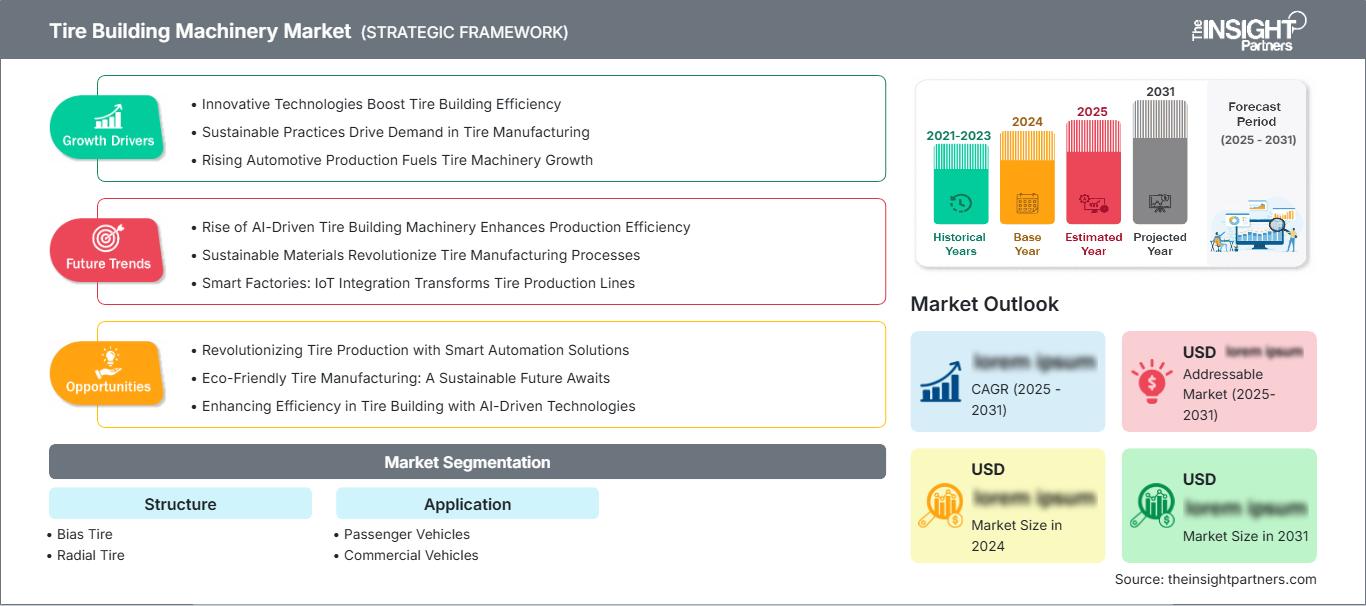
Tire Building Machinery Market: Strategic Insights
Regional Insights
North America Tire Building Machinery Market
North America represented 28–31% of global revenue in 2025, with the Tire Building Machinery Market share supported by replacement demand, premium light truck tires, and commercial fleet activity. The growth in CAGR in the region is at 5.8-6.3% due to brownfield upgradation as opposed to huge greenfield expansion, where automation is mainly about being less dependent on manpower and increasing consistency.
Regional customers are showing preference for radial manufacturers, handling components, and vision systems for inspections which can help achieve shorter runs and better tire specifications. Localization of the supply chain also helps in upgrading machines around vehicle manufacturing areas. VMI Group and TKH Group N.V. continue to be seen through their sophisticated platforms and service capabilities.
U.S. Tire Building Machinery Market
The U.S. accounted for 76–79% of North America in 2025 and is projected to expand at a CAGR of 5.9–6.4% through 2034. The demand is focused on the production of radial tires for passengers, light trucks, and commercial vehicles where tire manufacturers look for equipment producers that can reduce the level of scrap and enhance the traceability in the bead building, carcass, belt, and tread building processes.
Market position is supported by the presence of the global machinery producers who provide local service, spare parts, and retrofit solutions to the U.S. tire plants. The trend in applications includes increasing the demand for machinery for commercial vehicles due to more frequent tire changes in this segment.
Europe Tire Building Machinery Market
Europe held 24–27% share in 2025 and is expected to record a CAGR of 5.4–5.9% during 2026–2034. The leadership is held by Germany due to its engineering in machinery and high quality tire production; meanwhile, Italy and France make contributions due to equipment specialization, knowledge of retreading and tire manufacturing facilities.
The UK market tends to be characterized by replacement and servicing; therefore, there is no need in capacity expansion but only in improvement of inspection, handling and control. The contribution of France, Italy and Spain to orders comes from passenger tire upgrading and application in trucks. Energy efficiency and machinery safety become priorities of European clients.
APAC Tire Building Machinery Market
APAC accounted for 35–38% share in 2025 and is forecast to grow at a CAGR of 6.8–7.4% through 2034, making it the largest regional base. With large-scale domestic demand, exporting capability, and investments in radial tires, China drives demand, whereas Japan and South Korea concentrate on precise machinery and premium production.
As demand grows because of rising car parc and infrastructure investment, India is emerging as an increasingly strong growth node. Australia makes a consistent demand contribution based on replacements. There is support from policy for localization of manufacturing and industrial automation, making tire manufacturers invest in better-capable builders.
Middle East & Africa Tire Building Machinery Market
Middle East & Africa is expected to grow at a CAGR of 5.6–6.2% during 2026–2034, led by Saudi Arabia and the UAE in infrastructure-linked tire demand. South Africa still leads in automotive manufacturing production capacity. The demand from the Rest of MEA region will continue to be limited to replacement tire needs and fleet maintenance needs.
Various industries like energy, mining, construction, and logistics will have their demands for tires that will necessitate investments into equipment that can serve well. Purchasing of these tires should be based on durability and serviceability of the equipment rather than customization.
Segmentation Analysis
Structure
Structure is projected to grow at a CAGR of 6.1–6.7% during 2026–2034 as tire makers align machinery selection with radialization, product durability, and production flexibility. The Tire Building Machinery Market scope within this segment includes equipment for carcass assembly, belt placement, bead positioning, stitching, and green tire transfer across bias and radial architectures.
- Bias Tire remains relevant in select off-road, agricultural, industrial, and low-speed applications where sidewall strength, repairability, and cost control are valued over high-speed performance and fuel efficiency.
- Radial Tire dominates modern passenger and commercial vehicle production because it supports better heat dissipation, tread life, fuel efficiency, and handling, making machinery precision strategically important.
Application
Application is expected to grow at a CAGR of 6.3–6.9% during 2026–2034 as passenger and commercial tire producers upgrade lines for higher throughput and wider SKU diversity. Demand differs by vehicle type: passenger tire plants emphasize speed and uniformity, while commercial tire facilities prioritize durability, component handling strength, and process repeatability.
- Passenger Vehicles generate steady machinery demand because OE and replacement tires require high-volume radial production, lower defect rates, and adaptable systems for rim-size proliferation and performance variants.
- Commercial Vehicles require heavy-duty builders capable of handling larger components, reinforced structures, and stricter endurance requirements, making automation valuable for consistency, safety, and productivity.
Opportunity Snapshot
| Application | Revenue Contribution | Trend Tag | Adoption Stage |
| Passenger Vehicles | High | Radial Automation | Mature |
| Commercial Vehicles | Medium | Fleet Durability | Scaling |
Tire Building Machinery Market Growth Drivers and Impact Analysis
Radial Tire Capacity Modernization
In radial tire manufacturing, there is an increased need for control of the belt angle, carcass tension, bead positioning, and stitching pressure compared to conventional bias construction methods. As tire companies extend their high speed passenger and truck/buses radial tire lines, new equipment investments have a direct bearing on yield, warranty risk, and OE acceptance. Advanced machine technology reduces variations in manual labor and helps in capturing information about every green tire made by manufacturers, making it possible to detect issues early. The influence is highest in Asia-Pacific and North America due to the rise in plant utilization and complexity of products.
Automation Pressure from Labor and Quality Constraints
Tire plants face shortages of skilled operators, rising wage costs, and growing expectations for consistent quality across high-volume production. Automated tire building systems help manufacturers reduce dependence on manual positioning, improve ergonomic safety, and maintain stable output across shifts. The business impact is measurable through lower scrap, fewer rework loops, and stronger compliance with customer audits. Machinery vendors that combine mechanical engineering with sensors, controls, and predictive maintenance are gaining preference because buyers want uptime as much as throughput. This driver also supports retrofit demand where producers cannot justify full line replacement but need targeted automation improvements.
Commercial Fleet Expansion and Durable Tire Demand
Growth in logistics, construction, mining, and infrastructure fleets increases demand for commercial tires with stronger casings, better endurance, and consistent retreadability. Building these tires requires machinery capable of handling heavier components, thicker rubber profiles, and stricter geometry control. Tire producers are therefore investing in systems that improve repeatability while supporting larger rim sizes and application-specific designs. The effect is especially visible in India, the U.S., China, and Middle East markets where road freight and infrastructure programs shape tire consumption. Equipment suppliers benefit when they can offer rugged platforms, remote service, and modular upgrades for truck and bus radial production.
Tire Building Machinery Market Future Trends
AI-Enabled Quality Monitoring
One of the most important Tire Building Machinery Market trends is the shift from post-process inspection to embedded, AI-assisted quality monitoring. High-speed cameras, sensors, and analytics will increasingly assess component alignment, splice quality, material positioning, and build consistency during production rather than after green tire completion. This trend can reduce hidden defects and improve root-cause analysis when product variation emerges. Over the forecast period, tire makers are likely to favor platforms that can connect machine data with plant execution systems, enabling predictive quality control, faster troubleshooting, and stronger evidence for OE customer audits.
Flexible Platforms for Low-Volume Tire Variants
Product portfolios are becoming more fragmented as electric vehicles, SUVs, regional regulations, and performance categories require specialized tire designs. Future machinery platforms will need faster recipe changes, modular tooling, and software-guided setup to handle lower-volume variants without sacrificing productivity. This will move procurement decisions away from single-purpose capacity toward adaptable architectures that support multiple tire families. Suppliers able to combine mechanical flexibility with digital setup assistance will gain strategic relevance, particularly in premium passenger tire plants and commercial tire facilities serving mixed fleet requirements.
Tire Building Machinery Market Opportunities
Retrofit Programs for Installed Machinery
Retrofit programs offer a strong path for machinery suppliers because many tire plants operate older builders that remain mechanically viable but lack modern controls, sensors, and inspection capability. By offering upgrade kits, remote diagnostics, and staged automation packages, vendors can address budget-constrained customers without requiring full line replacement. Tire Building Machinery Market Forecasts indicate that retrofit demand will be strongest where manufacturers need better traceability and lower scrap but cannot interrupt production for long installations. Suppliers should package upgrades around measurable outcomes such as cycle-time reduction, reduced manual intervention, and improved component placement accuracy.
Localized Service Networks in Emerging Manufacturing Hubs
Emerging tire manufacturing hubs require more than imported machinery; they need responsive service, operator training, spare parts, and process support. Equipment suppliers can create differentiated value by building regional service centers in India, Southeast Asia, the Middle East, and Eastern Europe. Local support reduces downtime risk and improves buyer confidence in advanced automation platforms. This opportunity is especially relevant for mid-sized tire producers moving from semi-automatic to more integrated lines. Vendors that combine financing flexibility, localized maintenance capability, and scalable automation modules can secure long-term relationships rather than one-time equipment orders.
Recent Developments
- March 2025: VMI Group — received the Tire Manufacturing Innovation of the Year award at Tire Technology Expo 2025 for next-level integrated quality monitoring on MAXX and MILEXX platforms, reinforcing market interest in machine vision, hands-off operation, and AI-ready tire building quality systems.
- February 2024: Sumitomo Rubber Industries, Ltd. is pleased to announce the development of a new simulation technique called "Tire Aerodynamic Simulation," which is used in the process of tire development. In order to reduce the fuel (electricity) consumption of electric vehicles (EVs), it is very important to minimize tire rolling resistance as well as air resistance around the tire. We will pursue the development of a tire shape that optimizes aerodynamic performance by visualizing the airflow around the tire of a running vehicle through our own simulation using AI, and thereby aim to develop a tire that further contributes to lowering the electricity consumption of an EV in a next-generation EV tire to be launched in 2027.
Frequently Asked Questions

- Comprehensive Market Sizing and Forecast Analysis
- Detailed Segmentation Analysis
- In-Depth Market Dynamics Assessment
- Regional and Country-Level Insights
- Competitive Landscape and Company Benchmarking
- Strategic Business Intelligence
Recent Reports
Testimonials

The Insight Partners provided valuable market intelligence that supported our global go-to-market strategy. Their team was professional, responsive, and attentive to our feedback, providing thoughtful analysis and helpful methodological clarifications throughout the project.
Junmo Kim Chief Financial Officer (CFO), Enertech Co., Ltd.
The Insight Partners' SCADA System Market report is comprehensive, with valuable insights on current trends and future forecasts. The team was highly professional, responsive, and supportive throughout. We are very satisfied and highly recommend their services.
RAN KEDEM Partner, Reali Technologies LTDs
I requested a report on a very specific software market and the team produced the report in a few days. The information was very relevant and well presented. I then requested some changes and additions to the report. The team was again very responsive and I got the final report in less than a week.
JEAN-HERVE JENN Chairman, Future Analytica
We worked with The Insight Partners for an important market study and forecast. They gave us clear insights into opportunities and risks, which helped shape our plans. Their research was easy to use and based on solid data. It helped us make smart, confident decisions. We highly recommend them.
PIYUSH NAGPAL Sr. Vice President, High Beam Global
The Insight Partners delivered insightful, well-structured market research with strong domain expertise. Their team was professional and responsive throughout. The user-friendly website made accessing industry reports seamless. We highly recommend them for reliable, high-quality research services
YUKIHIKO ADACHI CEO, Deep Blue, LLC.
This is the first time I have purchased a market report from The Insight Partners.While I was unsure at first, I visited their web site and felt more comfortable to take the risk and purchase a market report.I am completely satisfied with the quality of the report and customer service. I had several questions and comments with the initial report, but after a couple of dialogs over email with their analyst I believe I have a report that I can use as input to our strategic planning process.Thank you so much for taking the extra time and making this a positive experience.I will definitely recommend your service to others and you will be my first call when we need further market data.
JOHN SUZUKI President and Chief Executive Officer, Board Director, BK Technologies
I wish to appreciate your support and the professionalism you displayed in the course of attending to my request for information regarding to infectious disease IVD market in Nigeria. I appreciate your patience, your guidance, and the fact that you were willing to offer a discount, which eventually made it possible for us to close a deal. I look forward to engaging The Insight Partners in the future, all thanks to the impression you have created in me as a result of this first encounter.
DR CHIJIOKE ONYIA MANAGING DIRECTOR, PineCrest Healthcare Ltd.Reason to Buy
- Informed Decision-Making
- Understanding Market Dynamics
- Competitive Analysis
- Identifying Emerging Markets
- Customer Insights
- Market Forecasts
- Risk Mitigation
- Boosting Operational Efficiency
- Strategic Planning
- Investment Justification
- Tracking Industry Innovations
- Aligning with Regulatory Trends





 Get Free Sample for