
Volumetric Cup Fillers Market Size, Share & Demand by 2034
Coverage: by Type (Manual, Semi-Automatic, Automatic); Form (Powder, Solid, Semi Solid, Liquid); Compatibility (Vertical Cartoners, Rigid Container Fillers, Pouch Fill/Seal Machine); Industry Vertical (Food and Beverages, Cosmetics, Pharmaceutical, Others) , and Geography (North America, Europe, Asia Pacific, and South and Central America)
- Status : Data Released
- Report Code : TIPRE00008361
- Category : Manufacturing and Construction
- No. of Pages : 150
- Available Report Formats :


- Last update date : September 28, 2026


2025 Market Size
US$ 7.35 Bn
Base year value
2034 Forecast
US$ 10.09 Bn
Projected by 2034
CAGR 2026-2034
3.59 %
Growth rate
Addressable Market
US$ 79.24 Bn
(2026-2034)
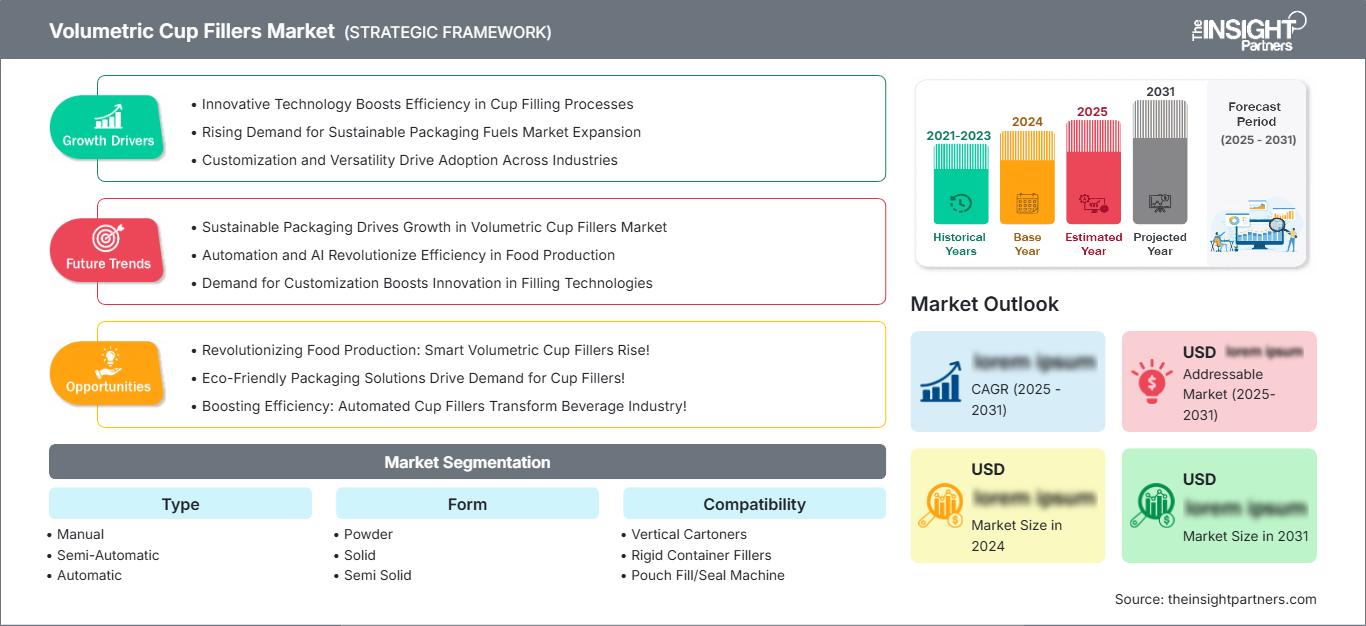
The volumetric cup fillers market is valued at US$ 7.35 Billion in 2025 and is projected to reach US$ 10.09 Billion by 2034, registering a CAGR of 3.59% from 2026 to 2034. The market encompasses equipment that portions products by calibrated volume and integrates with packaging systems serving food and beverages, cosmetics, and pharmaceutical applications. Demand is shaped by requirements for repeatable dosing, operational efficiency, flexible pack formats, and dependable integration with downstream packaging equipment.
North America is expected to record a CAGR in the range of 3.2–4.0% through 2034. The volumetric cup fillers market size in the region is supported by replacement of aging packaging equipment, expansion of contract packaging, demand for labor-efficient production, and continued investment in automated filling and checkweighing systems across food, pet food, pharmaceutical, and consumer product operations.
Volumetric Cup Fillers Market Assessment and Insights
- North America has a 2025 share of 30–34% and is projected to grow at a CAGR of 3.2–4.0% between 2026–2034, supported by automation, equipment replacement, and established packaged-food manufacturing.
- US represents approximately 24–27% of the global market in 2025 and is projected to grow at a CAGR of 3.3–4.1% between 2026–2034, led by food, pet food, and contract packaging demand.
- Europe accounts for a 2025 share of 25–29% and is expected to expand at a CAGR of 3.0–3.8% between 2026–2034, with Germany, the UK, France, Italy, and Spain supporting demand through packaging automation and manufacturing modernization.
- Asia Pacific represents a 2025 share of 27–31% and is forecast to advance at a CAGR of 4.2–5.0% between 2026–2034, led by China, Japan, South Korea, India, and Australia as packaged-product manufacturing capacity expands.
- Largest Segment is Automatic, holding a 2025 market share of 50–54% and growing at a CAGR of 4.0–4.8% between 2026–2034, reflecting demand for continuous, labor-efficient production.
- High Growth Segment is Semi-Automatic, representing a 2025 market share of 24–28% and expanding at a CAGR of 4.5–5.3% between 2026–2034, particularly among flexible and mid-scale producers.
- Key companies analyzed in detail: All-Fill Inc.; AMS Filling; AVS Pack Tech; Frain Industries; Inline Filling Systems; Labh Group of Companies; MESPACK; Pace Packaging; Spee-Dee Packaging Machinery, Inc.; YEAMAN Machine Technologies, Inc.
Source: The Insight Partners' analysis based on proprietary research, government publications, company annual reports, investor presentations, industry databases, and expert interviews.
Market evolution has moved from mechanical dosing equipment to systems equipped with servo drives, programmable control systems, tool change capabilities, checkweighing functions, and automated product handling systems. Today’s technology can handle different volumes of cups and packaging, while sanitary design and tool-less changeover help meet more stringent manufacturing demands.
Future growth is anticipated to go in favor of suppliers that offer filling precision along with connectivity, diagnostics, and flexibility. New manufacturing facilities that have been developed in Asia and Latin America offer potential for additional capacity, while food safety needs, pharmaceutical quality concerns, labor limitations, and environmental considerations drive investments into precise filling and packaging operations.
Volumetric Cup Fillers Market Report Scope
| Report Attribute | Details |
|---|---|
| Market size in 2025 | US$ 7.35 Billion |
| Market Size by 2034 | US$ 10.09 Billion |
| Global CAGR (2026 - 2034) | 3.59% |
| Historical Data | 2021-2024 |
| Forecast period | 2026-2034 |
Volumetric Cup Fillers Market Analysis
Expansion of the volumetric cup fillers market is mainly due to the need to measure the free-flowing materials with accurate precision and ensure that there are adequate throughputs as well as competitive prices for machines. Looking at the value chain, it involves testing, material hopper and cup loading, machine design and control, conveyors, filling, check weighing, sealing, coding, and machine maintenance after sales. Machine choice is heavily based on bulk density, particle size, flow ability, pack size, and speed of production.
The supply side will be affected by increasing modularity of machines and their integration capabilities. It is important that manufacturers should be able to provide machines compatible with vertical form-fill-seal machines, rigid pack filler, and bag filler. Stainless steel contacting parts, telescopic cups with adjustments, automatic volume adjustment, and check weigher feedback are all ways for suppliers to accommodate product variability without replacing entire lines.
From the volumetric cup fillers market report of volumetric cup fillers, it is clear that there is a competitive market whereby competitors have experience in manufacturing this type of machine because of their engineering, integration, services, and changeover abilities. Products from All-Fill Inc. consist of high speed and low speed filling machines of this nature, while those of Spee-Dee Packaging Machinery, Inc. provide filling and checkweighing services. In-line Filling Systems emphasize the integration ability, whereas MESPACK benefits from flexible packaging.
Companies tend to invest in the process automation rather than just filling equipment itself. Suppliers look for solutions with minimum operator interference, effective use of production line and connection of feeding processes with sealing or checking ones. In this case, the competitive position of firms depends on engineering adaptability, timely services, product testing and machine reconfiguration according to the changing size of packages.
● REPORT CUSTOMIZATION
Tailor This Report To Align With Your Specific Business Requirements
This report can be customized to align precisely with your business objectives, scope, and target markets. Customization options include tailored segmentation, geography, competitive analysis, and strategic insights to support informed decision-making.
Customize This Report →WHAT YOU CAN ADJUST
- ● Segmentations
- ● Geography
- ● Competitive Analysis
- ● Language Preferences
Volumetric Cup Fillers Market: Strategic Insights
Regional Insights
North America Volumetric Cup Fillers Market
The North American market had volumetric cup fillers market share of 30–34% in 2025 and is expected to grow at a CAGR of 3.2–4.0% over 2026–2034. The US is the key source of demand due to high volume production of packed foods, pet foods, contract packing, and automation. The replacement of aging filling equipment is driving capital spending.
The demand in Canada stems from the processing of foodstuffs, agricultural products, and consumer packaging. In general, across the region, there is a tendency for manufacturers to invest more in automatic equipment, checkweighers, and programmable controls in order to cope with labor shortages and ensure consistent output. The equipment makers have an opportunity to capitalize on the well-developed installed base that needs updating.
U.S. Volumetric Cup Fillers Market
The U.S. had about 78-82% volumetric cup fillers market share of the market in North America in 2025, which is nearly 24-27% worldwide and is projected to grow at a 3.3-4.1% CAGR during 2026-2034. There is a widespread need for food, pet food, snacks, coffee, seeds, and pharmaceuticals applications.
Relevant capability in volumetric filling and packaging machinery is available with companies like All-Fill Inc. and Spee-Dee Packaging Machinery, Inc. Automation becomes increasingly beneficial for situations where manufacturers desire increased capacity without corresponding increases in manpower. Digital recipe management, servo-based adjustments, checkweigher inputs, and fast changeover are increasingly relevant in multi-product plants.
Europe Volumetric Cup Fillers Market
European volumetric cup fillers market share was in the range of 25-29% in 2025 and is expected to grow at a CAGR of 3.0-3.8% during 2026-2034, with Germany being one of the prominent countries in the region. In the UK, efficient filling, along with mature food processing, is a key factor driving growth, whereas in Germany, machinery engineering and industrial automation play a role in growth. Processed foods, cosmetics, and pharmaceuticals produced by France, Italy, and Spain are some other factors that make Europe a favorable market.
APAC Volumetric Cup Fillers Market
Share of APAC stood at 27-31% in 2025 and the region is anticipated to have a CAGR of 4.2-5.0% till 2034. China dominates the market and is followed by Japan, South Korea, India and Australia. Growing demand for products from packaged food industry, pharmaceuticals and consumer goods has driven investments in filling machines.
China and India have strong volume potential, whereas Japan and South Korea have focused on precision and automation. India has gained significance due to growth in packaging capacity in food and pharmaceutical industries backed by overall industrial development and manufacturing in the country. MESPACK has also identified India as an emerging market for its packaging operations.
Middle East & Africa Volumetric Cup Fillers Market
In 2025, Middle East and Africa accounted for around 6-9% of global demand, which is expected to exhibit a 3.0-3.8% CAGR through 2034. The prominent Gulf countries include Saudi Arabia and the UAE, while South Africa continues to play a significant role as the manufacturing base of the region. Applications range from food processing to pharmaceuticals, chemicals, and consumer goods.
The need to invest in manufacturing and food production has made the region adopt new equipment, whereas the drive towards diversification in the Gulf is also creating a need for automation equipment. South Africa and Rest of MEA present promising future prospects as packaged goods penetration and manufacturing increase.
Segmentation Analysis
Type
Type is divided into Manual, Semi-Automatic, Automatic. Automatic systems represent the largest category because high-volume manufacturers prioritize continuous operation, consistent dosing, and reduced labor dependency. The segment is projected to grow at a 4.0–4.8% CAGR from 2026–2034. Semi-automatic systems remain important where production volumes and product portfolios do not justify full automation.
- Manual: Manual systems serve smaller production operations and applications requiring frequent product changes. Their lower acquisition cost and simple operation support demand among businesses prioritizing flexibility over throughput and automated material handling.
- Semi-Automatic: Semi-automatic machines provide a practical transition toward automation by combining operator loading with mechanized volumetric dosing. They are strategically relevant for small and medium manufacturers expanding capacity without committing to complete line automation.
- Automatic: Automatic equipment supports continuous filling, synchronized conveyors, recipe control, and integration with downstream machinery. It is preferred where production consistency, throughput, reduced operator intervention, and repeatable changeovers materially influence operating economics.
Form
Form comprises Powder, Solid, Semi Solid, Liquid. Powder and solid products are particularly compatible with volumetric portioning when flow characteristics and bulk density remain sufficiently consistent. The segment is expected to record a 3.5–4.3% CAGR from 2026–2034, supported by diverse packaged-product applications.
- Powder: Powder applications require careful control of flow behavior, dust, and density variation. Equipment configured with suitable hoppers, agitation, and containment can address these challenges across food, pharmaceutical, and consumer-product production.
- Solid: Solid products such as grains, seeds, snacks, and confectionery pieces are well suited to volumetric cups when particle dimensions and flow properties permit repeatable portioning. High-volume food production remains an important application.
- Semi Solid: Semi-solid materials present greater filling complexity because viscosity and product behavior can vary during production. Specialized configurations and controlled feeding are important where volumetric approaches are selected for suitable formulations.
- Liquid: Liquid applications require equipment designed around flow, viscosity, and container characteristics. Although volumetric cup technology is less dominant for liquids, compatible configurations can serve specialized packaging processes where controlled volume remains the principal requirement.
Compatibility
Compatibility includes Vertical Cartoners, Rigid Container Fillers, Pouch Fill/Seal Machine. The segment is projected to grow at a 3.7–4.5% CAGR from 2026–2034 as manufacturers increasingly integrate filling with broader packaging automation rather than operate isolated machines.
- Vertical Cartoners: Integration with vertical cartoning arrangements supports automated product transfer and synchronized packaging. Demand is associated with applications requiring compact footprints, consistent portioning, and efficient secondary packaging.
- Rigid Container Fillers: Rigid-container compatibility supports bottles, tubs, jars, and related formats. Integration with conveyors, checkweighers, capping, and labeling enables continuous production and reduces manual handling between process stages.
- Pouch Fill/Seal Machine: Pouch integration is important for dry foods, powders, and granular products. Synchronized dosing and sealing can improve line efficiency while supporting flexible pack sizes and high-volume consumer packaging.
Industry Vertical
Industry Vertical covers Food and Beverages, Cosmetics, Pharmaceutical. Food and beverages represent the principal application base because numerous dry, free-flowing products can be portioned economically. The segment is forecast to grow at a 3.6–4.4% CAGR from 2026–2034, while pharmaceutical applications benefit from tighter process-control requirements.
- Food and Beverages: Food producers use volumetric filling for products including grains, snacks, sugar, salt, seeds, and other free-flowing materials. Sanitation, repeatability, rapid changeovers, and reduced giveaway influence purchasing decisions.
- Cosmetics: Cosmetics applications emphasize presentation, controlled dosing, hygiene, and compatibility with varied formulations. Specialized equipment configurations can support manufacturers producing multiple pack sizes and short production runs.
- Pharmaceutical: Pharmaceutical operations prioritize validated processes, material compatibility, cleanability, and controlled dosing. GMP-oriented equipment and stainless-steel construction can support applications where contamination prevention and repeatable filling performance are essential.
Opportunity Snapshot
| Industry Vertical | Revenue Contribution | Trend Tag | Adoption Stage |
|---|---|---|---|
| Food and Beverages | High | Sanitary Automation | Mature |
| Cosmetics | Medium | Flexible Dosing | Scaling |
| Pharmaceutical | Medium | GMP Filling | Scaling |
Volumetric Cup Fillers Market Growth Drivers and Impact Analysis
Labor Efficiency and Automated Production Requirements
The suppliers of packaging face ongoing pressure to boost capacity in their facilities while keeping labor costs down and minimizing process variability. The automated volumetric fillers help in meeting this need by integrating the dosing, conveyance and subsequent packaging processes with minimal labor. This effect would be felt most by high-capacity food processing and consumer goods companies whose manual filling processes create bottlenecks and inefficiencies in the manufacturing line. In terms of control systems, the integration could help simplify recipe handling and changeover when there are multiple products being run on a single line. In the market for equipment, this trend alters buying decisions from simply requiring filling functionality towards automation features and integration.
Demand for Accurate Portioning and Lower Product Giveaway
The cost of materials makes the risk of overfilling a significant issue especially when it comes to large volume products that are packaged by weight or package quantity. The use of volumetric machines offers a solution for those products which have a predictable bulk density and flow ability. In terms of economics, the issue is not confined to the filling process since accurate dosing leads to fewer rejections, more uniform packages and even proper functioning of checkweighers. Feedback mechanisms can help to overcome the problem and achieve required production parameters. All-Fill International has developed a technology of active feedback that helps to minimize product giveaway, showing the economic importance of avoiding excess fill.
Expansion of Flexible Packaging and Pack-Format Variety
CPG companies are becoming increasingly adept at handling larger portfolios of products along with diversified packaging types, which makes it necessary to have filling machinery that supports easy changeover. The volumetric cup filling method can employ changeable cups to adjust fill volume without having to purchase entirely new machines. This is beneficial for companies that run several SKUs and also for contract packers who handle products from various clients. The adaptability of volumetric filling systems to work with vertical form-fill-seal machinery and pouch filling systems makes it even more useful. Companies that are able to integrate adaptable dosing equipment with programmable control along with easy changeover tooling can thus serve diverse needs.
Volumetric Cup Fillers Market Future Trends
Closed-Loop Filling and Intelligent Quality Control
In future, the design of equipment is set to incorporate volumetric dosing together with advanced feedback from checkweighers, sensors, and machine controls. Through automation, the system will detect variations and be able to make automatic adjustments within the operating range through machine controls. Such systems are likely to increase uniformity of dosing as well as minimize waste. Data from the machine can further be used to detect deviations, need for maintenance, and operational conditions by each type of product. This trend is especially applicable in facilities producing multiple products since there will be storage of recipes and adjustment in the machine. In the long run, intelligent control is likely to be a norm that will differentiate ordinary filling machines from automated systems.
Modular Machines for Multi-Product Manufacturing
The rise in the amount of variants being produced is pushing packaging machinery manufacturers towards designing modular systems that make it possible for manufacturers to switch cups, tooling, feeders, and control settings as easily as possible. In terms of modular machinery, there is an extended useful life of production equipment due to reconfigurable nature that can be used to adjust packaging requirements. This volumetric cup fillers market trend is particularly applicable to contract packagers and consumer products companies where there are short production runs. Such factors as quick-release systems, recipe-based control, toolless adjustments, and interface standardization may help to increase equipment utilization while reducing time needed for setup.
Volumetric Cup Fillers Market Opportunities
Automation Upgrades for Mid-Scale Producers
The mid-size food, cosmetics, and pharma manufacturers are an appealing market segment to invest in since the companies are usually somewhere in the middle ground between manual and completely automated packaging production lines. Semi-automatic machines, modular automatic fillers, and integrated checkweighing are suitable solutions that such companies could use without having to make any major adjustments within their production facilities. Manufacturers could create upgrade packages consisting of filling machines and other equipment and services. Such solutions may be financed, leased, tested for applications, and implemented gradually so as not to create a high capital hurdle. This is especially true in the case of growing economies with manufacturing firms that are increasing capacity but need labor-saving technologies.
Integrated Solutions for Pharmaceutical and High-Value Products
Pharmaceutical and high-value packaged products provide an opportunity for suppliers to emphasize controlled environments, cleanability, validated operation, and traceable process data rather than compete solely on machine price. Equipment designed with stainless-steel contact surfaces, dust containment, controlled material transfer, and recipe management can address demanding production requirements. Suppliers can also differentiate through product testing and application engineering before installation, reducing commissioning risks. As manufacturers seek higher process reliability, integrated filling, inspection, and packaging systems can command greater strategic importance than isolated fillers. The opportunity in the volumetric cup fillers market forecast extends to specialized contract manufacturers that require flexible equipment capable of handling multiple products while maintaining documented operating parameters and repeatable production conditions.
Frequently Asked Questions

- Comprehensive Market Sizing and Forecast Analysis
- Detailed Segmentation Analysis
- In-Depth Market Dynamics Assessment
- Regional and Country-Level Insights
- Competitive Landscape and Company Benchmarking
- Strategic Business Intelligence
Recent Reports
Testimonials

The Insight Partners' SCADA System Market report is comprehensive, with valuable insights on current trends and future forecasts. The team was highly professional, responsive, and supportive throughout. We are very satisfied and highly recommend their services.
RAN KEDEM Partner, Reali Technologies LTDs
I requested a report on a very specific software market and the team produced the report in a few days. The information was very relevant and well presented. I then requested some changes and additions to the report. The team was again very responsive and I got the final report in less than a week.
JEAN-HERVE JENN Chairman, Future Analytica
We worked with The Insight Partners for an important market study and forecast. They gave us clear insights into opportunities and risks, which helped shape our plans. Their research was easy to use and based on solid data. It helped us make smart, confident decisions. We highly recommend them.
PIYUSH NAGPAL Sr. Vice President, High Beam Global
The Insight Partners delivered insightful, well-structured market research with strong domain expertise. Their team was professional and responsive throughout. The user-friendly website made accessing industry reports seamless. We highly recommend them for reliable, high-quality research services
YUKIHIKO ADACHI CEO, Deep Blue, LLC.
This is the first time I have purchased a market report from The Insight Partners.While I was unsure at first, I visited their web site and felt more comfortable to take the risk and purchase a market report.I am completely satisfied with the quality of the report and customer service. I had several questions and comments with the initial report, but after a couple of dialogs over email with their analyst I believe I have a report that I can use as input to our strategic planning process.Thank you so much for taking the extra time and making this a positive experience.I will definitely recommend your service to others and you will be my first call when we need further market data.
JOHN SUZUKI President and Chief Executive Officer, Board Director, BK Technologies
I wish to appreciate your support and the professionalism you displayed in the course of attending to my request for information regarding to infectious disease IVD market in Nigeria. I appreciate your patience, your guidance, and the fact that you were willing to offer a discount, which eventually made it possible for us to close a deal. I look forward to engaging The Insight Partners in the future, all thanks to the impression you have created in me as a result of this first encounter.
DR CHIJIOKE ONYIA MANAGING DIRECTOR, PineCrest Healthcare Ltd.Reason to Buy
- Informed Decision-Making
- Understanding Market Dynamics
- Competitive Analysis
- Identifying Emerging Markets
- Customer Insights
- Market Forecasts
- Risk Mitigation
- Boosting Operational Efficiency
- Strategic Planning
- Investment Justification
- Tracking Industry Innovations
- Aligning with Regulatory Trends





 Get Free Sample for