
Wrap Around Labelling Machine Market Size, Demand & Growth by 2034
Coverage: by Type (Horizontal, Vertical); Technology (Automatic, Semi-Automatic); Dispensing Speed (Up to 20m/min, 20-40m/min, Above 40m/min); End Users (Food and Beverages, Electronics, Healthcare and Pharmaceuticals, E-Commerce, Cosmetics and Personal Care, Automotive, Others) , and Geography (North America, Europe, Asia Pacific, and South and Central America)
- Status : Data Released
- Report Code : TIPRE00012748
- Category : Manufacturing and Construction
- No. of Pages : 150
- Available Report Formats :


- Last update date : September 30, 2026


2025 Market Size
US$ 2.71 Bn
Base year value
2034 Forecast
US$ 4.27 Bn
Projected by 2034
CAGR 2026-2034
5.18 %
Growth rate
Addressable Market
US$ 31.66 Bn
(2026-2034)
The wrap around labelling machine market is valued at US$ 2.71 Billion in 2025 and is projected to reach US$ 4.27 Billion by 2034, expanding at a CAGR of 5.18% from 2026 to 2034. The market encompasses machinery designed to apply labels around cylindrical or similarly shaped products, supporting high-throughput packaging, product identification, regulatory information, and brand presentation across diverse manufacturing environments.
North America is expected to record an estimated CAGR of 5.4–6.0% during 2026–2034, supported by replacement of labor-intensive packaging operations and investments in automated production lines. The regional wrap around labelling machine market size is also supported by demand from food, pharmaceuticals, personal care, and e-commerce fulfillment, where accurate application, rapid changeovers, and integrated inspection increasingly influence equipment selection.
Wrap Around Labelling Machine Market Assessment and Insights
- North America: North America accounted for a modeled 27–31% wrap around labelling machine market share in 2025 and is expected to expand at a CAGR of 5.4–6.0% between 2026–2034, supported by automation investment and established packaging infrastructure.
- US: The US represented 21–24% of the global market in 2025 and is projected to grow at a CAGR of 5.5–6.1% between 2026–2034, driven by automated packaging upgrades.
- Europe: Europe represented 25–29% share in 2025 and is expected to grow at 4.8–5.5% CAGR through 2034, with Germany, Italy, France, the UK, and Spain providing a strong machinery manufacturing and packaging base.
- Asia Pacific: Asia Pacific held a modeled 30–34% share in 2025 and is forecast to grow at 6.0–6.7% CAGR during 2026–2034, led by China, Japan, South Korea, and India.
- Largest Segment: Automatic technology represented an estimated 54–58% market share in 2025 and is projected to expand at a 5.7–6.3% CAGR between 2026–2034, reflecting demand for continuous production.
- High Growth Segment: E-Commerce is estimated to represent 8–11% share in 2025 and is projected to expand at a 6.5–7.2% CAGR between 2026–2034, supported by fulfillment automation.
- Key companies analyzed in detail: ALTECH srl; Asia-PacificKS; ETIPACK S.p.A.; Excel Packaging Systems, Inc.; HERMA GmbH; Neostarpack Co., Ltd.; P.E. LABELLERS S.p.A.; Pack Leader Machinery Inc.; Shemesh Automation; Sidel Group.
Source: The Insight Partners' analysis based on proprietary research, government publications, company annual reports, investor presentations, industry databases, and expert interviews.
From mechanical applicator systems to modular systems including product handling, label dispensing, alignment, coding, verification, and rejection, the market has been developed. It has become very critical for cylindrical packaging since label positioning is an important factor from the view of both appearance and regulation. With tool-less changeovers, programmable control, sensors, and modular transport systems, modern equipment is becoming capable of accommodating different container sizes and preventing production disruption due to changeovers.
With respect to future investments, flexibility in the wrap around labelling machine market is likely to be considered when choosing lines which can accommodate shorter runs and wider SKU range. Manufacturing facilities emerging in Asia as well as some Middle Eastern countries will present a good business opportunity for those suppliers who are able to integrate in these markets. Traceability regulations along with product and pharmaceutical labeling regulations can encourage investments in systems that integrate application with coding and verification.
Wrap Around Labelling Machine Market Report Scope
| Report Attribute | Details |
|---|---|
| Market size in 2025 | US$ 2.71 Billion |
| Market Size by 2034 | US$ 4.27 Billion |
| Global CAGR (2026 - 2034) | 5.18% |
| Historical Data | 2021-2024 |
| Forecast period | 2026-2034 |
Wrap Around Labelling Machine Market Analysis
The connection between demand and the growth of packaged food products, drinks, pharmaceuticals, personal care, and home goods that need reliable identification is strong. The supply chain is made up of label stock producers, machine makers, applicator manufacturers, control providers, vision system providers, packaging line integration firms, and end users. In addition to considering speed for individual applications, purchasing decision-makers now consider the efficiency of the entire line more than before.
Wrap around labelling machine market development is driven by the need of manufacturers to limit manual operations and to maintain consistency in packaging across a wide range of cylindrical shapes. Dynamics of supply remain fragmented since customers usually require systems of application tailored to the sizes of containers, label types, line speed, and upstream filling equipment. Thus, the role of standardized modular systems becomes more important.
The competition in the wrap around labelling machine market involves a combination of specialized labelers as well as general packaging equipment manufacturers. The HERMA GmbH focuses on highly accurate wrap-around machines and modular machines. The Sidel Group provides labeling equipment in beverage and food packing equipment line. On the other hand, ALTECH srl, ETIPACK S.p.A., P.E. LABELLERS S.p.A., and Pack Leader Machinery Inc. compete in terms of applicability and specialization in configuration, while Neostarpack Co., Ltd. offers complete solution for bottling and labeling.
According to the wrap around labelling machine market report, investments are increasingly oriented towards automation, control systems, inspection, and simplicity of changeovers. Other competitors include Excel Packaging Systems, Inc., Shemesh Automation, and Asia-PacificKS, while HERMA GmbH continues to develop its products for the pharmaceuticals, food, cosmetics, and industrial industries. Therefore, competitive positioning will be based on engineering, installed base, customization, and complete packaging lines integration.
● REPORT CUSTOMIZATION
Tailor This Report To Align With Your Specific Business Requirements
This report can be customized to align precisely with your business objectives, scope, and target markets. Customization options include tailored segmentation, geography, competitive analysis, and strategic insights to support informed decision-making.
Customize This Report →WHAT YOU CAN ADJUST
- ● Segmentations
- ● Geography
- ● Competitive Analysis
- ● Language Preferences
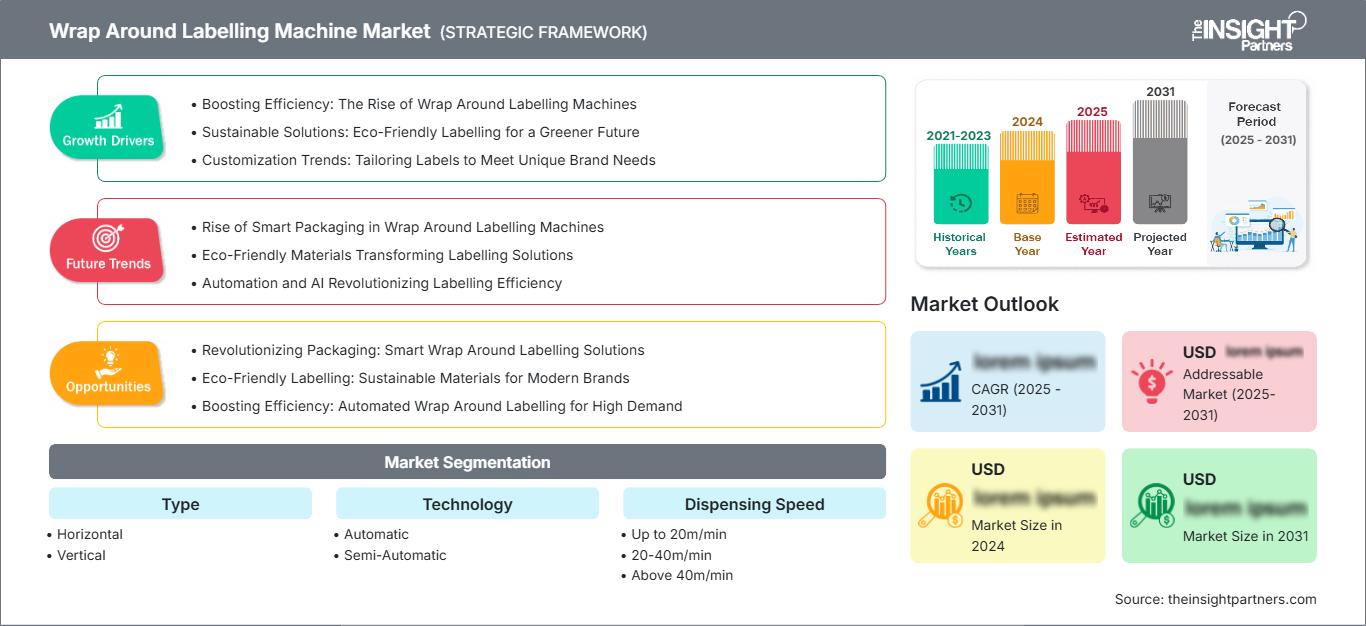
Wrap Around Labelling Machine Market: Strategic Insights
Regional Insights
North America wrap around labelling machine market
North America represented a modeled 27–31% share of the global wrap around labelling machine market in 2025 and is expected to expand at a 5.4–6.0% CAGR through 2034. Strengths include well-established food and beverage, pharmaceutical, cosmetics, and consumer goods manufacturing industries. Increasing demand is linked to automated packing lines that eliminate operator involvement and ensure consistent label placement. Buyers of machinery consider flexibility in handling because contract manufacturers and brand owners run multiple formats in their lines. Coding, vision inspection, rejection, and serialization functions are additional considerations for buying machinery in applications in which they are important to ensure qualification of production lines and maintain production flow.
The United States continues to be the leading regional market for demand owing to substantial production of packed food, pharmaceutical manufacturing, and contract packaging. Canadian demand is relatively small but is facilitated by food processing and consumer goods manufacturing. Increasingly, buyers consider machines' uptime, changeover time, accessibility of machines for maintenance, and ability to be integrated into existing conveyor systems and fillers. There is replacement demand driven by the existence of specialized machinery suppliers and packaging integrators.
U.S. wrap around labelling machine market
The wrap around labelling machine market forecast shows that the US accounted for a modeled 21–24% global share in 2025 and is projected to grow at a 5.5–6.1% CAGR during 2026–2034. Its location in North America is based on significant packaging activity in packaged food products, beverages, pharmaceuticals, personal care, and e-commerce packaging. Demand is skewed to the manufacturers that require automated equipment with inspection and coding functions.
The US comprises around 75-80% of the modeled North American market for 2025. The competition involves companies like Pack Leader Machinery Inc., Excel Packaging Systems, Inc., as well as more general packaging system integration firms, all competing in flexible automation, serviceability, and application engineering. Use cases include those related to contract packaging and high-mix manufacturing, where changeover of formats can be programmed to accommodate multiple SKUs without mechanical modifications.
Europe wrap around labelling machine market
Europe represented a modeled 25–29% share in 2025 and is projected to grow at a 4.8–5.5% CAGR. Germany is a major market owing to the presence of machinery manufacture, whereas Italy is still crucial for the engineering of equipment for packaging. In turn, France, Britain, and Spain provide the supply chain in relation to the production of foods, beverages, pharmaceuticals, cosmetics, and industrial products. The importance of the European market lies in the focus on accuracy, energy efficiency, modularity, cleanliness, and compliance with regulations. HERMA GmbH, ETIPACK S.p.A., P.E. LABELLERS S.p.A., and ALTECH srl complement the region’s technological infrastructure.
APAC wrap around labelling machine market
APAC held a modeled 30–34% share in 2025 and is expected to grow at a 6.0–6.7% CAGR. The leading nations that create demand in this region are China, Japan, South Korea, India, and Australia. Economic growth, growth in packaged food consumption, pharmaceutical production, and automation investments promote usage of machines. The labor issues faced by Japan help in developing compact automation solutions, whereas India gets advantages due to development of food/beverage/pharmaceutical/personal care production.
Middle East & Africa wrap around labelling machine market
Middle East and Africa is expected to expand at a 4.6–5.3% CAGR through 2034. Saudi Arabia and the UAE represent important Middle Eastern markets because of investments in food manufacturing, consumer goods, logistics, and industrial diversification. South Africa remains the leading African market, supported by established packaged-food and beverage production.
The regional demand is further affected by infrastructure development and economy diversification away from hydrocarbons. There are possibilities for automatic packaging providers catering to the needs of manufacturing plants in Saudi Arabia and the UAE, but the more developed installed base is found in South Africa. The Rest of MEA region is still fragmented, with purchasing decisions being driven by local integrators and service, imported machinery availability, and capital expenditure.
Segmentation Analysis
Type
The Type segment is divided between Horizontal and Vertical configurations. Horizontal systems are generally suited to products that can be conveyed and stabilized horizontally, while vertical systems support upright cylindrical containers and high-throughput packaging lines. Selection depends on container geometry, stability, production layout, and integration requirements. The segment is projected to grow at a 5.0–5.7% CAGR during 2026–2034.
- Horizontal: Horizontal systems support stable handling of selected cylindrical or irregular products and are strategically relevant where controlled orientation improves application accuracy. Their value increases in specialized packaging lines requiring consistent product positioning.
- Vertical: Vertical systems address upright containers across food, beverage, pharmaceutical, and personal-care applications. Their compatibility with conventional conveyors and rotary handling equipment supports broader deployment across continuous production environments.
Technology
Technology is segmented into Automatic and Semi-Automatic systems. Automatic equipment represents the dominant configuration because manufacturers increasingly prioritize continuous production, reduced labor dependence, and integration with upstream and downstream equipment. Semi-automatic machines remain relevant for lower-volume and higher-mix operations. The segment is projected to grow at a 5.4–6.0% CAGR during 2026–2034.
- Automatic: Automatic systems provide continuous feeding, application, and product discharge, making them strategically important for high-volume packaging. Integration with coding, inspection, rejection, and programmable controls further supports industrial deployment.
- Semi-Automatic: Semi-automatic systems remain attractive for smaller manufacturers and contract packagers requiring flexibility without full-line automation. Lower infrastructure requirements can make them suitable for moderate volumes, frequent SKU changes, and constrained production spaces.
Dispensing Speed
Dispensing Speed includes Up to 2m/min, 2-4m/min, and Above 4m/min. Speed selection depends on container geometry, label material, adhesive characteristics, product handling, and upstream line performance. High-speed equipment is increasingly selected where labeling represents a potential production bottleneck. The segment is projected to grow at a 5.2–5.9% CAGR during 2026–2034.
- Up to 2m/min: Lower-speed equipment serves small and medium production environments where flexibility and application accuracy take precedence over maximum throughput. It remains relevant for specialized, customized, and frequently changing packaging formats.
- 2-4m/min: Mid-range dispensing provides a balance between throughput and operational flexibility. It suits manufacturers upgrading from manual application while retaining compatibility with moderate production volumes and varied container formats.
- Above 4m/min: High-speed systems target continuous manufacturing environments where throughput, synchronization, and application stability are critical. Their strategic value is strongest in beverage, food, pharmaceutical, and large-scale consumer-product packaging.
End Users
End Users include Food and Beverages, Electronics, Healthcare and Pharmaceuticals, E-Commerce, Cosmetics and Personal Care, and Automotive. Demand differs according to regulatory requirements, package geometry, throughput, and product-mix complexity. The segment is projected to grow at a 5.6–6.2% CAGR during 2026–2034.
- Food and Beverages: High-volume packaged products require consistent application, clean handling, and compatibility with fast production lines. Wrap-around systems are particularly relevant for cylindrical bottles, jars, cans, and similar containers.
- Electronics: Electronics manufacturers prioritize accurate identification, traceability, and handling of compact components or packaged products. Flexible systems support varied SKUs and integration with coding or verification technologies.
- Healthcare and Pharmaceuticals: Regulated products require controlled application, verification, and reliable product handling. Pharmaceutical operations increasingly favor machines that integrate inspection, coding, rejection, and documented process controls.
- E-Commerce: Fulfillment environments prioritize scalable automation and rapid handling of varied packages. Labeling systems support automated identification while helping reduce repetitive manual activities in high-throughput distribution operations.
- Cosmetics and Personal Care: Packaging presentation is important alongside accuracy, particularly for bottles, jars, and tubes. Flexible labeling equipment supports frequent product launches and multiple package formats.
- Automotive: Automotive applications require durable identification and dependable placement across components, containers, and service products. Equipment selection often emphasizes reliability, repeatability, and integration with broader production workflows.
Opportunity Snapshot
| End Users | Revenue Contribution (High/Medium/Low) | Trend Tag (MAX 2 words) | Adoption Stage (Emerging/Scaling/Mature) |
| Food and Beverages | High | High Throughput | Mature |
| Electronics | Medium | Traceability Labels | Scaling |
| Healthcare and Pharmaceuticals | High | Verified Labels | Scaling |
| E-Commerce | Medium | Fulfillment Automation | Scaling |
| Cosmetics and Personal Care | Medium | SKU Flexibility | Scaling |
| Automotive | Medium | Durable Identification | Mature |
Wrap Around Labelling Machine Market Growth Drivers and Impact Analysis
Labor optimization and automated packaging-line integration
Manufacturers are increasingly redesigning packaging operations around automated material movement, application, inspection, and rejection to reduce dependence on repetitive manual tasks. The impact is strongest where labor availability is constrained or where production requires consistent application across long operating cycles. Automated wrap-around systems can also synchronize with fillers, cappers, conveyors, coding units, and case-packing equipment, reducing bottlenecks between individual processes. This encourages buyers to evaluate labeling machinery as part of an integrated line rather than an isolated purchase. For suppliers, the shift expands opportunities for modular systems, controls integration, remote diagnostics, and service contracts. Smaller manufacturers may adopt semi-automatic configurations before progressing toward full automation, creating a replacement pathway across equipment categories and supporting sustained demand for adaptable labeling technologies.
Growth of packaged products and SKU proliferation
The proliferation of packaged products is increasing the number of labeling formats that manufacturers must accommodate within existing production facilities. Food, beverages, personal care, pharmaceuticals, and household products frequently require different container sizes, label dimensions, adhesive specifications, and information layouts. This environment increases the economic value of equipment capable of rapid format changes without extensive mechanical adjustment. The market impact extends beyond new machine purchases because installed equipment can be upgraded through improved applicators, controls, sensors, printers, and inspection modules. Suppliers that combine standardized platforms with configurable handling components can address diverse customer requirements while limiting engineering complexity. For end users, flexible equipment can improve asset utilization by allowing more SKUs to run through the same production cell, particularly in contract manufacturing and multi-brand operations.
Traceability and compliance requirements across regulated packaging
Increasing emphasis on product identification, traceability, variable information, and verification is changing the functional requirements of labeling equipment. Pharmaceutical manufacturers in particular require dependable placement and inspection because errors can compromise product release and regulatory compliance. Similar requirements are emerging across food, cosmetics, chemicals, and logistics, where batch information, product codes, or serialized identifiers support downstream control. The impact is driving greater integration between labeling machines, printers, vision systems, databases, and rejection mechanisms. Equipment suppliers are therefore competing on the ability to provide controlled application combined with reliable data handling. This trend can increase system value because customers may justify investment through compliance, quality assurance, and reduced product-recall exposure rather than labor savings alone, encouraging replacement of older standalone applicators.
Wrap Around Labelling Machine Market Future Trends
Intelligent vision-assisted labeling systems
The wrap around labelling machine market trends are expected to increasingly involve machine vision, automated alignment, and software-assisted quality decisions. Future systems will likely combine camera-based verification with application control to identify missing labels, positional deviations, print defects, and unsuitable products before downstream packing. This development can reduce manual inspection and provide more consistent quality records. As vision hardware becomes easier to integrate, manufacturers may use shared interfaces connecting label application, coding, inspection, and rejection functions. Data generated by these systems can also support maintenance and production analysis by identifying recurring faults or process deviations. Suppliers that design standardized interfaces will be better positioned to serve factories seeking interoperable automation rather than proprietary equipment islands.
Modular equipment designed for shorter production runs
Future systems are likely to prioritize modular architectures that allow manufacturers to reconfigure application components, conveyors, sensors, and controls as product portfolios change. Shorter production cycles and more frequent SKU introductions make long mechanical changeovers increasingly costly because equipment remains idle while operators modify formats. Modular systems can reduce this burden by combining standardized machine frames with configurable application and handling modules. Digital position indicators, programmable recipes, tool-less adjustments, and guided setup procedures are likely to become more common. The resulting equipment will support a wider range of container geometries without requiring entirely new machines. This trend should particularly benefit contract manufacturers, private-label producers, and consumer-product companies managing multiple packaging formats across shared manufacturing assets.
Wrap Around Labelling Machine Market Opportunities
Expansion of automated packaging capacity in emerging manufacturing hubs
Manufacturing expansion in India, Southeast Asia, the Middle East, and selected Latin American markets creates opportunities for suppliers that can combine equipment with localized integration and after-sales support. New food, beverage, pharmaceutical, cosmetics, and consumer-product facilities often provide an opportunity to specify automated labeling during initial line design rather than retrofit older equipment. Suppliers can capture this opportunity by developing scalable platforms covering entry-level through high-throughput applications. Partnerships with local engineering firms can reduce installation barriers and improve response times for maintenance and spare parts. The strongest opportunities are likely to arise where industrial diversification, packaged-product consumption, and workforce constraints occur simultaneously. Local training and standardized service programs can further strengthen adoption by reducing the perceived operational risk associated with imported machinery.
Integrated labeling, coding, and inspection solutions
An important investment opportunity lies in combining application with coding, vision inspection, rejection, and production-data interfaces. Customers increasingly seek consolidated systems because separate machines can increase integration complexity, footprint, commissioning time, and maintenance requirements. Suppliers capable of offering integrated modules can create differentiated solutions for pharmaceutical, food, cosmetics, and logistics applications where product identification and quality verification are closely connected. The opportunity also extends to upgrading installed equipment because existing labeling machines can potentially receive new inspection, printing, control, or connectivity modules without complete replacement. Vendors with broad automation capabilities can therefore pursue both greenfield projects and retrofit demand. This approach can increase equipment value while helping manufacturers modernize production gradually and manage capital expenditure more effectively.
Frequently Asked Questions

- Comprehensive Market Sizing and Forecast Analysis
- Detailed Segmentation Analysis
- In-Depth Market Dynamics Assessment
- Regional and Country-Level Insights
- Competitive Landscape and Company Benchmarking
- Strategic Business Intelligence
Recent Reports
Testimonials

The Insight Partners' SCADA System Market report is comprehensive, with valuable insights on current trends and future forecasts. The team was highly professional, responsive, and supportive throughout. We are very satisfied and highly recommend their services.
RAN KEDEM Partner, Reali Technologies LTDs
I requested a report on a very specific software market and the team produced the report in a few days. The information was very relevant and well presented. I then requested some changes and additions to the report. The team was again very responsive and I got the final report in less than a week.
JEAN-HERVE JENN Chairman, Future Analytica
We worked with The Insight Partners for an important market study and forecast. They gave us clear insights into opportunities and risks, which helped shape our plans. Their research was easy to use and based on solid data. It helped us make smart, confident decisions. We highly recommend them.
PIYUSH NAGPAL Sr. Vice President, High Beam Global
The Insight Partners delivered insightful, well-structured market research with strong domain expertise. Their team was professional and responsive throughout. The user-friendly website made accessing industry reports seamless. We highly recommend them for reliable, high-quality research services
YUKIHIKO ADACHI CEO, Deep Blue, LLC.
This is the first time I have purchased a market report from The Insight Partners.While I was unsure at first, I visited their web site and felt more comfortable to take the risk and purchase a market report.I am completely satisfied with the quality of the report and customer service. I had several questions and comments with the initial report, but after a couple of dialogs over email with their analyst I believe I have a report that I can use as input to our strategic planning process.Thank you so much for taking the extra time and making this a positive experience.I will definitely recommend your service to others and you will be my first call when we need further market data.
JOHN SUZUKI President and Chief Executive Officer, Board Director, BK Technologies
I wish to appreciate your support and the professionalism you displayed in the course of attending to my request for information regarding to infectious disease IVD market in Nigeria. I appreciate your patience, your guidance, and the fact that you were willing to offer a discount, which eventually made it possible for us to close a deal. I look forward to engaging The Insight Partners in the future, all thanks to the impression you have created in me as a result of this first encounter.
DR CHIJIOKE ONYIA MANAGING DIRECTOR, PineCrest Healthcare Ltd.Reason to Buy
- Informed Decision-Making
- Understanding Market Dynamics
- Competitive Analysis
- Identifying Emerging Markets
- Customer Insights
- Market Forecasts
- Risk Mitigation
- Boosting Operational Efficiency
- Strategic Planning
- Investment Justification
- Tracking Industry Innovations
- Aligning with Regulatory Trends





 Get Free Sample for