
Abrasion Resistant Coatings Market Share, Growth & Demand by 2034
Coverage: By Type (Metal/Ceramic Coatings, Polymer Coatings); End User Industry (Construction, Marine, Mining, Oil and Gas, Power Generation, Transportation, Other End User Industries) , and Geography (North America, Europe, Asia Pacific, and South and Central America)
- Status : Data Released
- Report Code : TIPRE00006943
- Category : Chemicals and Materials
- No. of Pages : 150
- Available Report Formats :


- Last update date : July 15, 2026


2025 Market Size
US$ 14.02 Bn
Base year value
2034 Forecast
US$ 25.74 Bn
Projected by 2034
CAGR 2026-2034
6.99 %
Growth rate
Addressable Market
US$ 179.60 Bn
(2026-2034)
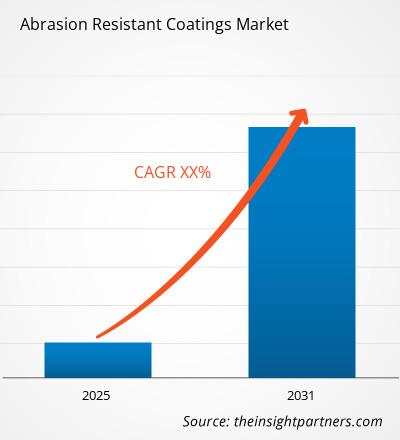
The abrasion-resistant coatings market was valued at US$ 14.02 billion in 2025 and is projected to reach US$ 25.74 billion by 2034, growing at a rate of 6.99% from 2026 to 2034. The increasing need for durable surface protection solutions in heavy industries, transportation systems, oil and gas infrastructure, and mining equipment drives the growth. A greater focus on asset longevity, operational efficiency, and resistance to wear and corrosion is speeding up the use of these coatings in both developed and emerging economies.
North America is expected to grow steadily at a rate of 6.3% to 6.8% from 2026 to 2034. This growth is supported by strong industrial maintenance and modernization of energy and power infrastructure. The rise in shale gas operations, aerospace manufacturing, and mining refurbishment projects is boosting the demand for coatings. Additionally, stricter workplace safety standards and asset protection needs are promoting the use of advanced polymer and ceramic-based abrasion-resistant systems.
Abrasion-Resistant Coatings Market Assessment and Insights
- North America: Accounted for a 28–32% share in 2025 and is projected to grow at a CAGR of 6.3–6.8% during 2026–2034. Demand is driven by oil & gas infrastructure upgrades, mining equipment protection, and aerospace component durability requirements across the U.S. and Canada.
- U.S.: Held 80–84% share of North America in 2025 and is expected to grow at a CAGR of 6.2–6.7% during 2026–2034, supported by shale production activities, defense manufacturing, and industrial maintenance demand.
- Europe: Accounted for a 25–29% share in 2025 and is projected to grow at a CAGR of 6.5–7.1% during 2026–2034, led by Germany, France, the UK, Italy, and Spain. Strong industrial automation and renewable energy expansion support coatings demand.
- Asia Pacific: Held a 33–37% share in 2025 and is projected to expand at a CAGR of 7.4–8.1% during 2026–2034, led by China, India, Japan, and South Korea. Rapid industrialization and infrastructure expansion are key drivers.
- Largest Segment – Metal/Ceramic Coatings: Accounted for 52–56% share in 2025 and is projected to grow at a CAGR of 6.8–7.2% during 2026–2034, driven by high-performance requirements in mining, oil & gas, and power generation.
- High Growth Segment – Mining Industry End User: Held 18–22% share in 2025 and is expected to grow at a CAGR of 7.6–8.3% during 2026–2034, due to extreme wear conditions and equipment lifecycle optimization needs.
- Key companies analyzed in detail: Akzo Nobel N.V., Axalta Coating Systems Ltd., Hardide plc, Hempel A/S, Jotun A/S, PPG Industries, Inc., Linde Advanced Material Technologies Inc., Compagnie de Saint-Gobain S.A., Sika AG, and The Sherwin-Williams Company.
Source: The Insight Partners' analysis based on proprietary research, government publications, company annual reports, investor presentations, industry databases, and expert interviews.
The abrasion-resistant coatings market has changed from traditional protective paints to highly engineered surface systems that include ceramic composites, polymer blends, and nano-enhanced formulations. Earlier uses were mainly for corrosion protection, but as mining, oil extraction, and high-load transportation grew, demand shifted to multifunctional coatings. Improvements in thermal spray technologies, plasma coating systems, and chemical vapor deposition have greatly increased coating adhesion and wear resistance. Manufacturers are putting more money into automated coating processes and digital quality control systems. These investments aim to ensure consistent thickness, lessen material waste, and improve operational reliability in large-scale industrial applications.
Abrasion-Resistant Coatings Market Report Scope
| Report Attribute | Details |
|---|---|
| Market size in 2025 | US$ 14.02 Billion |
| Market Size by 2034 | US$ 25.74 Billion |
| Global CAGR (2026 - 2034) | 6.99% |
| Historical Data | 2021-2024 |
| Forecast period | 2026-2034 |
Abrasion-Resistant Coatings Market Analysis
According to the abrasion-resistant coatings market report, there is a notable trend where investments are directed towards developing the next generation coating technologies, such as those based on nanotechnology, ceramic enhanced products, and eco-friendly coating materials. Companies involved in the sector are increasing production capacity in regions such as Asia Pacific, North America, and Middle East in order to cope with the growing demand driven by industrialization and mega projects. Some of the key strategies employed include mergers and acquisition, technological collaborations and joint ventures.
Overall, competitive rivalry is still at its peak among dominant multinational firms, who have been increasing their presence in the market through innovations and expansions of their portfolios. Top firms such as PPG Industries, Inc., Akzo Nobel N.V., The Sherwin-Williams Company, Jotun A/S, Hempel A/S, and Axalta Coating Systems Ltd. have been making substantial investments in R&D for providing high performance coating technologies. Capacity expansions, mergers, alliances and partnerships with industrial firms are aiding them to improve their market reach as well as technological capabilities. At the same time, regional players are gaining strength by providing cost effective coatings meeting the local industries’ requirements.
Value chain of the market includes various participants such as suppliers of raw materials and resins, coating formulation companies, applicators, distributors, and industries using the product. Epoxy, polyurethane, acrylic resins, ceramic pigments, metallic fillers, and special-purpose additives for enhanced abrasion resistance are among the key raw materials. Price trends of these raw materials are affected by the cost changes of petrochemical-based feeds, metals and environmental requirements for the production of chemicals. In order to enhance the performance and sustainability of coatings, formulation firms are adopting new formulations, automation techniques and low-volatile organic compound or water-based coatings technology.
The worldwide abrasion-resistant coating market has been registering constant growth in recent years, backed by the growing requirement for innovative protective systems in various sectors such as mining, manufacturing, marine, oil & gas, automotive, construction, and industrial processes. Growing investments in transportation infrastructure, heavy machinery, industrial machinery, and pipeline infrastructure are leading to increased use of coatings that help in reducing wear, extending equipment lifetime, and lowering maintenance costs. Additionally, there has been an increasing emphasis on the aspect of asset reliability, lifecycle cost reduction, and strict maintenance practices.
● REPORT CUSTOMIZATION
Tailor This Report To Align With Your Specific Business Requirements
This report can be customized to align precisely with your business objectives, scope, and target markets. Customization options include tailored segmentation, geography, competitive analysis, and strategic insights to support informed decision-making.
Customize This Report →WHAT YOU CAN ADJUST
- ● Segmentations
- ● Geography
- ● Competitive Analysis
- ● Language Preferences
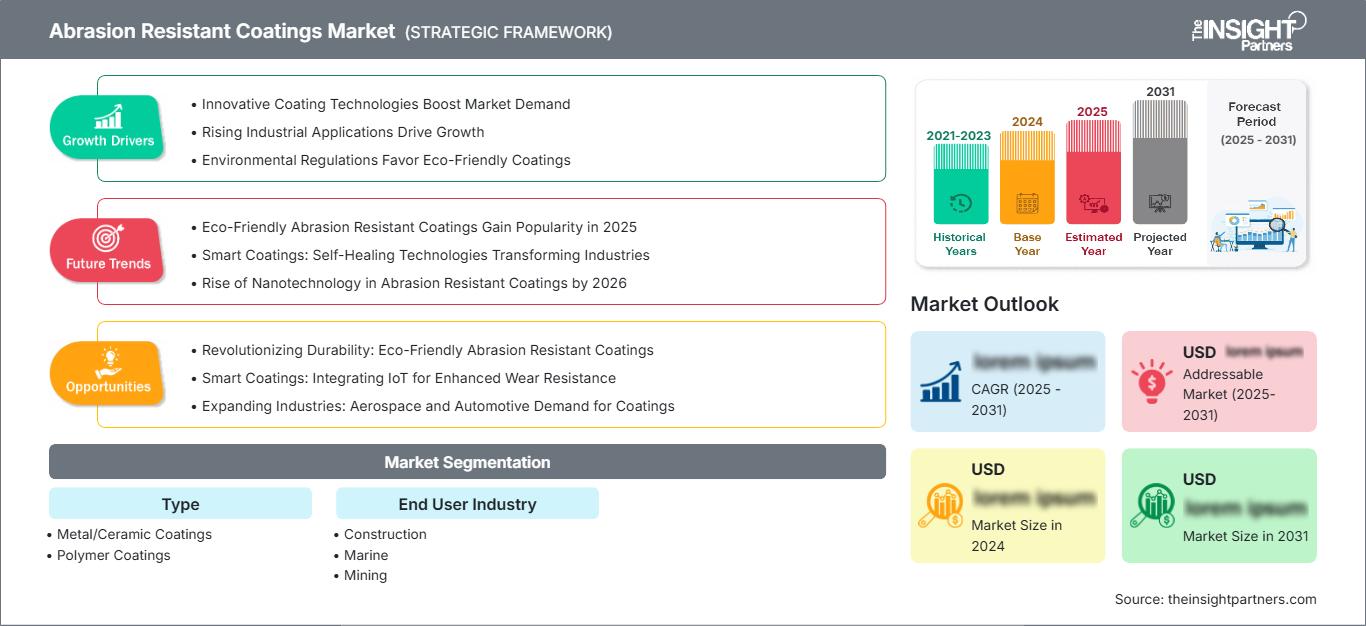
Abrasion-Resistant Coatings Market: Strategic Insights
Regional Insights
North America Abrasion-Resistant Coatings Market
North America held 28 to 32% of the abrasion-resistant coatings market share in 2025. It is expected to grow at a compound annual growth rate (CAGR) of 6.3 to 6.8% between 2026 and 2034. The demand comes from a strong industrial foundation in the United States and Canada, especially in oil and gas, mining, aerospace, and heavy machinery. There is a growing emphasis on extending asset life cycles and cutting down on maintenance downtime. This encourages the use of new coating technologies in important industrial settings.
The region benefits from robust research and development capabilities, efficient manufacturing systems, and a trend toward using high-performance polymer and ceramic-based coatings. Investments in shale gas exploration, updating refineries, and defense manufacturing are boosting demand. Strict safety standards and environmental rules are also leading to the replacement of traditional coatings with abrasion-resistant systems that enhance durability and operational efficiency.
U.S. Abrasion-Resistant Coatings Market
The United States accounted for 80 to 84% of North America's abrasion-resistant coatings market in 2025 and is expected to grow at a compound annual growth rate of 6.2 to 6.7% from 2026 to 2034. There is strong demand from oilfield operations, aerospace component manufacturing, industrial machinery maintenance, and mining equipment protection. Investments in infrastructure repair and energy sector growth are also boosting coatings use in important applications.
Leading companies like The Sherwin-Williams Company, PPG Industries, Inc., and Axalta Coating Systems Ltd. have solid production and distribution networks throughout the country. The rising use of ceramic and polymer coatings is improving resistance to abrasion, corrosion, and chemicals. The shift towards predictive maintenance and long-lasting industrial assets is increasing the need for high-performance protective coatings across the U.S. industrial sector.
Europe Abrasion-Resistant Coatings Market
Europe held a 25 to 29% share of the global abrasion-resistant coatings market in 2025 and is projected to grow at a CAGR of 6.5 to 7.1% during 2026 to 2034. Germany leads the regional market because of its strong automotive, machinery, and industrial engineering sectors. It is followed by France, the United Kingdom, Italy, and Spain. The increasing focus on energy efficiency and industrial sustainability is speeding up the use of improved protective coating systems.
UK displays stable demand for off-shore energy, aerospace, and manufacturing. The country of Germany is still making investments in automation and precision engineering that favor the performance of high-performance coatings. France and Italy are experiencing good use of high-performance coatings in transportation and industrial machinery sectors. Spain is enjoying modernization of infrastructure and development of renewable energy. The strict environmental regulations of EU are forcing manufacturers to use eco-friendly coating systems.
Asia Pacific Abrasion-Resistant Coatings Market
Asia Pacific accounted for 33 to 37% of the global abrasion-resistant coatings market size in 2025 and is expected to grow at a CAGR of 7.4 to 8.1% during 2026 to 2034. China holds a dominant position when it comes to demand because of the country’s significant industrial base, mines, and infrastructure developments. India is becoming a high growth market, due to industrial developments and investments in energy infrastructure. There are contributions from Japan and South Korea owing to their industries of automobiles, ships, and electronic goods. There is contribution from Australia owing to mining and extraction industries. Increasing government investments in infrastructure, fast urbanization, and industrialization is quickening the pace at which coatings are being adopted. The rising demand for durable coatings in difficult conditions is making APAC a rapidly growing region.
Middle East & Africa Abrasion-Resistant Coatings Market
The Middle East and Africa region is expected to grow at a rate of 6.8 to 7.5% from 2026 to 2034. Saudi Arabia is the leader in this market because of its strong oil and gas infrastructure, refinery expansions, and industrial diversification efforts supported by national development programs. The United Arab Emirates follows closely, driven by demand from the construction, aviation, and logistics sectors. South Africa shows steady demand mainly due to mining and heavy industrial activities.
Other economies in the region are gradually increasing their adoption of protective coatings through investments in infrastructure and energy. Tough environmental conditions, such as high abrasion and corrosion, are raising the need for durable protective coatings. Ongoing efforts in industrial diversification and infrastructure modernization are expected to boost long-term demand across the region.
Segmentation Analysis
Type
Type Segment is estimated to witness a CAGR of 6.7 to 7.3% between 2026 and 2034. This increase will be due to the rising requirements for effective surface protection systems under harsh operating conditions. The increase in industrial operations, infrastructural issues, and equipment maintenance has resulted in coatings that have the ability to withstand wear and tear, as well as corrosion and chemical resistance. The emphasis on improving the bonding capability, heat resistance, and durability of the coatings by manufacturers will drive growth. Additionally, growing applications in mining, oil and gas, and heavy machinery industries are fueling the growth of the market.
- Metal/Ceramic Coatings: Metal and ceramic coatings are popular due to their hardness, wear resistance, and thermal stability. These coatings are commonly used in mining equipment, turbine components, and industrial machinery that need to operate for long periods under extreme conditions.
- Polymer Coatings: Polymer coatings are becoming more popular because they are flexible, cost-effective, and resistant to corrosion. They are widely used in transportation, construction, and marine settings, where lightweight protection and easy application are significant benefits.
End User Industry
The End User Industry market is estimated to grow at a CAGR of 7.0-7.6% during the forecast period of 2026-2034. This growth can be attributed to growing industrial infrastructures, energy generation and transportation systems. Growing need for efficient operations, reduced maintenance periods and increased longevity of the machinery is leading to rising adoption in a wide array of industries. Industrialization of developing countries and upgrading of existing infrastructures in developed nations is adding up to the growing demands in the market. There is an increase in the use of abrasion-resistant coatings in various machineries by companies.
- Construction: The construction industry uses coatings for protecting structural steel, concrete surfaces, and heavy equipment. This improves durability and reduces surface wear in tough environments.
- Marine: Demand in the marine industry is driven by the need to protect against saltwater corrosion and abrasion. Advanced coatings are required for ship hulls, offshore platforms, and port infrastructure.
- Mining: Mining applications need highly durable coatings that can resist extreme abrasion from ore processing, excavation equipment, and conveyor systems facing severe mechanical stress.
- Oil and Gas: Oil and gas operations depend on abrasion-resistant coatings for pipelines, drilling equipment, and refinery components that are exposed to high wear, pressure, and corrosive environments.
- Power Generation: Power generation facilities protect turbines, boilers, and mechanical systems with coatings that guard against erosion, heat, and particulate abrasion during continuous operations.
- Transportation: In transportation, coatings are used on railways, automotive parts, and heavy vehicles. These coatings enhance wear resistance, lower maintenance costs, and improve operational reliability.
Opportunity Snapshot
| Segment Name | Revenue Contribution | Trend Tag | Adoption Stage |
| Construction | High | Infrastructure Durability | Mature |
| Marine | Medium | Corrosion Control | Scaling |
| Mining | High | Heavy Wear Protection | Scaling |
| Oil and Gas | High | Asset Longevity | Mature |
| Power Generation | Medium | Thermal Shielding | Scaling |
| Transportation | High | Mobility Protection | Mature |
Abrasion-Resistant Coatings Market Growth Drivers and Impact Analysis
Expansion of Heavy Industrial Operations and Mining Activities
The growth of mining, oil extraction, construction, and heavy engineering industries is a major factor driving the abrasion-resistant coatings market. These sectors function in environments with high abrasion, where equipment faces constant wear, impact from particles, and surface erosion. As global demand for metals, minerals, and energy resources rises, operators are increasing production capacity and extending the operational lifetimes of important assets. Abrasion-resistant coatings help decrease failure rates, cut down on maintenance time, and boost overall productivity. Mining trucks, crushers, drilling tools, pipelines, and conveyors are increasingly depending on ceramic and polymer-based coatings. This ongoing industrial growth, especially in Asia Pacific, the Middle East, and Latin America, is significantly increasing global demand and speeding up their adoption in industries that require heavy investment.
Rising Focus on Asset Longevity and Maintenance Cost Reduction
Industries are putting more emphasis on optimizing the lifecycle of assets, as operational costs, labor costs, and downtime for equipment continue to increase globally. Abrasion-resistant coatings are essential for prolonging the service life of machines and infrastructure by protecting surfaces from erosion, corrosion, and chemical damage. Companies in oil and gas, power generation, and manufacturing are using predictive maintenance strategies that depend on strong surface engineering solutions to minimize unplanned shutdowns. The shift towards enhancing long-term performance of assets instead of focusing on short-term replacements is driving higher investments in better coating technologies. Additionally, stricter performance standards in industrial purchasing policies are increasing the demand for coatings that provide reliable durability under harsh operating conditions, further boosting market growth in developed countries.
Technological Advancements in Coating Materials and Application Methods
Ongoing innovation in coating materials and application methods is greatly improving performance and broadening industrial use. Developments in nano-structured coatings, thermal spray methods, and hybrid polymer-ceramic systems are boosting abrasion resistance, adhesive strength, and thermal stability. Automated coating applications and robotic spraying methods are enhancing precision, cutting material waste, and ensuring even layer thickness on large industrial components. Research into self-healing coatings and environmentally friendly low-VOC formulas is also increasing market potential. These innovations allow manufacturers to create high-performance solutions designed for extreme settings like offshore platforms, mining areas, and high-speed transport systems. As technology use increases, abrasion-resistant coatings are becoming more efficient, durable, and cost-effective across industrial applications worldwide.
Abrasion-Resistant Coatings Market Future Trends
Shift Toward Sustainable and Low-VOC Coating Systems
Environmental regulations and commitments to sustainability are driving a significant move toward low-VOC, water-based, and environmentally friendly abrasion-resistant coatings. Regulatory bodies in North America and Europe are enforcing stricter emission standards. This pushes manufacturers to reformulate products while maintaining their performance. Companies are investing more in bio-based resins, recyclable materials, and energy-efficient production processes. End-user industries want to reduce their environmental impact and comply with ESG reporting frameworks. As a result, sustainable coating systems are becoming more popular in construction, transportation, and industrial maintenance applications. Over time, environmentally responsible formulations should become standard in many industrial sectors, changing product development strategies and supply chain structures within the global coatings industry.
Integration of Smart Coatings and Advanced Functional Surfaces
The development of smart coatings with improved functional capabilities is a key trend supporting the abrasion-resistant coatings market forecast. These coatings are designed to include features like self-healing, anti-fouling, temperature responses, and real-time wear tracking. Connecting with sensor-based systems helps industries monitor coating performance and predict maintenance needs more accurately. This is especially important in aerospace, oil and gas, and power generation sectors where equipment reliability matters greatly. Research institutions and manufacturers are working together to create multifunctional coatings that go beyond traditional protection roles. As digitalization and industrial IoT adoption continue to grow, smart coatings will likely play a bigger role in predictive maintenance systems and next-generation industrial asset management strategies.
Abrasion-Resistant Coatings Market Opportunities
Expansion in Emerging Industrial Economies
Emerging economies in Asia Pacific, Latin America, and the Middle East offer significant growth opportunities due to rapid industrialization, infrastructure development, and resource extraction. Countries like India, Indonesia, Brazil, Saudi Arabia, and Vietnam are heavily investing in sectors such as mining, energy, transportation, and construction, all of which need high-performance protective coatings. Local manufacturing growth and foreign investment are improving access to advanced coating technologies in these regions. Companies that set up production facilities and distribution networks can take advantage of lower costs and quicker market entry. Furthermore, government-led infrastructure projects and industrial diversification efforts are creating long-term demand, making these emerging markets a key focus for global manufacturers of abrasion-resistant coatings.
Innovation in High-Performance and Application-Specific Coatings
Manufacturers have a strong opportunity to create abrasion-resistant coatings that meet the specific needs of challenging environments like deep mining operations, offshore oil rigs, high-speed rail systems, and aerospace components. Custom-engineered coatings that resist abrasion, corrosion, temperature changes, and chemical exposure can offer better performance than standard options. Investment in research and development, along with the use of nanotechnology and advances in material science, is driving the creation of next-generation coatings with better lifecycle efficiency. Companies that concentrate on specialized solutions can achieve higher profit margins and greater customer loyalty. As industries place more emphasis on reliability and operational efficiency, the demand for customized high-performance coatings is likely to increase steadily in global industrial markets.
Recent Developments
- April 2026: Axalta Coating Systems Ltd launched its next-generation Zencore cabinet coating system. This system is designed to improve durability, consistency, and production efficiency for high-volume industrial manufacturing. It uses new resin technology to enhance surface durability and resistance to wear in tough industrial settings. This move strengthens Axalta's position in protective coatings for heavy-duty use cases.
- February 2026: Hempel A/S successfully applied its next-generation Hempaguard NB silicone-based protective coating on Maersk's newbuild vessels. This coating shows improved resistance and durability in harsh marine environments. This development boosts Hempel's marine coatings line, helping extend asset life cycles and enhance surface protection in tough conditions.
- April 2026: Axalta Coating Systems Ltd. introduced an upgrade to its Fast Cure Low Energy (FCLE) coating technology. This upgrade improves durability, energy efficiency, and resistance for automotive and industrial refinishing applications. It enhances the coating's lifecycle performance while lowering energy use during the process. This supports the growing demand for high-performance, wear-resistant coating systems in manufacturing and transportation.
Frequently Asked Questions

- Comprehensive Market Sizing and Forecast Analysis
- Detailed Segmentation Analysis
- In-Depth Market Dynamics Assessment
- Regional and Country-Level Insights
- Competitive Landscape and Company Benchmarking
- Strategic Business Intelligence
Recent Reports
Testimonials

The Insight Partners' SCADA System Market report is comprehensive, with valuable insights on current trends and future forecasts. The team was highly professional, responsive, and supportive throughout. We are very satisfied and highly recommend their services.
RAN KEDEM Partner, Reali Technologies LTDs
I requested a report on a very specific software market and the team produced the report in a few days. The information was very relevant and well presented. I then requested some changes and additions to the report. The team was again very responsive and I got the final report in less than a week.
JEAN-HERVE JENN Chairman, Future Analytica
We worked with The Insight Partners for an important market study and forecast. They gave us clear insights into opportunities and risks, which helped shape our plans. Their research was easy to use and based on solid data. It helped us make smart, confident decisions. We highly recommend them.
PIYUSH NAGPAL Sr. Vice President, High Beam Global
The Insight Partners delivered insightful, well-structured market research with strong domain expertise. Their team was professional and responsive throughout. The user-friendly website made accessing industry reports seamless. We highly recommend them for reliable, high-quality research services
YUKIHIKO ADACHI CEO, Deep Blue, LLC.
This is the first time I have purchased a market report from The Insight Partners.While I was unsure at first, I visited their web site and felt more comfortable to take the risk and purchase a market report.I am completely satisfied with the quality of the report and customer service. I had several questions and comments with the initial report, but after a couple of dialogs over email with their analyst I believe I have a report that I can use as input to our strategic planning process.Thank you so much for taking the extra time and making this a positive experience.I will definitely recommend your service to others and you will be my first call when we need further market data.
JOHN SUZUKI President and Chief Executive Officer, Board Director, BK Technologies
I wish to appreciate your support and the professionalism you displayed in the course of attending to my request for information regarding to infectious disease IVD market in Nigeria. I appreciate your patience, your guidance, and the fact that you were willing to offer a discount, which eventually made it possible for us to close a deal. I look forward to engaging The Insight Partners in the future, all thanks to the impression you have created in me as a result of this first encounter.
DR CHIJIOKE ONYIA MANAGING DIRECTOR, PineCrest Healthcare Ltd.Reason to Buy
- Informed Decision-Making
- Understanding Market Dynamics
- Competitive Analysis
- Identifying Emerging Markets
- Customer Insights
- Market Forecasts
- Risk Mitigation
- Boosting Operational Efficiency
- Strategic Planning
- Investment Justification
- Tracking Industry Innovations
- Aligning with Regulatory Trends





 Get Free Sample for