
Acetylcysteine Market Trends, Size & Forecast by 2034
Coverage: By Application (Medicine, Nutritional Supplements, Others); Product Type (Spray, Tracheal Drip, Tablet) , and Geography (North America, Europe, Asia Pacific, and South and Central America)
- Status : Data Released
- Report Code : TIPRE00028572
- Category : Life Sciences
- No. of Pages : 150
- Available Report Formats :


- Last update date : July 14, 2026


2025 Market Size
US$ 2,480.78 Mn
Base year value
2034 Forecast
US$ 13,980.72 Mn
Projected by 2034
CAGR 2026-2034
21.18 %
Growth rate
Addressable Market
US$ 65,784.61 Mn
(2026-2034)
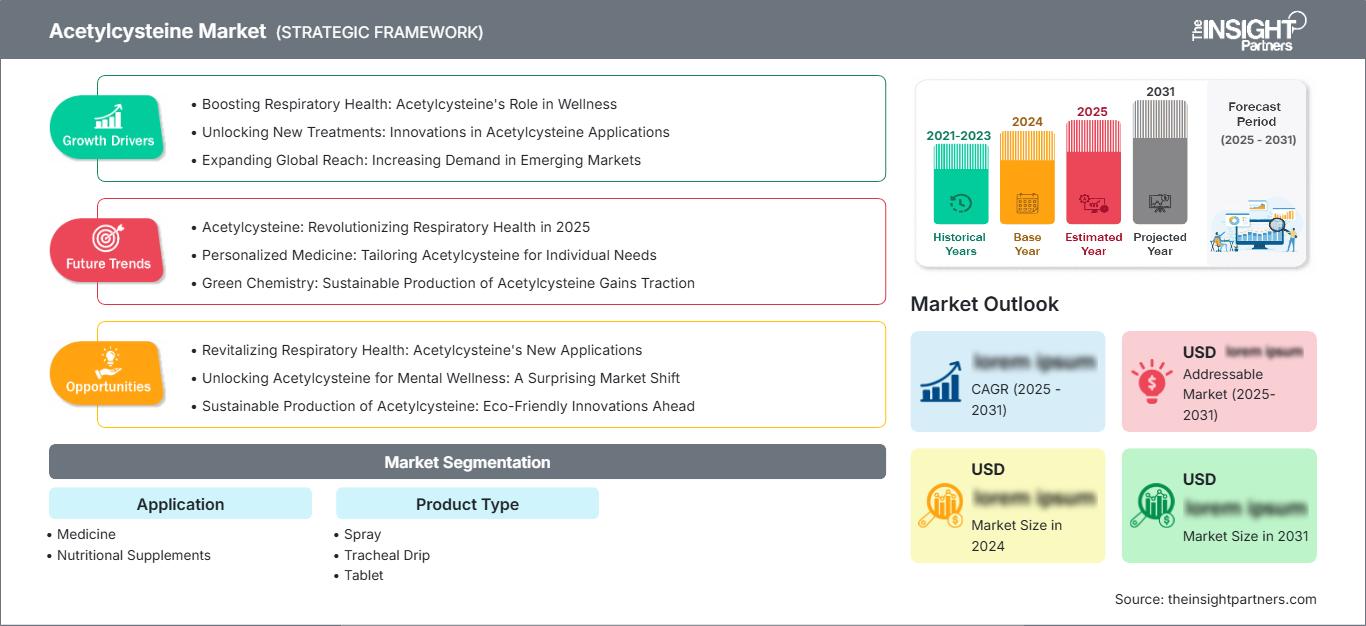
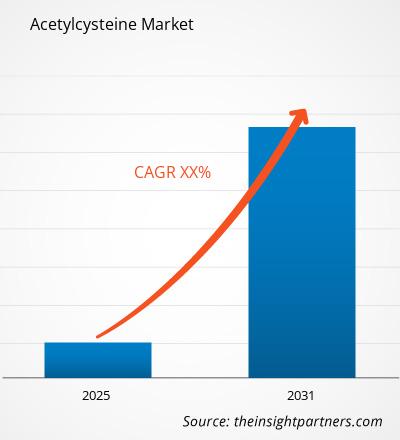
The acetylcysteine market size was valued at US$ 2,480.78 Million in 2025 and is projected to reach US$ 13,980.72 Million by 2034; it is expected to register a CAGR of 21.18% during 2026–2034. Demand is supported by respiratory medicine use, antidote applications, mucus management therapies, and rising nutritional supplement adoption across pharmaceutical and wellness channels.
In North America, the acetylcysteine market size reflects a regulated, dual-channel environment, with an estimated CAGR range of 20.0–20.8% during 2026–2034. Growth is supported by hospital use in acetaminophen overdose management, respiratory care protocols, and renewed supplement availability under enforcement discretion, while buyers continue to emphasize pharmacopoeial quality, validated API sourcing, and compliant product labeling.
Acetylcysteine Market Assessment and Insights
- North America held an estimated 24–26% of the acetylcysteine market share in 2025 and is expected to grow at a CAGR between 2026–2034 of 20.0–20.8%, supported by regulated medicine demand, supplement relisting, and hospital antidote use.
- US accounted for 86–89% of North America in 2025 and is projected to grow at a CAGR between 2026–2034 of 20.2–21.0%, led by injectable, oral, and supplement channels.
- Europe represented 21–23% share in 2025 and is forecast to grow at a CAGR between 2026–2034 of 18.5–19.5%, with Germany, Italy, and France leading through respiratory and API supply strength.
- Asia Pacific captured 44–47% share in 2025 and is expected to grow at a CAGR between 2026–2034 of 23.0–24.5%, led by China, India, Japan, and South Korea through manufacturing scale.
- Largest Segment Medicine held 72–76% market share in 2025 and is projected to grow at a CAGR range of 20.5–21.5% during 2026–2034 due to hospital and respiratory applications.
- High Growth Segment Nutritional Supplements held 24–28% market share in 2025 and is projected to grow at a CAGR range of 22.5–23.8% during 2026–2034 as antioxidant positioning expands.
- Key companies analyzed in detail: Zambon S.p.A., PharmaZell GmbH, Manus Aktteva Biopharma LLP, Wuxi Enovo Chemical Co., Ltd., Xinyi Hanling Biological Engineering Co., Ltd., Moehs Group, Nippon Rika Co., Ltd., Zhejiang Cheng Yi Pharmaceutical Co., Ltd., Wuhan Grand Hoyo Co., Ltd., Donboo Amino Acid Co., Ltd.
Source: The Insight Partners' analysis based on proprietary research, government publications, company annual reports, investor presentations, industry databases, and expert interviews.
The acetylcysteine market trends has expanded from a mere mucolytic for respiratory tract and an antidote to an overall molecule utilized in hospitals, prescription and wellness channels. The production economics are determined by L-cysteine availability, acetylation rates, impurities control, sulfur smell prevention and stability protection. Another factor affecting the market for acetylcysteine is the presence of unique dosage forms, like tablets, aerosols, and tracheal drops, each having distinct requirements in terms of quality, packaging and usage.
Potential growth will be fueled by respiratory diseases prevalence, acetaminophen poisoning management, supplementation channel standardization and API capacities in Asia. Emerging economies are improving access via local manufacturing and inclusion into hospital formularies, whereas controlled markets are concerned about documentation, batch homogeneity and labeling conformity. Compliance considerations will benefit manufacturers with the presence of DMF, pharmacopoeial grade, documented sources and quality systems.
Acetylcysteine Market Report Scope
| Report Attribute | Details |
|---|---|
| Market size in 2025 | US$ 2,480.78 Million |
| Market Size by 2034 | US$ 13,980.72 Million |
| Global CAGR (2026 - 2034) | 21.18% |
| Historical Data | 2021-2024 |
| Forecast period | 2026-2034 |
Acetylcysteine Market Analysis
Acetylcysteine growth drivers include the incidence of respiratory diseases, mucolytic action, existing usage in acetaminophen overdosage therapy, and consumers’ increasing preference for glutathione-boosting supplements. WHO-recognized respiratory-related concerns, along with increased pollution in urbanized economies, make the demand for products that can reduce the mucus burden remain high. Hospitals need a guaranteed supply for their toxicological protocols in emergencies.
There are many links in the chain including amino acid manufacturers, fine chemicals producers, API manufacturers, formulators, contract manufacturers, packaging firms, hospitals, pharmacies, and supplement stores. The supply depends on reliable availability of L-cysteine, purity, proper synthesis, moisture protection, and packaging with no odor issues. Acetylcysteine buyers consider the following characteristics of the product: assay, impurities, pharmacopeia adherence, solubility, and storage stability.
Competitive positioning is affected by API quality, formulating skills, and geography, and market analysis of acetylcysteine indicates that even in the wake of rising demand for dietary supplements, the importance of specialist companies remains undiminished. While Zambon S.p.A. continues to maintain its branded drug importance, PharmaZell GmbH, Moehs Group, Nippon Rika Co., Ltd., and Manus Aktteva Biopharma LLP satisfy the requirement of controlled API.
Regional and Chinese producers boost supply potential and pricing considerations. The Acetylcysteine market report highlights companies include Wuxi Enovo Chemical Co., Ltd., Xinyi Hanling Biological Engineering Co., Ltd., Zhejiang Cheng Yi Pharmaceutical Co., Ltd., Wuhan Grand Hoyo Co., Ltd., and Donboo Amino Acid Co., Ltd., which compete based on their manufacturing strength, amino acid synthesis capabilities, and ability to export. Investments are in impurity analysis, manufacturing scale, nutraceutical grade, and dosage form variety.
● REPORT CUSTOMIZATION
Tailor This Report To Align With Your Specific Business Requirements
This report can be customized to align precisely with your business objectives, scope, and target markets. Customization options include tailored segmentation, geography, competitive analysis, and strategic insights to support informed decision-making.
Customize This Report →WHAT YOU CAN ADJUST
- ● Segmentations
- ● Geography
- ● Competitive Analysis
- ● Language Preferences
Acetylcysteine Market: Strategic Insights
Regional Insights
North America Acetylcysteine market
North America accounted for an estimated 24–26% share in 2025 and is expected to grow at a CAGR of 20.0–20.8% during 2026–2034. The region benefits from strong hospital antidote use, respiratory treatment infrastructure, and renewed dietary supplement channel availability. The acetylcysteine market share is supported by both pharmaceutical-grade products and consumer wellness demand for antioxidant-support supplements.
Demand is strongest in emergency departments, toxicology programs, pulmonary care, pharmacies, and e-commerce supplement channels. Buyers require strong documentation because acetylcysteine spans medicine and supplement classifications. Suppliers with USP-grade material, stable import channels, compliant labels, and reliable inventory are better positioned as retailers, hospitals, and formulators rebuild long-term product availability.
U.S. Acetylcysteine market
The U.S. represented 86–89% of North America in 2025 and is projected to grow at a CAGR of 20.2–21.0% during 2026–2034. Demand is supported by acetaminophen overdose protocols, hospital formularies, oral respiratory products, and supplement retailers. The market remains highly compliance-sensitive because product positioning differs between drug, bulk ingredient, and dietary supplement channels.
Application trends emphasize medicine for emergency and respiratory care, while nutritional supplements regain visibility through online and specialty health stores. U.S. buyers increasingly compare certificates of analysis, domestic inventory, allergen and contaminant testing, and label language. PharmaZell GmbH and international API suppliers remain relevant for regulated sourcing, while finished-product brands compete through trust and availability.
Europe Acetylcysteine market
Europe held an estimated 21–23% share in 2025 and is expected to expand at a CAGR of 18.5–19.5% during 2026–2034. Germany is the leading country due to API production heritage, respiratory medicine adoption, pharmacy access, and high quality expectations. Italy and France remain important markets through branded mucolytic use and hospital prescribing.
The UK market is shaped by pharmacy-led respiratory care, formulary discipline, and strict claims control for supplements. Germany benefits from local API expertise, established pharmacopoeial standards, and regulated medicine distribution. France shows steady demand in cough and mucus management, where acetylcysteine remains familiar to clinicians and pharmacists within controlled product communications.
Italy and Spain contribute meaningful volume through over-the-counter respiratory therapy, prescription channels, and hospital applications. Italy is especially relevant because of Zambon S.p.A.’s historical Fluimucil franchise and respiratory medicine presence. Across Europe, suppliers must support multilingual labeling, pharmacovigilance, quality release documentation, and conservative supplement communication to maintain market access.
APAC Acetylcysteine market
APAC represented 44–47% share in 2025 and is forecast to grow at a CAGR of 23.0–24.5% during 2026–2034. China is the leading country by scale, supported by respiratory disease burden, hospital demand, and API manufacturing capacity. India, Japan, South Korea, and Australia add demand through pharmaceutical manufacturing, regulated medicine use, and supplement adoption.
Industrial and policy drivers include domestic API self-reliance, expanding respiratory care infrastructure, and rising consumer wellness spending. China’s hospital market is particularly important for injectable and respiratory formulations, while India supports export-oriented API and finished-dose manufacturing. Suppliers with scalable production and export documentation can serve both regional and regulated global customers.
Middle East & Africa Acetylcysteine market
Middle East & Africa is expected to grow at a CAGR of 19.0–20.2% during 2026–2034, led by Saudi Arabia and the UAE. Hospital modernization, respiratory disease burden, and imported medicine access support demand for prescription and hospital acetylcysteine products. South Africa remains the most structured sub-Saharan market.
Energy-linked fiscal capacity in Gulf countries supports tertiary hospitals, pulmonary care, and pharmacy chains carrying imported respiratory brands. Rest of MEA demand is uneven because regulatory approvals, affordability, and distributor reach vary widely. Suppliers with stable pricing, Arabic or multilingual labeling, and reliable cold or controlled logistics where needed can improve access.
Segmentation Analysis
Application
Application is expected to grow at a CAGR of 21.0–22.0% during 2026–2034. The acetylcysteine market scope by application is defined by medical necessity, regulatory classification, and consumer wellness adoption. Medicine remains the largest channel because acetylcysteine is used in respiratory care and poisoning management, while nutritional supplements are expanding as consumers seek antioxidant and glutathione-support products.
- Medicine dominates because acetylcysteine has established use in hospital toxicology, respiratory mucus management, and clinician-directed treatment where dosage control and quality standards are critical.
- Nutritional Supplements are gaining strategic importance as consumer awareness of antioxidant support, glutathione pathways, liver wellness, and respiratory wellness increases across online and specialty retail channels.
Product Type
Product Type is projected to grow at a CAGR of 20.8–21.8% during 2026–2034. Product selection depends on route of administration, care setting, convenience, and formulation stability. Tablets serve large oral-use demand, sprays support localized respiratory convenience, and tracheal drip formats remain clinically relevant where hospital or physician-supervised airway management is required.
- Spray products support localized respiratory use and patient convenience, requiring consistent dose delivery, stability, packaging integrity, and clear instructions for appropriate application.
- Tracheal Drip formats are important in supervised clinical settings where airway secretion management requires controlled administration, sterile handling, and close patient monitoring.
- Tablet products represent the broadest oral format because they support pharmacy distribution, supplement use, stable dosing, easier storage, and higher consumer familiarity.
Opportunity Snapshot
| Application | Revenue Contribution | Trend Tag | Adoption Stage |
| Medicine | High | Respiratory Care | Mature |
| Nutritional Supplements | Medium | Glutathione Support | Scaling |
| Acarbose Chewable Tables | Low | Meal Convenience | Emerging |
Acetylcysteine Market Growth Drivers and Impact Analysis
Rising respiratory disease burden and mucus management needs
Various respiratory disorders like chronic bronchitis, chronic obstructive pulmonary diseases, acute respiratory infections, and respiratory irritation due to pollution keep driving the requirement for mucolytic drugs. The use of acetylcysteine is appreciated in medicine since it lowers the viscosity of mucus by breaking the disulfide bonds between mucoproteins. Market potential is the highest in pharmacies, hospitals, and respiratory clinics, where treatment regimens depend on the use of well-known compounds. In addition, the market is stimulated by the seasons of respiratory diseases and poor air quality in cities.
Established emergency role in acetaminophen overdose protocols
Acetylcysteine continues to be an essential drug for the treatment of acetaminophen overdose, hence demand from hospitals which is more certain than from consumers using supplements. In the emergency departments and in poisoning protocols, reliable supply is necessary due to the likelihood of increased risks to the liver should the treatment be delayed. The practical importance of this driver lies in purchasing prudence in terms of sourcing injectable and oral drugs. This ensures the supplier gains competitive advantage among hospitals and in national healthcare systems.
Renewed supplement availability and antioxidant positioning
Consumers' demand for supplements that have antioxidants, liver, immunity, and glutathione benefits will contribute to the incremental growth for supplements outside the traditional prescription category. The supplements are experiencing growth through e-commerce search, recommendations from health practitioners, and consumer awareness of the use of NAC in health products. This impact will be seen in tablet and capsule adjacent oral form factors in which brands will compete in terms of dose, purity, testing, and labeling. This growth will lead to regulatory burden since the claims should be kept compliant and cannot suggest any disease treatment.
Acetylcysteine Market Future Trends
Clearer differentiation between drug and supplement channels
The emerging trends in the acetylcysteine industry are going to revolve around the separation of distribution channels, where pharmaceuticals focus on clinical indication, pharmacopeia adherence, and regulated distribution, whereas supplements employ conservative structure/function claims approach. Future success is contingent upon the ability of the company to work with label claims, quality documentation, and retailer specifications in a more precise manner. This differentiation will help minimize confusion between both the buyer and the regulator while making it easier for both channels to grow.
Higher-value formulations and route-specific innovation
The future development of products will no longer be restricted to generic acetylcysteine but will rather include formulations which have been developed with regard to their usability, stability, and suitability of care setting. Effervescent tablets, advanced spray formulations, ready to use solutions, and dual purpose respiratory products may come under consideration where applicable from a regulatory point of view. Attention will go towards masking the smell, formulation dissolution, protection against light in packaging, and compliance in patients. Ready to use formulations with clear labeling may help hospitals in reducing preparation efforts.
Acetylcysteine Market Opportunities
Regulated API supply for global respiratory brands
API supply offers a strong investment opportunity because finished-dose manufacturers need dependable acetylcysteine sources that can support respiratory brands, antidote products, and export filings. The acetylcysteine market forecast indicate rapid expansion, but growth will depend on suppliers meeting documentation, impurity control, and pharmacopoeial expectations. API producers can differentiate through DMF support, CEP alignment, multi-site resilience, and faster customer audit response. Commercial teams should target manufacturers seeking second-source qualification and regional supply security. This opportunity is strongest for companies able to combine cost efficiency with regulated-market readiness.
Compliant nutritional supplement expansion
Nutritional supplements create a practical opportunity if companies build portfolios around transparent testing and conservative claims. Brands can develop tablets or oral powders positioned for antioxidant support, glutathione support, and general wellness without implying disease treatment. Success will depend on ingredient traceability, third-party testing, retailer compliance, and clear consumer education. E-commerce brands can use subscriptions and bundled wellness routines to improve retention, but they must manage claim review carefully. Suppliers that provide supplement-grade material with contaminant testing and documentation can capture demand from brands rebuilding NAC portfolios.
Recent Developments
- June 2025: Zambon S.p.A. announced approval and launch in China of the intravenous formulation of Fluimucil, N-acetylcysteine. The approval followed local Phase 1 and Phase 3 clinical development, including a 333-patient Phase 3 study across 28 Chinese hospital centers for respiratory diseases with abnormal mucus secretions.
- June 2026: Axplora, including PharmaZell GmbH announced consolidation of global UDCA manufacturing at its Vizag facility, reflecting continued optimization of its API manufacturing network. PharmaZell’s acetylcysteine offering remains listed within API supplier databases with regulatory documentation and GMP-related positioning, supporting its relevance in regulated acetylcysteine sourcing.
- November 2023: U.S. Food and Drug Administration added its systematic review of literature regarding N-acetyl-L-cysteine to the Peer Review Agenda after issuing final guidance in August 2022 on enforcement discretion for certain NAC dietary supplement products. This remains important for U.S. supplement channel continuity and regulatory interpretation.
Frequently Asked Questions

- Comprehensive Market Sizing and Forecast Analysis
- Detailed Segmentation Analysis
- In-Depth Market Dynamics Assessment
- Regional and Country-Level Insights
- Competitive Landscape and Company Benchmarking
- Strategic Business Intelligence
Recent Reports
Testimonials

The Insight Partners' SCADA System Market report is comprehensive, with valuable insights on current trends and future forecasts. The team was highly professional, responsive, and supportive throughout. We are very satisfied and highly recommend their services.
RAN KEDEM Partner, Reali Technologies LTDs
I requested a report on a very specific software market and the team produced the report in a few days. The information was very relevant and well presented. I then requested some changes and additions to the report. The team was again very responsive and I got the final report in less than a week.
JEAN-HERVE JENN Chairman, Future Analytica
We worked with The Insight Partners for an important market study and forecast. They gave us clear insights into opportunities and risks, which helped shape our plans. Their research was easy to use and based on solid data. It helped us make smart, confident decisions. We highly recommend them.
PIYUSH NAGPAL Sr. Vice President, High Beam Global
The Insight Partners delivered insightful, well-structured market research with strong domain expertise. Their team was professional and responsive throughout. The user-friendly website made accessing industry reports seamless. We highly recommend them for reliable, high-quality research services
YUKIHIKO ADACHI CEO, Deep Blue, LLC.
This is the first time I have purchased a market report from The Insight Partners.While I was unsure at first, I visited their web site and felt more comfortable to take the risk and purchase a market report.I am completely satisfied with the quality of the report and customer service. I had several questions and comments with the initial report, but after a couple of dialogs over email with their analyst I believe I have a report that I can use as input to our strategic planning process.Thank you so much for taking the extra time and making this a positive experience.I will definitely recommend your service to others and you will be my first call when we need further market data.
JOHN SUZUKI President and Chief Executive Officer, Board Director, BK Technologies
I wish to appreciate your support and the professionalism you displayed in the course of attending to my request for information regarding to infectious disease IVD market in Nigeria. I appreciate your patience, your guidance, and the fact that you were willing to offer a discount, which eventually made it possible for us to close a deal. I look forward to engaging The Insight Partners in the future, all thanks to the impression you have created in me as a result of this first encounter.
DR CHIJIOKE ONYIA MANAGING DIRECTOR, PineCrest Healthcare Ltd.Reason to Buy
- Informed Decision-Making
- Understanding Market Dynamics
- Competitive Analysis
- Identifying Emerging Markets
- Customer Insights
- Market Forecasts
- Risk Mitigation
- Boosting Operational Efficiency
- Strategic Planning
- Investment Justification
- Tracking Industry Innovations
- Aligning with Regulatory Trends





 Get Free Sample for