
Acrylate Market Size, Share & Growth by 2034
Coverage: By Type (Butylacrylate, Ethylacrylate, Ethylhexylacrylate, Methylacrylate); Application (Paints and Coatings, Plastics, Adhesives and Sealants, Fabrics, Others) , and Geography (North America, Europe, Asia Pacific, and South and Central America)
- Status : Data Released
- Report Code : TIPRE00004841
- Category : Chemicals and Materials
- No. of Pages : 150
- Available Report Formats :


- Last update date : July 15, 2026


2025 Market Size
US$ 14.49 Bn
Base year value
2034 Forecast
US$ 23.72 Bn
Projected by 2034
CAGR 2026-2034
5.63 %
Growth rate
Addressable Market
US$ 173.21 Bn
(2026-2034)
The acrylate market was valued at US$ 14.49 billion in 2025 and is projected to reach US$ 23.72 billion by 2034, registering a CAGR of 5.63% during 2026–2034. Growth in the usage of high performance coatings, adhesives, plastics and specialty chemicals in the construction, automotive, packaging and textiles industry will boost demand. Growth in the production processes in the industry, developments in acrylic chemistry and investments in sustainable products will further contribute to future market growth.
North America still remains technologically advanced in production and usage, thanks to the well-established coatings, construction and automotive industries. The acrylate market size in the region is expected to expand steadily at a CAGR of 4.8–5.3% during the forecast period, driven by increasing adoption of waterborne coatings, renovation activities, and sustained investments in specialty chemicals. Stringent environmental regulations are also encouraging manufacturers to develop low-VOC and sustainable acrylate-based products.
Acrylate Market Assessment and Insights
- North America: North America accounted for 28–32% share in 2025 and is projected to expand at a CAGR of 4.8–5.3% during 2026–2034. Demand remains supported by mature construction, automotive refinishing, industrial coatings, and specialty adhesives industries alongside continued innovation in sustainable acrylic chemistry.
- US: The US represented 76–80% of North American demand in 2025 and is anticipated to grow at a CAGR of 4.9–5.4% during 2026–2034, supported by strong manufacturing capabilities and continuous investments in advanced coating technologies.
- Europe: Europe captured 24–28% share in 2025 and is forecast to register a CAGR of 4.7–5.2% during 2026–2034. Germany, France, Italy, and the UK remain leading markets owing to established automotive manufacturing, industrial coatings production, and strict environmental compliance requirements.
- Asia Pacific: Asia Pacific accounted for 38–42% share in 2025 and is projected to grow at a CAGR of 6.3–6.8% during 2026–2034. China, India, Japan, and South Korea continue to benefit from expanding manufacturing activities, infrastructure investments, and rising demand from packaging and consumer industries.
- Largest Segment: Paints and Coatings held a acrylate market share of 42–46% in 2025 and is expected to register a CAGR of 5.5–6.0% during 2026–2034, driven by increasing infrastructure development and industrial maintenance activities.
- High Growth Segment: Adhesives and Sealants accounted for 20–24% market share in 2025 and is anticipated to expand at a CAGR of 6.5–7.0% during 2026–2034, supported by lightweight manufacturing trends, construction modernization, and flexible packaging demand.
- Key companies analyzed in detail: Air Liquide S.A., Arkema S.A., BASF SE, Evonik Industries AG, LG Chem Ltd., Mitsubishi Chemical Corporation, NIPPON SHOKUBAI CO., LTD., Sasol Limited, SIBUR Holding, Wanhua Chemical Group Co., Ltd.
Source: The Insight Partners' analysis based on proprietary research, government publications, company annual reports, investor presentations, industry databases, and expert interviews.
The use of advanced manufacturing technology in the production of acrylates has been realized through developments in catalysts, process optimization for esterification, and better integration with other specialty chemicals. Increases in capacity in Asia alongside feedstock optimization strategies have improved efficiency in production while allowing producers to manufacture different varieties of acrylates for various purposes including coatings, plastics, textiles, and adhesives. There is also an increasing focus on using bio-based sources and sustainable production techniques in the industry.
In the future, development of the industry will be determined by manufacturing diversification in different regions, innovations, and sustainability policies. Investments in Southeast Asia, the Middle East, and certain Latin American nations will improve the production capacity and reduce the risks of having concentration problems in the supply chain. There will also be more research done into bio-based acrylates, recyclable products, and functional polymers.
Acrylate Market Report Scope
| Report Attribute | Details |
|---|---|
| Market size in 2025 | US$ 14.49 Billion |
| Market Size by 2034 | US$ 23.72 Billion |
| Global CAGR (2026 - 2034) | 5.63% |
| Historical Data | 2021-2024 |
| Forecast period | 2026-2034 |
Acrylate Market Analysis
Further increases in infrastructural investment, growing production in automobiles and packaging industries are expected to fuel the demand for acrylate derivatives globally. The acrylate market growth will be driven by increased use of high-performance binders, coatings, pressure-sensitive adhesives, and engineered plastics that exhibit outstanding characteristics such as weatherability, transparency, and chemical resistance. Renovation and maintenance operations within industrial settings have driven demand due to requirements for environmentally friendly protective coatings.
These value chains include feedstock suppliers, acrylic acid producers, acrylate esters producers, formulators, compounders, distributors, and end-user industries. The resilience of the supply chain has been increased through regional development, vertical integration, and digitalization of the production processes. Additional investments are being made towards process improvement that will lower energy use and improve production efficiencies while adhering to volatile organic compounds regulations.
High competition intensity is maintained by the global manufacturers who concentrate their efforts on increasing their specialty product portfolio instead of engaging in a battle over production capacity. The acrylate market analysis shows that the companies dominating the market, such as BASF SE, Arkema S.A., LG Chem Ltd., Mitsubishi Chemical Corporation, Evonik Industries AG, and Wanhua Chemical Group Co., Ltd., consistently increase their competitiveness in terms of innovation in technology and manufacturing facilities, customization of their products, and environmentally-friendly approach to product design.
Companies are investing in production of acrylates of high purity, manufacturing technologies of reduced carbon footprint, and developing new uses of the products in electronics, renewable energy, and construction industries. Some of the leading companies, such as NIPPON SHOKUBAI CO., LTD., Sasol Limited, SIBUR Holding, and Air Liquide S.A., improve their processes by introducing digital manufacturing, automation, and energy efficiency programs.
● REPORT CUSTOMIZATION
Tailor This Report To Align With Your Specific Business Requirements
This report can be customized to align precisely with your business objectives, scope, and target markets. Customization options include tailored segmentation, geography, competitive analysis, and strategic insights to support informed decision-making.
Customize This Report →WHAT YOU CAN ADJUST
- ● Segmentations
- ● Geography
- ● Competitive Analysis
- ● Language Preferences
Acrylate Market: Strategic Insights
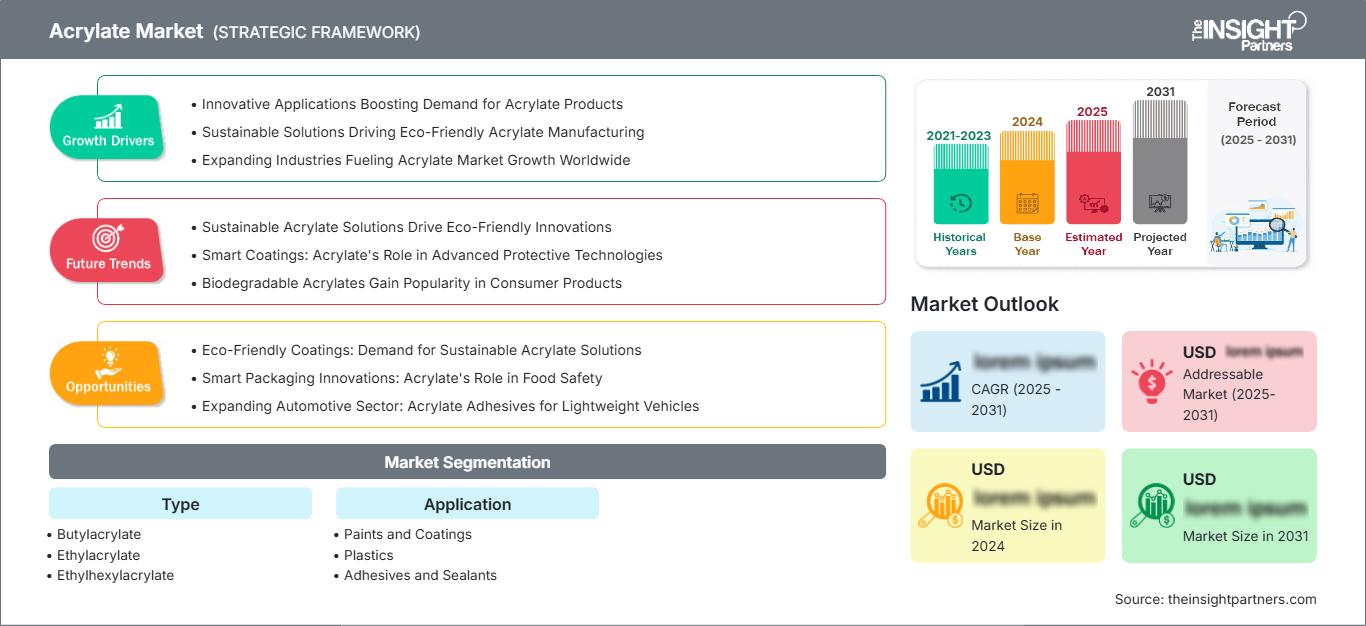
Regional Insights
North America Acrylate Market
North America accounted for 28–32% of the global market in 2025 and is anticipated to register a CAGR of 4.8–5.3% during 2026–2034. The region has the advantage of an already existing chemical manufacturing infrastructure, availability of raw materials, and high demand from the construction, automotive, packaging, and industrial coatings sectors. Rising usage of water-based coating systems and low VOC materials is also contributing to rising demand for acrylates in various applications. The share of acrylates is considerable due to the existence of integrated manufacturers and sophisticated downstream manufacturing facilities.
Initiatives related to the development of eco-friendly products have been driving the innovation of products in the region. Infrastructure development, residential remodeling, and industrial maintenance have been the key factors supporting the growth of the demand for acrylate paints, sealants, and specialty polymers. Development in the field of bio-acrylic resins, along with rising use of advanced manufacturing technologies, will help drive competitiveness in the region.
U.S. Acrylate Market
The US represented 76–80% of North American demand in 2025 and is projected to grow at a CAGR of 4.9–5.4% during 2026–2034. Construction activities, technological prowess in specialty chemicals, and robust demand for industrial coatings will continue driving the market’s growth. Also, strong indigenous manufacturing capability ensures consistent supply to downstream markets such as automotive, packaging, consumer goods, and infrastructure.
Leading players remain committed to capacity enhancement, sustainable manufacturing practices, and polymer technology innovations to ensure operational efficiencies. Rising demand for pressure sensitive adhesives, advanced coatings, and engineering plastics continues to drive innovation in acrylics. Growing regulatory focus on low emissions and sustainability of products is pushing the industry towards environment-friendly acrylates solutions.
Europe Acrylate Market
Europe held 24–28% of the global market in 2025 and is forecast to expand at a CAGR of 4.7–5.2% during 2026–2034. Germany continues to be the top market in the region because of high automotive manufacturing, industrial coatings manufacture, and chemical processes capabilities. Germany's strong research capabilities also ensure the continued development of specialty acrylate materials.
Demand for UK is steady owing to construction renovation, advancement in packaging, and upkeep of industries. Other countries such as France, Italy, and Spain combine their efforts due to increased production of coatings, adhesives, plastics, and textiles sectors. Manufacturers in the region keep on improving their products in line with EU environmental regulations.
APAC Acrylate Market
Asia Pacific accounted for 38–42% of global demand in 2025 and is expected to register the highest CAGR of 6.3–6.8% during 2026–2034. China will remain the biggest producer and consumer, whereas India, Japan, South Korea, and Australia will further improve regional demand by increasing their industrial production and investing in infrastructure.
Urbanization, increasing production of automobiles, rising usage of packaging materials, and the government policies that encourage local production of chemicals will further boost the growth potential of the region. Downstream investments in specialty chemicals and capacity expansions will help Asia Pacific emerge as the biggest producer and consumer of acrylate products.
Middle East & Africa Acrylate Market
The Middle East & Africa is projected to witness steady expansion at a CAGR of 5.0–5.5% during 2026–2034. Saudi Arabia and the UAE continue their diversification into petrochemicals, whereas South Africa continues to drive demand through its construction, mining, and industrial manufacturing sectors. The growth in downstream chemical output will help meet regional demand.
Improvements in infrastructure, industrial diversification plans, and investment in manufacturing have ensured long-term demand. There will be more demand from acrylate manufacturers due to the greater use of high-performance coatings, adhesives, and plastics in energy, transportation, and commercial construction applications.
Segmentation Analysis
Type
The Type segment is expected to grow at a CAGR of 5.5–6.0% during 2026–2034. Product selection depends on performance characteristics such as flexibility, hardness, weather resistance, adhesion, and compatibility with downstream formulations. The acrylate market scope continues to expand as manufacturers introduce specialized acrylate esters designed for advanced coatings, pressure-sensitive adhesives, engineered plastics, and functional polymer systems serving multiple industrial sectors.
- Butylacrylate – Widely utilized in architectural coatings, pressure-sensitive adhesives, sealants, and textile finishing applications owing to its flexibility, durability, and excellent weather resistance, making it one of the most commercially significant acrylate esters.
- Ethylacrylate – Primarily consumed in specialty coatings, paints, adhesives, and polymer synthesis where balanced mechanical strength, transparency, and chemical resistance are required across industrial and consumer applications.
- Ethylhexylacrylate – Increasingly preferred for high-performance pressure-sensitive adhesives, elastomeric coatings, and specialty polymers due to its superior flexibility, low-temperature performance, and enhanced durability under demanding operating conditions.
- Methylacrylate – Extensively applied in surface coatings, plastics, textile treatments, and specialty copolymer production because of its excellent polymerization characteristics and compatibility with various industrial formulations.
Application
The Application segment is projected to record a CAGR of 5.8–6.3% during 2026–2034, supported by expanding industrial manufacturing and increasing adoption of advanced polymer technologies. Demand continues to diversify across construction, automotive, consumer goods, packaging, and textile industries as manufacturers seek durable, lightweight, and environmentally compliant material solutions.
- Paints and Coatings – The largest application segment, benefiting from increasing infrastructure development, industrial maintenance requirements, and demand for weather-resistant protective coatings across residential, commercial, and manufacturing sectors.
- Plastics – Acrylates improve impact resistance, transparency, weatherability, and processing efficiency, making them valuable components in engineering plastics, consumer products, automotive components, and packaging materials.
- Adhesives and Sealants – Growing demand for lightweight bonding technologies, flexible packaging, construction materials, and automotive assembly continues to increase consumption of advanced acrylic adhesive formulations with enhanced durability and performance.
- Fabrics – Textile manufacturers utilize acrylates for finishing treatments, coating applications, and functional performance enhancement, improving wrinkle resistance, durability, water repellency, and overall fabric quality for industrial and consumer textiles.
Opportunity Snapshot
| Application | Revenue Contribution | Trend Tag | Adoption Stage |
| Paints and Coatings | High | Low-VOC | Mature |
| Plastics | Medium | Lightweight Parts | Scaling |
| Adhesives and Sealants | High | Flexible Packaging | Scaling |
| Fabrics | Low | Functional Textiles | Emerging |
Acrylate Market Growth Drivers and Impact Analysis
Expansion of Sustainable Construction and Protective Coatings
In the coming years, residential, commercial, and infrastructure construction investments worldwide are likely to lead to the growth of demands for coatings with superior physical performance and environmentally friendly characteristics. Acrylic binder has been renowned due to the excellent adhesion and weather-resistance performance as well as UV-resistance and color fastness; therefore, acrylate is a good choice for coating applications. The growing regulation concerning the reduction of the VOC emissions level in the developed countries has boosted the demand for the water-based acrylic systems. In contrast, emerging economies are expected to have more investment in infrastructure construction projects, which will open up new opportunities for coating manufacturers.
Growing Demand for Lightweight Automotive and Industrial Materials
Automobile makers will keep on focusing on making lightweight vehicles to enhance their fuel economy and adopt electrification technology. Acrylic based adhesives, coatings, engineered plastics and polymers help in achieving lightweight without compromising on mechanical properties and resistance to corrosion. Equipment makers in industrial sectors are also increasingly relying on acrylics to achieve increased durability and long operational life. Growth in the production of electric cars, commercial transport machinery and domestic appliances reinforces the demand from the downstream sector. Innovations in polymer chemistry allow the manufacturers to customize products with better heat stability and process efficiency.
Advancements in Specialty Polymer Manufacturing Technologies
The swift advancement in catalyst technology, process automation, digitized manufacturing, and feedstock optimization has led to increased acrylate manufacturing efficiency. Advanced manufacturing technology has been successful in saving energy, maintaining product uniformity, improving process flexibility, and allowing manufacturers to react swiftly to any change in customer specifications. Higher spending on specialty polymers that can be used in the medical device industry, electronics industry, renewable energy applications, and durable packaging products opens up business prospects. The exploration of bio-derived acrylates and recyclable polymers is another development that will help drive the transformation within the industry.
Acrylate Market Future Trends
Transition Toward Bio-Based Acrylic Raw Materials
As the demand for sustainability grows within the chemicals, construction, automobile, and packaging industries, investments are being made in renewable sources of feedstock for the manufacture of acrylics. The acrylates marekt trends continue to move towards the adoption of biobased acrylic acid, sustainable manufacturing processes, and low lifecycle emissions. Manufacturers are investing heavily in the study of renewable carbon sources and enhancing the efficiency of catalysts. With increasing stringency of environmental laws, bio-based acrylates that are commercially feasible are poised to see increased adoption across the coatings, adhesives, plastics, and textiles segments.
Digital Manufacturing and Smart Production Integration
Digital solutions are increasingly being applied within the manufacture of acrylates as companies strive for efficiency and product uniformity. With AI, process analytics, automation, and real-time monitoring, manufacturers are able to fine-tune their processes while ensuring waste reduction and conservation of energy. Digital solutions are not only useful for ensuring greater visibility within the supply chains but also in making the production process more flexible, helping manufacturers react quickly to changes in customer needs. As digitization continues within the specialty chemicals sector, those manufacturers implementing intelligent production processes should perform better than their competitors within the review period.
Acrylate Market Opportunities
Investment in High-Growth Asian Manufacturing Ecosystems
Rapid industrialization across China, India, Vietnam, Indonesia, and other Southeast Asian economies continues to create attractive investment opportunities for acrylate manufacturers. The acrylate market Forecasts indicate that expanding downstream demand from coatings, adhesives, packaging, and engineered plastics will encourage additional production capacity throughout the region. Companies establishing integrated manufacturing facilities near key raw material sources and major customer clusters can improve supply chain efficiency while reducing logistics costs. Strategic partnerships with regional distributors and specialty chemical formulators are also expected to accelerate product commercialization, strengthen customer relationships, and improve long-term profitability within rapidly expanding industrial markets.
Development of High-Performance Specialty Applications
Emerging applications in electric vehicles, advanced electronics, renewable energy equipment, healthcare products, and functional packaging present substantial long-term growth potential for acrylate producers. Manufacturers capable of developing customized acrylic formulations with improved durability, thermal stability, optical clarity, and chemical resistance are well positioned to capture premium market segments. Continued investment in research and development, application laboratories, and customer collaboration programs will support product innovation tailored to evolving industrial requirements. Expanding intellectual property portfolios and strengthening technical service capabilities are expected to create sustainable competitive advantages while enabling access to higher-value specialty chemical markets.
Recent Developments
- June 5, 2026: BASF SE announced a price increase of up to US$100 per metric ton for butyl acrylate in the Asia Pacific region. They cited higher costs for feedstock and production inputs while ensuring a reliable supply in the area. Butyl acrylate is an essential raw material for paints, coatings, adhesives, and sealants. This announcement reflects ongoing cost pressures in the acrylate value chain and their impact on downstream product prices and buying strategies.
- March 10, 2026: BASF SE announced the start of commercial production of biomass balance (BMB) polyether polyols in North America at its Verbund site in Geismar, Louisiana. This expands its range of sustainable polyurethane raw materials. While focusing on polyurethane uses, this development supports the shift towards lower-carbon specialty chemicals. This trend is driving innovation and the use of sustainable feedstocks in the wider acrylate market.
Frequently Asked Questions

- Comprehensive Market Sizing and Forecast Analysis
- Detailed Segmentation Analysis
- In-Depth Market Dynamics Assessment
- Regional and Country-Level Insights
- Competitive Landscape and Company Benchmarking
- Strategic Business Intelligence
Recent Reports
Testimonials

The Insight Partners provided valuable market intelligence that supported our global go-to-market strategy. Their team was professional, responsive, and attentive to our feedback, providing thoughtful analysis and helpful methodological clarifications throughout the project.
Junmo Kim Chief Financial Officer (CFO), Enertech Co., Ltd.
The Insight Partners' SCADA System Market report is comprehensive, with valuable insights on current trends and future forecasts. The team was highly professional, responsive, and supportive throughout. We are very satisfied and highly recommend their services.
RAN KEDEM Partner, Reali Technologies LTDs
I requested a report on a very specific software market and the team produced the report in a few days. The information was very relevant and well presented. I then requested some changes and additions to the report. The team was again very responsive and I got the final report in less than a week.
JEAN-HERVE JENN Chairman, Future Analytica
We worked with The Insight Partners for an important market study and forecast. They gave us clear insights into opportunities and risks, which helped shape our plans. Their research was easy to use and based on solid data. It helped us make smart, confident decisions. We highly recommend them.
PIYUSH NAGPAL Sr. Vice President, High Beam Global
The Insight Partners delivered insightful, well-structured market research with strong domain expertise. Their team was professional and responsive throughout. The user-friendly website made accessing industry reports seamless. We highly recommend them for reliable, high-quality research services
YUKIHIKO ADACHI CEO, Deep Blue, LLC.
This is the first time I have purchased a market report from The Insight Partners.While I was unsure at first, I visited their web site and felt more comfortable to take the risk and purchase a market report.I am completely satisfied with the quality of the report and customer service. I had several questions and comments with the initial report, but after a couple of dialogs over email with their analyst I believe I have a report that I can use as input to our strategic planning process.Thank you so much for taking the extra time and making this a positive experience.I will definitely recommend your service to others and you will be my first call when we need further market data.
JOHN SUZUKI President and Chief Executive Officer, Board Director, BK Technologies
I wish to appreciate your support and the professionalism you displayed in the course of attending to my request for information regarding to infectious disease IVD market in Nigeria. I appreciate your patience, your guidance, and the fact that you were willing to offer a discount, which eventually made it possible for us to close a deal. I look forward to engaging The Insight Partners in the future, all thanks to the impression you have created in me as a result of this first encounter.
DR CHIJIOKE ONYIA MANAGING DIRECTOR, PineCrest Healthcare Ltd.Reason to Buy
- Informed Decision-Making
- Understanding Market Dynamics
- Competitive Analysis
- Identifying Emerging Markets
- Customer Insights
- Market Forecasts
- Risk Mitigation
- Boosting Operational Efficiency
- Strategic Planning
- Investment Justification
- Tracking Industry Innovations
- Aligning with Regulatory Trends





 Get Free Sample for