
Acrylic Elastomers Market Demand, Size & Forecast by 2034
Coverage: By Type (Ethylene-Acrylate Elastomer, Alkyl Acrylate Copolymer); End-User Industry (Automotive, Construction, Industrial, Others), and Geography (North America, Europe, Asia Pacific, and South and Central America)
- Status : Data Released
- Report Code : TIPRE00014596
- Category : Chemicals and Materials
- No. of Pages : 150
- Available Report Formats :


- Last update date : November 05, 2026


2025 Market Size
US$ 1.59 Bn
Base year value
2034 Forecast
US$ 2.94 Bn
Projected by 2034
CAGR 2026-2034
7.05 %
Growth rate
Addressable Market
US$ 20.43 Bn
(2026-2034)
The Acrylic Elastomers Market was valued at US$ 1.59 Billion in 2025 and is projected to reach US$ 2.94 Billion by 2034, registering a CAGR of 7.05% during 2026–2034. Expansion is supported by demand for heat-, oil-, ozone-, and weather-resistant rubber components, particularly in automotive sealing systems, hoses, gaskets, and high-performance industrial components. Increasing thermal requirements in modern powertrains and tighter component durability specifications are encouraging material substitution toward acrylic elastomers, where conventional rubber grades face performance limitations.
North America represents a mature application base for acrylic elastomers, supported by established automotive production, replacement demand for sealing components, and specialized industrial equipment manufacturing. The region is expected to register a ~6% CAGR through 2034. Continued qualification of high-performance sealing materials, together with demand for durable components capable of operating under elevated temperatures and aggressive fluids, should sustain regional expansion. As a result, North America is expected to account for a significant Acrylic Elastomers Market share throughout the forecast period.
Acrylic Elastomers Market Assessment and Insights
Regional Outlook
- North America: ~22% of the global market in 2025 | ~6% CAGR through 2034. Market position: North America maintains a substantial mature-market position, supported by automotive manufacturing, aftermarket replacement requirements, industrial machinery, and established compound development capabilities. Demand increasingly favors higher-performance materials for thermal and fluid-resistant sealing applications.
- US: ~85% of North American market revenue in 2025 | ~6% CAGR through 2034. Market position: The US accounts for most North American demand because of its large automotive and industrial equipment base, extensive component manufacturing ecosystem, and continued engineering focus on durable seals, hoses, gaskets, and fluid-handling systems.
- Europe: ~27% of the global market in 2025 | ~6% CAGR through 2034. Market position: Europe is a mature acrylic elastomer market, with Germany representing the leading country in Europe. Germany, France, Italy, Spain, and the UK sustain demand through automotive engineering, industrial machinery, construction equipment, and specialized sealing applications.
- Asia Pacific: ~35% of the global market in 2025 | ~8% CAGR through 2034. Market position: Asia Pacific is the fastest-growing region, supported by automotive manufacturing, expanding industrial capacity, localized polymer production, and increasing adoption of high-performance rubber components. China is the leading country in the Asia Pacific, with Japan and South Korea providing substantial technology and manufacturing depth.
Segment Outlook
- Application: ~60% Share in 2025 | ~7% CAGR through 2034. Market position: Application demand is concentrated in automotive systems because acrylic elastomers combine the heat, oil, ozone, and weather resistance required for seals, gaskets, hoses, and other components exposed to demanding operating environments. Automotive applications are expected to maintain a ~7% CAGR.
- Type: ~40% Share in 2025 | ~8% CAGR through 2034. Market position: Type demand increasingly shifts toward higher-performance ethylene acrylic elastomers as component designers address greater thermal and chemical requirements. Acrylic Co-Monomer Elastomers remain important for established sealing specifications, while the segment is expected to expand at a ~8% CAGR.
Competitive Coverage
BASF SE, DuPont de Nemours, Inc., HEXPOL AB, Kuraray Co., Ltd., NOK Corporation, Trelleborg AB, Zeon Corporation, ARLANXEO Holding B.V., Dow Inc., Changzhou Haiba Ltd.
Methodology
The Insight Partners follows Data Collection & Secondary Research, Primary Research, Data Analysis, and Data Triangulation & Final Review to validate market estimates and insights.
Source: The Insight Partners' analysis based on proprietary research, government publications, company annual reports, investor presentations, industry databases, and expert interviews.
Acrylic elastomers have progressed from specialty sealing compounds to formulated rubber systems based on thermal stability, oil resistance, ozone resistance, and mechanical resilience. Manufacturing processes are gradually becoming more dependent on polymer design, chemistry at cure sites, formulations, and greater control over molecular properties. Component manufacturers in the automotive industry keep qualifying materials based on temperatures, fluids, compression set, fatigue, and lifetime, thus differentiating between traditional acrylic rubber and more advanced ethylene acrylic rubbers.
Looking forward, production footprints will become more regionally balanced due to the growth of automotive and industrial manufacturing in the Asia Pacific. The focus of investments is moving towards material sustainability, supply reliability, specialized grades for applications, and increased efficiency of formulations. Pressure from regulators on material composition and carbon intensity can help suppliers create more sustainable raw materials and production processes, while qualification will still benefit those who can guarantee performance through multiple production sites.
Acrylic Elastomers Market Report Scope
| Report Attribute | Details |
|---|---|
| Market size in 2025 | US$ 1.59 Billion |
| Market Size by 2034 | US$ 2.94 Billion |
| Global CAGR (2026 - 2034) | 7.05% |
| Historical Data | 2021-2024 |
| Forecast period | 2026-2034 |
Acrylic Elastomers Market Analysis
Demands are centered on applications where rubber parts have to exhibit stability and sealing characteristics under high temperatures, oils, lubrication, ozone, and environmental conditions. The automotive industry forms the core demand base in this case, especially for transmission, engine, fuel, thermal management, and fluid handling systems. There is other demand in industrial machinery, such as from hoses, gaskets, seals, and other oil-exposed components.
Value chain starts from manufacture of acrylic monomers and specialty polymers, to elastomer compounding, curing, molding of components, testing and incorporation of parts in complete equipment. The manufacturers of polymers affect supply and development of material grades, whereas the compounders convert properties of polymers into application oriented formulas. The supply situation is affected by costs of monomers, energy, specialty polymer capacities, qualification cycles and geographic production locations. Extended customer qualification cycles lead to supply situations that could last longer than those of commodity rubbers.
Positioning in the competition involves the use of polymer science, formulation, location of production, technical services, and associations with auto part producers as well as industrial component producers. Vamac line of ethylene acrylic elastomers from DuPont de Nemours Inc. is known to occupy a strong position. Zeon Corporation produces ACM grade, which can withstand heat and lubricants and protect against the impact of weather. NOK Corporation uses knowledge on acrylic elastomers in their seal applications.
Instead, investments are being made towards specialized manufacturing, sustainable raw materials, automated compounding, and application engineering. In this regard, Trelleborg AB capitalizes on its advanced sealing solutions and polymer components, whereas BASF SE and Dow Inc. engage in the high performance polymer and elastomer material systems eco system. Further additions come in the form of specialty polymers provided by Kuraray Co., Ltd., ARLANXEO Holding B.V., and Changzhou Haiba Ltd.
● REPORT CUSTOMIZATION
Tailor This Report To Align With Your Specific Business Requirements
This report can be customized to align precisely with your business objectives, scope, and target markets. Customization options include tailored segmentation, geography, competitive analysis, and strategic insights to support informed decision-making.
Customize This Report →WHAT YOU CAN ADJUST
- ● Segmentations
- ● Geography
- ● Competitive Analysis
- ● Language Preferences
Acrylic Elastomers Market: Strategic Insights
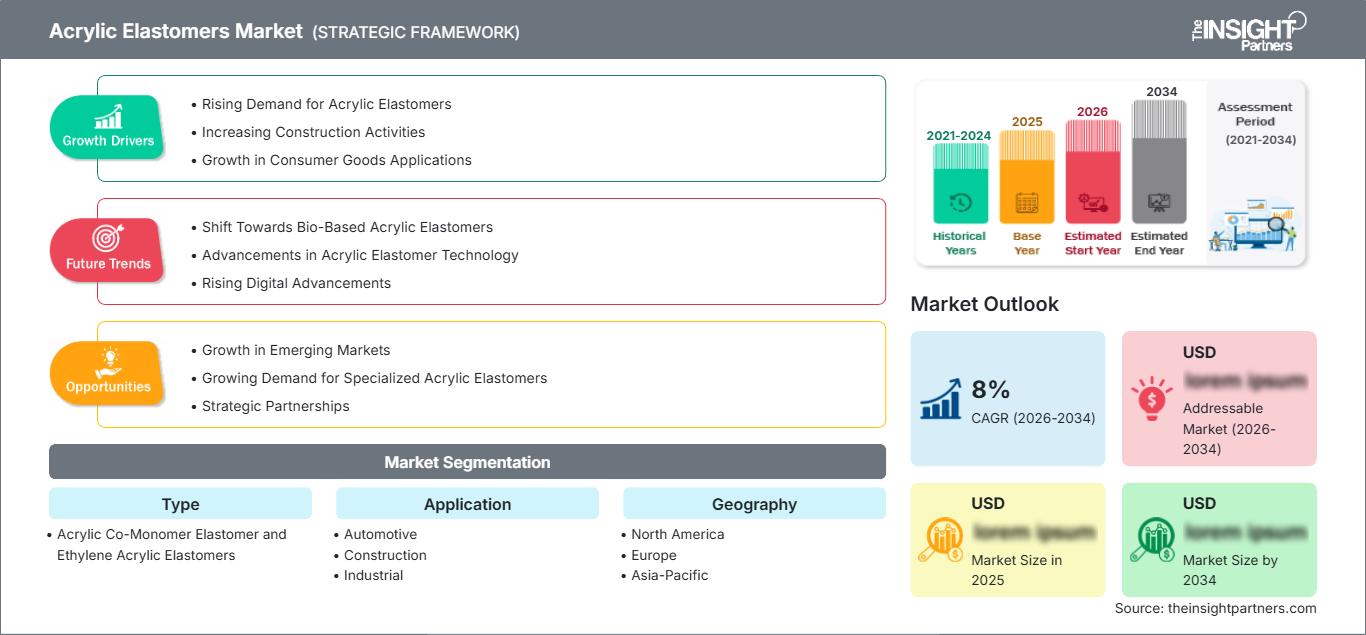
Regional Insights
North America Acrylic Elastomers Market
North America represented ~22% of the global market in 2025 and is expected to expand at a ~6% CAGR through 2034. The region benefits from a mature automotive manufacturing base, established industrial equipment production, and extensive aftermarket activity. Acrylic elastomers are particularly relevant where seals, hoses, and gaskets must withstand elevated temperatures and exposure to lubricants or transmission fluids. The US accounts for ~85% of the North American market revenue, giving regional demand a strong concentration around US automotive and industrial production. These factors support the region's significant position in the Acrylic Elastomers Market report, with North America remaining an important contributor to overall industry revenue throughout the forecast period.
Automotive engineering continues to be the most important commercial driver, with the use of industrial machinery, construction equipment, and fluid handling systems expanding the scope. Materials and components from DuPont de Nemours, Inc., HEXPOL AB, NOK Corporation, and Trelleborg AB facilitate the availability of regional demand. The increasing importance of qualification standards for durable seals influences the growth in demand, alongside the need for periodic replacements, which is a factor outside original-equipment manufacturing. Mexico plays an integral part in the region’s manufacturing dynamics due to the production of automotive parts.
U.S. Acrylic Elastomers Market
The US represented ~85% of North American acrylic elastomer revenue in 2025 and is expected to grow at a ~6% CAGR through 2034. Its position reflects the scale of automotive production, industrial machinery, heavy equipment, and engineered component manufacturing. Material selection increasingly emphasizes thermal endurance, resistance to automotive fluids, compression-set performance, and long service life. These factors are expected to support continued demand and remain key drivers in the Acrylic Elastomers Market forecast through the forecast period.
DuPont de Nemours, Inc. is one company that produces Vamac ethylene acrylic elastomer for use in automotive sealing applications, while another company HEXPOL AB produces ACM and AEM compounds for use in automotive and industrial component manufacturers. NOK Corporation, on the other hand, produces applications of acrylic elastomers in automotive seals and industrial components. It is clear that the US market will involve the supply of polymers, the manufacture of compounds, the manufacture of components, and the aftermarket replacements.
Europe Acrylic Elastomers Market
Europe accounted for ~27% of the global market in 2025 and is projected to record a ~6% CAGR through 2034. Germany is the leading country in Europe, supported by its automotive engineering base, extensive supplier network, and concentration of industrial manufacturing. Germany's requirements for high-temperature and oil-resistant seals support sustained use of acrylic elastomers across engine, transmission, hose, and machinery applications. France and Italy add demand through automotive components, industrial machinery, and specialized rubber processing. These factors collectively highlight key Acrylic Elastomers Market trends, with manufacturers focusing on advanced sealing materials, enhanced thermal performance, improved chemical resistance, and durable elastomer solutions for automotive and industrial applications across Europe.
The UK contributes with its expertise in industrial engineering, automotive parts, and sealing technology, whereas Spain gains from its vehicle manufacturing and production processes. Decisions regarding procurement in the region today are more focused on factors such as consistency of materials, durability, compliance with regulations, and supply reliability. Trelleborg AB offers engineered polymers and sealing technology, whereas HEXPOL AB offers production and compounding technology with ACM and AEM grades. The well-established customer qualification process in the region makes it advantageous for established suppliers.
Demand from Europe will also be driven by the move towards greater efficiency in vehicles and industrial equipment. Even though the electrification of machines may make some needs for traditional engines less important, it also introduces new thermal management and fluid control needs that could be beneficial for some high-performance elastomers. Sustainable development trends are making manufacturers seek alternative material solutions and production efficiencies.
APAC Acrylic Elastomers Market
Asia Pacific held ~35% of the global market in 2025 and is expected to grow at a ~8% CAGR through 2034, making it the fastest-growing region. China is the leading country in the Asia Pacific, supported by its automotive manufacturing scale and expanding industrial production. Japan remains important because of its established specialty rubber technology and manufacturers such as Zeon Corporation and NOK Corporation. These developments reinforce Asia Pacific's strategic importance in the Acrylic Elastomers Market, with the region expected to remain a key contributor to global revenue growth throughout the forecast period.
South Korea contributes via automotive and industrial components production, whereas India continues to develop its automotive and machinery sector and improve its local production capabilities. Australia is another small but specialized market tied to mining, industrial machinery, and equipment maintenance. The regional development is driven by manufacturing localization, increased performance demands for components, and investments in new production plants. The rising use of high-performance sealing compounds will likely continue to benefit acrylic elastomers that have to operate under conditions that are beyond the capacity of less expensive rubber materials.
Middle East & Africa Acrylic Elastomers Market
The Middle East & Africa is expected to record a ~5% CAGR through 2034. Saudi Arabia represents the leading country in the Middle East & Africa based on its industrial development, energy-related equipment base, and expanding manufacturing and infrastructure investments. UAE demand is supported by industrial services, construction equipment, logistics infrastructure, and specialized maintenance requirements. These factors support the region's growing role in the Acrylic Elastomers Market, with industrial diversification and infrastructure development contributing to sustained demand across the forecast period.
South Africa contributes through automotive manufacturing, mining equipment, and industrial machinery, while the Rest of MEA remains linked to infrastructure development, energy projects, and equipment maintenance. Acrylic elastomers can benefit where machinery operates under high temperatures, oil exposure, dust, and demanding environmental conditions. Regional purchasing remains more project-oriented than in mature automotive markets, making distributor networks, local technical support, and reliable component availability important commercial factors. Growth is therefore expected to remain gradual but supported by industrial diversification and infrastructure investment.
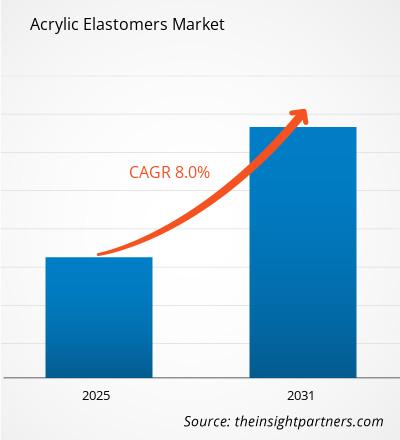
Segmentation Analysis
Type
Type represents a fundamental determinant of performance, processing behavior, service temperature, and application suitability in the Acrylic Elastomers Market. Demand remains concentrated around established automotive and industrial sealing requirements, but material selection is becoming more performance-driven as component operating conditions become more demanding. Ethylene Acrylic Elastomers are expected to maintain the stronger growth trajectory, with a ~8% CAGR through 2034, supported by higher-performance sealing requirements and broader qualification in demanding mobility applications.
- Acrylic Co-Monomer Elastomer: Acrylic Co-Monomer Elastomers remain important for established sealing specifications requiring balanced heat, oil, ozone, and weather resistance. Their established processing knowledge and broad compatibility with automotive fluids support continued use across mature component designs and replacement applications.
- Ethylene Acrylic Elastomers: Ethylene Acrylic Elastomers provide a combination of heat resistance, oil resistance, low-temperature performance, and dynamic durability. Their positioning is strengthened where engineers require improved performance margins for modern powertrains, thermal-management systems, and demanding industrial sealing environments.
Application
Application demand reflects the operating environment of the finished component and the performance requirements imposed by equipment manufacturers in the Acrylic Elastomers Market. Automotive remains the largest application because seals, hoses, gaskets, and related components encounter combinations of heat, oil, vibration, pressure, and environmental exposure. Automotive demand is expected to maintain a ~7% CAGR through 2034 as component qualification increasingly favors engineered elastomer performance.
- Automotive: Automotive applications represent the core demand base for acrylic elastomers because they require durable sealing across engines, transmissions, fluid systems, hoses, gaskets, and related components. Long qualification cycles and replacement requirements reinforce recurring material demand.
- Construction: Construction applications use acrylic elastomers where equipment, seals, hoses, and components face weathering, temperature variation, lubricants, and mechanical stress. Infrastructure and equipment modernization can broaden demand, particularly where service reliability is prioritized.
- Industrial: Industrial applications span machinery, fluid-handling equipment, pumps, compressors, and specialized systems. Demand is shaped by operating temperature, exposure to oils and chemicals, maintenance cycles, and requirements for longer component service life.
Opportunity Snapshot
| Application | Revenue Contribution | Trend Tag | Adoption Stage |
| Automotive | High | EV Sealing | Mature |
| Construction | Medium | Equipment Sealing | Scaling |
| Industrial | Medium | Fluid Handling | Scaling |
Acrylic Elastomers Market Growth Drivers and Impact Analysis
Higher Thermal Requirements in Automotive Sealing Systems
Automotive component designs increasingly require elastomers to maintain sealing performance under higher temperatures, extended service intervals, and complex fluid exposure. Acrylic elastomers provide a useful performance balance for applications where oil resistance, heat resistance, ozone resistance, and mechanical durability must coexist. This requirement supports the continued qualification of ACM and AEM materials in seals, hoses, gaskets, and related components. The market impact is strongest when vehicle manufacturers and Tier 1 suppliers redesign components around tighter dimensional tolerances and longer durability targets. Material suppliers that can provide consistent grades, application data, and technical support can gain qualification opportunities without relying solely on price competition. The effect extends beyond original equipment because replacement components must frequently meet established performance specifications.
Expansion of Industrial Equipment and Specialized Machinery
Industrial machinery creates a diversified demand base for acrylic elastomers because equipment used in pumps, compressors, construction machinery, manufacturing systems, and fluid-handling applications often operates under heat, pressure, lubricant exposure, or outdoor conditions. Acrylic elastomers can provide an alternative where standard rubber grades cannot deliver the required balance of oil resistance and thermal durability. Industrial demand is particularly relevant in regions investing in manufacturing capacity, mining equipment, infrastructure, and energy-related systems. The market impact is distributed across original equipment and maintenance activities, reducing dependence on a single automotive demand cycle. Suppliers with formulation expertise can capture additional value by adapting compounds to specific operating environments rather than selling only standardized polymer grades.
Growth of Localized Automotive and Rubber Manufacturing in Asia Pacific
Asia Pacific's expanding automotive and industrial manufacturing base is increasing the addressable customer pool for specialty elastomer suppliers. China, Japan, South Korea, and India combine vehicle production, machinery manufacturing, component processing, and increasingly localized supply chains. As local manufacturers improve component quality requirements, purchasing decisions are shifting from basic material availability toward consistency, durability, technical qualification, and life-cycle performance. This supports greater use of engineered rubber grades in demanding applications. For acrylic elastomer producers, regional manufacturing can reduce logistics exposure and improve responsiveness to customer qualification programs. The resulting market impact is strongest in China and Japan, while India provides a growing opportunity as automotive and industrial manufacturing capacity expands.
Acrylic Elastomers Market Future Trends
Bio-Based Feedstocks and Lower-Impact Elastomer Production
Sustainability is expected to become increasingly integrated into specialty elastomer procurement rather than remaining a separate environmental consideration. Producers are exploring biomass-derived feedstocks, mass-balance approaches, lower-emission manufacturing, and more transparent material accounting. For acrylic elastomers, the commercial challenge will be maintaining thermal, oil, ozone, and mechanical performance while reducing dependence on conventional fossil-derived inputs. Qualification requirements mean that sustainable grades cannot gain adoption solely through environmental attributes; they must demonstrate equivalent or improved technical performance in demanding applications. Over time, material suppliers that combine traceable feedstock strategies with stable quality and application-specific performance can improve their competitiveness in automotive and industrial procurement programs.
Performance Migration Toward Higher-Temperature AEM Grades
Future product development is likely to favor higher-performance ethylene acrylic elastomer grades where component temperatures, fluid exposure, and durability requirements exceed the practical range of conventional materials. Modern powertrain architectures and increasingly compact component designs can raise thermal loads around sealing interfaces, while industrial equipment continues to demand longer maintenance intervals. This creates a pathway for AEM materials to capture applications that previously relied on conventional ACM or other high-performance rubber systems. The transition will not eliminate ACM because cost, existing qualifications, and established specifications remain important. Instead, the market is likely to become more differentiated, with material selection increasingly determined by the precise combination of temperature, fluid, dynamic, and durability requirements.
Acrylic Elastomers Market Opportunities
Regional Production and Technical Support in Asia Pacific
Expanding manufacturing ecosystems in the Asia Pacific create an opportunity for acrylic elastomer producers to establish closer production and technical-service relationships with automotive and industrial customers. Localized compounding, application laboratories, technical centers, and shorter supply chains can reduce qualification delays and improve responsiveness to regional component manufacturers. China provides scale, Japan offers deep specialty-rubber expertise, South Korea contributes advanced automotive manufacturing, and India provides expanding vehicle and machinery production. Investment strategies should therefore prioritize customer qualification capabilities alongside physical capacity. Companies that develop regional technical resources can strengthen relationships with Tier 1 suppliers and component manufacturers while reducing dependence on long-distance supply routes. This opportunity is particularly relevant for higher-performance AEM grades requiring application-specific formulation support.
Specialty Compounds for EV and Thermal-Management Components
The evolution of vehicle architectures creates opportunities for specialty acrylic elastomer compounds designed around new sealing environments rather than legacy engine applications. Electric and hybrid vehicles introduce different combinations of thermal cycling, lubricants, coolants, vibration, electrical-system packaging, and compact component geometries. Suppliers can address these requirements through application-specific compounds, improved compression-set performance, enhanced fluid compatibility, and tighter manufacturing tolerances. The commercial opportunity lies less in replacing every conventional elastomer and more in qualifying acrylic materials where their performance advantages justify the material cost. Collaboration with component manufacturers during early design and validation stages can help suppliers secure specifications before vehicle programs enter full production, creating longer-duration demand relationships.
Recent Developments
- June 9, 2025: Zeon Corporation opened a new research facility at Zeon Chemicals Yonezawa to accelerate the development of plant-derived production processes for synthetic rubber raw materials, including butadiene and isoprene. The facility supports the company's carbon neutrality strategy and advances biotechnology for next-generation specialty elastomer manufacturing.
- June 19, 2026: Synthomer plc entered into an agreement to divest its Acrylate Monomers business in the Czech Republic to Mutares SE & Co. KGaA as part of its strategy to simplify its portfolio and strengthen its focus on higher-margin specialty chemicals. The transaction includes the Sokolov manufacturing site, a leading European producer of acrylic acid and related monomers, while ensuring the continued supply of acrylic monomers and dispersions to Synthomer under long-term supply arrangements.
Frequently Asked Questions

- Comprehensive Market Sizing and Forecast Analysis
- Detailed Segmentation Analysis
- In-Depth Market Dynamics Assessment
- Regional and Country-Level Insights
- Competitive Landscape and Company Benchmarking
- Strategic Business Intelligence
Recent Reports
Testimonials

The Insight Partners provided valuable market intelligence that supported our global go-to-market strategy. Their team was professional, responsive, and attentive to our feedback, providing thoughtful analysis and helpful methodological clarifications throughout the project.
Junmo Kim Chief Financial Officer (CFO), Enertech Co., Ltd.
The Insight Partners' SCADA System Market report is comprehensive, with valuable insights on current trends and future forecasts. The team was highly professional, responsive, and supportive throughout. We are very satisfied and highly recommend their services.
RAN KEDEM Partner, Reali Technologies LTDs
I requested a report on a very specific software market and the team produced the report in a few days. The information was very relevant and well presented. I then requested some changes and additions to the report. The team was again very responsive and I got the final report in less than a week.
JEAN-HERVE JENN Chairman, Future Analytica
We worked with The Insight Partners for an important market study and forecast. They gave us clear insights into opportunities and risks, which helped shape our plans. Their research was easy to use and based on solid data. It helped us make smart, confident decisions. We highly recommend them.
PIYUSH NAGPAL Sr. Vice President, High Beam Global
The Insight Partners delivered insightful, well-structured market research with strong domain expertise. Their team was professional and responsive throughout. The user-friendly website made accessing industry reports seamless. We highly recommend them for reliable, high-quality research services
YUKIHIKO ADACHI CEO, Deep Blue, LLC.
This is the first time I have purchased a market report from The Insight Partners.While I was unsure at first, I visited their web site and felt more comfortable to take the risk and purchase a market report.I am completely satisfied with the quality of the report and customer service. I had several questions and comments with the initial report, but after a couple of dialogs over email with their analyst I believe I have a report that I can use as input to our strategic planning process.Thank you so much for taking the extra time and making this a positive experience.I will definitely recommend your service to others and you will be my first call when we need further market data.
JOHN SUZUKI President and Chief Executive Officer, Board Director, BK Technologies
I wish to appreciate your support and the professionalism you displayed in the course of attending to my request for information regarding to infectious disease IVD market in Nigeria. I appreciate your patience, your guidance, and the fact that you were willing to offer a discount, which eventually made it possible for us to close a deal. I look forward to engaging The Insight Partners in the future, all thanks to the impression you have created in me as a result of this first encounter.
DR CHIJIOKE ONYIA MANAGING DIRECTOR, PineCrest Healthcare Ltd.Reason to Buy
- Informed Decision-Making
- Understanding Market Dynamics
- Competitive Analysis
- Identifying Emerging Markets
- Customer Insights
- Market Forecasts
- Risk Mitigation
- Boosting Operational Efficiency
- Strategic Planning
- Investment Justification
- Tracking Industry Innovations
- Aligning with Regulatory Trends





 Get Free Sample for