
Active Pharmaceutical Ingredient (API) Market Size, Share & Trends by 2034
Coverage: By Type of Synthesis ( Biotech, Synthetic ); Therapeutic Application (Cardiology, Oncology, CNS and Neurology, Orthopaedic, Endocrinology, Pulmonology, Gastroenterology, Nephrology, Ophthalmology, Others ), and Geography (North America, Europe, Asia Pacific, and South and Central America)
- Status : Data Released
- Report Code : TIPRE00003407
- Category : Life Sciences
- No. of Pages : 150
- Available Report Formats :


- Last update date : July 22, 2026


2025 Market Size
US$ 231.06 Bn
Base year value
2034 Forecast
US$ 441 Bn
Projected by 2034
CAGR 2026-2034
7.45 %
Growth rate
Addressable Market
US$ 3,030.04 Bn
(2026-2034)
The active pharmaceutical ingredient market size was estimated to be valued at US$ 231.06 Billion in 2025, forecasted to grow to US$ 441 Billion by 2034, growing at a CAGR of 7.45% from 2026–2034. The market is growing owing to increased manufacturing of small molecules, biologicals, potent drugs, and complex APIs, which are utilized across various categories of medicines such as branded, generics, specialties, and biosimilars.
In the North American region, active pharmaceutical ingredient market size is forecasted to grow at a CAGR of 6.8–7.7%, due to reasons like reshoring trends, increased adoption of GMP manufacturing processes, and high demand for oncology, cardiometabolic, neurology, and obesity treatments.
Active Pharmaceutical Ingredient (API) Market Assessment and Insights
- North America held 34–37% share in 2025 and is projected to grow at a CAGR between 6.8–7.7% during 2026–2034, supported by reshoring, oncology pipelines, and high-value biologic manufacturing.
- US represented 82–86% of North America share in 2025 and is expected to grow at a CAGR between 6.7–7.6% during 2026–2034, driven by domestic capacity expansion.
- Europe accounted for 24–27% share in 2025 and is forecast to grow at a CAGR between 6.1–7.0% during 2026–2034, led by Germany, Ireland, Switzerland, France, and Italy.
- Asia Pacific captured 31–34% share in 2025 and is likely to grow at a CAGR between 8.2–9.4% during 2026–2034, led by India, China, Japan, South Korea, and Singapore.
- Largest Segment Synthetic recorded 67–71% market share in 2025 and is expected to grow at a CAGR between 6.8–7.8% during 2026–2034 due to broad generic and small-molecule demand.
- High Growth Segment Biotech held 29–33% market share in 2025 and is projected to grow at a CAGR between 8.4–9.8% during 2026–2034 as biologics and biosimilars expand.
- Key companies analyzed in detail: Teva Pharmaceutical Industries Ltd., AbbVie Inc., Boehringer Ingelheim International GmbH, Cipla Inc., Merck & Co., Inc., Bristol-Myers Squibb Company, Albemarle Corporation, Viatris Inc., Aurobindo Pharma Limited, Sun Pharmaceutical Industries Limited.
Source: The Insight Partners' analysis based on proprietary research, government publications, company annual reports, investor presentations, industry databases, and expert interviews.
API manufacture is transitioning from a commodity chemistry approach with an emphasis on scale into one that involves high containment, digital monitoring, and Quality by Design (QbD). Manufacturers have been changing synthesis processes, adding peptides and biologics capabilities, and incorporating continuous manufacturing in order to enhance yields, control impurities, and ensure sustainability. Energy prices, solvent recycling, China plus one strategies, and regulation that addresses data integrity, validated cleaning, and supply chain traceability affect the dynamics of production.
Future developments will hinge on capacity in India, reshoring in the US and Europe, and investments in more complex compounds. Regulations will create favorable winds for firms with qualified suppliers, and public health systems will consider supply chain resilience following medicine shortages. Pharmaceutical companies with diverse manufacturing footprints, rich DMF portfolios, and solid quality records can gain procurement advantage.
Active Pharmaceutical Ingredient (API) Market Report Scope
| Report Attribute | Details |
|---|---|
| Market size in 2025 | US$ 231.06 Billion |
| Market Size by 2034 | US$ 441 Billion |
| Global CAGR (2026 - 2034) | 7.45% |
| Historical Data | 2021-2023 |
| Forecast period | 2026-2034 |
Active Pharmaceutical Ingredient (API) Market Analysis
Market growth for active pharmaceutical ingredients is being supported by factors such as the incidence of chronic diseases, patent expiry, specialty drugs, and increasing use of potent compounds. The demand comes from a value chain comprising raw material suppliers, route developers, CDMOs, captive API operations, formulators, regulators, and purchasing teams. Market supply dynamics favor companies that have multi-purpose plants, robust impurity profiling, and ability to handle various batch sizes for both commercial and late-stage clinical development processes.
Statistics provided by the WHO show that more than 43 million people died due to non-communicable diseases in 2021, out of which 19 million people succumbed to cardiovascular disease and 10 million people to cancer, leading to sustained pharmaceutical demand in areas such as cardiology, oncology, diabetes, respiratory, and renal medicines. The FDA approved 46 new drugs via the CDER in 2025.
The active pharmaceutical ingredient market analysis shows that the competition is fragmented but strategically important. Teva Pharmaceutical Industries Ltd, Viatris Inc, Aurobindo Pharma Limited, Sun Pharmaceutical Industries Limited, and Cipla Inc are key players among generic APIs, whereas AbbVie Inc, Merck & Co., Inc., Bristol-Myers Squibb Company, and Boehringer Ingelheim International GmbH offer captive and specialized manufacturing for innovative products.
Investments are being made into local resilience, biologics, peptides, high potency APIs, and green chemistry. The Albemarle Corporation provides specialty chemicals support, whereas the Indian companies have increased their regulated markets submissions. Strategic position becomes increasingly dependent on DMF knowledge, audit results, quick regulatory response, cost efficiency, and capability of serving both captive formulators and outside customers.
● REPORT CUSTOMIZATION
Tailor This Report To Align With Your Specific Business Requirements
This report can be customized to align precisely with your business objectives, scope, and target markets. Customization options include tailored segmentation, geography, competitive analysis, and strategic insights to support informed decision-making.
Customize This Report →WHAT YOU CAN ADJUST
- ● Segmentations
- ● Geography
- ● Competitive Analysis
- ● Language Preferences
Active Pharmaceutical Ingredient (API) Market: Strategic Insights
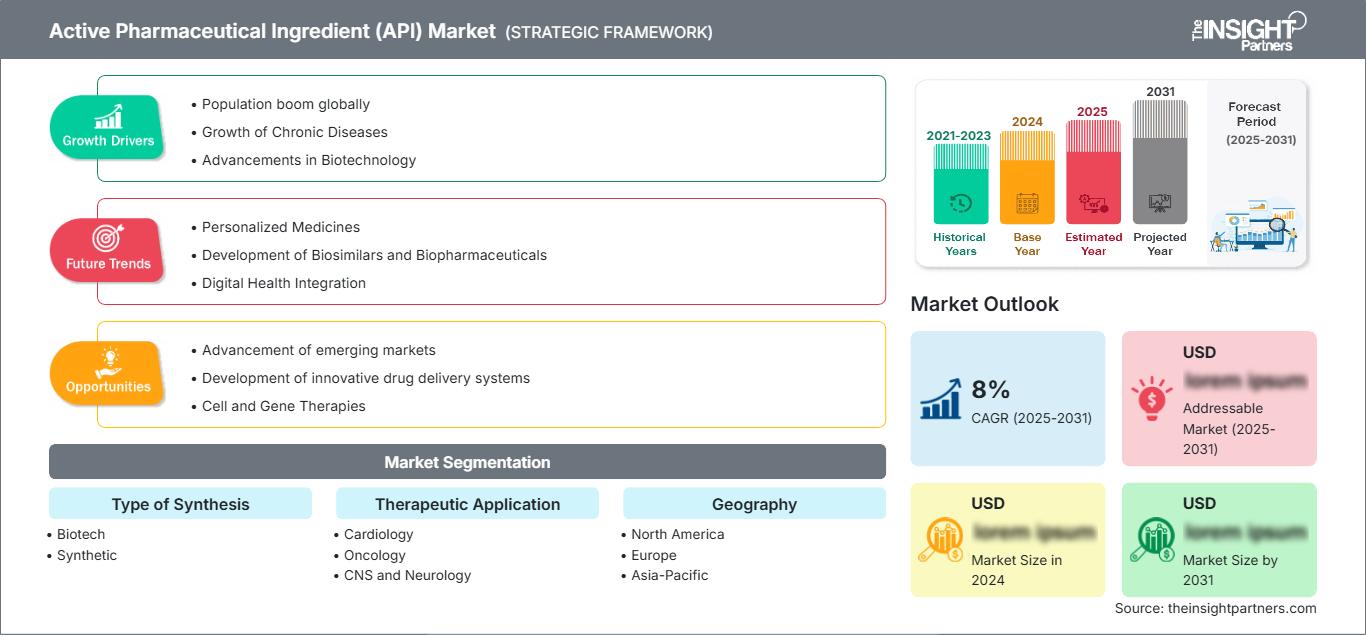
Regional Insights
North America Active pharmaceutical ingredient market
North America held 34–37% share in 2025 and is projected to grow at a CAGR between 6.8–7.7% during 2026–2034. The active pharmaceutical ingredient market share is supported by high-value innovative medicines, advanced biologics, specialty APIs, and increasing policy focus on domestic manufacturing resilience. US and Canadian buyers prioritize validated suppliers, strong audit performance, and supply security.
Oncology, obesity, immunology, neuroscience, and cardiometabolic drug development programs support regional demand. AbbVie Inc., Merck & Co., Inc., Bristol-Myers Squibb Company, and Teva Pharmaceutical Industries Ltd. still play an important role thanks to their manufacturing network and product portfolio. Procurement takes into account geopolitical risks, FDA inspection, environmental compliance, and the scalability of APIs for market launch.
U.S. Active pharmaceutical ingredient market
The U.S. held a market share of 82–86% in North America in 2025, and it will register growth at a compound annual growth rate ranging from 6.7–7.6% in 2026–2034. There will be growth in domestic manufacturing capacity driven by medicines shortages, trade war fears, and supply chain concerns for the country. Small molecule drug development, peptides, oncology APIs, and biologics intermediaries will be key areas of focus.
There will be a high level of player penetration in captive manufacturing, CDMO alliances, regulated-market filings, and the specialty drugs portfolio. In 2026, Merck & Co., Inc. committed more than US$ 70 billion to expand its manufacturing capabilities and R&D operations in the U.S., whereas AbbVie Inc. opened its new North Chicago API manufacturing site.
Europe Active pharmaceutical ingredient market
Europe had a market share of 24-27% in 2025 and is predicted to grow by a CAGR of 6.1-7.0% during 2026-2034. The UK improves life science manufacturing through innovation clusters and CDMO capabilities but faces cost pressures that affect procurement. It favors carbon-low manufacturing, GMP compliance, and secure availability of essential medications.
Germany is the biggest European player with the support of excellent chemical engineering know-how, high-standard manufacturing, and pharmaceutical clusters. Ireland and Switzerland are still key players in biologics, sterile manufacturing, and premium products. France, Italy, and Spain have contributions from branded and generic drugs manufacture with increasing focus of European policies to decrease reliance on essential APIs.
The supplier choices are influenced by EU GMP standards, environmental regulations, and value-based health care systems. Firms which have good documentation, superior containment technologies, sustainability initiatives, and reliable raw material sourcing will be favored. Europe is not characterized by volume but is stronger in complex manufacturing, quality systems, and proximity to multinational drug companies.
APAC Active pharmaceutical ingredient market
The market share of APAC was 31–34% in 2025, with the region expected to register a compound annual growth rate of 8.2–9.4% from 2026 to 2034. India leads due to the vast DMF portfolio, inclusion of generics, and chemical efficiency. China continues to be significant for intermediates and fermentation, whereas Japan and South Korea rely on quality-intensive APIs.
Singapore is important for high-end biologics as well as supply chain management. The key drivers of the policies in the region include India's production-linked incentive policy, manufacturing transformation in China, and Japan's supply security policy.
Middle East & Africa Active pharmaceutical ingredient market
The Middle East & Africa is expected to grow at a CAGR between 6.4–7.3% during 2026–2034. Saudi Arabia is the leading country due to healthcare localization, industrial diversification, and investment in pharmaceutical production. The UAE is building regional distribution and life sciences hubs for specialty medicine access.
South Africa remains the most established sub-Saharan market, supported by local formulation capacity and public health procurement. Rest of MEA demand is improving through hospital expansion and essential medicine programs. Energy-sector revenues in Gulf economies support industrial infrastructure, but API production remains selective and partnership-led.
Segmentation Analysis
Type of Synthesis
Type of Synthesis is expected to grow at a CAGR between 7.2–8.4% during 2026–2034. The active pharmaceutical ingredient market scope across synthesis routes is shaped by molecule complexity, regulatory pathway, manufacturing economics, and therapeutic innovation. Synthetic APIs remain the largest base because of broad small-molecule demand, while biotech APIs are expanding faster as biologics, biosimilars, peptides, and cell-signaling therapies require advanced upstream and downstream capabilities.
- Biotech APIs are gaining strategic importance because biologics, biosimilars, peptides, and recombinant therapies require specialized fermentation, cell culture, purification, analytics, and cold-chain capabilities.
- Synthetic APIs remain dominant due to extensive use in generics, oral solid dosage forms, cardiovascular therapy, oncology molecules, CNS drugs, and high-volume chronic disease medicines.
Therapeutic Application
Therapeutic Application is projected to grow at a CAGR between 7.0–8.2% during 2026–2034. API demand differs by disease burden, patent cycles, molecule potency, and clinical innovation. Oncology and cardiology remain high-value categories, while endocrinology is gaining momentum from metabolic disease pipelines. CNS, nephrology, ophthalmology, and pulmonology also require specialized APIs with strict impurity profiles and stability controls.
- Cardiology APIs benefit from long-term use of antihypertensives, lipid-lowering agents, anticoagulants, heart failure medicines, and combination therapies serving large chronic patient populations.
- Oncology APIs require high-containment production, potent compound handling, complex synthesis, and strict impurity control, making quality systems and operator safety strategically important.
- CNS and Neurology APIs support medicines for epilepsy, depression, migraine, schizophrenia, Parkinson’s disease, and emerging neurodegenerative indications requiring differentiated chemistry and sustained supply.
- Orthopaedic APIs serve treatments for pain, inflammation, osteoporosis, and musculoskeletal disorders, with demand linked to aging populations and post-surgical care.
- Endocrinology APIs are expanding through diabetes, thyroid, obesity, and hormonal therapies, with peptides and metabolic medicines increasing manufacturing complexity.
- Pulmonology APIs support asthma, COPD, pulmonary hypertension, and respiratory infection therapies where inhalation-grade particle control and stability are important.
- Gastroenterology APIs benefit from demand for acid-suppression, inflammatory bowel disease, liver disease, antiemetic, and gastrointestinal motility treatments.
- Nephrology APIs are linked to chronic kidney disease, anemia management, electrolyte disorders, transplant medicines, and dialysis-related therapeutic needs.
- Ophthalmology APIs require sterile-compatible quality, low impurity burden, and precise potency for anti-inflammatory, glaucoma, dry eye, and retinal disease medicines.
Opportunity Snapshot
| Therapeutic Application | Revenue Contribution | Trend Tag | Adoption Stage |
| Cardiology | High | Chronic Therapy | Mature |
| Oncology | High | HPAPI Scale | Scaling |
| CNS and Neurology | Medium | Neuro Pipeline | Scaling |
| Orthopaedic | Medium | Aging Pain | Mature |
| Endocrinology | High | Metabolic Drugs | Scaling |
| Pulmonology | Medium | Inhaled APIs | Mature |
| Gastroenterology | Medium | IBD Therapy | Scaling |
| Nephrology | Medium | Renal Care | Scaling |
| Ophthalmology | Medium | Sterile APIs | Scaling |
| Others | Low | Specialty Niches | Emerging |
Active Pharmaceutical Ingredient (API) Market Growth Drivers and Impact Analysis
Chronic disease burden and sustained medicine utilization
The increased incidence of cardiovascular diseases, cancers, diabetes, respiratory disorders, and renal diseases means that there will be continuous volume requirements for APIs of both branded drugs and generics. As opposed to episodic treatments, some chronic medications are required for life, which makes procurement reliable and allows for long-term contracts with suppliers. This effect will be most pronounced in cardiology, endocrinology, oncology, and CNS therapeutic classes due to the confluence of high patient numbers, off-patent products, and the introduction of new drugs. API suppliers enjoy steady, consistent demand, whereas formulators look to dual-source to prevent shortages.
Patent expiries and expansion of generic manufacturing
Patent expirations continue to present new business opportunities for API manufacturers in regulated generic markets. Following the end of patent exclusivity period, formulators need to access a source of APIs which can help to file abbreviated NDAs and get the product to market on time. This driver leads to a higher interest in synthetic APIs, complex generics, and high potency APIs. From practice, it means the following: more supplier qualification, more DMF filing, and increased competition between Indian, European, and North American manufacturers.
Supply-chain resilience and regional manufacturing policies
Governments and pharmaceutical companies are reassessing API sourcing because shortages, geopolitical disruptions, and export dependencies have exposed vulnerabilities in medicine supply chains. This driver is pushing investment into regional production, strategic inventories, and qualified backup suppliers. This is clearly seen in US and European reshoring initiatives, incentives provided by India, and increased requirements for supplier risk assessment. Purchasing companies no longer consider API suppliers solely on price. Geographic distribution, previous audits, environmental safety, and the sourcing of materials are also under consideration. Only those suppliers who possess a diverse network, open quality systems, and reliable logistics will win lucrative contracts in important medicines.
Active Pharmaceutical Ingredient (API) Market Future Trends
Continuous manufacturing and greener synthesis routes
The active pharmaceutical ingredient market trends are moving toward continuous processing, biocatalysis, solvent reduction, and route redesign to improve yield, safety, and environmental performance. Continuous manufacturing can reduce batch variability, lower inventory, and improve process control for selected molecules. Green chemistry will also become more important as regulators, customers, and investors examine emissions, waste, and water use. Future API winners will be those that combine cost efficiency with credible sustainability metrics. This trend is especially relevant for high-volume synthetic APIs and complex molecules where process mass intensity, hazardous solvents, and energy demand affect both margins and customer qualification.
More biologics, peptides, and high-potency API capacity
Future growth will increasingly come from technically demanding APIs rather than simple commodity chemistry. Biologics, peptides, antibody-drug conjugate payloads, oligonucleotides, and high-potency small molecules require specialized containment, purification, analytics, and skilled operators. This shift will reshape investment priorities toward flexible facilities that can handle smaller batches, higher value per kilogram, and stricter quality requirements. Demand will also create opportunities for CDMOs with integrated development and manufacturing services. Companies that master complex process transfer, regulatory documentation, and safe containment will gain pricing power, while basic API producers will face stronger margin pressure in commoditized molecules.
Active Pharmaceutical Ingredient (API) Market Opportunities
High-potency and oncology-focused capacity expansion
Suppliers can expand by investing in high-containment suites, potent compound analytics, oncology route development, and safe scale-up capabilities. active pharmaceutical ingredient market Forecasts indicate that oncology pipelines will continue requiring specialized APIs with strict impurity control and operator protection. Investment should focus on flexible containment, validated cleaning, closed transfer systems, and regulatory packages that support global filings. The opportunity is strongest for manufacturers serving branded innovators, complex generic entrants, and CDMOs with late-stage oncology programs. Companies able to provide development-to-commercial continuity can capture higher margins and reduce customer switching risk.
Regional dual-sourcing partnerships for essential medicines
Pharmaceutical companies and public buyers are seeking alternative API sources for critical medicines, creating opportunities for suppliers with credible regional capacity. Partnership models can include long-term purchase agreements, technology transfer, toll manufacturing, and localized production of priority molecules. The opportunity is attractive in the US, Europe, India, and select Middle Eastern markets where policy support aligns with supply-security objectives. Suppliers should prioritize molecules with shortage histories, high public health relevance, and feasible economics. Success depends on transparent quality systems, competitive cost structures, and willingness to share risk through inventory commitments and regulatory support.
Recent Developments
- May 2026: Bristol-Myers Squibb Company evaluated Houston for a potential US$ 1 billion pharmaceutical manufacturing facility that could produce medicines for domestic and international markets. The filing indicated a 600,000-square-foot project and nearly 500 jobs, reflecting wider US momentum toward domestic pharmaceutical manufacturing capacity and resilient API-linked supply networks.
- February 2026: AbbVie Inc. announced a US$ 380 million investment to build two active pharmaceutical ingredient manufacturing facilities at its North Chicago campus. The facilities will support next-generation neuroscience and obesity medicines, integrate advanced manufacturing technologies with artificial intelligence, begin construction in spring 2026, and become fully operational in 2029.
- December 2025: Sun Pharmaceutical Industries Limited approved an investment of INR 3,000 crores, approximately US$ 332 million, for a new formulations manufacturing facility in Madhya Pradesh. The project supports broader manufacturing capacity expansion in India and complements the company’s integrated network of finished dosage and API facilities serving regulated and emerging markets.
Frequently Asked Questions

- Comprehensive Market Sizing and Forecast Analysis
- Detailed Segmentation Analysis
- In-Depth Market Dynamics Assessment
- Regional and Country-Level Insights
- Competitive Landscape and Company Benchmarking
- Strategic Business Intelligence
Recent Reports
Testimonials

The Insight Partners' SCADA System Market report is comprehensive, with valuable insights on current trends and future forecasts. The team was highly professional, responsive, and supportive throughout. We are very satisfied and highly recommend their services.
RAN KEDEM Partner, Reali Technologies LTDs
I requested a report on a very specific software market and the team produced the report in a few days. The information was very relevant and well presented. I then requested some changes and additions to the report. The team was again very responsive and I got the final report in less than a week.
JEAN-HERVE JENN Chairman, Future Analytica
We worked with The Insight Partners for an important market study and forecast. They gave us clear insights into opportunities and risks, which helped shape our plans. Their research was easy to use and based on solid data. It helped us make smart, confident decisions. We highly recommend them.
PIYUSH NAGPAL Sr. Vice President, High Beam Global
The Insight Partners delivered insightful, well-structured market research with strong domain expertise. Their team was professional and responsive throughout. The user-friendly website made accessing industry reports seamless. We highly recommend them for reliable, high-quality research services
YUKIHIKO ADACHI CEO, Deep Blue, LLC.
This is the first time I have purchased a market report from The Insight Partners.While I was unsure at first, I visited their web site and felt more comfortable to take the risk and purchase a market report.I am completely satisfied with the quality of the report and customer service. I had several questions and comments with the initial report, but after a couple of dialogs over email with their analyst I believe I have a report that I can use as input to our strategic planning process.Thank you so much for taking the extra time and making this a positive experience.I will definitely recommend your service to others and you will be my first call when we need further market data.
JOHN SUZUKI President and Chief Executive Officer, Board Director, BK Technologies
I wish to appreciate your support and the professionalism you displayed in the course of attending to my request for information regarding to infectious disease IVD market in Nigeria. I appreciate your patience, your guidance, and the fact that you were willing to offer a discount, which eventually made it possible for us to close a deal. I look forward to engaging The Insight Partners in the future, all thanks to the impression you have created in me as a result of this first encounter.
DR CHIJIOKE ONYIA MANAGING DIRECTOR, PineCrest Healthcare Ltd.Reason to Buy
- Informed Decision-Making
- Understanding Market Dynamics
- Competitive Analysis
- Identifying Emerging Markets
- Customer Insights
- Market Forecasts
- Risk Mitigation
- Boosting Operational Efficiency
- Strategic Planning
- Investment Justification
- Tracking Industry Innovations
- Aligning with Regulatory Trends





 Get Free Sample for