
Adhesive Dispensing System Market Demand, Size & Forecast by 2034
Coverage: by Dispenser Type (Portable hand dispensers, Air-powered syringe dispensers, Pneumatic Foot Dispensers, Robot dispensers, Others); Adhesive Type (Hot melt glue, Cold glue); Application (Medical device, Electronics, Automotive, Construction, Aerospace, Telecommunications, Furniture, Defense industries, Others) , and Geography (North America, Europe, Asia Pacific, and South and Central America)
- Status : Data Released
- Report Code : TIPRE00009627
- Category : Chemicals and Materials
- No. of Pages : 150
- Available Report Formats :


- Last update date : July 15, 2026


2025 Market Size
US$ 2.75 Bn
Base year value
2034 Forecast
US$ 5.34 Bn
Projected by 2034
CAGR 2026-2034
7.67 %
Growth rate
Addressable Market
US$ 36.47 Bn
(2026-2034)
The adhesive dispensing system market size was valued at US$ 2.75 Billion in 2025 and is projected to reach US$ 5.34 Billion by 2034, expanding at a CAGR of 7.67% during 2026–2034. The market will grow owing to increased automation in manufacturing industries, increased use of precision bonding processes, and the growing need for dispensing equipment of high quality in electronics, automotive, medical device manufacturing, and other industries where the consistent application of adhesives and minimized wastage are essential.
North America will remain technologically mature and driven by extensive factory automation, sophisticated electronics manufacturing, and advanced medical device manufacturing. The North American adhesive dispensing system market size is expected to grow at a rate of 6.8% to 7.4% from 2026 to 2034. Increased spending on collaborative robots, smart manufacturing, and high-value manufacturing in industry have driven demand for programmable dispensing systems.
Adhesive Dispensing System Market Assessment and Insights
- North America: Accounted for 34–38% adhesive dispensing system market share in 2025 and is projected to expand at a CAGR of 6.8–7.4% during 2026–2034, supported by strong industrial automation investments, medical manufacturing, and electronics assembly requiring precision adhesive application.
- US: Represented 74–78% of the North American market in 2025 and is anticipated to grow at a CAGR of 6.9–7.5% during 2026–2034, driven by automotive electrification, aerospace manufacturing, and expanding semiconductor investments.
- Europe: Held 25–29% share in 2025 while advancing at a CAGR of 6.5–7.2% during 2026–2034. Germany, France, Italy, and the UK continue to lead regional adoption through Industry 4.0 investments and advanced manufacturing modernization.
- Asia Pacific: Captured 29–33% share in 2025 and is forecast to register the fastest regional expansion with a CAGR of 8.5–9.2% during 2026–2034, supported by manufacturing expansion across China, Japan, South Korea, and India.
- Largest Segment: Application – Electronics accounted for 27–31% market share in 2025 and is expected to expand at a CAGR of 8.0–8.6% during 2026–2034, supported by increasing semiconductor packaging and miniaturized electronic component production.
- High Growth Segment: Dispenser Type – Robot dispensers represented 20–24% market share in 2025 while recording the fastest growth at a CAGR of 9.5–10.2% during 2026–2034, driven by smart factory deployment and robotic production lines.
- Key companies analyzed in detail: Adhesive Dispensing Ltd., DOPAG Group, Dymax Corporation, Fishman Corporation, Genesis Systems Group, Glue Machinery Corporation, Henkel AG & Co. KGaA, Nordson Corporation, Techcon Systems, Valco Melton, Inc.
Source: The Insight Partners' analysis based on proprietary research, government publications, company annual reports, investor presentations, industry databases, and expert interviews.
Automated dispensing requirements across industries have greatly influenced dispensing technology over the last ten years. Manufacturers today look for dispensing machines that can repeatedly regulate adhesive volume with minimal waste and higher production output. The use of programmable controls, inspection systems, and robotics in the industry has helped in increasing accuracy in the dispensing process with minimal human input. Dispensing technology is rapidly gaining popularity across the electronics, medical devices, automotive parts, and aerospace assemblies industries.
Future growth will largely depend on rapid manufacturing investments in Southeast Asia, Eastern Europe, and some economies in the Middle East looking to engage in more industrial production. Government incentives for smart factories and the rising use of collaborative robots and industrial digitization are likely to drive upgrades in dispensing equipment. Sustainability policies advocating reduced adhesive waste, energy consumption, and more efficient production processes are likely to drive capital investment in the technology.
Adhesive Dispensing System Market Report Scope
| Report Attribute | Details |
|---|---|
| Market size in 2025 | US$ 2.75 Billion |
| Market Size by 2034 | US$ 5.34 Billion |
| Global CAGR (2026 - 2034) | 7.67% |
| Historical Data | 2021-2024 |
| Forecast period | 2026-2034 |
Adhesive Dispensing System Market Analysis
Increasing manufacturing automation is the key driver that propels the adhesive dispensing system market growth worldwide. Precision dispensing has gained increasing importance as manufacturers shift towards lightweight materials, miniaturized electronic assemblies, and automated processes that require high repeatability in adhesive application. Electrification of automobiles, semiconductor packaging, and medical device manufacturing continue to drive demand for programmable dispensers that ensure consistent bonding while wasting minimal material. Meanwhile, rising labor costs in manufacturing sectors across developed economies are driving investment in automated dispensing systems to improve production efficiency.
Key players in this industry include adhesive manufacturers, dispensing equipment vendors, robotics providers, automation solution providers, software developers, and manufacturers. Cooperation among these players ensures the development of solutions that enable more flexible production processes, preventive maintenance, and digital control of the production process. The adoption of Industry 4.0 trends drives more integration between dispensing equipment and the factory management system.
The competition remains strong as established vendors add new products to their lines through innovation, acquisitions, and alliances. In addition, this market assessment for adhesive dispensing systems reveals an increasing trend among manufacturers toward intelligent dispensing systems featuring machine vision, programmable dispensing parameters, remote diagnostics, and Industrial Internet of Things (IIOT) technology. The companies include Nordson Corporation, DOPAG Group, Dymax Corporation, Techcon Systems, Valco Melton, Inc., and Fishman Corporation, which have continued to invest in precision technologies for tough industrial processes in industries such as electronics, medicine, aerospace, and automotive manufacturing.
Investments have increasingly been directed towards the development of modular dispensing systems capable of dispensing various types of adhesives while also enabling flexible manufacturing processes. Equipment vendors have been emphasizing features such as software-enabled optimization, robotization, and predictive maintenance. Strategic expansion in rapidly industrializing regions along with local technical service support, has helped to increase competitiveness in the market as manufacturers look for reliable adhesive dispensing systems.
● REPORT CUSTOMIZATION
Tailor This Report To Align With Your Specific Business Requirements
This report can be customized to align precisely with your business objectives, scope, and target markets. Customization options include tailored segmentation, geography, competitive analysis, and strategic insights to support informed decision-making.
Customize This Report →WHAT YOU CAN ADJUST
- ● Segmentations
- ● Geography
- ● Competitive Analysis
- ● Language Preferences
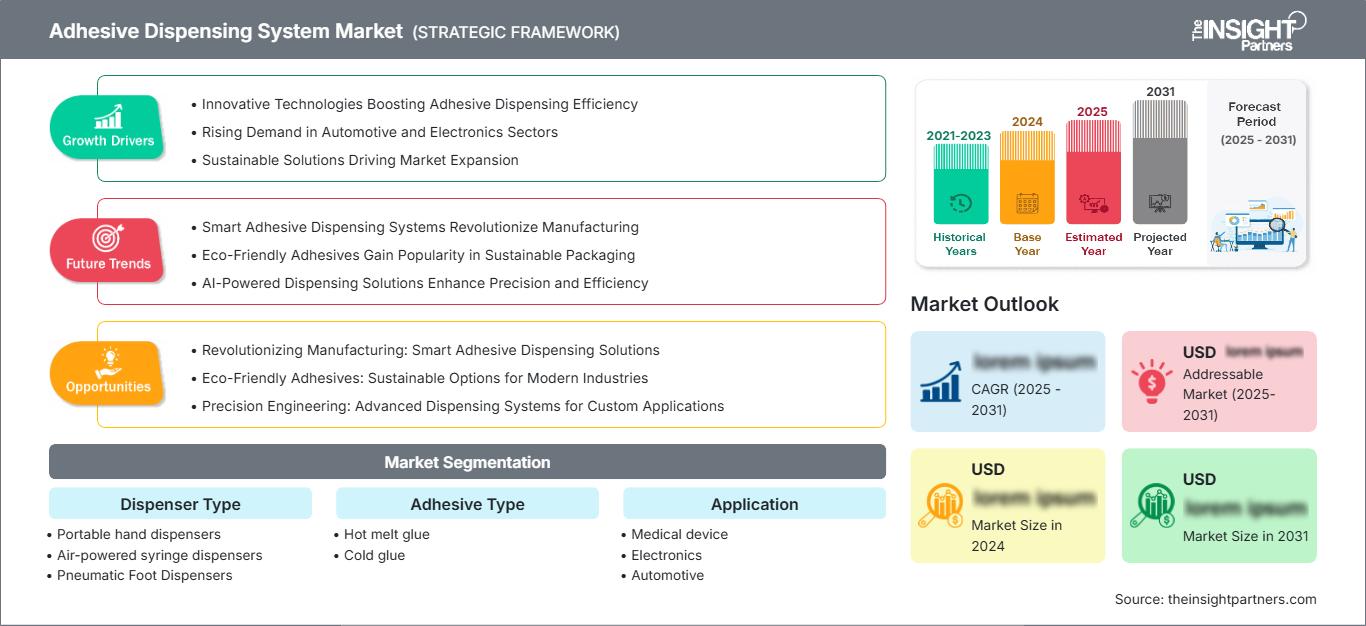
Adhesive Dispensing System Market: Strategic Insights
Regional Insights
North America Adhesive Dispensing System Market
North America accounted for 34–38% of the adhesive dispensing system market share in 2025 and is projected to expand at a CAGR of 6.8–7.4% during 2026–2034. The region benefits from advanced manufacturing infrastructure, early adoption of industrial automation, and high investment in precision production technologies. Strong demand from medical device manufacturing, automotive electrification, aerospace assemblies, and semiconductor packaging continues to support equipment replacement and new installations. Increasing labor costs are also encouraging manufacturers to deploy automated dispensing systems that improve process consistency and reduce adhesive waste.
In modernization programs in industry across the United States, Canada, and Mexico, there is increasing investment in smart factories with collaborative robots, dispensing systems with vision guidance, and quality control using digital methods. There are increased reshoring efforts and the development of more battery manufacturing facilities, which means greater demand for programmable dispensing equipment with adhesive capabilities to meet high-production and high-quality standards. The region continues to be at the forefront of technology because of innovation and applied engineering.
U.S. Adhesive Dispensing System Market
The United States represented 74–78% of the North American market in 2025 and is anticipated to register a CAGR of 6.9–7.5% through 2034. The country remains the largest regional manufacturing hub for aerospace, electronics, automotive, and medical technologies requiring precision adhesive application. Extensive presence of leading dispensing equipment manufacturers, automation specialists, and industrial robotics suppliers has created a highly competitive environment that encourages continuous product innovation and adoption of intelligent dispensing technologies.
Dispensing technologies are increasingly incorporated into machine vision, IoT systems, and robotic production cells. Investments in semiconductors, electric vehicle batteries, and advanced electronic manufacturing are further driving equipment requirements. There is also increased attention to sustainability by implementing dispensing solutions that optimize adhesive usage, reduce defect rates, and cut production costs.
Europe Adhesive Dispensing System Market
Europe captured 25–29% market share in 2025 and is forecast to grow at a CAGR of 6.5–7.2% during 2026–2034. The region benefits from advanced engineering capabilities, widespread Industry 4.0 implementation, and a strong automotive supply chain. Germany remains the leading national market owing to its highly automated manufacturing sector, while France, Italy, and the United Kingdom continue expanding investments in electronics, aerospace, and industrial automation applications.
Automated dispensing machines are being widely adopted in the United Kingdom across the aerospace manufacturing industry, medical technology, and the production of advanced electronics. Increased spending on digital manufacturing and precision engineering is contributing to the modernization of manufacturing plants, along with growing needs for programmable dispensing equipment, which provides consistent application accuracy and increased production efficiency.
Germany continues to maintain regional dominance owing to its well-developed automobile, machinery, and industrial automation sectors. Increased spending on robotic manufacturing, electric car production, and smart factories enables the extensive use of advanced dispensing equipment. Increasing preferences for automated solutions among German manufacturers.
France, Italy, and Spain continue strengthening market demand through expansion of aerospace manufacturing, industrial machinery production, packaging equipment, and consumer electronics assembly. Increasing government support for industrial digitalization and sustainable manufacturing encourages adoption of automated dispensing technologies capable of reducing material waste while improving manufacturing precision across multiple end-use industries.
APAC Adhesive Dispensing System Market
Asia Pacific accounted for 29–33% share in 2025 and is projected to expand at the fastest CAGR of 8.5–9.2% during 2026–2034. China remains the largest regional market, followed by Japan, South Korea, and India, supported by expanding electronics manufacturing, automotive production, and semiconductor investments.
The government-sponsored manufacturing program, industrial automation, and the increased use of collaborative robots will continue to drive market growth. Australia helps by making sophisticated mining equipment and industrial automation systems, and India sees increasing use in electronics assembly, automobile parts manufacturing, and medical device manufacturing due to production-based investment programs.
Segmentation Analysis
Dispenser Type
The dispenser type segment is projected to expand at a CAGR of 8.1–8.7% during 2026–2034. Selection depends on production scale, dispensing accuracy, adhesive viscosity, and automation requirements. Manufacturers increasingly invest in flexible dispensing technologies capable of supporting multiple production environments while improving productivity and minimizing adhesive consumption. The adhesive dispensing system market scope continues expanding as manufacturers integrate intelligent dispensing platforms with robotics and digital production systems.
- Portable hand dispensers provide economical adhesive application for maintenance, repair, low-volume production, and flexible manufacturing environments where manual control remains practical and installation costs must remain relatively low.
- Air-powered syringe dispensers deliver highly controlled dispensing volumes for electronics assembly, laboratory applications, and medical device manufacturing where repeatability, precision, and contamination control are operational priorities.
- Pneumatic Foot Dispensers improve operator productivity by enabling hands-free adhesive dispensing, making them suitable for medium-volume industrial production requiring improved consistency and reduced operator fatigue.
- Robot dispensers have become the preferred solution for high-volume manufacturing because they support programmable dispensing paths, superior repeatability, automated inspection integration, and continuous production with minimal human intervention.
Adhesive Type
The adhesive type segment is expected to record a CAGR of 7.3–7.9% during 2026–2034. Selection is primarily determined by production requirements, curing characteristics, bonding performance, and substrate compatibility. Increasing demand for efficient manufacturing and sustainable production practices encourages adoption of dispensing systems capable of handling diverse adhesive formulations with high precision.
- Hot melt glue remains widely adopted across packaging, furniture manufacturing, consumer goods, and automotive interiors because of its rapid setting characteristics, high production efficiency, and compatibility with automated dispensing systems.
- Cold glue continues serving applications requiring moisture resistance, paper bonding, woodworking, labeling, and selected industrial assembly processes where longer working time and lower processing temperatures provide manufacturing advantages.
Application
The application segment is projected to expand at a CAGR of 8.2–8.8% during 2026–2034. Electronics remains the dominant application because manufacturers require highly accurate adhesive placement for compact assemblies, semiconductor packaging, and sensitive electronic components. Increasing automation across multiple industries continues strengthening long-term equipment demand.
- Medical device manufacturing requires precision dispensing to ensure sterile production, reliable bonding, and compliance with demanding regulatory and quality standards.
- Electronics represents the leading application owing to rapid semiconductor packaging, printed circuit board assembly, and miniaturized consumer electronics requiring highly repeatable adhesive dispensing.
- Automotive manufacturers increasingly deploy automated dispensing systems for electric vehicle batteries, lightweight materials, interior assembly, and structural bonding applications.
- Construction utilizes dispensing equipment for insulation materials, panel assembly, glazing systems, prefabricated structures, and specialty building products requiring consistent adhesive application.
- Aerospace applications emphasize lightweight assembly, structural reliability, composite bonding, and traceable manufacturing processes supported by advanced programmable dispensing technologies.
- Telecommunications manufacturers utilize dispensing systems during network equipment assembly, optical component production, and electronic module manufacturing requiring high precision.
- Furniture manufacturers employ dispensing technologies to improve production speed, adhesive utilization, product consistency, and assembly quality across wood-based manufacturing operations.
- Defense industries require precision dispensing equipment capable of supporting mission-critical electronic systems, composite materials, specialized assemblies, and demanding quality assurance protocols.
Opportunity Snapshot
| Segment Name | Revenue Contribution | Trend Tag | Adoption Stage |
| Medical device | Medium | Sterile Assembly | Scaling |
| Electronics | High | Chip Packaging | Mature |
| Automotive | High | EV Batteries | Scaling |
| Construction | Medium | Prefabrication | Scaling |
| Aerospace | Medium | Composite Bonding | Mature |
| Telecommunications | Medium | Optical Modules | Scaling |
| Furniture | Low | Automated Gluing | Mature |
| Defense industries | Low | Mission Systems | Emerging |
Adhesive Dispensing System Market Growth Drivers and Impact Analysis
Rising Industrial Automation Across Manufacturing Facilities
This shift towards automated manufacturing settings has greatly increased the need for sophisticated adhesive dispensing systems. Companies are using automated dispensing machines to replace manual methods to increase accuracy, minimize product defects, and maximize material utilization. There are many automobile, electronics, aerospace, and medical device companies investing heavily in robots for manufacturing that can maintain consistent dispensing volumes at high speeds. Machine vision systems, programmable logic controllers, and the IIoT are being used to monitor processes in real time and enable predictive maintenance. With further adoption of smart manufacturing by many factories to overcome labor shortages and improve efficiency, demand for intelligent dispensing equipment will increase in both developed and developing countries.
Expansion of Electronics and Semiconductor Manufacturing
Rapid growth in semiconductor fabrication, printed circuit board assembly, and advanced electronics manufacturing continues to strengthen demand for precision adhesive dispensing systems. Miniaturization of electronic components requires highly accurate adhesive placement to ensure product reliability, thermal management, and long-term performance. Increasing production of electric vehicles, consumer electronics, communication equipment, and industrial sensors further supports investments in programmable dispensing platforms capable of micron-level accuracy. Government incentives encouraging domestic semiconductor production across North America, Europe, and Asia Pacific are accelerating establishment of new manufacturing facilities equipped with automated dispensing technologies. Equipment manufacturers are responding by developing dispensing solutions compatible with increasingly sophisticated electronic packaging processes and advanced production environments requiring continuous quality monitoring.
Growing Adoption of Lightweight Materials in Transportation Industries
Automotive and aerospace manufacturers are increasingly utilizing structural adhesives to replace traditional mechanical fastening methods in lightweight vehicle and aircraft designs. This transition requires highly controlled dispensing equipment capable of delivering consistent adhesive volumes while supporting diverse material combinations including composites, aluminum, engineered plastics, and advanced alloys. Electrification of transportation further increases adhesive usage within battery systems, thermal management modules, and electronic control units. Automated dispensing solutions improve assembly precision, reduce adhesive waste, and enhance manufacturing productivity while maintaining strict quality requirements. Continuous innovation in vehicle design and expanding production of electric mobility platforms are expected to generate sustained investment in advanced dispensing technologies throughout the forecast period.
Adhesive Dispensing System Market Future Trends
Artificial Intelligence and Smart Process Control Integration
Artificial intelligence is becoming an important differentiator within automated dispensing platforms. Manufacturers are integrating intelligent software capable of monitoring dispensing parameters, detecting process deviations, and automatically adjusting dispensing volumes to maintain production quality. The adhesive dispensing system market trends increasingly reflect adoption of machine learning, digital twins, and predictive analytics that optimize maintenance schedules and improve manufacturing efficiency. These technologies also support remote diagnostics, production traceability, and continuous process optimization. As industrial digitalization expands across global manufacturing facilities, AI-enabled dispensing solutions are expected to become standard features in high-value production environments requiring superior precision and operational reliability.
Sustainable Dispensing Technologies Supporting Material Efficiency
Environmental sustainability is becoming a major consideration for manufacturing operations implementing adhesive dispensing equipment. Equipment suppliers are developing dispensing technologies that minimize adhesive waste, reduce compressed air consumption, and improve energy efficiency without compromising dispensing accuracy. Manufacturers are also introducing modular equipment supporting recyclable components, easier maintenance, and extended operational lifecycles. Increasing adoption of bio-based adhesives and environmentally preferable bonding materials further encourages development of dispensing platforms compatible with diverse formulations. Sustainability objectives established by manufacturers across automotive, electronics, medical devices, and packaging industries are expected to accelerate replacement of older dispensing equipment with digitally optimized, resource-efficient production systems over the coming decade.
Adhesive Dispensing System Market Opportunities
Expanding Smart Manufacturing Investments in Emerging Economies
Emerging manufacturing economies are investing substantially in industrial automation to strengthen global competitiveness and attract advanced manufacturing operations. The adhesive dispensing system market forecasts indicate that countries across Southeast Asia, India, Eastern Europe, and selected Middle Eastern economies will continue expanding electronics assembly, automotive manufacturing, medical device production, and industrial equipment manufacturing. Government-supported industrial modernization programs, favorable investment policies, and increasing adoption of robotics provide significant opportunities for dispensing equipment suppliers. Companies capable of offering localized technical support, modular automation platforms, and application-specific engineering services are well positioned to expand their presence as manufacturers modernize production facilities and seek higher manufacturing productivity with improved quality control.
Customized Dispensing Solutions for High-Value Industrial Applications
Demand for customized dispensing equipment continues increasing as manufacturers require application-specific solutions for complex production environments. Industries including aerospace, medical devices, electric vehicles, semiconductor packaging, and telecommunications increasingly seek dispensing systems capable of handling specialized adhesive chemistries while integrating seamlessly with automated production lines. Equipment suppliers can create additional value by offering configurable software, advanced vision systems, remote monitoring capabilities, and predictive maintenance services. Expansion of contract manufacturing organizations and specialized industrial production facilities also creates opportunities for tailored dispensing solutions that improve operational flexibility, accelerate production changeovers, and deliver higher precision across multiple manufacturing applications while strengthening long-term customer relationships.
Recent Developments
- May 21, 2026: Graco Inc. announced a definitive agreement to acquire Valco Melton, a global provider of precision adhesive application and quality assurance systems, for approximately US$ 447 million. The acquisition expands Graco's industrial fluid handling portfolio while strengthening its capabilities in adhesive dispensing, vision-based inspection, and packaging automation across global manufacturing industries.
- July 01, 2025: Nordson Corporation introduced the VersaBlue II Melter, an advanced adhesive dispensing platform designed for disposable hygiene manufacturing. The new system incorporates enhanced gear dosing, EtherCAT and OPC UA connectivity, real-time diagnostics, and improved thermal insulation that can reduce energy consumption by up to 10%, enabling manufacturers to improve dispensing precision, lower material waste, and simplify integration into automated production lines.
Frequently Asked Questions

- Comprehensive Market Sizing and Forecast Analysis
- Detailed Segmentation Analysis
- In-Depth Market Dynamics Assessment
- Regional and Country-Level Insights
- Competitive Landscape and Company Benchmarking
- Strategic Business Intelligence
Recent Reports
Testimonials

The Insight Partners' SCADA System Market report is comprehensive, with valuable insights on current trends and future forecasts. The team was highly professional, responsive, and supportive throughout. We are very satisfied and highly recommend their services.
RAN KEDEM Partner, Reali Technologies LTDs
I requested a report on a very specific software market and the team produced the report in a few days. The information was very relevant and well presented. I then requested some changes and additions to the report. The team was again very responsive and I got the final report in less than a week.
JEAN-HERVE JENN Chairman, Future Analytica
We worked with The Insight Partners for an important market study and forecast. They gave us clear insights into opportunities and risks, which helped shape our plans. Their research was easy to use and based on solid data. It helped us make smart, confident decisions. We highly recommend them.
PIYUSH NAGPAL Sr. Vice President, High Beam Global
The Insight Partners delivered insightful, well-structured market research with strong domain expertise. Their team was professional and responsive throughout. The user-friendly website made accessing industry reports seamless. We highly recommend them for reliable, high-quality research services
YUKIHIKO ADACHI CEO, Deep Blue, LLC.
This is the first time I have purchased a market report from The Insight Partners.While I was unsure at first, I visited their web site and felt more comfortable to take the risk and purchase a market report.I am completely satisfied with the quality of the report and customer service. I had several questions and comments with the initial report, but after a couple of dialogs over email with their analyst I believe I have a report that I can use as input to our strategic planning process.Thank you so much for taking the extra time and making this a positive experience.I will definitely recommend your service to others and you will be my first call when we need further market data.
JOHN SUZUKI President and Chief Executive Officer, Board Director, BK Technologies
I wish to appreciate your support and the professionalism you displayed in the course of attending to my request for information regarding to infectious disease IVD market in Nigeria. I appreciate your patience, your guidance, and the fact that you were willing to offer a discount, which eventually made it possible for us to close a deal. I look forward to engaging The Insight Partners in the future, all thanks to the impression you have created in me as a result of this first encounter.
DR CHIJIOKE ONYIA MANAGING DIRECTOR, PineCrest Healthcare Ltd.Reason to Buy
- Informed Decision-Making
- Understanding Market Dynamics
- Competitive Analysis
- Identifying Emerging Markets
- Customer Insights
- Market Forecasts
- Risk Mitigation
- Boosting Operational Efficiency
- Strategic Planning
- Investment Justification
- Tracking Industry Innovations
- Aligning with Regulatory Trends





 Get Free Sample for