
Advanced Printer Market Trends, Share & Demand by 2034
Coverage: by Technology (Laser, Thermal, Inkjet, Dot Matrix, Others); Connectivity (Wired, Wireless); Application (Apparel and Textile, Signage, Advertising and Décor, Office and Professional, CAD and Technical Printing, Commercial and Publication, Others); End-User Industry (Industrial, Commercial, Residential) , and Geography (North America, Europe, Asia Pacific, and South and Central America)
- Status : Data Released
- Report Code : TIPRE00011340
- Category : Electronics and Semiconductor
- No. of Pages : 150
- Available Report Formats :


- Last update date : July 09, 2026


2025 Market Size
US$ 16.7 Bn
Base year value
2034 Forecast
US$ 31.26 Bn
Projected by 2034
CAGR 2026-2034
8.15 %
Growth rate
Addressable Market
US$ 226.96 Bn
(2026-2034)
The Advanced Printer Market was valued at US$ 16.7 Billion in 2025 and is projected to reach US$ 31.26 Billion by 2034, expanding at a CAGR of 8.15% from 2026 to 2034. Demand is being shaped by higher-quality digital output, connected work environments, industrial printing use cases, and cost-efficient multifunction systems across commercial, office, textile, signage, and technical printing environments.
North America is expected to grow at an estimated 7.4%–8.1% CAGR, supported by enterprise device refresh cycles, hybrid-work print management, and high-value commercial printing. The region benefits from strong office automation budgets, managed print services, cybersecurity requirements for networked printers, and growing use of wide-format and technical printers in architecture, engineering, retail graphics, and packaging workflows. The Advanced Printer Market share in North America is supported by these factors, as well as continued investment in digital printing technologies and workflow automation.
Advanced Printer Market Assessment and Insights
- North America: The region accounted for 27%–31% share in 2025 and is growing at a 7.4%–8.1% CAGR between 2026–2034, supported by enterprise refresh, managed print services, and secure connected printing.
- US: The U.S. represented 78%–83% of North America in 2025 and is growing at a 7.5%–8.2% CAGR between 2026–2034, led by offices, commercial print providers, and technical printing users.
- Europe: Europe held 22%–26% share in 2025 and is growing at a 6.8%–7.5% CAGR between 2026–2034, led by Germany, the UK, France, Italy, and Spain.
- Asia Pacific: Asia Pacific held 34%–39% share in 2025 and is growing at a 8.7%–9.5% CAGR between 2026–2034, led by China, Japan, South Korea, India, and Australia.
- Largest Segment: Laser held 37%–42% market share in 2025 and is growing at a 6.9%–7.6% CAGR between 2026–2034 due to office, professional, and commercial print reliability.
- High Growth Segment: Wireless held 46%–51% market share in 2025 and is growing at a 9.2%–10.1% CAGR between 2026–2034 as cloud, mobile, and distributed workflows expand.
- Key companies analyzed in detail: HP Inc., Brother Industries, Ltd., Canon Inc., Konica Minolta, Inc., KYOCERA Corporation, Lexmark International, Inc., Panasonic Holdings Corporation, Seiko Epson Corporation, Sharp Corporation, Xerox Holdings Corporation.
Source: The Insight Partners' analysis based on proprietary research, government publications, company annual reports, investor presentations, industry databases, and expert interviews.
The Advanced Printer Market has evolved from single-purpose output devices toward integrated, secure, and software-managed print ecosystems. IDC reported that global hardcopy peripheral shipments reached about 19.4 million units in Q1 2025, rising 2.7% year over year, while shipment value declined 3.2% to roughly US$ 9.0 billion. This indicates buyers are prioritizing cost efficiency, refillable ink systems, multifunction capability, and connected device management over simple hardware replacement.
Forward demand will be influenced by industrial digitization, hybrid workplaces, textile customization, and packaging personalization. The Advanced Printer Market report highlights how enterprises are widening adoption by connecting devices to cloud print platforms, automating supplies replenishment, and embedding print security into endpoint governance. APAC manufacturing scale, European sustainability rules, and North American managed-service adoption create a balanced growth outlook for technology suppliers and channel partners.
Advanced Printer Market Report Scope
| Report Attribute | Details |
|---|---|
| Market size in 2025 | US$ 16.7 Billion |
| Market Size by 2034 | US$ 31.26 Billion |
| Global CAGR (2026 - 2034) | 8.15% |
| Historical Data | 2021-2024 |
| Forecast period | 2026-2034 |
Advanced Printer Market Analysis
Demand is anchored in office automation, commercial publishing, apparel decoration, technical drawings, retail signage, and transactional printing. The Advanced Printer Market benefits from higher print quality expectations and shorter production runs that favor digital workflows. The value chain includes printhead suppliers, toner and ink manufacturers, electronics assemblers, software providers, distributors, managed print service firms, and maintenance partners.
Supply dynamics are shifting toward lower operating costs, refillable ink platforms, cybersecurity, remote diagnostics, and modular service models. The Advanced Printer Market forecast indicates that buyers increasingly compare the total cost of ownership, uptime, consumables yield, color consistency, and fleet visibility. Component availability, logistics cost, and channel inventory discipline remain important because printers are hardware-intensive products with long service lives.
The competitive environment includes diversified printer OEMs with a solid distribution network, supply chain efficiencies, and service abilities for the installed base. The companies competing include HP Inc., Canon Inc., Seiko Epson Corporation, Brother Industries, Ltd., Konica Minolta, Inc., KYOCERA Corporation, Lexmark International, Inc., Sharp Corporation, Xerox Holdings Corporation, and Panasonic Holdings Corporation through reliability of devices, workflow applications, sustainability, and customer support.
The investment trends have been favorable to ink tanks, AI-assisted printing technology, secure MFPs, and high-speed inkjet for business applications. According to the data published by IDC, the Q1 2025 shipment of hardcopy peripheral devices was led by HP Inc., which captured a market share of 34.4%, followed by Epson (21.7%), Canon Group (20.1%), and Brother (9.4%). The Advanced Printer Market size continues to be influenced by these factors, as leading vendors leverage scale, distribution networks, and recurring consumables revenue to strengthen their market position.
● REPORT CUSTOMIZATION
Tailor This Report To Align With Your Specific Business Requirements
This report can be customized to align precisely with your business objectives, scope, and target markets. Customization options include tailored segmentation, geography, competitive analysis, and strategic insights to support informed decision-making.
Customize This Report →WHAT YOU CAN ADJUST
- ● Segmentations
- ● Geography
- ● Competitive Analysis
- ● Language Preferences
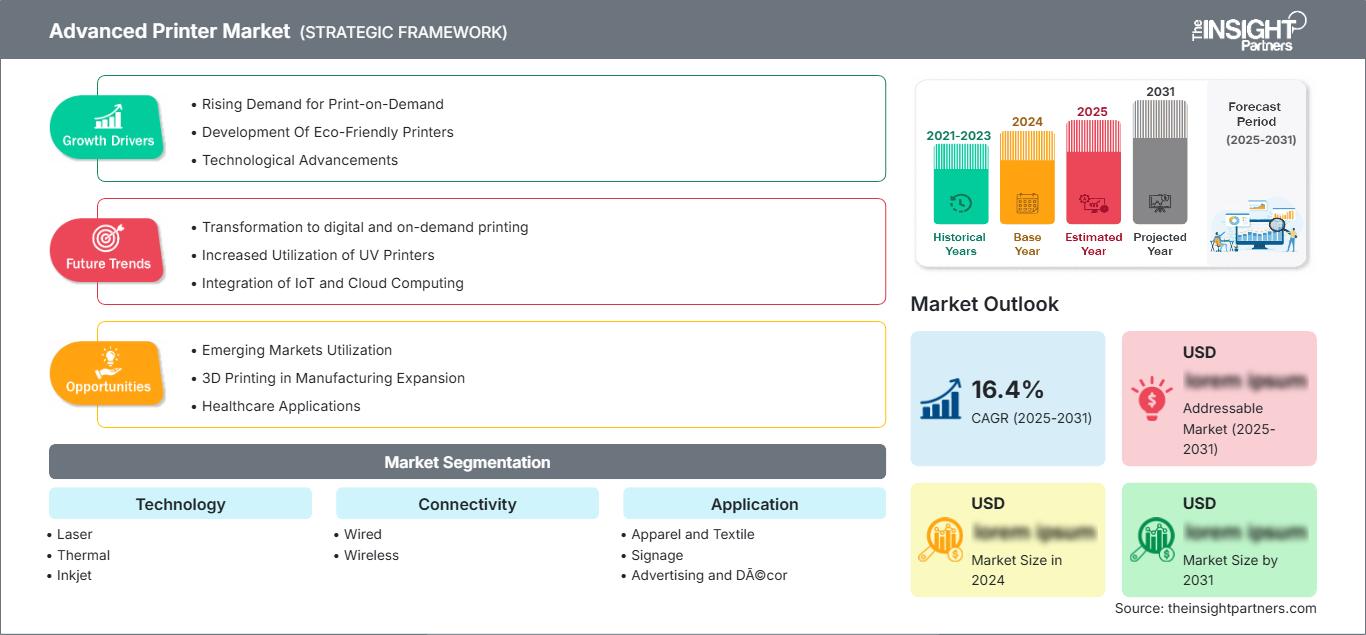
Advanced Printer Market: Strategic Insights
Regional Insights
North America Advanced Printer
North America held 27%–31% share in 2025 and is growing at a 7.4%–8.1% CAGR between 2026–2034. The Advanced Printer Market is supported by hybrid workplace print management, enterprise cybersecurity requirements, commercial graphics, CAD output, and managed print service contracts across offices, healthcare, education, legal services, and retail networks.
Regional buyers emphasize wireless fleets, secure authentication, energy efficiency, and predictable consumables costs. The U.S. drives most demand, while Canada contributes through education, public administration, and professional services. Inkjet and laser devices remain central, but thermal printers serve retail and logistics, and wide-format systems support signage, décor, and technical documentation. Advanced Printer Market trends are increasingly shaped by connected printing environments, sustainability initiatives, and the growing adoption of intelligent fleet management solutions.
U.S. Advanced Printer Market
The U.S. represented 78%–83% of North America in 2025 and is growing at a 7.5%–8.2% CAGR between 2026–2034. Demand is strongest in corporate offices, commercial printing, healthcare administration, legal services, education, packaging support, retail labeling, and engineering documentation. The Advanced Printer Market continues to benefit from sustained demand across these end-use sectors, supported by ongoing digital workflow integration and print infrastructure modernization.
The company has a significant presence throughout OEM hardware, distribution, supplies, and managed services. The list includes HP Inc., Canon Inc., Seiko Epson Corporation, Brother Industries, Ltd., Lexmark International, Inc., Xerox Holdings Corporation, and Sharp Corporation. The applications are moving toward wireless multifunction printing, print security and release, ink tanks, and wide-format sign printing.
Europe Advanced Printer Market
Europe held 22%–26% share in 2025 and is growing at a 6.8%–7.5% CAGR between 2026–2034. Germany is the leading country because manufacturing, automotive engineering, packaging, and technical documentation create sustained demand for lasers, inkjet, CAD, and professional printers. The Advanced Printer Market is supported by these industrial and commercial requirements, alongside increasing adoption of efficient and high-performance printing technologies across the region.
The UK market consists of finance, educational, medical, and design sectors, which rely on multifunction security and cloud-based printing solutions. The German economy benefits from a strong manufacturing sector, which needs robust commercial, technical, and packaging print applications. At the same time, the sustainability factors push for energy-efficient devices and refillable ink systems.
France, Italy, and Spain provide demand in terms of government, retail signage, tourist promotion, publishing, apparel decoration, and office refurbishment markets. France focuses on security and governmental sector procurement, Italy relies on textile and interior decoration applications, and Spain takes advantage of retail graphics and educational sectors.
APAC Advanced Printer Market
Asia Pacific held 34%–39% share in 2025 and is growing at a 8.7%–9.5% CAGR between 2026–2034. China is the leading country, supported by manufacturing scale, e-commerce logistics, education demand, industrial printing, and domestic electronics supply chains. The Advanced Printer Market benefits from these advantages, which continue to drive adoption across commercial, industrial, and consumer printing applications throughout the region.
Both Japan and South Korea favor small multifunctional devices, productivity in the office environment, accurate output, and secure networked workflows. They both have well-established business environments that can provide advanced laser printers and inkjet printers, along with high competence in electronics.
India and Australia add to the success of Advanced Printer through education, government services, product labeling, business office upgrade, signage, and CAD printing. The policies supporting digitalized public services, production in the country, smart cities, and small businesses make the future growth of Advanced Printer favorable.
Middle East & Africa Advanced Printer Market
The Middle East & Africa is growing at a 7.9%–8.6% CAGR between 2026–2034. Saudi Arabia is the leading country, supported by office construction, education expansion, government digitization, energy projects, and commercial graphics linked to infrastructure programs. The Advanced Printer Market is benefiting from these developments as organizations invest in modern printing solutions to support administrative, commercial, and industrial requirements.
Saudi Arabia and the UAE use advanced printers in all government, retail, logistics, hospitality, and project documentation processes. The energy and infrastructure industries need durable printers for office and engineering prints of reports, asset registers, labels, etc.
In South Africa and the rest of MEA, the demand comes from the educational sector, financial institutions, public services, mining, retail, and small to medium enterprises (SMEs). Growth is driven by the availability of channels, accessibility of supplies, electricity, and service coverage of fleets.
Segmentation Analysis
Technology
The Technology segment is growing at a 7.5%–8.3% CAGR between 2026–2034. Laser remains important for high-volume office and professional output, while inkjet is gaining from tank systems, graphics quality, and lower waste. Thermal supports logistics and retail labels, and dot matrix retains use in multipart forms and rugged transactional environments. The Advanced Printer Market continues to benefit from the coexistence of these technologies, each serving distinct performance, cost, and application requirements across end-user industries.
- Laser: Laser printers hold a strong position in office and professional settings where speed, text quality, duty cycle, and predictable toner yields support centralized document production.
- Thermal: Thermal printers are strategically important in retail, warehousing, logistics, healthcare labels, and ticketing because they deliver compact, reliable output with limited maintenance requirements.
- Inkjet: Inkjet printers are expanding through tank platforms, wide color capability, photo output, textile decoration, and signage applications where flexibility and image quality matter.
- Dot Matrix: Dot Matrix devices retain demand in banking, logistics, government forms, and industrial paperwork where multipart printing, rugged operation, and low-cost consumables remain valuable.
Connectivity
The Connectivity segment is growing at a 8.4%–9.1% CAGR between 2026–2034. Wired devices remain relevant where reliability, security, and fixed workstation use are priorities. Wireless adoption is accelerating as mobile printing, cloud queues, remote administration, and distributed workplaces require flexible access without complex cabling.
- Wired: Wired connectivity is preferred in secure offices, production floors, and high-volume print rooms where stable data transfer, controlled access, and network policy enforcement are critical.
- Wireless: Wireless printers are gaining share through hybrid work, mobile devices, cloud print services, classroom use, retail counters, and small offices seeking flexible installation.
Application
The Application segment is growing at a 7.9%–8.6% CAGR between 2026–2034. Office and professional use provides recurring demand, while apparel, signage, décor, CAD, and commercial publication create higher-value specialized opportunities. Buyers increasingly seek digital workflows, color consistency, substrate flexibility, and shorter turnaround times.
- Apparel and Textile: Apparel and textile printing benefits from customization, short fashion cycles, direct-to-garment output, and small-batch production that reduces inventory exposure.
- Signage: Signage demand is supported by retail refurbishment, events, wayfinding, transportation hubs, and outdoor advertising that require durable, high-resolution visual output.
- Advertising and Décor: Advertising and décor applications use advanced printers for personalized graphics, wall coverings, promotional displays, and interior branding across retail and hospitality settings.
- Office and Professional: Office and professional users prioritize multifunction productivity, secure print release, compact footprints, predictable supplies cost, and integration with digital document workflows.
- CAD and Technical Printing: CAD and technical printing support architecture, engineering, construction, utilities, and manufacturing teams requiring precise line quality, large formats, and dependable output.
- Commercial and Publication: Commercial and publication printers use advanced systems for short runs, variable data, color accuracy, quick turnaround, and customized marketing materials.
End-User Industry
The End-User Industry segment is growing at a 7.8%–8.5% CAGR between 2026–2034. Commercial users lead procurement because printing supports business documentation, retail communication, publishing, graphics, and managed services. Industrial users require rugged output and labeling, while residential demand is tied to hybrid work, education, and low-cost ink systems.
- Industrial: Industrial users require durable printers for labels, work orders, technical records, packaging support, and plant documentation where uptime and rugged operation are essential.
- Commercial: Commercial users represent the broadest opportunity across offices, retail, print shops, education, healthcare, and publishing due to recurring document and graphics needs.
- Residential: Residential demand is supported by home offices, students, small creators, and households adopting compact wireless devices with lower running costs.
Opportunity Snapshot
| Application | Revenue Contribution | Trend Tag | Adoption Stage |
| Apparel and Textile | Medium | Garment Print | Scaling |
| Signage | Medium | Wide Format | Scaling |
| Advertising and Décor | Medium | Custom Décor | Emerging |
| Office and Professional | High | Secure Fleet | Mature |
| CAD and Technical Printing | Medium | Technical Output | Mature |
| Commercial and Publication | High | Short Runs | Scaling |
| Others | Low | Niche Uses | Emerging |
Advanced Printer Market Growth Drivers and Impact Analysis
Hybrid Work and Secure Fleet Modernization
With hybrid work models, printer acquisition processes have evolved from being about individual device replacement to fleet management. Companies require wireless connectivity, security authentication, remote diagnostics, and usage monitoring in all their offices, branch locations, and home office workers. It is beneficial for the Advanced Printer Market since wireless MFPs can help with mobility while cutting down on uncontrolled desktop printers. The 19.4 million hardcopy peripheral shipments reported by IDC for Q1 2025 are clear proof of persistent demand despite digitization efforts.
Shift Toward Lower-Cost and Sustainable Ink Platforms
Refillable ink systems and efficient consumables are becoming central purchasing criteria as organizations try to reduce waste and long-term printing costs. IDC noted that ink tank devices recorded a fourth consecutive quarter of global year-over-year growth in Q1 2025, while Western Europe’s hardcopy peripheral market rose 10.1% year over year. This shift supports Advanced Printer Market trends around lower total cost of ownership, fewer cartridge replacements, and sustainability-oriented procurement. The impact is a stronger investment in inkjet platforms, supplies innovation, channel education, and lifecycle service models.
Growth in Commercial, Textile, and Technical Print Workflows
Commercial users are using advanced printing technology to facilitate short-run publishing, personalized marketing materials, CAD drawings, textile decorating, signage, and décor. To meet the needs of such applications, color accuracy, media adaptability, speed, and variable-data capabilities are essential and are not available with regular office printers. The value of Advanced Printers will be driven by more high-end inkjet, laser, and wide-format printers. The bottom line is an increased target market for Original Equipment Manufacturers (OEMs), print service providers, and software providers.
Advanced Printer Market Future Trends
AI-Assisted Print Management and Predictive Maintenance
AI-assisted print management will become more influential as enterprises seek lower service costs and fewer workflow interruptions. Networked printers generate data on page volumes, consumables use, device errors, print queues, and user behavior. Analytics can predict toner or ink needs, identify abnormal usage, optimize device placement, and schedule preventive service before downtime occurs. The Advanced Printer Market is strengthened by this shift, as intelligence moves value from hardware margins toward software, subscriptions, and managed services. Vendors with secure analytics platforms and channel training will be better positioned for enterprise renewals.
Digital Printing for Personalized and Short-Run Production
Personalization will drive digital printing further into applications such as packaging, clothing, décor, and marketing production. There is an increasing need for localization of marketing efforts, shorter manufacturing cycles, and varied production without the setup problems of analog printing. Modern inkjet and laser printing technologies are able to enable small batch sizes and fast changes of products with varied information, which makes it possible for print service providers to work on fragmented market needs in a profitable way.
Advanced Printer Market Opportunities
Managed Print Services for Distributed Enterprises
Distributed organizations present a significant market for managed print services due to the difficulty in controlling the device fleets throughout branches, campuses, clinics, stores, and hybrid workplaces. There is a requirement for standardization of procurement processes, remote management, security policy enforcement, consistent supply chain, and performance accountability on the part of the buyers. Both OEMs and their channel partners can generate recurring revenues through subscriptions that combine hardware, software, supplies, analysis, and maintenance. The best target markets include healthcare, education, professional services, government, and retail sectors.
Industrial and Creative Printing in Emerging Economies
Emerging markets provide opportunities for investment in areas like clothing embellishment, labeling, signage, CAD printing, learning, retail, and printing by small businesses. In these countries, manufacturers, printers, and creative professionals require machines that have both high-quality and cost-efficient operation and maintenance. Manufacturers should focus on developing ink tank systems, robust thermal printers, wide format printers, and financing plans. Collaboration with distributors, training institutions, and supply chains for printing supplies can enhance the implementation of such technology. This venture stands out since it relies less on the office replacement cycle and more on entrepreneurship and the formality of small businesses.
Recent Developments
- December 2024: Canon India Launches 10 New Advanced Printers for Modern Offices. Canon India introduced 10 new printers under its PIXMA MegaTank and imageCLASS series, targeting SOHO, SMB, and enterprise users. The lineup offers faster printing, automatic duplex printing, enhanced security, and versatile connectivity features. New models such as the PIXMA G3780/G4780 and imageCLASS series are designed to improve productivity while supporting cost-efficient and sustainable printing. Canon stated that the launch addresses the growing needs of hybrid work environments.
- February 2025: Canon Launches imagePROGRAF PRO-310 A3+ Professional Photo Printer Canon announced the imagePROGRAF PRO-310, an A3+ professional inkjet photo printer aimed at photography enthusiasts and graphic artists. The printer features a new 10-color LUCIA PRO II pigment ink system that delivers richer colors, deeper blacks, enhanced gloss uniformity, and improved scratch resistance. Prints can retain their quality for up to 200 years under recommended conditions. Canon also adopted eco-friendly packaging materials to reduce environmental impact.
- June 2026: Epson Introduces WorkForce Enterprise AM-C10000 Inkjet MFP Epson launched the WorkForce Enterprise AM-C10000, a flagship A3 color line-inkjet multifunction printer designed for high-volume office environments. Powered by Epson’s Heat-Free technology, the device consumes up to 93% less energy than comparable laser printers while delivering speeds of up to 100 pages per minute. The printer offers high-capacity paper handling, advanced finishing options, and reduced maintenance needs. Epson positions the product as a sustainable, productivity-focused solution for modern enterprise printing.
Frequently Asked Questions

- Comprehensive Market Sizing and Forecast Analysis
- Detailed Segmentation Analysis
- In-Depth Market Dynamics Assessment
- Regional and Country-Level Insights
- Competitive Landscape and Company Benchmarking
- Strategic Business Intelligence
Recent Reports
Testimonials

The Insight Partners' SCADA System Market report is comprehensive, with valuable insights on current trends and future forecasts. The team was highly professional, responsive, and supportive throughout. We are very satisfied and highly recommend their services.
RAN KEDEM Partner, Reali Technologies LTDs
I requested a report on a very specific software market and the team produced the report in a few days. The information was very relevant and well presented. I then requested some changes and additions to the report. The team was again very responsive and I got the final report in less than a week.
JEAN-HERVE JENN Chairman, Future Analytica
We worked with The Insight Partners for an important market study and forecast. They gave us clear insights into opportunities and risks, which helped shape our plans. Their research was easy to use and based on solid data. It helped us make smart, confident decisions. We highly recommend them.
PIYUSH NAGPAL Sr. Vice President, High Beam Global
The Insight Partners delivered insightful, well-structured market research with strong domain expertise. Their team was professional and responsive throughout. The user-friendly website made accessing industry reports seamless. We highly recommend them for reliable, high-quality research services
YUKIHIKO ADACHI CEO, Deep Blue, LLC.
This is the first time I have purchased a market report from The Insight Partners.While I was unsure at first, I visited their web site and felt more comfortable to take the risk and purchase a market report.I am completely satisfied with the quality of the report and customer service. I had several questions and comments with the initial report, but after a couple of dialogs over email with their analyst I believe I have a report that I can use as input to our strategic planning process.Thank you so much for taking the extra time and making this a positive experience.I will definitely recommend your service to others and you will be my first call when we need further market data.
JOHN SUZUKI President and Chief Executive Officer, Board Director, BK Technologies
I wish to appreciate your support and the professionalism you displayed in the course of attending to my request for information regarding to infectious disease IVD market in Nigeria. I appreciate your patience, your guidance, and the fact that you were willing to offer a discount, which eventually made it possible for us to close a deal. I look forward to engaging The Insight Partners in the future, all thanks to the impression you have created in me as a result of this first encounter.
DR CHIJIOKE ONYIA MANAGING DIRECTOR, PineCrest Healthcare Ltd.Reason to Buy
- Informed Decision-Making
- Understanding Market Dynamics
- Competitive Analysis
- Identifying Emerging Markets
- Customer Insights
- Market Forecasts
- Risk Mitigation
- Boosting Operational Efficiency
- Strategic Planning
- Investment Justification
- Tracking Industry Innovations
- Aligning with Regulatory Trends





 Get Free Sample for