
Aeroderivative Gas Turbine Market Share, Growth & Demand by 2034
Coverage: By Capacity (Below 500kW, 500kW to 1MW, 1MW to 30MW, 30MW to 70MW, Above 70MW.); Technology (Open Cycle, Combined cycle.); Application (Power Plants, Oil and Gas, Process Plants, Aviation, Marine, Others.) , and Geography (North America, Europe, Asia Pacific, and South and Central America)
- Status : Data Released
- Report Code : TIPRE00027584
- Category : Energy and Power
- No. of Pages : 150
- Available Report Formats :


- Last update date : March 27, 2026


2025 Market Size
US$ 3.91 Bn
Base year value
2034 Forecast
US$ 6.79 Bn
Projected by 2034
CAGR 2026-2034
6.3 %
Growth rate
Addressable Market
US$ 48.36 Bn
(2026-2034)
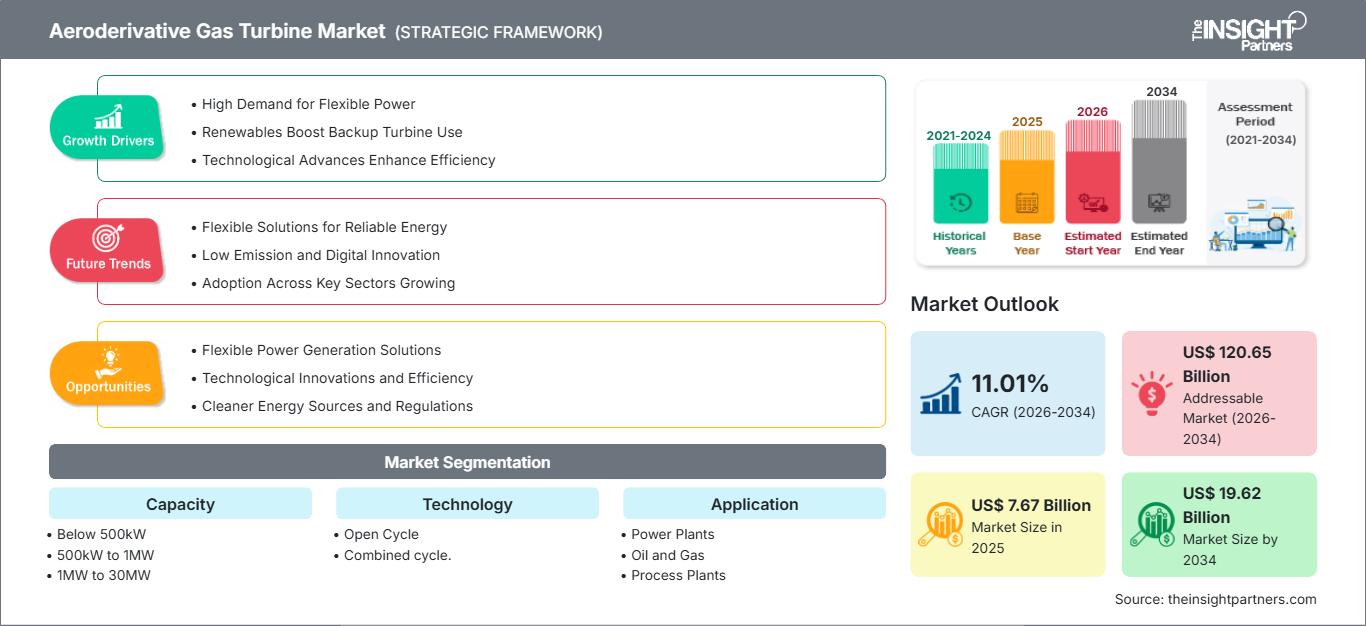
Aeroderivative Gas Turbine market is expected to register a CAGR of 11.01% from 2026 to 2034, with the market size expanding from US$ 7.67 Billion in 2025 to US$ 19.62 Billion by 2034.
Key market dynamics include an urgent global requirement for operational flexibility in power grids, the rapid decentralization of energy systems, and a significant shift toward lower-emission transition fuels. Additionally, the market is expected to benefit from the increasing integration of intermittent renewable energy sources, the expansion of modular power solutions in emerging economies, and the rising demand for high-efficiency mechanical drives in the oil and gas and marine sectors.
Aeroderivative Gas Turbine Market Analysis
The aeroderivative gas turbine market analysis indicates a fundamental shift from traditional base-load duties toward high-value ancillary services. As energy markets evolve, these turbines are increasingly valued for their frequency regulation and black-start capabilities, which command premium pricing in stabilized grids. The market is prompting a surge in the refurbishment and secondary market segments. Strategic opportunities are now concentrating on hydrogen-ready combustor retrofits, as operators seek to future-proof existing assets against tightening carbon taxes. Furthermore, the analysis highlights that competitive edge is no longer solely about thermal efficiency, but rather dispatch reliability, the ability to start and stop multiple times a day without incurring the heavy maintenance penalties typical of larger frame turbines.
Aeroderivative Gas Turbine Market Overview
Aeroderivative gas turbines represent the pinnacle of dual-use technology, leveraging the rigorous engineering of aviation engines for terrestrial and marine applications. Aeroderivative gas turbines are defined by the rapid modularization of power, where units are delivered as pre-tested, containerized power blocks that reduce on-site commissioning time. This trend is particularly vital for the Oil and Gas midstream, where mobile turbines power remote compression stations. While North America remains the largest revenue contributor due to its extensive shale gas network, Asia-Pacific region is emerging as the epicenter of innovation in small-scale distributed generation. The US market is also seeing a transition in fuel strategies, with dual-fuel systems that can switch between natural gas and liquid fuels becoming the standard to ensure energy security during supply disruptions.
Market Research Highlights
- Global market for Aeroderivative Gas Turbine was valued at US$ 7.67 Billion in 2025
- Annual market size is expected to reach US$ 19.62 Billion by 2034
- Total addressable market (TAM) during 2026-2034 is projected to reach approximately US$ 120.65 Billion
- Market is anticipated to register a CAGR of 11.01% during the forecast period
- The United States represents a key market, supported by High Demand for Flexible Power, Renewables Boost Backup Turbine Use, Technological Advances Enhance Efficiency, as well as evolving industry dynamics
- Market analysis covers North America, Europe, Asia-Pacific, South and Central America, Middle East and Africa, with growth evaluated across the forecast period
- Market opportunities such as Flexible Power Generation Solutions, Technological Innovations and Efficiency, Cleaner Energy Sources and Regulations are expected to influence market dynamics and addressable market
- Report profiles industry participants, including General Electric, Mitsubishi Hitachi Power Systems, Siemens, Wood Group, Kawasaki Heavy Industries, Solar Turbines, MTU Aero Engines, Ansaldo Energia, Sulzer, MAN Diesel and Turbo, while analyzing competitive strategies and innovation developments
-
Source: The Insight Partners' analysis based on proprietary research, government publications, company annual reports, investor presentations, industry databases, and expert interviews.
● REPORT CUSTOMIZATION
Tailor This Report To Align With Your Specific Business Requirements
This report can be customized to align precisely with your business objectives, scope, and target markets. Customization options include tailored segmentation, geography, competitive analysis, and strategic insights to support informed decision-making.
Customize This Report →WHAT YOU CAN ADJUST
- ● Segmentations
- ● Geography
- ● Competitive Analysis
- ● Language Preferences
Aeroderivative Gas Turbine Market: Strategic Insights
-
Get Top Key Market Trends of this report.This FREE sample will include data analysis, ranging from market trends to estimates and forecasts.
Aeroderivative Gas Turbine Market Drivers and Opportunities
Market Drivers:
- Grid Stability and Renewable Integration: As solar and wind power expand, aeroderivative turbines provide the spinning reserve and rapid-start capabilities (reaching full load in under 10 minutes) necessary to balance intermittent supply.
- Decarbonization and Coal-to-Gas Switching: National mandates to reduce carbon footprints are driving the replacement of coal-fired plants with high-efficiency gas units, which emit significantly less CO2 and particulate matter.
- Rapid Expansion of Decentralized Energy: Growing focus on microgrids and localized power for critical infrastructure, such as hospitals and data centers, is fueling the adoption of smaller capacity aeroderivative units.
Market Opportunities:
- Hydrogen Blending and Synthetic Fuels: The transition to zero-carbon fuels like green hydrogen and Sustainable Aviation Fuel (SAF) presents a massive retrofit market for the global installed base.
- Electrification of Marine Fleets: High-speed naval and commercial vessels are moving toward integrated electric propulsion systems that favor the high power density of aeroderivative cores.
- Smart Grid Microgrids: There is a significant opportunity for capacity units below 1MW to serve as the backbone of resilient industrial microgrids in disaster-prone regions.
Aeroderivative Gas Turbine Market Report Segmentation Analysis
The aeroderivative gas turbine market share is analyzed across various segments to provide a clearer understanding of its structure, growth potential, and emerging trends. Below is the standard segmentation approach used in industry reports:
By Capacity:
- Below 500kW: A fast-growing niche that aligns with global sustainability trends and micro-cogeneration for residential and small commercial clusters.
- 500kW to 1MW: Dominant in small-scale industrial applications and remote telecommunications infrastructure where reliable, compact power is essential.
- 1MW to 30MW: The primary volume driver for industrial CHP and mechanical drives in midstream oil and gas due to high fuel efficiency and transportability.
- 30MW to 70MW: Increasingly preferred by utility-scale peaking plants and large industrial facilities for grid-balancing and back-up power.
- Above 70MW: The fastest-rising segment for large-frame utility applications seeking aircraft-derived efficiency for base-load and heavy peaking duties.
By Technology:
- Open Cycle: Preferred for its lower upfront cost and rapid start-up times, making it the primary choice for emergency backup and peaking power.
- Combined Cycle: Dominant in larger utility installations where maximizing thermal efficiency (often exceeding 60%) and minimizing fuel consumption are the top priorities.
By Application:
- Power Plants: Remains the largest revenue segment, serving both utility peaking and distributed grid support.
- Oil and Gas: Vital for offshore platforms and pipeline compression where space is restricted, and high power-to-weight ratios are critical.
- Process Plants: Providing essential heat and power for chemical, food processing, and textile industries through cogeneration.
- Aviation: Utilizing aeroderivative cores for auxiliary power units (APUs) and ground support equipment.
- Marine: Powering high-speed ferries, cruise ships, and naval vessels that require high torque and low emissions.
- Others: Including mining, construction, and disaster relief mobile power units.
By Geography:
- North America
- Europe
- Asia Pacific
- South & Central America
- Middle East & Africa
Aeroderivative Gas Turbine Market Report Scope
| Report Attribute | Details |
|---|---|
| Market size in 2025 | US$ 3.91 Billion |
| Market Size by 2034 | US$ 6.79 Billion |
| Global CAGR (2026 - 2034) | 6.3% |
| Historical Data | 2021-2024 |
| Forecast period | 2026-2034 |
| Segments Covered |
By Capacity
|
| Regions and Countries Covered |
North America
|
| Market leaders and key company profiles |
|
Aeroderivative Gas Turbine Market Players Density: Understanding Its Impact on Business Dynamics
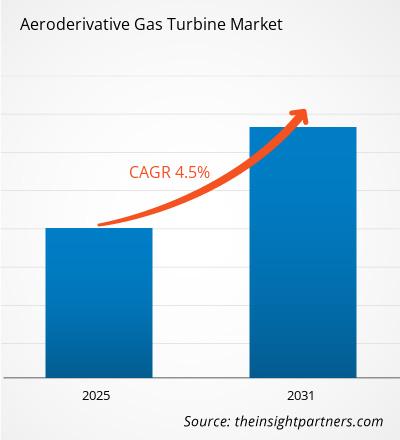
The Aeroderivative Gas Turbine Market is growing rapidly, driven by increasing end-user demand due to factors such as evolving consumer preferences, technological advancements, and greater awareness of the product's benefits. As demand rises, businesses are expanding their offerings, innovating to meet consumer needs, and capitalizing on emerging trends, which further fuels market growth.
Aeroderivative Gas Turbine Market Share Analysis by Geography
Asia-Pacific is expected to grow fastest in the coming years. Emerging markets in South & Central America, the Middle East, and Africa also have many untapped opportunities for premium energy producers and decentralized power providers to expand.
The aeroderivative gas turbine market is undergoing a significant transformation, moving from traditional backup assets to global high-value flexible energy solutions. Growth is driven by the rising need for rapid-response power, a surge in decentralized energy demand, and the expansion of offshore oil and gas. Below is a summary of market share and trends by region:
North America
- Market Share: Holds a dominant position, driven by the ongoing shale gas revolution and the replacement of aging coal-fired infrastructure.
- Key Drivers:
- Increasing investment in natural gas-fired peaking plants to balance high wind and solar penetration.
- Modernization of industrial facilities with high-efficiency cogeneration (CHP) systems.
- Stringent EPA regulations favoring lower-emission aeroderivative technology over traditional heavy-duty units.
- Trends: Scaling of mobile power fleets for emergency response and the successful adoption of hydrogen blending in existing turbine packages to meet state-level carbon-neutral goals.
Europe
- Market Share: Holds a significant share globally, anchored by a deep-seated commitment to decarbonization and high-efficiency energy standards in Germany, the UK, and France.
- Key Drivers:
- Urgent requirement for flexible power to support the European Green Deal and volatile renewable output.
- Established district heating networks that utilize aeroderivative turbines for combined heat and power.
- Robust government incentives for R&D in green hydrogen and synthetic fuel compatibility.
- Trends: A strategic shift toward prioritizing hydrogen-ready turbine retrofits and the expansion of digital twin technology for remote offshore maintenance.
Asia-Pacific
- Market Share: The fastest-growing region, with China, India, and Japan acting as primary drivers for industrial expansion and urban power demand.
- Key Drivers:
- Massive industrialization in Southeast Asia requires reliable, off-grid power solutions.
- Government-supported shifts from coal to gas to combat urban air pollution.
- Rapid urbanization leading to a preference for compact, modular power plants that fit within dense city limits.
- Trends: Heavy reliance on B2B contracts for high-end aeroderivative units in the manufacturing and mining, alongside the formalization of rural microgrid networks.
South and Central America
- Market Share: Emerging market with a growing energy in countries like Brazil and Chile.
- Key Drivers:
- Increasing awareness of the operational superiority of gas turbines for stabilizing hydro-dependent grids during droughts.
- Modernization of offshore oil platforms to utilize associated gas for on-platform power.
- Rising interest in mobile energy solutions for remote mining and industrial clusters.
- Trends: Growth of lease-to-own models for power-on-wheels units and the introduction of dual-fuel turbines to differentiate from fixed-infrastructure bovine power.
Middle East and Africa
- Market Share: Developing market with deep roots in oil and gas, transitioning toward formalized commercial power production.
- Key Drivers:
- Traditional presence of aeroderivative units in regional oilfields for mechanical drive and gas reinjection.
- High demand for fast-start peaking power in arid climates with growing air-conditioning loads.
- Strategic investments in smart infrastructure to improve local energy security and reduce reliance on liquid fuel imports.
- Trends: Implementation of modern digital monitoring and desalination-linked power projects, coupled with a focus on high-efficiency units for the industrial manufacturing segment.
High Market Density and Competition
Competition is intensifying due to the presence of established leaders such as GE Vernova, Siemens Energy, and Mitsubishi Power. Regional specialists and niche players like Solar Turbines, Baker Hughes, and Kawasaki Heavy Industries also contribute to a diverse and rapidly expanding market landscape.
This competitive environment pushes vendors to differentiate through:
- Technological Innovation and Hydrogen Readiness: Position aeroderivative turbines as a superior nutritional alternative to heavy-duty units by emphasizing fast-start times, frequent cycling capability, and hydrogen-ready combustors for eco-conscious utilities.
- Diversified Product Portfolios: Aeroderivative solutions now include more than just simple power units. Companies offer mobile power-on-wheels, dual-fuel mechanical drives for pipelines, and high-efficiency combined cycle packages.
- Vertical Integration and Life-Cycle Services: Producers manage the entire value chain, from core engine adaptation to long-term service agreements (LTSA). This approach ensures quality, transparency, and meets high availability standards.
- Advanced Digitalization: New processing technologies, like digital twins and predictive analytics, help create high-reliability turbine fleets used in the most demanding industrial and naval environments worldwide.
Opportunities and Strategic Moves
- Partner with utility providers and industrial microgrid developers to tap into the surging demand for flexible, fast-start power in Asia-Pacific and North American markets.
- Incorporate sustainable fuel technologies and carbon-capture-ready certifications to appeal to environmentally conscious governments and Gen Z voters seeking ethical energy transitions.
Major Companies operating in the Aeroderivative Gas Turbine Market are:
- General Electric
- Mitsubishi Hitachi Power Systems
- Siemens
- Wood Group
- Kawasaki Heavy Industries
- Solar Turbines
- MTU Aero Engines
- Ansaldo Energia
- Sulzer
- MAN Diesel and Turbo
Disclaimer: The companies listed above are not ranked in any particular order.
Aeroderivative Gas Turbine Market News and Recent Developments
- In November 2025, Vertiv and Caterpillar Inc. announced the signing of a strategic undertaking to collaborate on advanced energy optimization solutions for data centers. This initiative will integrate Vertiv’s power distribution and cooling portfolio with Caterpillar’s and its subsidiary Solar. This collaboration directly addresses the growing demand for on-site energy solutions that deliver reliable power and cooling.
- In July 2025, GE Vernova Inc. and Crusoe announced a significant deal to deliver 29 units of GE Vernova’s breakthrough LM2500XPRESS aeroderivative gas turbine packages to Crusoe AI data centers. These orders highlight GE Vernova’s ability to provide flexible and efficient power to energy-intensive data centers supporting AI applications.
Aeroderivative Gas Turbine Market Report Coverage and Deliverables
The Aeroderivative Gas Turbine Market Size and Forecast (2021–2034) report provides a detailed analysis of the market covering below areas:
- Aeroderivative Gas Turbine Market size and forecast at global, regional, and country levels for all the key market segments covered under the scope
- Aeroderivative Gas Turbine Market trends, as well as market dynamics such as drivers, restraints, and key opportunities
- Detailed PEST and SWOT analysis
- Aeroderivative Gas Turbine Market analysis covering key market trends, global and regional framework, major players, regulations, and recent market developments
- Industry landscape and competition analysis covering market concentration, heat map analysis, prominent players, and recent developments in the Aeroderivative Gas Turbine Market.
- Detailed company profiles
Frequently Asked Questions

- Comprehensive Market Sizing and Forecast Analysis
- Detailed Segmentation Analysis
- In-Depth Market Dynamics Assessment
- Regional and Country-Level Insights
- Competitive Landscape and Company Benchmarking
- Strategic Business Intelligence
Recent Reports
Testimonials

The Insight Partners' SCADA System Market report is comprehensive, with valuable insights on current trends and future forecasts. The team was highly professional, responsive, and supportive throughout. We are very satisfied and highly recommend their services.
RAN KEDEM Partner, Reali Technologies LTDs
I requested a report on a very specific software market and the team produced the report in a few days. The information was very relevant and well presented. I then requested some changes and additions to the report. The team was again very responsive and I got the final report in less than a week.
JEAN-HERVE JENN Chairman, Future Analytica
We worked with The Insight Partners for an important market study and forecast. They gave us clear insights into opportunities and risks, which helped shape our plans. Their research was easy to use and based on solid data. It helped us make smart, confident decisions. We highly recommend them.
PIYUSH NAGPAL Sr. Vice President, High Beam Global
The Insight Partners delivered insightful, well-structured market research with strong domain expertise. Their team was professional and responsive throughout. The user-friendly website made accessing industry reports seamless. We highly recommend them for reliable, high-quality research services
YUKIHIKO ADACHI CEO, Deep Blue, LLC.
This is the first time I have purchased a market report from The Insight Partners.While I was unsure at first, I visited their web site and felt more comfortable to take the risk and purchase a market report.I am completely satisfied with the quality of the report and customer service. I had several questions and comments with the initial report, but after a couple of dialogs over email with their analyst I believe I have a report that I can use as input to our strategic planning process.Thank you so much for taking the extra time and making this a positive experience.I will definitely recommend your service to others and you will be my first call when we need further market data.
JOHN SUZUKI President and Chief Executive Officer, Board Director, BK Technologies
I wish to appreciate your support and the professionalism you displayed in the course of attending to my request for information regarding to infectious disease IVD market in Nigeria. I appreciate your patience, your guidance, and the fact that you were willing to offer a discount, which eventually made it possible for us to close a deal. I look forward to engaging The Insight Partners in the future, all thanks to the impression you have created in me as a result of this first encounter.
DR CHIJIOKE ONYIA MANAGING DIRECTOR, PineCrest Healthcare Ltd.Reason to Buy
- Informed Decision-Making
- Understanding Market Dynamics
- Competitive Analysis
- Identifying Emerging Markets
- Customer Insights
- Market Forecasts
- Risk Mitigation
- Boosting Operational Efficiency
- Strategic Planning
- Investment Justification
- Tracking Industry Innovations
- Aligning with Regulatory Trends





 Get Free Sample for