
Aerospace Sealants Market Size, Growth & Trends by 2034
Coverage: By Chemistry (Polysulfide, Silicone, Others); Aircraft (Commercial, Military, Others.), and Geography (North America, Europe, Asia Pacific, and South and Central America)
- Status : Data Released
- Report Code : TIPRE00017373
- Category : Chemicals and Materials
- No. of Pages : 150
- Available Report Formats :


- Last update date : July 20, 2026


2025 Market Size
US$ 1.24 Bn
Base year value
2034 Forecast
US$ 1.92 Bn
Projected by 2034
CAGR 2026-2034
4.98 %
Growth rate
Addressable Market
US$ 14.34 Bn
(2026-2034)
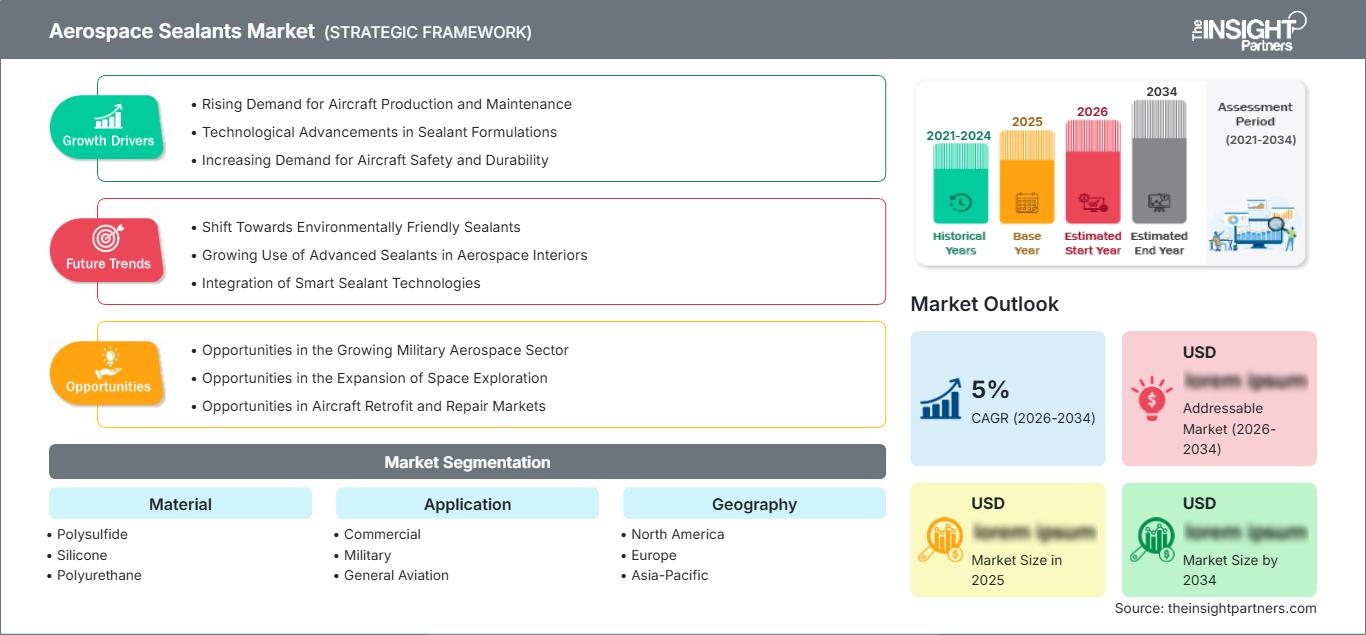
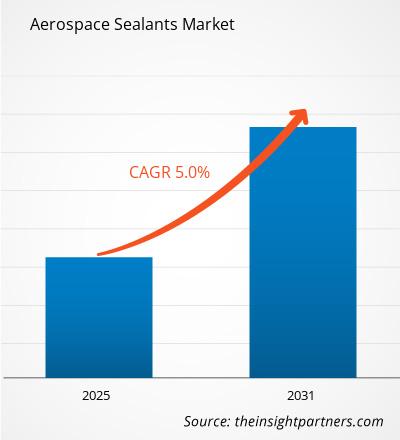
Global Aerospace Sealants Market Size held a value of US$ 1.24 Billion in 2025 and is estimated to witness further growth at a CAGR of 4.98%, to reach a value of US$ 1.92 Billion by 2034. Growth in the market is driven by continued commercial aircraft production, increase in MRO activities, and growing usage of innovative and lightweight airframe materials, which need tough sealing materials resistant to harsh operational environments.
In North America, the market is favored by the presence of established aerospace manufacturing industry, ongoing modernization initiatives of its military force, and growing facilities for aircraft maintenance. North America market is likely to grow at a CAGR of 4.6-5.2% in the coming years till 2034 owing to investments in advanced aircraft models and sustainable aviation technologies.
Aerospace Sealants Market Assessment and Insights
- North America: Accounted for 34–38% Aerospace Sealants Market share in 2025 and is expected to expand at a CAGR of 4.6–5.2% during 2026–2034. Strong aircraft manufacturing capabilities, defense procurement, and an extensive MRO ecosystem continue supporting long-term demand for aerospace-grade sealing technologies.
- US: Represented 72–76% of the North American market in 2025 and is projected to grow at a CAGR of 4.7–5.3% during 2026–2034, supported by leading aircraft manufacturers, defense programs, and continuous fleet modernization investments.
- Europe: Held 26–30% share in 2025 while advancing at a CAGR of 4.4–5.0% during 2026–2034. Germany, France, and the UK remain leading contributors through commercial aerospace production, advanced material innovation, and strong supplier networks.
- Asia Pacific: Captured 25–29% share in 2025 and is forecast to register the highest CAGR of 5.5–6.1% during 2026–2034, driven by expanding aircraft deliveries, indigenous aerospace manufacturing, and increasing defense aviation investments across China, India, Japan, and South Korea.
- Largest Segment: Commercial accounted for 61–65% market share in 2025 and is anticipated to grow at a CAGR of 4.8–5.3% during 2026–2034, supported by expanding passenger fleets, aircraft production backlogs, and rising global air travel demand.
- High Growth Segment: Silane-Modified Polymer is expected to account for 10–14% market share in 2025 while registering a CAGR of 6.0–6.6% during 2026–2034, benefiting from improved adhesion, environmental compliance, and compatibility with lightweight composite structures.
- Key companies analyzed in detail: 3M Company, BASF SE, Flamemaster Corporation, H.B. Fuller Company, Henkel AG & Co. KGaA, Permatex LLC, PPG Industries, Inc., Solvay SA, Dow Inc., Permabond LLC.
Source: The Insight Partners' analysis based on proprietary research, government publications, company annual reports, investor presentations, industry databases, and expert interviews.
The production process of the aircraft has moved towards composite airframes, advanced metal alloy and structural components, which require robust sealing systems able to offer high performance and durability in severe conditions. The increase in automation during the manufacturing process, the improvement in precision of dispensing and sealant formulations have enhanced the manufacturing process and helped companies meet the demands set by strict aerospace certification regulations. The growing need for lightweight aircraft and cost reduction in lifecycle maintenance is driving the development of materials with better chemical resistance, thermal stability, and adhesion properties, thus boosting the steady growth in the aerospace sealants market.
Future growth will be driven by increasing investments in the aerospace industry in Asia Pacific and the Middle East regions, increasing localization of aircraft parts manufacturing and regulation focus on environmentally friendly products. Manufacturers are making investments in sealants with low-VOC content, fast curing properties and sealants for advanced composite structures. Increasing MRO services, higher utilization of aircraft and fleet replacement programs will drive future growth prospects in the market.
Aerospace Sealants Market Report Scope
| Report Attribute | Details |
|---|---|
| Market size in 2025 | US$ 1.24 Billion |
| Market Size by 2034 | US$ 1.92 Billion |
| Global CAGR (2026 - 2034) | 4.98% |
| Historical Data | 2021-2024 |
| Forecast period | 2026-2034 |
Aerospace Sealants Market Analysis
The aerospace industry is committed to designing structures that are light in weight, fuel-efficient, and can serve longer periods, thus generating constant demand for more sealants. In terms of the market analysis of the aerospace sealants industry, there is increased use of carbon-fiber composites, stricter airworthiness standards, and high commercial aircraft usage, which are boosting the use of sealants that are able to withstand hydraulic fluids, fuel, vibrations, UV rays, and temperature variations. Additional investments in maintenance, repair, and overhaul operations are driving more demand for replacing sealants as airlines require longer intervals between inspections.
The ecosystem of the aerospace sealants industry is contributing to its growth by maintaining collaborations with raw material suppliers, sealants developers, aircraft manufacturers, component manufacturers, certification authorities, and maintenance service providers. There are continuous advancements being made on the resin chemistries, fillers, cure agents, and adhesion technology for improving application performance while cutting down the weight. There is also an increase in the adoption of digital manufacturing and automated dispensing systems.
The level of competition will still be high as existing chemical companies and aerospace material suppliers develop portfolios via innovation in formulations, alliances, and manufacturing facilities in different geographical locations. Some of the players in the market include 3M Company, PPG Industries, Inc., Henkel AG & Co. KGaA, Dow Inc., BASF SE, Solvay SA, Flamemaster Corporation, H.B. Fuller Company, Permatex LLC, and Permabond LLC, which have continued building their market position through the development of sealants that are environmentally friendly and meet the requirements of aerospace certification.
There will be an increased investment in sustainable materials, fast-curing sealants, automated applications, and composite sealants that suit the new generation of aircraft models. There will also be expansion of services to help in qualification of OEM and maintenance in airline of the emerging aerospace industry. The collaboration between material producers, aircraft manufacturers, and defense firms will play a key role in the success of the aerospace sealants market.
● REPORT CUSTOMIZATION
Tailor This Report To Align With Your Specific Business Requirements
This report can be customized to align precisely with your business objectives, scope, and target markets. Customization options include tailored segmentation, geography, competitive analysis, and strategic insights to support informed decision-making.
Customize This Report →WHAT YOU CAN ADJUST
- ● Segmentations
- ● Geography
- ● Competitive Analysis
- ● Language Preferences
Aerospace Sealants Market: Strategic Insights
Regional Insights
North America Aerospace Sealants Market
North America held a market share of 34–38% in the aerospace sealants market in 2025 and is anticipated to grow at a CAGR of 4.6–5.2% from 2026 to 2034. North America enjoys the advantage of being home to many leading aircraft manufacturers, defense companies, and aerospace supply chain firms. High aircraft production, modernization of the aircraft fleet, and MRO services have contributed to the continued need for sealants having excellent properties.
Strict certifications mandated by aviation bodies push the use of advanced sealants which provide better performance in terms of chemical resistance, thermal stability, and durability. Sustainable aviation, lightweight composite airframes, and digital manufacturing technologies will enhance the competitive edge of the region even further. Collaboration between material suppliers and aircraft manufacturers is continuing to boost innovation in sealants that are environment-friendly.
U.S. Aerospace Sealants Market
In 2025, the U.S. was holding a share of 72%-76% of the North American market, and it is projected to witness a CAGR of 4.7%-5.3% till 2034. Presence of aircraft production industry within the region, large-scale defense spending, and being home to one of the largest MRO industries keeps fueling the need for sealants. Production centers of commercial aircrafts, military aircrafts, helicopters, and aerospace parts give rise to new applications of sealants that fulfill aerospace qualification criteria.
Availability of well-developed network of suppliers makes it easier to commercialize new material products for sealants that cater to the composite aircraft structure and propulsion system of the future generation. Investments made in military aircraft upgradation, UASs, and sustainable aviation add to the potential applications. Research collaborations among aerospace manufacturers, chemical companies, and academics are instrumental in developing high-performance sealants.
Europe Aerospace Sealants Market
Europe is estimated to hold 26% - 30% of the global market share in 2025, and is expected to witness a growth rate of 4.4% – 5.0% during 2026 - 2034. The region has been known for its substantial aerospace manufacturing capability along with efficient engineering and supply chain management and investments towards aircraft innovations. Germany dominates the region on account of its robust aerospace manufacturing capability and precision engineering knowledge base and presence in the manufacture of aircraft structures and components.
The United Kingdom has been profiting from its globally competitive aircraft engines manufacturing industry, defense aerospace manufacturing capability and the increasing maintenance infrastructure of the region for the consistent demand of superior performance sealants for commercial and military applications. France is constantly reinforcing the regional market through large scale aircraft assembly operations, while Italy and Spain are helping the region through their contributions to aerospace components manufacturing, aerostructures manufacturing and collaborative efforts in the European aviation industry.
APAC Aerospace Sealants Market
The Asia Pacific region dominated the global market with a share of 25-29% in 2025 and is expected to have a significant CAGR of 5.5-6.1% from 2026-2034. In terms of regional demand, China tops the chart by virtue of its growing commercial aircraft production and defense aerospace investments, while Japan and South Korea are making progress in aerospace components manufacturing.
India is rapidly building up its aerospace manufacturing infrastructure with the help of localization policies and purchase of aircrafts. Australia makes its contribution through its defense aerospace programs and growing MRO services capacity.
Middle East & Africa Aerospace Sealants Market
The Middle East & Africa market is projected to expand at a CAGR of 4.3–4.9% during 2026–2034. Saudi Arabia and the UAE continue investing in aerospace manufacturing, aircraft maintenance infrastructure, and defense aviation capabilities to diversify industrial development beyond hydrocarbons.
South Africa has maintained its niche in aerospace manufacturing through defense & component manufacturing, and the rest of the MEA region is benefiting from expansion in airline fleets and airport facilities. Growing emphasis in the region towards aviation services and fleet maintenance is anticipated to generate demand for aerospace sealants.
Segmentation Analysis
Material
The material segment represents the technological foundation of the aerospace sealants market, with manufacturers continuously improving chemical formulations to achieve higher durability, adhesion, fuel resistance, and compatibility with lightweight composite structures. Material innovation remains essential for meeting increasingly stringent aerospace certification standards while reducing maintenance frequency and improving aircraft operational efficiency. The aerospace sealants market scope continues expanding as advanced polymer chemistries enable longer service life and broader application across commercial, military, and general aviation aircraft. The segment is expected to grow at a CAGR of 4.9–5.5% during 2026–2034.
- Polysulfide: Remains the most widely adopted material because of excellent fuel resistance, flexibility, and long-term durability, making it suitable for integral fuel tanks, fuselage joints, and other critical aircraft sealing applications.
- Silicone: Offers outstanding thermal stability and weather resistance, supporting applications exposed to significant temperature fluctuations, cabin pressurization systems, and external aerospace structures requiring long-term environmental protection.
- Polyurethane: Provides strong adhesion and mechanical performance while maintaining flexibility under dynamic operating conditions, making it valuable for structural bonding and vibration-resistant sealing applications across multiple aircraft platforms.
- Silane-Modified Polymer: Gains increasing attention owing to low volatile emissions, excellent adhesion to composite substrates, and compatibility with environmentally sustainable manufacturing processes adopted by modern aerospace manufacturers.
Application
Application-specific demand continues evolving alongside global aircraft production, fleet expansion, and maintenance requirements. Commercial aviation remains the largest contributor due to sustained aircraft deliveries and rising passenger traffic, while defense modernization and expanding private aviation activities support additional demand across specialized aircraft platforms. The application segment is anticipated to register a CAGR of 5.0–5.6% during 2026–2034.
- Commercial: Represents the dominant application because of high aircraft production volumes, expanding airline fleets, increasing maintenance requirements, and continuous investments in fuel-efficient next-generation commercial aircraft.
- Military: Demand is supported by defense modernization programs, procurement of advanced fighter aircraft, transport aircraft, helicopters, and unmanned aerial systems requiring highly durable sealing materials under demanding operational conditions.
- General Aviation: Benefits from increasing business aviation activity, pilot training fleets, recreational aircraft ownership, and regional aircraft maintenance requirements, supporting steady adoption of certified aerospace sealant products.
Opportunity Snapshot
| Application | Revenue Contribution | Trend Tag | Adoption Stage |
|---|---|---|---|
| Commercial | High | Fleet Renewal | Mature |
| Military | Medium | Defense Upgrade | Scaling |
| General Aviation | Low | Business Aviation | Emerging |
Aerospace Sealants Market Growth Drivers and Impact Analysis
Increasing production of composite-intensive aircraft platforms
The transition from conventional metallic airframes to composite-intensive aircraft is significantly reshaping material requirements across the aerospace industry. Carbon fiber reinforced polymer structures require sealants with superior adhesion, flexibility, and environmental resistance to maintain structural integrity throughout long operational lifecycles. Aircraft manufacturers are increasingly integrating lightweight materials to reduce fuel consumption and carbon emissions while improving payload capacity. These developments create sustained demand for advanced sealant chemistries that perform consistently under thermal cycling, vibration, hydraulic fluid exposure, and high-altitude operating conditions. Material suppliers continue investing in formulations compatible with automated manufacturing processes, supporting higher production efficiency and improved quality control. As next-generation commercial, military, and business aircraft increasingly rely on composite assemblies, demand for specialized aerospace sealants is expected to strengthen across both OEM production and aftermarket maintenance activities.
Growing global aircraft maintenance and fleet modernization activities
Commercial airlines, defense organizations, and business aircraft operators are extending fleet lifecycles through comprehensive maintenance, repair, and overhaul programs. Aging aircraft require periodic replacement of sealing materials used in fuel tanks, fuselage joints, doors, windows, cargo compartments, and cabin interiors to maintain safety and regulatory compliance. Simultaneously, fleet modernization programs involve structural upgrades, avionics integration, and cabin refurbishment, all of which require certified aerospace sealing solutions. Expanding global passenger traffic and increasing aircraft utilization rates continue driving maintenance demand across mature and emerging aviation markets. Independent MRO providers are also expanding regional service capabilities, creating additional opportunities for sealant manufacturers to supply qualified products that reduce maintenance downtime while improving long-term operational reliability.
Environmental regulations encouraging advanced low-emission formulations
Regulatory agencies and aircraft manufacturers are placing greater emphasis on reducing hazardous emissions throughout aerospace manufacturing and maintenance operations. Environmental standards encourage the development of sealants containing lower volatile organic compounds while maintaining stringent mechanical performance and certification requirements. Manufacturers are investing in innovative curing technologies, sustainable raw materials, and improved polymer chemistries that minimize environmental impact without compromising durability or chemical resistance. Digital dispensing equipment further reduces material waste and improves application precision across aircraft assembly lines. These regulatory and technological developments encourage continuous product innovation while supporting broader adoption of environmentally responsible aerospace sealants across commercial aviation, military programs, and maintenance facilities worldwide.
Aerospace Sealants Market Future Trends
Expansion of sustainable sealing technologies for next-generation aircraft
Sustainability is becoming a defining factor in aerospace material innovation as manufacturers seek products that reduce environmental impact throughout aircraft production and operation. The aerospace sealants market trends increasingly reflect investments in low-VOC chemistries, recyclable packaging solutions, bio-based raw material research, and energy-efficient curing technologies. Sealant suppliers are collaborating with aircraft manufacturers to develop materials compatible with advanced composite structures while complying with evolving environmental regulations. Continued emphasis on lightweight aircraft and lower lifecycle emissions is expected to accelerate commercialization of sustainable sealing technologies across commercial, military, and general aviation applications during the forecast period.
Automation and digital manufacturing transforming sealant application
Aircraft manufacturers are expanding the use of robotic dispensing systems, automated inspection technologies, and digital production management to improve manufacturing consistency and reduce process variability. Automated sealant application enables precise material placement, lower waste generation, and enhanced production efficiency compared with manual processes. Digital quality monitoring further supports compliance with stringent aerospace certification standards by improving traceability and process validation. As production rates increase for next-generation aircraft, automation is expected to become an increasingly important differentiator for sealant suppliers capable of delivering products optimized for high-speed manufacturing environments and advanced assembly technologies.
Aerospace Sealants Market Opportunities
Expanding aerospace manufacturing across emerging economies
Emerging aerospace manufacturing hubs present substantial long-term investment opportunities for sealant producers seeking geographic expansion. Governments across Asia Pacific, the Middle East, and selected Latin American countries continue supporting domestic aircraft manufacturing, aerospace industrial parks, and localized component production through favorable investment policies and infrastructure development. Rising defense procurement, commercial aviation growth, and expanding maintenance capabilities further increase demand for certified aerospace materials. Aerospace sealants market Forecasts indicate that manufacturers establishing regional production facilities, technical support centers, and collaborative partnerships with aircraft OEMs will be well positioned to strengthen supply chain resilience while serving rapidly growing aerospace ecosystems with shorter delivery timelines and localized engineering support.
Development of multifunctional high-performance sealant formulations
Future product innovation is expected to focus on multifunctional sealants that combine structural bonding, corrosion protection, thermal insulation, electromagnetic shielding, and enhanced durability within a single material system. Such products can simplify aircraft assembly, reduce component weight, and improve manufacturing efficiency while lowering lifecycle maintenance costs. Advances in polymer science, nanotechnology, and specialty additives are enabling the development of next-generation formulations that address increasingly demanding aerospace performance requirements. Companies investing in research collaborations, advanced testing capabilities, and proprietary material technologies are likely to strengthen competitive differentiation while supporting evolving aircraft design philosophies centered on lightweight construction and operational efficiency.
Recent Developments
- June 9, 2026: PPG Industries, Inc. showcased new aerospace innovations during its Aerospace Business deep-dive event, highlighting PPG PRC Seal Caps, ARE 3D Printed Sealants, and other advanced sealing technologies designed to improve manufacturing productivity, reduce material waste, and support long-term growth in commercial, military, and general aviation markets.
- May 8, 2025: PPG Industries, Inc. announced a US$ 380 million investment to construct a new aerospace coatings and sealants manufacturing facility in Shelby, North Carolina. The plant will manufacture PPG's full portfolio of aerospace coatings and sealants, expand production capacity, improve supply chain resilience, and support increasing demand from commercial and defense aerospace customers.
Frequently Asked Questions

- Comprehensive Market Sizing and Forecast Analysis
- Detailed Segmentation Analysis
- In-Depth Market Dynamics Assessment
- Regional and Country-Level Insights
- Competitive Landscape and Company Benchmarking
- Strategic Business Intelligence
Recent Reports
Testimonials

The Insight Partners' SCADA System Market report is comprehensive, with valuable insights on current trends and future forecasts. The team was highly professional, responsive, and supportive throughout. We are very satisfied and highly recommend their services.
RAN KEDEM Partner, Reali Technologies LTDs
I requested a report on a very specific software market and the team produced the report in a few days. The information was very relevant and well presented. I then requested some changes and additions to the report. The team was again very responsive and I got the final report in less than a week.
JEAN-HERVE JENN Chairman, Future Analytica
We worked with The Insight Partners for an important market study and forecast. They gave us clear insights into opportunities and risks, which helped shape our plans. Their research was easy to use and based on solid data. It helped us make smart, confident decisions. We highly recommend them.
PIYUSH NAGPAL Sr. Vice President, High Beam Global
The Insight Partners delivered insightful, well-structured market research with strong domain expertise. Their team was professional and responsive throughout. The user-friendly website made accessing industry reports seamless. We highly recommend them for reliable, high-quality research services
YUKIHIKO ADACHI CEO, Deep Blue, LLC.
This is the first time I have purchased a market report from The Insight Partners.While I was unsure at first, I visited their web site and felt more comfortable to take the risk and purchase a market report.I am completely satisfied with the quality of the report and customer service. I had several questions and comments with the initial report, but after a couple of dialogs over email with their analyst I believe I have a report that I can use as input to our strategic planning process.Thank you so much for taking the extra time and making this a positive experience.I will definitely recommend your service to others and you will be my first call when we need further market data.
JOHN SUZUKI President and Chief Executive Officer, Board Director, BK Technologies
I wish to appreciate your support and the professionalism you displayed in the course of attending to my request for information regarding to infectious disease IVD market in Nigeria. I appreciate your patience, your guidance, and the fact that you were willing to offer a discount, which eventually made it possible for us to close a deal. I look forward to engaging The Insight Partners in the future, all thanks to the impression you have created in me as a result of this first encounter.
DR CHIJIOKE ONYIA MANAGING DIRECTOR, PineCrest Healthcare Ltd.Reason to Buy
- Informed Decision-Making
- Understanding Market Dynamics
- Competitive Analysis
- Identifying Emerging Markets
- Customer Insights
- Market Forecasts
- Risk Mitigation
- Boosting Operational Efficiency
- Strategic Planning
- Investment Justification
- Tracking Industry Innovations
- Aligning with Regulatory Trends





 Get Free Sample for