
Aesthetic Exosomes Market to 2031- Size, Share and Forecast
Coverage: By Source (Human-derived, Animal-derived, and Plant-derived), Route of Administration (Topical and Injectable), Application (Skin Rejuvenation, Wrinkle Reduction and Fine Line Correction, Scar and Pigmentation, Post-procedure Recovery, Hair Restoration, and Others), and End User (Hospitals, Dermatology Clinics, Medical Spas, and Others), and Geography (North America, Europe, Asia Pacific, Middle East and Africa, and South and Central America)
- Status : Published
- Report Code : TIPRE00041701
- Category : Life Sciences
- No. of Pages : 232
- Available Report Formats :


- Last update date : December 17, 2025


2024 Market Size
US$ 218.28 Mn
Base year value
2031 Forecast
US$ 669.87 Mn
Projected by 2031
CAGR 2025-2031
17.4 %
Growth rate
Addressable Market
US$ 3,054.23 Mn
(2025-2031)
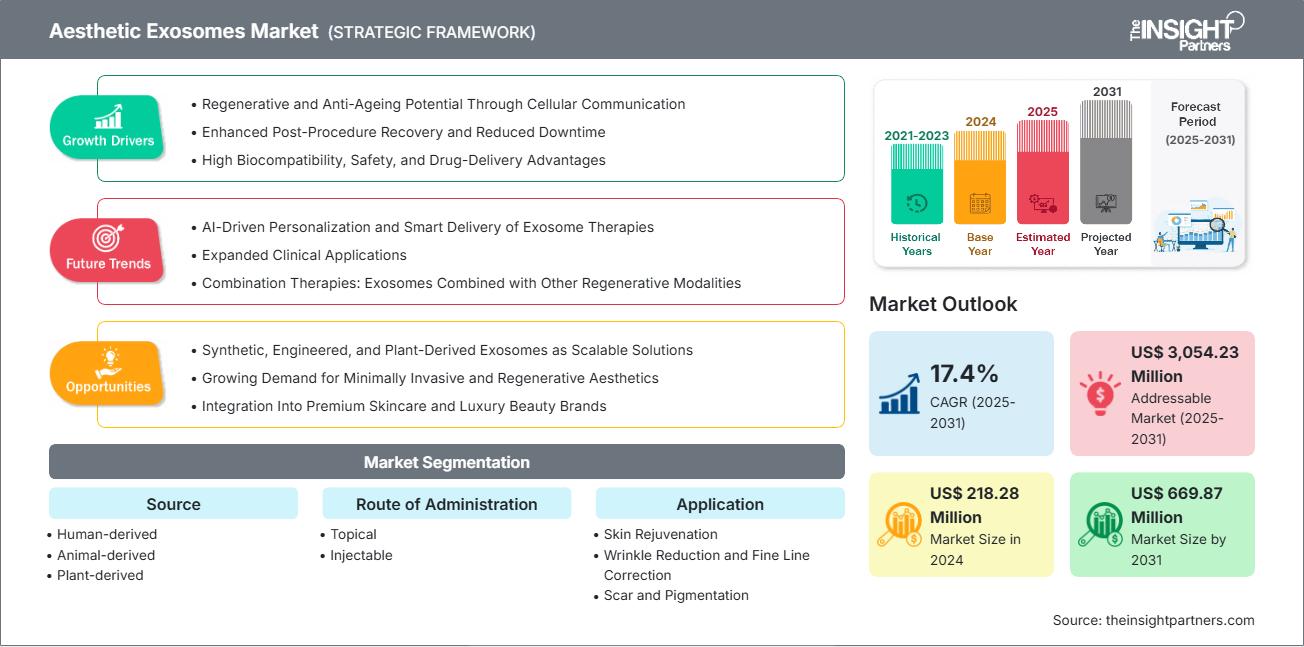
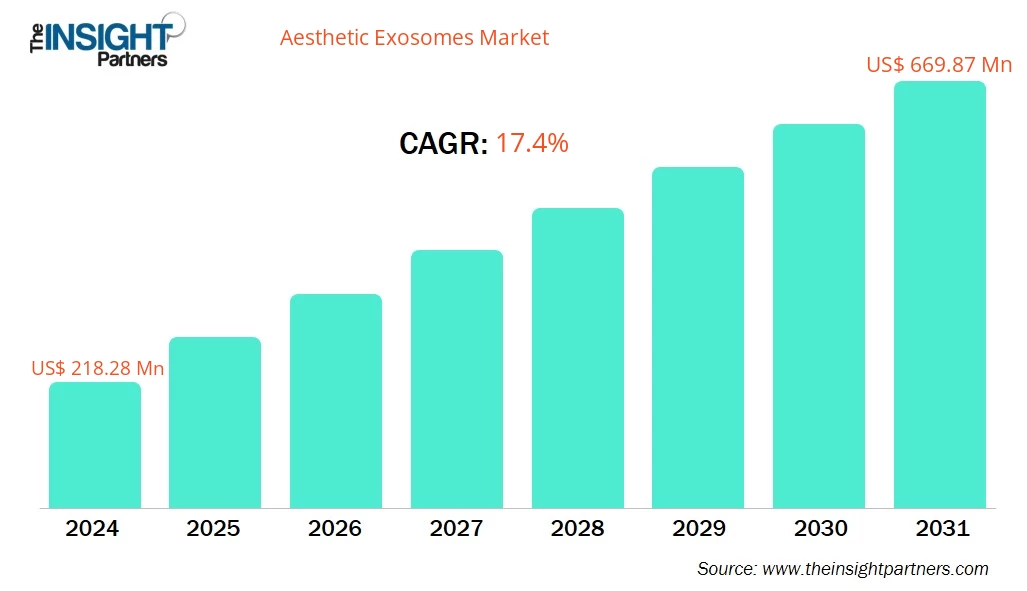
The aesthetic exosomes market size is projected to reach US$ 669.87 million by 2031 from US$ 218.28 million in 2024. The market is expected to register a CAGR of 17.4% during 2025–2031.
Aesthetic Exosomes Market Analysis
The market's growth is driven by regenerative and anti-ageing potential through cellular communication and enhanced post-procedure recovery, and reduced downtime. Additionally, high biocompatibility, safety, and drug-delivery advantages contribute to market development. Synthetic, engineered, and plant-derived exosomes as scalable solutions, growing demand for minimally invasive and regenerative aesthetics, and integration into premium skincare and luxury beauty brands are expected to create ample opportunities for the aesthetic exosomes market growth.
Aesthetic Exosomes Market Overview
The aesthetic exosome market represents a significant advancement in beauty technology, offering less invasive cosmetic interventions. Exosomes are small extracellular vesicles containing growth factors, lipids, proteins, and nucleic acids that facilitate cellular communication and tissue regeneration. In aesthetics, they are used for skin rejuvenation, post-procedure therapy, and recovery to accelerate healing, boost collagen synthesis, and improve skin texture. Demand is increasing as both clinicians and consumers seek minimally invasive, scientifically backed, and natural anti-aging solutions with fewer side effects.
Market Assessment and Insights
- North America dominated the market with 54.3% share in 2024.
- Asia Pacific is poised to grow at a CAGR of 18% over the forecast period.
- United States market is projected to grow at a CAGR of 17.8% over the forecast period.
- By Source, the Human-derived segment accounted for the largest market share of 45.6% in 2024.
- By Route Of Administration, the Topical segment is anticipated to witness the fastest growth, registering a CAGR of 17.7% over the forecast period
- By Application, the Skin Rejuvenation segment accounted for the largest market share of 38.5% in 2024.
- By End User, the Dermatology Clinics segment is anticipated to witness the fastest growth, registering a CAGR of 18.1% over the forecast period
- The report profiles key industry players such as Creative Biolabs Inc, Kimera Labs, Laboratorio Innoaesthetics, S.L.U., BENEV COMPANY INC, Croma Pharma, Rion Aesthetics, Exocel Bio, ELEVAI Labs, Inc, Advancexo, Mibelle AG, while also analyzing key developments in novel ideas, disruptive products, and innovative services that could reshape the future market and reveal emerging themes across the industry.
Source: The Insight Partners' analysis based on proprietary research, government publications, company annual reports, investor presentations, industry databases, and expert interviews.
● REPORT CUSTOMIZATION
Tailor This Report To Align With Your Specific Business Requirements
This report can be customized to align precisely with your business objectives, scope, and target markets. Customization options include tailored segmentation, geography, competitive analysis, and strategic insights to support informed decision-making.
Customize This Report →WHAT YOU CAN ADJUST
- ● Segmentations
- ● Geography
- ● Competitive Analysis
- ● Language Preferences
Aesthetic Exosomes Market: Strategic Insights
-
Get Top Key Market Trends of this report.This FREE sample will include data analysis, ranging from market trends to estimates and forecasts.
Aesthetic Exosomes Market Drivers and Opportunities
Market Drivers:
- Regenerative and Anti-Ageing Potential Through Cellular Communication: Exosomes make skin rejuvenation more effective as they bring the miRNAs and growth factors that stimulate collagen, inhibit MMPs, alleviate inflammation, and enhance elasticity, thus indirectly supporting the trend of non-invasive regenerative anti-ageing solutions.
- Enhanced Post-Procedure Recovery and Reduced Downtime: Exosomes help in recovery after the intervention as they can reduce inflammation, erythema, and scarring while increasing patient comfort and recovery speed, thus encouraging the clinic staff to implement exosome-enriched protocols to meet patient expectations for minimal downtime.
- High Biocompatibility, Safety, and Drug-Delivery Advantages: Exosomes are a natural, low-immunogenic delivery system for bioactive molecules that lead to collagen support and reduction of oxidative stress, and thus, are safer and more effective than synthetic carriers, which is the major reason for adopting them in aesthetic dermatology.
Market Opportunities:
- Synthetic, Engineered, and Plant-Derived Exosomes as Scalable Solutions: Among the different types of exosomes, engineered, synthetic, and plant-derived ones represent scalable, customizable, and biocompatible solutions that do not require human-derived vesicles. As a result, these exosomes ensure consistent outcomes, facilitate regulation, and allow for mass-market commercialization of the next-generation anti-aging and regenerative skincare.
- Growing Demand for Minimally Invasive and Regenerative Aesthetics: The move away from surgical to non-surgical, regenerative, and “prejuvenation” treatments has been a significant driver for exosome usage. This is because exosomes have anti-inflammatory and collagen-boosting properties that enhance the recovery period after the procedure, thus attracting younger, biotechnology-savvy consumers who are looking for cellular-level skin health.
- Integration Into Premium Skincare and Luxury Beauty Brands: Exosomes' bioactive delivery and regenerative effects position them as strong candidates for luxury skincare. High-end brands can leverage these benefits to differentiate products, justify premium pricing, and meet demand for science-driven, innovative beauty solutions.
Aesthetic Exosomes Market Report Segmentation Analysis
The aesthetic exosomes market is divided into different segments to give a clearer view of how it works, its growth potential, and the latest trends. Below is the standard segmentation approach used in most industry reports:
By Source:
- Human-Derived: Human-derived exosomes are most effective for dermal remodeling, melanogenesis regulation, and wound healing due to their histocompatibility and bioactive content. They are considered the clinical gold standard despite higher costs and strict regulatory requirements.
- Animal-Derived: Exosomes from animal sources present high-yield, growth factor-rich, and relatively inexpensive solutions for collagen stimulation and inflammation reduction. However, their immunogenicity, risk of prions, and variability hinder their acceptance in the markets of premium and ethically conscious consumers.
- Plant-Derived: Exosomes from plants are a vegan and hypoallergenic source of miRNAs and polyphenols, thus they can offer antioxidant defense and skin barrier support with less complex regulation, perfect for topical cosmeceuticals, albeit with less deep-skin potency.
By Route of Administration:
- Topical
- Injectable
By Application:
- Skin Rejuvenation
- Wrinkle Reduction and Fine Line Correction
- Scar and Pigmentation
- Post-procedure Recovery
- Hair Restoration
- Others
By End User:
- Hospitals
- Dermatology Clinics
- Medical Spas
- Others
Each end user in the aesthetic exosomes market has distinct handling, safety, and regulatory needs, shaping equipment selection and operational protocols.
By Geography:
- North America
- Europe
- Asia Pacific
- Latin America
- Middle East & Africa
The aesthetic exosomes market in Asia Pacific is expected to witness the fastest growth. The market is driven by its strong beauty and biotech culture, especially in countries such as South Korea, China, and Japan.
Aesthetic Exosomes Market Report Scope
| Report Attribute | Details |
|---|---|
| Market size in 2024 | US$ 218.28 Million |
| Market Size by 2031 | US$ 669.87 Million |
| Global CAGR (2025 - 2031) | 17.4% |
| Historical Data | 2021-2023 |
| Forecast period | 2025-2031 |
| Segments Covered |
By Source
|
| Regions and Countries Covered |
North America
|
| Market leaders and key company profiles |
|
Aesthetic Exosomes Market Players Density: Understanding Its Impact on Business Dynamics
The Aesthetic Exosomes Market is growing rapidly, driven by increasing end-user demand due to factors such as evolving consumer preferences, technological advancements, and greater awareness of the product's benefits. As demand rises, businesses are expanding their offerings, innovating to meet consumer needs, and capitalizing on emerging trends, which further fuels market growth.
Aesthetic Exosomes Market Share Analysis by Geography
Asia Pacific is expected to grow the fastest in the next few years. Emerging markets in Latin America, the Middle East, and Africa also have many untapped opportunities for aesthetic exosomes providers to expand.
The aesthetic exosomes market grows differently in each region owing to the economic growth and regenerative and anti-ageing potential through cellular communication, followed by the enhanced post-procedure recovery and reduced downtime. Below is a summary of market share and trends by region:
1. North America
- Market Share: Holds a significant portion of the global market
- Key Drivers: The high adoption of advanced aesthetics, a strong biotechnology-related infrastructure, and an increasing demand for non-invasive anti-aging treatments.
- Trends: Biotech research and development, and medical aesthetics, exosomes are integrated into premium post‑procedure recovery protocols.
2. Europe
- Market Share: Substantial share due to early adoption of aesthetic exosomes
- Key Drivers: The easy regulatory compliance, increased public awareness of cosmetic procedures, and the preference of users for skincare products that are clinically backed.
- Trends: Emphasis on clean-label and plant‑derived exosome skincare
3. Asia Pacific
- Market Share: Fastest-growing region with rising market share every year
- Key Drivers: The rapid growth of the medical aesthetics industry in Asia Pacific is the presence of tech-savvy consumers, who have strong interests in minimally invasive, rejuvenating skincare, which in turn increases exosome product usage.
- Trends: Rapid adoption of exosome serums, sheet masks, and post‑procedure therapies
4. South and Central America
- Market Share: Growing market with steady progress
- Key Drivers: The increase in disposable income, the rising of a beauty-conscious population, and the growth of dermatology clinics in the region.
- Trends: Growing beauty‑clinic penetration and social‑media–driven awareness
5. Middle East and Africa
- Market Share: Although small, but growing quickly
- Key Drivers: The luxury beauty trends, medical tourism, and a high demand for quality anti-aging treatments.
- Trends: Luxury medspas and medical tourism are pushing exosome adoption.
Aesthetic Exosomes Market Players Density: Understanding Its Impact on Business Dynamics
High Market Density and Competition
Competition is strong due to the presence of established players, such as BENEV COMPANY INC, Laboratorio Innoaesthetics, S.L.U., Kimera Labs, and Rion Aesthetics, which are adding to the competitive landscape across different regions.
This high level of competition urges companies to stand out by offering:
- Competitive pricing models
- Strong customer support and easy integration
Opportunities and Strategic Moves
- Top-tier companies are putting money into bioengineered exosomes and sophisticated isolation techniques that make aesthetic solutions more consistent, targeted, and personalized. Such a scenario comprises clinical-grade as well as consumer-facing products backed by strong scientific validation and regulatory compliance.
- Often, new product introductions are deliberately made to premium segments where customers highly appreciate innovation, absolute ingredient transparency, and proven effectiveness. Moreover, brands use loyalty programs and the strategic placement of fillers to cultivate long-term relationships with consumers.
- Ongoing investigation aimed at refining exosome technology and gaining deeper insight into their mechanisms is resulting in the arrival of bioengineered and highly functional exosome products.
Other companies analysed during the course of research:
- Xollent Biotech
- Paradise Life Technology
- Xiamen Aisai Biotechnology Co., Ltd.
- ANTEAGE
- ZEO ScientifiX, Inc.
- Cosmedicine Co., Ltd.
- L’Oréal
- Shiseido
- Cellexus
- Aesthetics Biomedical
- MediTox
- Exosome Sciences
- E-Exosomes
- E-Exosomes
- BIONET Therapeutics Corp.
- ExoOcean (plant-derived exosome brand)
- CALECIM / CellResearch Corporation
- Brexogen / BREXTEM
- Reviheal
- YOUTHHEAL by RFBio
Aesthetic Exosomes Market News and Recent Developments
- Aurecell Laboratories Launches AureExo Exosome Skin Rejuvenation Serum for Professional Aesthetic Practices: Aurecell Laboratories, Inc., launched its new AureExo Exosome Skin Rejuvenation Serum, developed in collaboration with Deep Harbour Cell Valley Healthcare and Technology Co., Ltd.
- Introducing JuveXO Aesthetics, a New Exosome-powered Skincare Line From JuveXO: JuveXO is launching JuveXO Aesthetics, a new physician-dispensed exosome skincare line that includes JuveXO Skin, JuveXO Hair, and JuveXO Lyo. Derived from umbilical lining stem cells (ULSCs), a form of mesenchymal stem cell (MSC), JuveXO is produced through ExoCM. This proprietary, patent-pending technology enables control of the factors released by ULSCs.
Aesthetic Exosomes Market Report Coverage and Deliverables
The "Aesthetic Exosomes Market Size and Forecast (2021–2031)" report provides a detailed analysis of the market covering below areas:
- Aesthetic Exosomes Market size and forecast at global, regional, and country levels for all the key market segments covered under the scope
- Aesthetic Exosomes Market trends, as well as market dynamics such as drivers, restraints, and key opportunities
- Detailed PEST and SWOT analysis
- Aesthetic Exosomes Market analysis covering key market trends, global and regional framework, major players, regulations, and recent market developments
- Industry landscape and competition analysis covering market concentration, heat map analysis, prominent players, and recent developments for the Aesthetic Exosomes Market
- Detailed company profiles
Frequently Asked Questions

- Comprehensive Market Sizing and Forecast Analysis
- Detailed Segmentation Analysis
- In-Depth Market Dynamics Assessment
- Regional and Country-Level Insights
- Competitive Landscape and Company Benchmarking
- Strategic Business Intelligence
Recent Reports
Testimonials

The Insight Partners' SCADA System Market report is comprehensive, with valuable insights on current trends and future forecasts. The team was highly professional, responsive, and supportive throughout. We are very satisfied and highly recommend their services.
RAN KEDEM Partner, Reali Technologies LTDs
I requested a report on a very specific software market and the team produced the report in a few days. The information was very relevant and well presented. I then requested some changes and additions to the report. The team was again very responsive and I got the final report in less than a week.
JEAN-HERVE JENN Chairman, Future Analytica
We worked with The Insight Partners for an important market study and forecast. They gave us clear insights into opportunities and risks, which helped shape our plans. Their research was easy to use and based on solid data. It helped us make smart, confident decisions. We highly recommend them.
PIYUSH NAGPAL Sr. Vice President, High Beam Global
The Insight Partners delivered insightful, well-structured market research with strong domain expertise. Their team was professional and responsive throughout. The user-friendly website made accessing industry reports seamless. We highly recommend them for reliable, high-quality research services
YUKIHIKO ADACHI CEO, Deep Blue, LLC.
This is the first time I have purchased a market report from The Insight Partners.While I was unsure at first, I visited their web site and felt more comfortable to take the risk and purchase a market report.I am completely satisfied with the quality of the report and customer service. I had several questions and comments with the initial report, but after a couple of dialogs over email with their analyst I believe I have a report that I can use as input to our strategic planning process.Thank you so much for taking the extra time and making this a positive experience.I will definitely recommend your service to others and you will be my first call when we need further market data.
JOHN SUZUKI President and Chief Executive Officer, Board Director, BK Technologies
I wish to appreciate your support and the professionalism you displayed in the course of attending to my request for information regarding to infectious disease IVD market in Nigeria. I appreciate your patience, your guidance, and the fact that you were willing to offer a discount, which eventually made it possible for us to close a deal. I look forward to engaging The Insight Partners in the future, all thanks to the impression you have created in me as a result of this first encounter.
DR CHIJIOKE ONYIA MANAGING DIRECTOR, PineCrest Healthcare Ltd.Reason to Buy
- Informed Decision-Making
- Understanding Market Dynamics
- Competitive Analysis
- Identifying Emerging Markets
- Customer Insights
- Market Forecasts
- Risk Mitigation
- Boosting Operational Efficiency
- Strategic Planning
- Investment Justification
- Tracking Industry Innovations
- Aligning with Regulatory Trends





 Get Free Sample for