
Agave Nectar Market Size, Share & Growth by 2034
Coverage: By Type (Light, Dark); Category (Organic, Conventional); Distribution Channel (Hypermarkets and Supermarkets, Convenience Stores, Online Retail, Others.) , and Geography (North America, Europe, Asia Pacific, and South and Central America)
- Status : Data Released
- Report Code : TIPRE00020185
- Category : Food and Beverages
- No. of Pages : 150
- Available Report Formats :


- Last update date : August 10, 2026


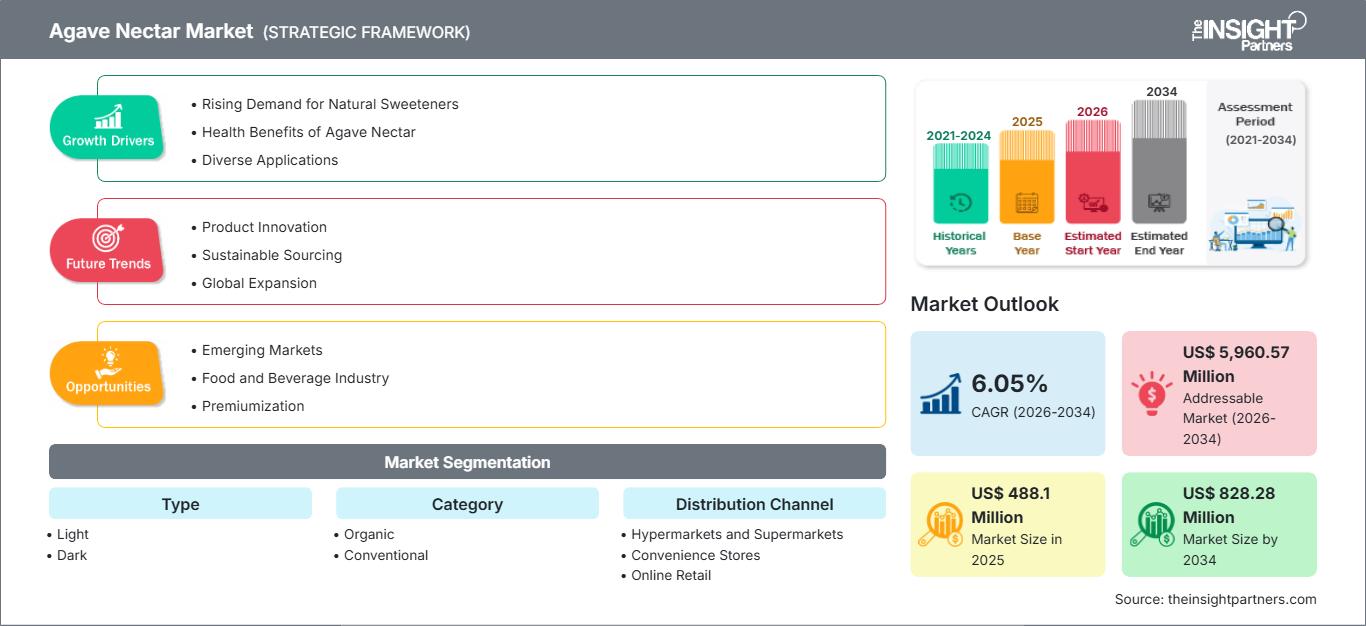
2025 Market Size
US$ 488.1 Mn
Base year value
2034 Forecast
US$ 828.28 Mn
Projected by 2034
CAGR 2026-2034
6.05 %
Growth rate
Addressable Market
US$ 5,960.57 Mn
(2026-2034)
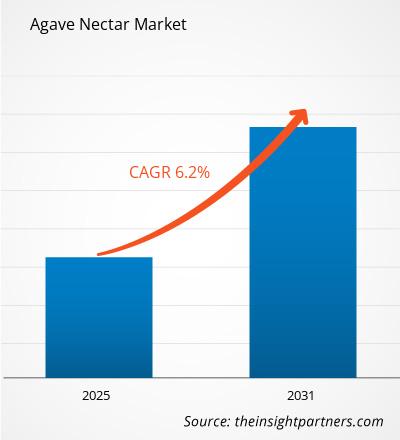
The agave nectar market is projected to grow from US$ 488.1 Million in 2025 to US$ 828.28 Million by 2034, registering a CAGR of 6.05% during 2026–2034. Demand is supported by clean-label sweetener adoption, wider use in bakery and beverage formulations, and consumer preference for plant-based alternatives to refined sugar and honey.
North America remains a key demand center as natural sweeteners move from specialty retail into mainstream grocery, foodservice, and online channels. The agave nectar market size in the region is supported by established Mexican agave supply, U.S. health-food penetration, and reformulation activity among beverage, bakery, and snack manufacturers seeking recognizable ingredients.
Agave Nectar Market Assessment and Insights
- North America: The region is estimated to hold 34–37% share in 2025 and grow at a CAGR of 5.8–6.4% between 2026–2034, supported by mature natural sweetener usage and online retail adoption.
- US: The U.S. is expected to account for 72–76% of North America share in 2025 and grow at a CAGR of 5.7–6.2% through 2034.
- Europe: Europe is estimated at 24–27% share in 2025, growing at 5.4–6.0% CAGR, led by the UK, Germany, France, Italy, and Spain.
- Asia Pacific: Asia Pacific is projected to hold 18–21% share in 2025 and grow at 6.6–7.2% CAGR, led by China, Japan, South Korea, India, and Australia.
- Largest Segment: Light agave nectar is estimated to hold 53–57% market share in 2025 and grow at a CAGR of 5.8–6.3% through 2034.
- High Growth Segment: Organic agave nectar is estimated to hold 36–40% share in 2025 and grow at a CAGR of 6.8–7.4% through 2034.
- Key companies analyzed in detail: Ciranda, Inc.; Dipasa USA, Inc.; Domino Foods, Inc.; Health Garden USA; Madhava Ltd.; NOW Health Group, Inc.; The Groovy Food Company; The Hain Daniels Group Limited; The iidea Company; Wholesome Sweeteners Inc.
Source: The Insight Partners' analysis based on proprietary research, government publications, company annual reports, investor presentations, industry databases, and expert interviews.
Agave nectar production has evolved from niche syrup processing into a more structured natural sweetener supply chain, with improved filtration, controlled hydrolysis, and organic certification supporting food-grade consistency. Agave nectar market growth is linked to its role in beverages, bakery, sauces, dressings, and packaged health foods, where manufacturers require a liquid sweetener with mild flavor, high solubility, and vegan positioning.
In terms of investments, there will be a focus on certified sourcing, shelf-stable products, and channels. Market expectations are also influenced by sugar reduction programs, vegan diet trends, and transparency in the labeling of ingredients. The suppliers that are able to offer reliable agave sourcing and formulation help are expected to get long-term contracts.
Agave Nectar Market Report Scope
| Report Attribute | Details |
|---|---|
| Market size in 2025 | US$ 488.1 Million |
| Market Size by 2034 | US$ 828.28 Million |
| Global CAGR (2026 - 2034) | 6.05% |
| Historical Data | 2021-2024 |
| Forecast period | 2026-2034 |
Agave Nectar Market Analysis
Agave nectar market growth is driven by clean-label reformulation, especially in bakery, beverages, confectionery, and breakfast products. Its low-glycemic positioning, vegan suitability, and neutral taste support use as a substitute for honey, refined sugar, and corn syrup. Supply dynamics remain tied to Mexican agave cultivation cycles, making inventory planning and processor relationships important for buyers.
Distribution is spreading across hypermarkets and supermarkets, convenience stores, online shopping, and specialized health sales. Online shopping becomes significant since people often discover pantry items, organic sweeteners, and products for special diets via subscription baskets, marketplace search, and direct consumer merchandise. It is the best channel to offer premium organic brands and specialty brands.
According to market analysis, the competitive landscape is relatively fragmented. Ciranda, Inc., Dipasa USA, Inc., Madhava Ltd., NOW Health Group, Inc., Wholesome Sweeteners Inc., and The iidea Company compete based on organic certification, use of blue agave, and food service contracts. At the same time, Domino Foods, Inc. and The Hain Daniels Group Limited have wider sweetener and natural foods lines.
Strategic positioning is moving from simple sweetener supply toward application support, retail visibility, and certified ingredient assurance. Companies that can balance price stability with verified sourcing are likely to gain share as food manufacturers scrutinize fructose content, sustainability claims, and supply continuity before expanding agave nectar in mainstream products.
● REPORT CUSTOMIZATION
Tailor This Report To Align With Your Specific Business Requirements
This report can be customized to align precisely with your business objectives, scope, and target markets. Customization options include tailored segmentation, geography, competitive analysis, and strategic insights to support informed decision-making.
Customize This Report →WHAT YOU CAN ADJUST
- ● Segmentations
- ● Geography
- ● Competitive Analysis
- ● Language Preferences
Agave Nectar Market: Strategic Insights
Regional Insights
North America Agave Nectar Market
North America is expected to hold a 34–37% Agave Nectar Market share in 2025, supported by consumer familiarity with natural sweeteners and strong retail access. The region is forecast to grow at a CAGR of 5.8–6.4% during 2026–2034 as supermarkets, online retail platforms, and specialty food stores expand shelf space for organic and low-glycemic alternatives.
Agave Cultivation in Mexico and Clean Label Ingredient Demand in the United States Create Structural Importance for the Region. Manufacturers also gain an advantage due to established food service applications in cafes, smoothie shops, cocktail mixers, and snacks using natural sources, where liquid sweeteners contribute to improving the quality and uniformity of the product. Furthermore, growing demand due to consumer interest in plant-based diets, lower sugar content products, and natural ingredients keeps creating opportunities for manufacturers. Innovation in flavored beverages, nutritional products, dairy substitutes, and functional foods increases possibilities of application, while premiumization is leading to higher use of agave nectar by consumers.
U.S. Agave Nectar Market
The U.S. is projected to represent 72–76% of North American demand in the market in 2025 and grow at a CAGR of 5.7–6.2% through 2034. Demand is concentrated in natural grocery, e-commerce, beverage formulation, bakery mixes, and household sweetener purchases.
Company presence is enabled through brands and suppliers, including Madhava Ltd., NOW Health Group, Inc., Wholesome Sweeteners Inc., Health Garden USA, and Domino Foods, Inc. Such entities leverage customer familiarity, health-oriented merchandising, and the capability to cater to retail and ingredient customers through varied packaging options. Furthermore, increasing consumer inclination towards natural sweeteners, organic food items, and clean label ingredients remains a significant factor bolstering demand in both retail and food service sectors.
Europe Agave Nectar Market
Europe is estimated to account for a 24–27% share of the market in 2025, with a CAGR of 5.4–6.0% during 2026–2034. The UK and Germany lead demand due to plant-based product launches, organic retail penetration, and consumer preference for minimally processed sweeteners, according to the Agave Nectar Market report.
France, Italy, and Spain contribute more growth by way of premium bakery, café, and food specialty routes. European consumers tend to focus on products certified organic, transparent source, and reduction in sugar content, making way for the suppliers that can maintain high standards and comply with regulations in multiple markets. Rising trends for clean label ingredients, functional beverages, and natural sugars are contributing further to the growth of the market, while the rising regulatory emphasis on healthy eating promotes the use of sweeteners in food.
APAC Agave Nectar Market
Asia Pacific is projected to hold an 18–21% share of the market in 2025 and grow at a CAGR of 6.6–7.2% through 2034. China, Japan, South Korea, India, and Australia are key demand centers as modern retail, premium bakery, café culture, and health-oriented packaged foods expand, according to the Agave Nectar Market forecast.
The regional growth is attributed to increased disposable income, easy availability of imported natural sweeteners, and growing preference towards plant-based nutrition. The trends associated with the consumption of agave nectar have been seen the most in urban consumers who are ready to spend on the special ingredients associated with wellness, vegan, and clean-label requirements. The factors of growing E-commerce distribution, heightened health consciousness, and increased demand for functional foods and beverages are adding further to the market growth. Moreover, the food companies are also including natural sweeteners in premium product formulations, providing opportunities to agave nectar producers in retail as well as foodservice sectors.
Middle East & Africa Agave Nectar Market
The Middle East & Africa market is expected to grow at a CAGR of 5.2–5.8% during 2026–2034, with Saudi Arabia, the UAE, and South Africa leading adoption. Demand is developing through premium grocery, foodservice, hospitality, and imported health-food channels, reflecting key Agave Nectar Market trends.
Although growth is still lower compared to that in North America and Europe, urban consumers continue to be introduced to natural sweeteners through cafes and wellness stores, as well as e-commerce platforms. Growing health and wellness trends, along with an increased demand for cleaner labeling in food and premium beverages, are slowly driving market penetration within important urban centers. Dependence on imports, high prices, and lack of consumer awareness hinder market development, while premium positioning, modern retail channels, and specialty foods facilitate market growth.
Segmentation Analysis
Type
The type segment of the market includes Light and Dark agave nectar. Type-level demand is expected to grow at a CAGR of 5.9–6.4% during 2026–2034 as formulators select variants based on flavor intensity, color, and end-use compatibility. The market scope is strongest in products where texture, solubility, and flavor balance matter.
- Light: Light agave nectar leads because its mild flavor works well in beverages, bakery products, dressings, yogurt alternatives, and tabletop sweetening without overpowering finished product profiles. Its neutral taste, light color, and ease of blending make it particularly suitable for clean-label formulations and premium health-focused food products.
- Dark: Dark agave nectar serves recipes requiring richer color and deeper caramel-like notes, including sauces, desserts, craft beverages, and specialty bakery applications. The variety is valued for its distinctive flavor profile and ability to enhance taste complexity, making it a preferred ingredient in gourmet, artisanal, and premium food and beverage offerings.
Category
The category segment of the market includes Organic and Conventional agave nectar. Category-level demand is expected to grow at a CAGR of 6.1–6.7% through 2034, with organic variants outpacing conventional products because consumers increasingly associate certification with traceability, farming standards, and premium clean-label positioning.
- Organic: Organic agave nectar attracts health-focused buyers, natural food retailers, and premium packaged food manufacturers seeking certified ingredients for label differentiation. Growing consumer preference for organic food products, sustainable sourcing practices, and minimally processed ingredients continues to strengthen demand across retail and foodservice channels. Premium pricing and strong brand positioning further support growth in this category.
- Conventional: Conventional agave nectar remains important for cost-sensitive bakery, beverage, and foodservice applications that require consistent sweetness and liquid handling performance. Its broader availability, competitive pricing, and suitability for large-scale food manufacturing make it a preferred option for commercial users. Demand is expected to remain stable as manufacturers seek cost-effective natural sweetening solutions without the added certification requirements of organic products.
Distribution Channel
The distribution channel segment of the market includes Hypermarkets and Supermarkets, Convenience Stores, Online Retail, and Others. Channel-level demand is expected to grow at a CAGR of 6.0–6.6% during 2026–2034 as shelf visibility, private label expansion, and digital grocery search improve consumer access.
- Hypermarkets and Supermarkets: These outlets remain the largest route for household adoption because shoppers can directly compare agave nectar with honey, maple syrup, stevia, and cane sugar alternatives. Broad product availability, promotional activities, and increasing shelf space for natural and organic food products continue to support category growth.
- Convenience Stores: Convenience outlets support impulse and smaller-format purchases, mainly in urban locations where wellness snacks and natural pantry products are gaining visibility. Growing demand for healthier on-the-go food options is encouraging retailers to expand their assortment of alternative sweeteners.
- Online Retail: Online retail is strategically important in the market for organic, specialty, bulk, and subscription purchases because consumers can compare certifications, formats, reviews, and prices quickly. The channel also enables direct-to-consumer sales and provides access to a wider range of premium and niche products that may not be available through traditional retail outlets.
Opportunity Snapshot
| Segments | Revenue Contribution | Trend Tag | Adoption Stage |
| Light | High | Mild Flavor | Mature |
| Dark | Medium | Craft Use | Scaling |
| Organic | High | Certified Clean | Scaling |
| Conventional | Medium | Value Sweetener | Mature |
| Hypermarkets and Supermarkets | High | Shelf Expansion | Mature |
| Convenience Stores | Low | Urban Access | Emerging |
| Online Retail | High | Digital Pantry | Scaling |
Agave Nectar Market Growth Drivers and Impact Analysis
Clean-Label Sweetener Reformulation
Within the Agave Nectar Market, manufacturers of food and drinks are shifting away from the use of refined sugars, corn syrups, and artificial sweeteners toward more familiar ingredients that can be used to achieve clean-label marketing. Agave nectar is known for providing liquid functionality, its vegan composition, as well as its mild flavor, which makes it applicable in beverages, bakery products, sauces, dressings, and snacks. The natural composition of agave nectar assists brands in coping with consumers' concerns about additives.
Expansion of Organic and Plant-Based Diets
In the Agave Nectar Market, organic and plant-based diets are expanding the addressable consumer base because the ingredient fits vegan, vegetarian, and natural food claims more easily than honey. Certified organic agave nectar is particularly attractive to premium brands, health-focused consumers, and specialty retailers seeking traceable supply chains, sustainable sourcing practices, and stronger shelf differentiation. The product’s plant-derived origin aligns well with the growing popularity of vegan foods, dairy alternatives, functional beverages, and clean-label packaged products.
As consumers increasingly connect sweetener choices with wellness, sustainability, and ingredient simplicity, organic agave nectar benefits from both household purchases and industrial formulation demand. Food and beverage manufacturers are incorporating organic agave nectar into bakery products, nutritional bars, cereals, beverages, and condiment formulations to meet demand for recognizable and minimally processed ingredients. In addition, expanding availability through natural food stores, supermarkets, and online retail channels is improving product accessibility, supporting wider market penetration and long-term growth within the Agave Nectar Market.
Growth of Digital Grocery and Specialty Retail
In the Agave Nectar Market, online retail is enabling smaller and emerging brands to reach consumers without relying solely on traditional retail shelf space. Digital sales channels provide a cost-effective platform for product promotion, consumer engagement, and direct-to-consumer distribution, allowing manufacturers to expand their geographic reach and target niche customer segments more efficiently. Online platforms also support detailed product education, certification verification, ingredient transparency, and comparison shopping, helping consumers make informed purchasing decisions.
The channel becomes particularly valuable for organic, premium, bulk-packed, and specialty agave nectar, which often come with certain features, like organic certification, non-GMO label, vegan compatibility, and sustainability. The use of specialty stores and e-commerce channels makes it easier for consumers to find different types of agave nectar, such as light, dark, organic, and flavored agave nectar, that might not be available offline. Subscription-based models and repeat purchase options can also become an instrument to build consumer loyalty and foster regular consumption. With the increasing preference for the convenience of customers, online retail provides better access for suppliers and builds strong brand visibility while helping to maintain premium prices among consumers actively looking for low glycemic, vegan, clean-label, and natural sweeteners.
Agave Nectar Market Future Trends
Certified Supply Chain Transparency
In the Agave Nectar Market, trends are increasingly moving toward greater traceability as retailers and food manufacturers ask for clearer origin, farming, processing, and certification details. Suppliers are expected to invest in documentation, audits, and batch-level quality systems to support organic, non-GMO, and sustainability claims. This shift will separate commodity syrup suppliers from premium ingredient partners, particularly in export markets where labeling rules and consumer expectations are increasingly demanding. Enhanced traceability also helps strengthen consumer trust, improve supply chain transparency, reduce quality risks, and support brand differentiation, creating valuable competitive advantages for suppliers targeting premium and regulated international markets.
Functional Sweetener Blends
The future innovations in Product Development for the Agave Nectar Market will include the blend of agave nectar with fibers, botanicals, electrolytes, or alternative sweetening systems that will ensure a balanced sweetness level, consistency and nutritional claims. Beverage, snack, or wellness manufacturers will benefit from such blends, as they will be able to solve the issue of fructose content while maintaining the natural image of their products. This innovation will create more opportunities for product applications apart from table-top uses, including beverages, protein-based snacks, breakfast items, and premium sauces.
Agave Nectar Market Opportunities
Premium Organic Private Label Programs
Retailers can expand premium organic private label agave nectar lines to capture margin while serving shoppers seeking affordable, clean-label sweeteners. The opportunity is strongest in supermarkets and online grocery platforms that already sell organic baking ingredients, plant-based pantry products, and natural beverages. Agave Nectar Market forecasts indicate that certified products can command stronger loyalty when packaging clearly communicates origin, usage occasions, and compatibility with vegan diets. Growing consumer trust in retailer-owned brands, combined with increasing demand for transparent sourcing and organic certification, is expected to further strengthen sales and support premium category expansion across key distribution channels.
Foodservice Formulation Partnerships
In the Agave Nectar Market, foodservice outlets, cafes, smoothie bars, and bakery franchises provide suppliers access to higher volume repeat business. Agave nectar works well in cool drinks, dressings, glazes, and baked products, which allows suppliers to help operators market natural sweetness without any significant changes in their recipes. Suppliers that offer stabilized prices, large volume pack sizes, recipe development, and uniform viscosity will be able to develop strong relationships with franchises looking for unique types of sweeteners. The rise in demand for luxury beverages and baked goods, coupled with consumers' increasing interest in natural ingredients, will further fuel the growth of foodservice use.
Frequently Asked Questions

- Comprehensive Market Sizing and Forecast Analysis
- Detailed Segmentation Analysis
- In-Depth Market Dynamics Assessment
- Regional and Country-Level Insights
- Competitive Landscape and Company Benchmarking
- Strategic Business Intelligence
Recent Reports
Testimonials

The Insight Partners provided valuable market intelligence that supported our global go-to-market strategy. Their team was professional, responsive, and attentive to our feedback, providing thoughtful analysis and helpful methodological clarifications throughout the project.
Junmo Kim Chief Financial Officer (CFO), Enertech Co., Ltd.
The Insight Partners' SCADA System Market report is comprehensive, with valuable insights on current trends and future forecasts. The team was highly professional, responsive, and supportive throughout. We are very satisfied and highly recommend their services.
RAN KEDEM Partner, Reali Technologies LTDs
I requested a report on a very specific software market and the team produced the report in a few days. The information was very relevant and well presented. I then requested some changes and additions to the report. The team was again very responsive and I got the final report in less than a week.
JEAN-HERVE JENN Chairman, Future Analytica
We worked with The Insight Partners for an important market study and forecast. They gave us clear insights into opportunities and risks, which helped shape our plans. Their research was easy to use and based on solid data. It helped us make smart, confident decisions. We highly recommend them.
PIYUSH NAGPAL Sr. Vice President, High Beam Global
The Insight Partners delivered insightful, well-structured market research with strong domain expertise. Their team was professional and responsive throughout. The user-friendly website made accessing industry reports seamless. We highly recommend them for reliable, high-quality research services
YUKIHIKO ADACHI CEO, Deep Blue, LLC.
This is the first time I have purchased a market report from The Insight Partners.While I was unsure at first, I visited their web site and felt more comfortable to take the risk and purchase a market report.I am completely satisfied with the quality of the report and customer service. I had several questions and comments with the initial report, but after a couple of dialogs over email with their analyst I believe I have a report that I can use as input to our strategic planning process.Thank you so much for taking the extra time and making this a positive experience.I will definitely recommend your service to others and you will be my first call when we need further market data.
JOHN SUZUKI President and Chief Executive Officer, Board Director, BK Technologies
I wish to appreciate your support and the professionalism you displayed in the course of attending to my request for information regarding to infectious disease IVD market in Nigeria. I appreciate your patience, your guidance, and the fact that you were willing to offer a discount, which eventually made it possible for us to close a deal. I look forward to engaging The Insight Partners in the future, all thanks to the impression you have created in me as a result of this first encounter.
DR CHIJIOKE ONYIA MANAGING DIRECTOR, PineCrest Healthcare Ltd.Reason to Buy
- Informed Decision-Making
- Understanding Market Dynamics
- Competitive Analysis
- Identifying Emerging Markets
- Customer Insights
- Market Forecasts
- Risk Mitigation
- Boosting Operational Efficiency
- Strategic Planning
- Investment Justification
- Tracking Industry Innovations
- Aligning with Regulatory Trends





 Get Free Sample for