
Aggregates Market Growth, Size & Forecast by 2034
Coverage: By Type (Crushed Stone, Sand, Gravel, Others); Application (Concrete, Road Base and Coverings, Others), and Geography (North America, Europe, Asia Pacific, and South and Central America)
- Status : Data Released
- Report Code : TIPRE00016498
- Category : Chemicals and Materials
- No. of Pages : 150
- Available Report Formats :


- Last update date : July 20, 2026


2025 Market Size
US$ 463.05 Bn
Base year value
2034 Forecast
US$ 620.75 Bn
Projected by 2034
CAGR 2026-2034
3.31 %
Growth rate
Addressable Market
US$ 4,921.71 Bn
(2026-2034)
The aggregates market was valued at US$ 463.05 billion in 2025 and is projected to reach US$ 620.75 billion by 2034, expanding at a CAGR of 3.31% during 2026–2034. Demand remains fundamentally supported by residential and commercial construction, transport infrastructure modernization, mining activities, and industrial development. Sustainable quarrying practices, recycled aggregate utilization, and digital quarry management are gradually reshaping production efficiency while governments continue investing in long-term infrastructure resilience.
Across North America, the aggregates market size continues to expand as federal infrastructure funding, highway rehabilitation programs, and logistics facility construction accelerate material consumption. The region is expected to register a CAGR of 3.1–3.5% through 2034, supported by increasing replacement of aging transportation assets, residential development, and sustained investments in manufacturing facilities, energy infrastructure, and data center construction requiring large volumes of crushed stone, sand, and gravel.
Aggregates Market Assessment and Insights
- North America: Accounted for 30–34% share in 2025 and is anticipated to expand at a CAGR of 3.1–3.5% during 2026–2034, supported by federal infrastructure spending, strong residential activity, quarry modernization, and continuous investments in highways, airports, and industrial developments.
- US: Represented 80–84% of North American demand in 2025 and is projected to grow at a CAGR of 3.2–3.6% during 2026–2034, driven by transportation infrastructure upgrades, commercial construction, and sustained housing demand.
- Europe: Held 23–27% share in 2025 while growing at a CAGR of 2.8–3.2% during 2026–2034. Germany, France, the UK, Italy, and Spain remain leading producers owing to mature construction sectors and continuous public infrastructure investments.
- Asia Pacific: Captured 29–33% share in 2025 and is forecast to expand at a CAGR of 3.8–4.3% during 2026–2034, led by China, India, Japan, South Korea, and Australia through urbanization and transport infrastructure expansion.
- Largest Segment: Crushed Stone accounted for 48–52% market share in 2025 and is projected to grow at a CAGR of 3.2–3.5% during 2026–2034, reflecting widespread use across highways, commercial buildings, airports, and industrial projects.
- High Growth Segment: Concrete represented 39–43% market share in 2025 and is expected to register the highest CAGR of 3.7–4.1% during 2026–2034, supported by urban redevelopment, infrastructure renewal, and large-scale public construction programs.
- Key companies analyzed in detail: Adbri Limited, CEMEX, S.A.B. de C.V., CRH plc, Heidelberg Materials AG, Holcim Ltd, LSR Group PJSC, Martin Marietta Materials, Inc., Rogers Group Inc., Vulcan Materials Company, Breedon Group plc.
Source: The Insight Partners' analysis based on proprietary research, government publications, company annual reports, investor presentations, industry databases, and expert interviews.
Modern quarrying operations have evolved from conventional extraction toward highly automated production systems integrating drone-based surveying, GPS-guided fleet management, predictive maintenance, digital blasting technologies, and automated crushing equipment. Producers increasingly prioritize operational efficiency while reducing environmental footprints through optimized fuel consumption, water recycling, dust suppression systems, and greater incorporation of recycled construction materials. These developments improve production consistency, lower operating costs, and strengthen supply reliability for large infrastructure projects requiring continuous aggregate availability.
Looking ahead, sustained infrastructure investments across emerging economies, stricter sustainability requirements, and increased adoption of recycled aggregates are expected to reshape competitive dynamics. Government initiatives supporting transport modernization, renewable energy infrastructure, industrial corridors, and affordable housing programs continue creating favorable long-term demand conditions. Companies are simultaneously investing in resource optimization, quarry expansion, logistics efficiency, and digital production technologies to improve profitability while complying with increasingly stringent environmental regulations.
Aggregates Market Report Scope
| Report Attribute | Details |
|---|---|
| Market size in 2025 | US$ 463.05 Billion |
| Market Size by 2034 | US$ 620.75 Billion |
| Global CAGR (2026 - 2034) | 3.31% |
| Historical Data | 2021-2024 |
| Forecast period | 2026-2034 |
Aggregates Market Analysis
Growing infrastructure investment remains the principal catalyst supporting aggregates market growth across both developed and emerging economies. National transportation programs, urban redevelopment initiatives, airport expansions, industrial parks, renewable energy installations, and commercial real estate developments continue generating sustained consumption of crushed stone, sand, and gravel. The value chain begins with geological exploration and quarry licensing, followed by extraction, crushing, screening, washing, grading, transportation, and distribution to concrete producers, asphalt manufacturers, contractors, and public infrastructure developers. Increasing emphasis on localized sourcing also minimizes transportation costs while improving project economics and reducing supply chain risks.
Supply dynamics increasingly depend on quarry permitting timelines, environmental compliance requirements, transportation availability, and energy costs associated with extraction and processing. Producers continue expanding reserves through acquisitions while investing in automation to improve productivity and maintain consistent product quality. Digital fleet management, AI-enabled production monitoring, and advanced material classification systems further enhance operational efficiency, enabling suppliers to meet fluctuating construction demand without significantly increasing production costs.
The competitive landscape within the aggregates market analysis reflects strong regional consolidation alongside continuous investments in production capacity and logistics infrastructure. Global leaders including CRH plc, Holcim Ltd, Heidelberg Materials AG, CEMEX, S.A.B. de C.V., Martin Marietta Materials, Inc., and Vulcan Materials Company continue strengthening their positions through strategic acquisitions, quarry modernization, downstream integration, and expanded distribution networks. Regional specialists such as Adbri Limited, Rogers Group Inc., Breedon Group plc, and LSR Group PJSC maintain competitive advantages through localized resource ownership and established customer relationships.
Investment activity increasingly targets sustainable quarry development, alternative fuel adoption, recycled aggregate processing facilities, and digital asset management platforms. Companies are integrating predictive maintenance technologies, electrified mobile equipment, and carbon reduction initiatives to improve operational resilience while addressing evolving environmental regulations. Vertical integration across extraction, processing, logistics, ready-mix concrete, and asphalt production further enables major producers to stabilize margins, optimize supply chains, and secure long-term contracts associated with large public infrastructure and commercial construction projects.
● REPORT CUSTOMIZATION
Tailor This Report To Align With Your Specific Business Requirements
This report can be customized to align precisely with your business objectives, scope, and target markets. Customization options include tailored segmentation, geography, competitive analysis, and strategic insights to support informed decision-making.
Customize This Report →WHAT YOU CAN ADJUST
- ● Segmentations
- ● Geography
- ● Competitive Analysis
- ● Language Preferences
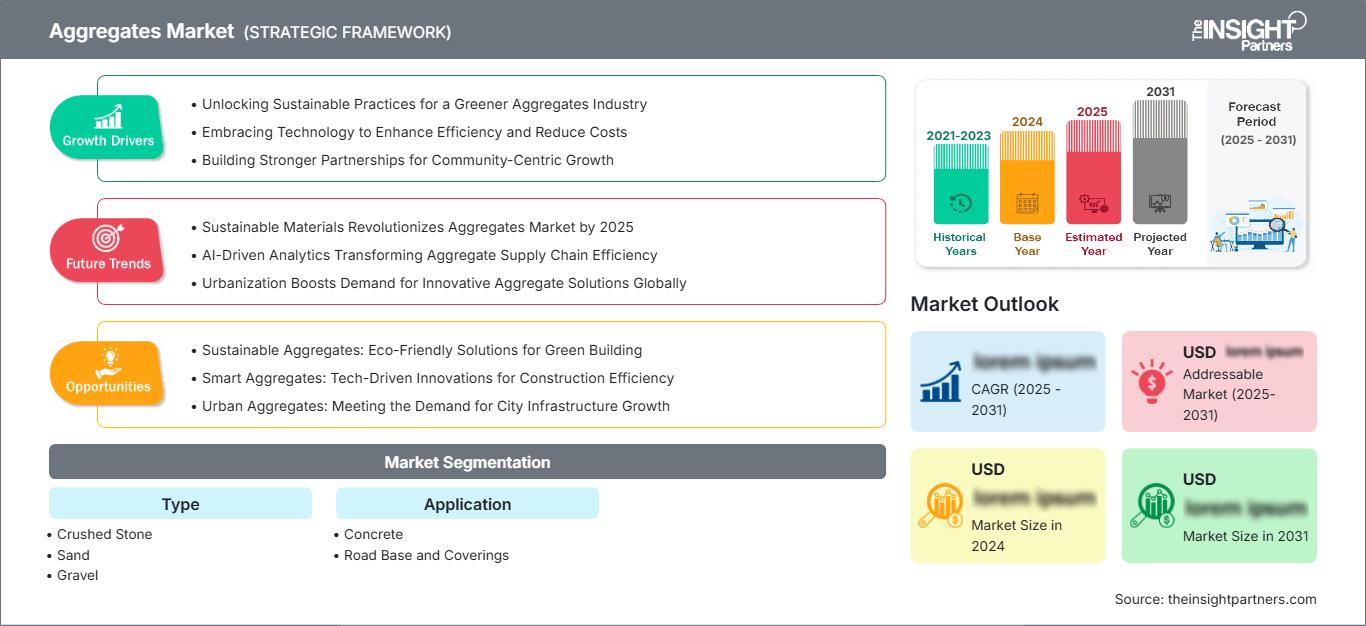
Aggregates Market: Strategic Insights
Regional Insights
North America Aggregates Market
North America accounted for 30–34% of the aggregates market share in 2025 and is anticipated to expand at a CAGR of 3.1–3.5% during 2026–2034. Regional demand is primarily supported by large-scale transportation infrastructure rehabilitation, commercial construction, residential housing projects, and investments in logistics facilities. The implementation of long-term federal infrastructure funding programs has accelerated the replacement of aging highways, bridges, airports, and water infrastructure, significantly increasing consumption of crushed stone, sand, and gravel. Growing industrial construction associated with manufacturing reshoring and renewable energy developments further supports sustained aggregate demand.
The regional supply base benefits from abundant natural reserves, advanced quarrying technologies, well-established transportation networks, and high levels of equipment automation. Producers continue investing in quarry expansion, mobile crushing technologies, digital fleet management, and recycled aggregate processing to improve productivity and comply with stricter environmental regulations. Rising adoption of recycled construction materials and circular economy practices is also strengthening resource efficiency while ensuring long-term availability for infrastructure and urban development projects.
U.S. Aggregates Market
The United States represented 80–84% of North American demand in 2025 and is projected to register a CAGR of 3.2–3.6% through 2034. Federal funding allocated through nationwide infrastructure modernization programs continues driving demand across highways, railways, airports, ports, and public utilities. Residential housing construction, warehouse developments, manufacturing investments, and data center expansion also contribute significantly to aggregate consumption. States including Texas, Florida, California, Arizona, and North Carolina remain among the largest consumers due to continuous urban expansion and infrastructure development.
Major players such as Vulcan Materials Company, Martin Marietta Materials, Inc., Rogers Group Inc., CRH plc, Holcim Ltd, and Heidelberg Materials AG run extensive quarry operations and logistics networks, managing large-scale networks of integrated producers that are still expanding production capacity and implementing new technology such as digital quarry management systems, autonomous machinery, predictive maintenance, and recycled aggregates. Infrastructure development plans of several years’ standing and the robustness of the construction business should sustain stable market growth throughout the planning period.
Europe Aggregates Market
Europe market was estimated to account for 23-27% of the world market in 2025 and is predicted to grow with a CAGR of 2.8-3.2% from 2026-2034. Germany is the market leader in Europe because of its well-established infrastructure, industrial construction, and large-scale renovations in the residential segment. Investments in infrastructure development, such as rail transport upgrades and bridge maintenance, along with the need for sustainable development, will continue to drive high demand for construction aggregates.
The UK represents a steady demand through construction activities, infrastructure projects, and housing. Demand for the region across France, Italy, and Spain means a large regional business, renewable energy, airport, and infrastructure development. European demand for the aggregates market will be affected by Environmental directives towards recycling and good quarry practices.
APAC Aggregates Market
Asia Pacific region accounted for 29–33% of the product's total consumption in 2025 and is projected to record the highest regional CAGR of 3.8–4.3% during 2026–2034. In terms of regional market ranking, China, India, Japan, South Korea, and Australia are the leading markets due to high levels of urbanization and industrialization, and investments in various transport corridors, housing, port facilities, and renewables.
Government infrastructure development, urban growth, and industrial investment have increased aggregate demand in the area. Developments in quarrying techniques, improvements in logistics, and the use of green building methods increase production capabilities.
Middle East & Africa Aggregates Market
The Middle East & Africa market is forecast to have a CAGR of 3.4% to 3.8% during 2026 to 2034 due to significant investments in infrastructure across Saudi Arabia, UAE, South Africa, and other emerging countries. The urbanization process, infrastructure development, tourism development, and transportation projects continue to drive strong demand for construction aggregates.
Saudi Arabia will continue to be the largest country in the Middle East & Africa market due to large economic diversification projects, UAE will enjoy its growth in commercial and logistics infrastructure projects, while South Africa will benefit from mining and public works projects. The rest of the region will see continued demand for quarry development, driven by road construction, energy infrastructure, and urban housing projects.
Segmentation Analysis
Type
The Type segment accounted for the largest share of the market, supported by extensive consumption across residential, commercial, industrial, and transportation infrastructure projects. The aggregates market scope continues to broaden as producers invest in advanced crushing technologies, recycled aggregate processing, and sustainable quarry management to meet evolving environmental standards and growing construction demand. The segment is projected to expand at a CAGR of 3.2–3.5% during 2026–2034.
- Crushed Stone: The dominant product category owing to its superior strength, durability, and widespread application in concrete production, road construction, railway ballast, airport runways, and heavy civil engineering projects.
- Sand: Maintains strong demand for concrete, mortar, asphalt mixtures, land reclamation, and infrastructure development. Manufactured sand adoption continues increasing where restrictions on natural sand extraction are becoming more stringent.
- Gravel: Widely utilized in drainage systems, road foundations, landscaping, railway construction, and residential projects due to its excellent load-bearing characteristics, permeability, and comparatively lower processing requirements.
Application
The Application segment represents the primary demand center for construction aggregates as infrastructure modernization, urban redevelopment, and commercial construction continue accelerating globally. Growing public investment in highways, bridges, tunnels, airports, and residential developments supports stable consumption across major application areas. The segment is anticipated to record a CAGR of 3.4–3.8% during 2026–2034, with concrete applications remaining the strongest contributor.
- Concrete: Represents the largest application because aggregates constitute the majority of concrete volume. Continuous investments in residential buildings, commercial complexes, transportation infrastructure, and industrial facilities sustain long-term demand.
- Road Base and Coverings: Experiences steady growth through highway expansion, pavement rehabilitation, airport construction, and municipal road improvement programs requiring high-performance aggregate materials with consistent quality and durability.
Opportunity Snapshot
| Application | Revenue Contribution | Trend Tag | Adoption Stage |
|---|---|---|---|
| Concrete | High | Green Concrete | Mature |
| Road Base and Coverings | Medium | Smart Highways | Scaling |
Aggregates Market Growth Drivers and Impact Analysis
Global Infrastructure Modernization and Public Investment Programs
Modernizing the transportation sector, infrastructure renovation, flood defense schemes, airports, harbors, and public services continue to form the focus of governments through capital investment policies. High expenditure on highways, bridges, railways, metros, and low-cost housing projects increases aggregate demand, as these constitute basic building materials. Investments in infrastructure in North America, Asia-Pacific, and the Middle East have enhanced quarrying capacity, logistics, and the signing of long-term contracts between producers and contractors. Such investments create steady revenue streams for aggregate suppliers and minimize the private sector's dependence on short-term construction cycles.
Urbanization and Residential Construction Expansion
The rapid population growth in urban areas remains one of the factors driving demand for housing, commercial buildings, educational institutions, health facilities, and infrastructure. Developing countries are experiencing ongoing construction of residential buildings, whereas developed countries are focusing on the redevelopment and rehabilitation of existing infrastructure. There is a need for considerable quantities of aggregates for the construction of any residential building, from foundations and structural concrete to drainage systems, landscaping, and the roads leading to the building.
Increasing Adoption of Sustainable Quarrying and Recycled Aggregates
Environmental laws, along with the concept of a circular economy, are driving investment in recycled construction materials and sustainable quarry operations. Construction materials producers are increasingly processing demolition waste into high-quality recycled aggregates for road construction and fill applications. At the same time, quarry owners are utilizing electrical machinery, blast optimization technology, dust control solutions, and water recycling. This trend will help the industry reduce its carbon footprint, conserve resources, comply with regulations, and meet consumer demand for environmentally friendly construction materials.
Aggregates Market Future Trends
Digital Quarry Management and Intelligent Production Systems
Digital transformation is becoming a defining characteristic of the aggregates market trends as producers introduce artificial intelligence, drones, autonomous haul trucks, predictive maintenance systems, and live monitoring of the production process into quarry operations. These innovations allow for more efficient equipment use, lower fuel consumption, better working conditions, and improved crushing efficiency. The rising labor shortage and high operating costs will make digital quarry management a key competitive advantage, helping producers increase efficiency and maintain consistent product quality.
Growing Integration of Circular Construction Materials
Construction firms and infrastructure builders have been integrating recycled aggregates into road and commercial structures, aiming to minimize environmental impacts. Governments have been developing more policies to promote resource conservation and recycling, creating an ideal environment for recycled aggregates to flourish. Investment in the development of sorting and crushing technologies will enable a wider availability of high-quality recycled aggregates.
Aggregates Market Opportunities
Expansion into High-Growth Infrastructure Markets
Emerging economies across Asia Pacific, the Middle East, and Africa continue investing heavily in transportation corridors, industrial parks, renewable energy projects, airports, ports, and urban housing developments. These projects present substantial opportunities for quarry operators to establish new production facilities, expand logistics capabilities, and secure long-term supply contracts. The Aggregates Market Forecasts predict that firms that can establish strategically located quarries, invest in effective transport systems, and remain compliant with regulations are well positioned to benefit from sustained demand driven by infrastructure projects over the coming years.
Investment in Low-Carbon and Recycled Aggregate Production
Increasing sustainability pressures create opportunities for producers to diversify their offerings through recycled aggregates, low-carbon manufacturing processes, and sustainable quarrying. Firms that make investments in material recovery technology, electrified mobile machinery, renewable energy systems, and recycling technologies stand to become more efficient in their operations, as well as enhance their environmental reputation. Such investments will help producers benefit from the government's sustainable construction materials procurement initiatives.
Recent Developments
- June 2025: Holcim Ltd completed the spin-off of its North American business as Amrize, creating an independent building solutions company with significant operations across aggregates, ready-mix concrete, asphalt, and construction materials. The move strengthens both companies' strategic focus on infrastructure and regional investment.
- June 2025: Heidelberg Materials AG officially inaugurated the Brevik carbon capture and storage (CCS) facility in Norway, the world's first industrial-scale CCS installation in the cement industry. The project supports lower-carbon cement and complements Heidelberg Materials' global aggregates and heavy building materials portfolio.
Frequently Asked Questions

- Comprehensive Market Sizing and Forecast Analysis
- Detailed Segmentation Analysis
- In-Depth Market Dynamics Assessment
- Regional and Country-Level Insights
- Competitive Landscape and Company Benchmarking
- Strategic Business Intelligence
Recent Reports
Testimonials

The Insight Partners' SCADA System Market report is comprehensive, with valuable insights on current trends and future forecasts. The team was highly professional, responsive, and supportive throughout. We are very satisfied and highly recommend their services.
RAN KEDEM Partner, Reali Technologies LTDs
I requested a report on a very specific software market and the team produced the report in a few days. The information was very relevant and well presented. I then requested some changes and additions to the report. The team was again very responsive and I got the final report in less than a week.
JEAN-HERVE JENN Chairman, Future Analytica
We worked with The Insight Partners for an important market study and forecast. They gave us clear insights into opportunities and risks, which helped shape our plans. Their research was easy to use and based on solid data. It helped us make smart, confident decisions. We highly recommend them.
PIYUSH NAGPAL Sr. Vice President, High Beam Global
The Insight Partners delivered insightful, well-structured market research with strong domain expertise. Their team was professional and responsive throughout. The user-friendly website made accessing industry reports seamless. We highly recommend them for reliable, high-quality research services
YUKIHIKO ADACHI CEO, Deep Blue, LLC.
This is the first time I have purchased a market report from The Insight Partners.While I was unsure at first, I visited their web site and felt more comfortable to take the risk and purchase a market report.I am completely satisfied with the quality of the report and customer service. I had several questions and comments with the initial report, but after a couple of dialogs over email with their analyst I believe I have a report that I can use as input to our strategic planning process.Thank you so much for taking the extra time and making this a positive experience.I will definitely recommend your service to others and you will be my first call when we need further market data.
JOHN SUZUKI President and Chief Executive Officer, Board Director, BK Technologies
I wish to appreciate your support and the professionalism you displayed in the course of attending to my request for information regarding to infectious disease IVD market in Nigeria. I appreciate your patience, your guidance, and the fact that you were willing to offer a discount, which eventually made it possible for us to close a deal. I look forward to engaging The Insight Partners in the future, all thanks to the impression you have created in me as a result of this first encounter.
DR CHIJIOKE ONYIA MANAGING DIRECTOR, PineCrest Healthcare Ltd.Reason to Buy
- Informed Decision-Making
- Understanding Market Dynamics
- Competitive Analysis
- Identifying Emerging Markets
- Customer Insights
- Market Forecasts
- Risk Mitigation
- Boosting Operational Efficiency
- Strategic Planning
- Investment Justification
- Tracking Industry Innovations
- Aligning with Regulatory Trends





 Get Free Sample for